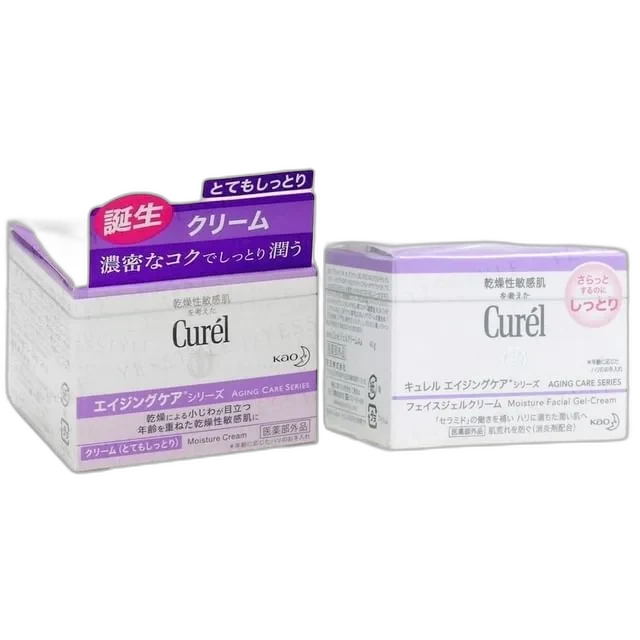
Aging Care Moisture Facial Cream
J-Beauty Ceramide Pioneer
 Verified reviewer
Pros & cons.
- +Contains Kao's proprietary pseudo-ceramide backed by 30+ years of research and development
- +Lightweight, non-greasy texture absorbs quickly despite rich barrier-repair benefits
- +Fragrance-free and gentle enough for sensitive, reactive, and post-procedure skin
- +Eucalyptus extract promotes natural ceramide production for dual-source barrier support
- +Excellent complement to retinoid and active-heavy routines that stress the skin barrier
- +From Japan's #1 brand for dry, sensitive skin since 2008
- −Expensive for a 40g jar — may last only 6-8 weeks with regular use
- −Contains methylparaben, which some consumers specifically avoid
- −Limited US availability — must be sourced through online retailers or Asian beauty shops
- −Jar packaging is less hygienic than tube or pump formats
- −May not provide enough occlusion for severely dry skin without layering additional products
The full review.
There is a particular kind of product that exists at the intersection of deep scientific research and complete marketing restraint. You will not find it in a Sephora end cap. It will not trend on TikTok. Its packaging looks like it was designed by someone who believes the product should speak for itself, which is a polite way of saying it looks like something you would find in a Japanese pharmacy, because that is exactly where it comes from.
Curél’s Aging Care Moisture Facial Cream is built on a foundation that most skincare brands can only reference secondhand: Kao Corporation’s proprietary pseudo-ceramide, Cetyl-PG Hydroxyethyl Palmitamide. This is not a generic ceramide tossed into a formula for label appeal. Kao has been researching ceramide synthesis since the mid-1980s and became the first company in the world to develop ceramide functional ingredients for skincare application in 1987. When Curél launched in Japan in 1999, it became the clinical expression of that research — a brand built entirely around the science of restoring the skin’s lipid barrier. By 2008, it had become Japan’s number-one brand for dry, sensitive skin, a position it has held for over fifteen years.
The Aging Care line extends Curél’s barrier-repair philosophy to the specific problem of age-related moisture loss. As skin ages, natural ceramide production declines, thinning the intercellular lipid matrix that holds moisture in the epidermis and keeps irritants out. The result is the kind of fine lines and dullness that people mistakenly attribute to collagen loss alone, when in many cases the primary issue is simply a barrier that can no longer hold water. This cream addresses that mechanism directly.
The texture strikes a careful balance between richness and wearability. The dimethicone and squalane base creates a silky, almost velvety consistency that spreads easily without feeling heavy or greasy. It absorbs within about a minute, leaving skin noticeably softer and more supple — the kind of immediate tactile improvement that confirms something is happening at the barrier level, not just sitting on the surface. For a cream targeting mature, dry skin, the lightweight finish is impressive.
Allantoin at 0.50% serves as the listed active ingredient, providing gentle cell-renewal stimulation and soothing properties. It is not a dramatic active in the way that retinol or vitamin C are dramatic — it works quietly, supporting surface cell turnover and calming irritation without forcing the issue. For sensitive, aging skin that reacts to more aggressive actives, this gentle approach is a feature, not a limitation.
The supporting ingredients reveal Curél’s attention to the ecosystem around its ceramide technology. Eucalyptus globulus leaf extract is a Curél signature inclusion that research suggests promotes the skin’s own ceramide production — an elegant pairing with the exogenous pseudo-ceramide that essentially supports the skin from both directions. Ginger root extract provides antioxidant support and mild circulation-stimulating properties. Squalane, a skin-identical lipid whose natural levels decline with age, provides emollience without comedogenic risk.
What makes this cream particularly interesting in the context of an aging skincare routine is its philosophy of complementarity. This is not a product trying to replace retinol, vitamin C, or peptides. It is designed to create the optimal barrier conditions for those treatments to work. A retinoid applied to ceramide-depleted skin penetrates unevenly, causes excessive irritation, and often gets abandoned. A retinoid applied to skin whose lipid matrix has been restored by consistent ceramide use works more effectively and with less drama. Curél understands this relationship because their dermatological providers see it play out in clinical practice across Japan.
The jar format is a minor practical concern — dipping fingers into a jar introduces contamination risk, and the 40g volume means the product does not last particularly long with twice-daily face and neck application. At approximately thirty-two dollars for a jar that may last six to eight weeks, the cost per ounce is notably higher than mass-market alternatives. The presence of methylparaben as a preservative, while perfectly safe by regulatory standards, will give pause to those who specifically avoid parabens.
Availability in the United States is another consideration. This is a Japanese domestic product that must typically be sourced through Amazon, YesStyle, or specialty Asian beauty retailers. The US Curél product line, while sharing the name, has a different formulation history — the Japanese Aging Care line is distinct from what you will find at Target or Walgreens under the Curél banner.
For the skincare enthusiast who appreciates J-beauty’s evidence-based approach and understands that barrier health is the foundation of anti-aging, this cream represents genuine ceramide science from the company that wrote the textbook on it. It is not flashy. It will not give you an Instagram-ready glow. What it will do is quietly restore the lipid architecture of your skin, reduce the fine lines that come from chronic dehydration, and create a more resilient canvas for whatever active treatments you layer underneath. Three decades of research in a forty-gram jar.
Ingredient analysis.
Full INCI list
Active Ingredient: Allantoin (0.50%). Inactive Ingredients: Water (Aqua), Dimethicone, Glycerin, Cetyl-PG Hydroxyethyl Palmitamide, Squalane, Butylene Glycol, Phytosteryl/Isostearyl/Cetyl/Stearyl/Behenyl Dimer Dilinoleate, Polyglyceryl-2 Diisostearate, Phytosteryl/Octyldodecyl Lauroyl Glutamate, PEG-3 Dimethicone, Dimethicone/Vinyl Dimethicone Crosspolymer, Cholesteryl/Octyldodecyl Lauroyl Glutamate, Magnesium Sulfate, Dextrin Palmitate, Isostearyl Glyceryl Ether, Succinic Acid, Zingiber Officinale (Ginger) Root Extract, Sodium Hydroxide, Thujopsis Dolabrata Branch Extract, Eucalyptus Globulus Leaf Extract, Tocopherol, Methylparaben
Skin match.
The science.
The Science
Kao Corporation's pseudo-ceramide (Cetyl-PG Hydroxyethyl Palmitamide) is a synthetic analog that mimics Ceramide 2 (Ceramide NS), a major ceramide in the skin's intercellular lipid matrix. Kao's laboratory research shows this pseudo-ceramide integrates into the lipid bilayer between corneocytes. This restores the lamellar structure that maintains skin barrier function and water retention. Studies from Kao researchers show consistent topical application improves transepidermal water loss (TEWL) and stratum corneum hydration.
Dermatological literature documents age-related ceramide decline. Research in the Journal of Investigative Dermatology shows total ceramide content in the stratum corneum decreases significantly with age, which correlates with higher TEWL and fine lines from chronic dehydration. This formula addresses ceramide depletion from two angles: it adds exogenous ceramides and uses eucalyptus extract to stimulate endogenous production.
Kao researches Eucalyptus globulus leaf extract as a ceramide synthesis promoter. In vitro studies show specific compounds in eucalyptus extract upregulate enzymes for ceramide biosynthesis in keratinocytes, including serine palmitoyltransferase (SPT), the rate-limiting enzyme in de novo ceramide synthesis.
Allantoin, at a 0.50% concentration, promotes keratinocyte proliferation and gentle desquamation. Research in the Journal of Cosmetic Dermatology confirms allantoin enhances wound healing and cell regeneration at concentrations as low as 0.1%. The 0.50% concentration in this formula is therapeutically relevant for supporting age-related cell turnover decline.
Dermatologist Perspective
Dermatologists recognize ceramide depletion as an aging mechanism distinct from collagen loss and photoaging. Board-certified dermatologists in Japan frequently recommend Curél products for patients with compromised barrier function from aging, environmental damage, or treatment-induced sensitivity. The ceramide-first approach follows dermatological guidance: barrier repair should precede or accompany aggressive anti-aging treatments. A well-hydrated, intact barrier reduces the irritation and inflammation that undermine retinoids and chemical exfoliants. Dermatologists often recommend a ceramide-focused moisturizer like this one for patients who cannot tolerate retinol or want to maximize retinoid tolerance.
Where it fits in your routine.
Cleanse skin and apply serums or essences first. Warm a pearl-sized amount between your fingertips. Press the product into your face and neck using upward motions. Use morning and evening. Apply sunscreen in the morning. At night, use this as the final step unless you apply an occlusive over very dry areas. Layer over a hyaluronic acid serum for more hydration.
At approximately $32 for 40g, this moisturizer costs more than drugstore brands but competes within the J-beauty ceramide category. The pseudo-ceramide technology comes from proprietary R&D instead of off-the-shelf ingredient blending, which justifies the premium. However, the 40g size is small and lasts only 6-8 weeks. Comparable ceramide-rich moisturizers from CeraVe cost less and provide more product, but they use a different ceramide formulation without the specific pseudo-ceramide Kao developed. The value is highest for users seeking Kao's ceramide technology and J-beauty's clinical formulation philosophy.
This works for dry-to-normal aging skin targeting fine lines, dullness, and barrier compromise using ceramide science instead of, or alongside, retinoid therapy. It suits sensitive skin that lacks tolerance for aggressive anti-aging treatments and J-beauty enthusiasts who value ingredient science from decades of corporate R&D.
Oily skin types who find cream moisturizers too heavy, paraben-free shoppers, and those needing easy US retail availability will like this. It is not an ideal standalone anti-aging treatment for deep wrinkles or significant photoaging, as it focuses on barrier repair and hydration instead of collagen stimulation.
Product details.
This smooth, medium-weight cream melts into skin. The dimethicone and squalane base leaves a silky, non-greasy finish.
Fragrance-free; no detectable scent
Small jar with screw-top lid; clean, pharmaceutical-style Japanese design
The first application shows a cream thicker than its light appearance suggests. It spreads easily and absorbs within a minute, making skin immediately softer and more supple. There is no stinging, no fragrance, and no adjustment period. Skin feels calm and protected from the first use.
6-8 weeks with twice-daily application to face and neck
12 months
All Year
The backstory.
Curél's Aging Care line emerged from Kao's recognition that aging skin doesn't just lose collagen — it loses ceramides. The intercellular lipid matrix that keeps skin plump and hydrated thins with age, and Kao's ceramide research, which began in the 1980s, positioned Curél uniquely to address this mechanism. The Aging Care Moisture Facial Cream applies the same pseudo-ceramide technology that made Curél Japan's #1 sensitive skin brand to the specific challenge of age-related barrier decline.
About Curél
Established Brand (5–20 years)Kao Corporation, a Japanese conglomerate founded in 1887, launched Curél in 1999. Kao first developed ceramide functional ingredients for skincare in 1987. Curél became Japan's #1 brand for dry, sensitive skin in 2008 and stays there. The brand's ceramide research has over three decades of scientific backing.
Common myths.
Synthetic ceramides work less effectively than natural ceramides
Kao's pseudo-ceramide (Cetyl-PG Hydroxyethyl Palmitamide) mimics natural skin ceramide structures and integrates into the intercellular lipid bilayer. Research shows it restores barrier function as well as natural ceramides, but offers better stability and formulation consistency.
Anti-aging creams need retinol or peptides to be effective
Ceramide-focused moisturizers target barrier lipid depletion, an aging mechanism retinol and peptides do not address. Restoring the lipid matrix reduces dryness-related fine lines and improves skin resilience. A ceramide cream complements retinoid therapy instead of replacing it.
FAQ.
What is the pseudo-ceramide in Curél products?
Cetyl-PG Hydroxyethyl Palmitamide is Kao Corporation's proprietary synthetic ceramide analog, born from research starting in 1987. It mimics natural skin ceramide structure and function, integrates into the intercellular lipid matrix to restore barrier function, and reduces moisture loss. This ingredient is the foundation of all Curél moisturizers.
Is Curél Aging Care Moisture Cream suitable for sensitive skin?
Yes — Curél designed this cream for dry, sensitive skin. The fragrance-free formula uses the brand's gentle pseudo-ceramide technology and includes allantoin as the active ingredient. It does contain methylparaben, which some paraben-sensitive users avoid.
How is Curél Aging Care different from Curél Intensive Moisture?
The Aging Care line uses ginger root extract and eucalyptus extract to target age-related skin concerns and promote firmness and natural ceramide production. The Intensive Moisture line focuses on deep hydration for dry skin and lacks the anti-aging botanical additions.
Can I use Curél Aging Care Cream with retinol?
Yes — the ceramide-rich formula works well with retinol. Retinoids can damage the skin barrier and cause dryness; the pseudo-ceramide in this cream restores the lipid matrix that retinol disrupts, reducing irritation and dryness while supporting the retinoid's effectiveness.
Where can I buy Curél Aging Care Moisture Cream in the US?
You can buy this product through Amazon, YesStyle, Japanese Taste, and other Asian beauty retailers. US brick-and-mortar stores may have limited stock. The Japanese Curél Aging Care line differs from the US Curél product range, which has a different formulation history.
What the community says.
"Rich yet lightweight texture that absorbs without greasiness"
"Effectively reduces dry-skin fine lines"
"Calms and strengthens sensitive skin barrier"
"Works well in both dry and humid climates"
"Fragrance-free and gentle enough for reactive skin"
"Expensive for a small 40g jar"
"Contains methylparaben which some users avoid"
"May not provide enough moisture for severely dry skin without layering"
"Availability can be limited outside Japan and Asian beauty retailers"