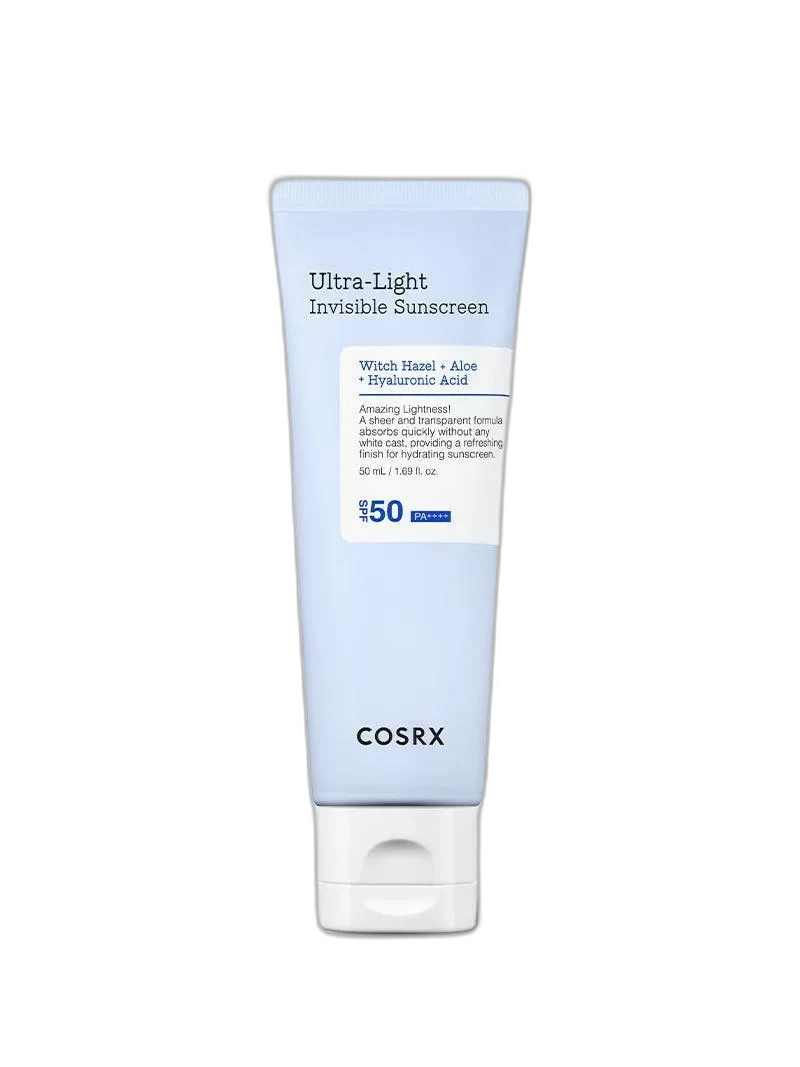
Ultra-Light Invisible Sunscreen SPF 50
Invisible Protection Pioneer
 Verified reviewer
Pros & cons.
- +Four-filter Mexoryl + Uvinul UV system is among the most photostable at any price point
- +Zero white cast — truly invisible on all skin tones from first application
- +Ultra-lightweight texture absorbs in under 60 seconds with no stickiness
- +66% aloe water base provides a cooling, soothing application experience
- +Niacinamide, adenosine, and HA add genuine skincare benefits beyond UV protection
- +Completely fragrance-free with three separate clinical irritation tests passed
- +Outstanding value at $16 for premium UV filter technology
- −Can pill under certain foundations or water-based makeup products
- −May not provide sufficient moisture for dry skin without a moisturizer underneath
- −Witch hazel water could concern very sensitive or reactive skin types
- −Some users report increased oiliness after several hours in hot weather
- −Only available in 50 mL size — runs out in 2-3 months with daily face use
The full review.
There’s a quiet revolution happening in K-beauty sunscreens, and it has nothing to do with the dewy finish or the whipped-cream textures that dominate the category’s marketing. It’s about UV filter technology. And COSRX’s Ultra-Light Invisible Sunscreen, launched in April 2024 without much fanfare, may be one of the most technically impressive daily sunscreens at any price — let alone sixteen dollars.
The filter system tells the story. Four chemical UV filters: Drometrizole Trisiloxane (Mexoryl XL), Terephthalylidene Dicamphor Sulfonic Acid (Mexoryl SX), Diethylamino Hydroxybenzoyl Hexyl Benzoate (Uvinul A Plus), and Ethylhexyl Triazone (Uvinul T 150). If those names mean nothing to you, here’s what matters: these are among the most photostable UV filters on the global market. ‘Photostable’ means they don’t break down quickly under UV exposure — unlike older filters that can lose protection within hours, these maintain their shielding capacity throughout extended sun exposure.
The Mexoryl pair is particularly notable. Mexoryl XL (oil-soluble) and Mexoryl SX (water-soluble) together cover both phases of the formula, meaning the UV protection is evenly distributed whether the sunscreen’s oils or waters sit on your skin surface. Uvinul T 150 has the highest molar extinction coefficient among commercial UVB filters — technical jargon that means it absorbs the most UV radiation per molecule, providing efficient protection with less filter needed. Uvinul A Plus rounds out the system with targeted UVA coverage. Together, these four filters deliver SPF 50 PA++++ with a level of photostability and spectral coverage that many fifty-dollar European sunscreens would envy.
But technical excellence doesn’t matter if people won’t wear the sunscreen. And this is where COSRX’s K-beauty sensibility earns its keep. The texture is extraordinary. The formula uses 66% aloe barbadensis leaf water as its primary base instead of purified water, combined with hamamelis (witch hazel) leaf water. The result is a lotion that applies with a noticeable cooling sensation — refreshing rather than clinical, soothing rather than heavy. It has the consistency of a lightweight serum-moisturizer hybrid, spreading across the face with zero resistance and absorbing within thirty to sixty seconds.
There is no white cast. None. Not during application, not as it dries, not after hours of wear. This is a purely chemical sunscreen with no mineral filters, so white cast was never going to be an issue — but the formulation goes further. It doesn’t leave any visible residue, sheen, or alteration to your skin’s appearance. On application, it genuinely disappears. Multiple reviewers on darker skin tones have confirmed what COSRX claims: this sunscreen is invisible.
The finish sits in a pleasant middle ground — what one reviewer aptly described as ‘matt-dewy.’ It’s not the glass-skin gloss of many K-beauty sunscreens, nor the powder-dry matte of American mineral formulas. It’s a natural, skin-like finish that doesn’t announce its presence. For oily and combination skin, this translates to comfortable all-day wear in most conditions. Some users report mild oiliness after several hours in hot, humid weather, but this is typical for chemical sunscreens without heavy mattifying agents.
The inclusion of niacinamide at a seemingly meaningful concentration (listed seventh on the INCI, ahead of two UV filters) adds skincare benefits beyond sun protection. Adenosine provides anti-aging support, sodium hyaluronate adds hydration, and allantoin soothes. This is a sunscreen that does more than block UV — it actively supports the skin while doing so.
The honest limitation is that dry skin types may find this insufficient as both sunscreen and moisturizer. The lightweight formula prioritizes wearability over hydration, and those with dry or dehydrated skin will likely need a moisturizer layer underneath. The witch hazel water also warrants mention — while it contributes to the formula’s refreshing feel, some dermatologists flag witch hazel as a potential irritant for very reactive skin. At the concentration present here (not the primary base, which is aloe), this is a minor concern for most users, but worth noting for the extremely sensitive.
At sixteen dollars for fifty milliliters, the value proposition is outstanding. The four-filter UV system alone justifies the price — these filters are typically found in premium European sun care products. The aloe water base, niacinamide, and supporting actives are bonuses that make the daily sunscreen step feel like skincare rather than obligation.
COSRX has historically been known for their treatment products — the snail mucin, the BHA, the retinol line. This sunscreen suggests they’re equally capable of engineering the daily protection that makes all those treatments worthwhile. It’s not the flashiest product in their lineup, but it might be the most important one.
Formula
Ingredient analysis.
Full INCI list
Aloe Barbadensis Leaf Water, Diethylhexyl Succinate, Propanediol, Aqua/Water, Drometrizole Trisiloxane, Ethylhexyl Triazone, Niacinamide, Diethylamino Hydroxybenzoyl Hexyl Benzoate, Terephthalylidene Dicamphor Sulfonic Acid, 1,2-Hexanediol, Behenyl Alcohol, Methyl Trimethicone, Sodium Polyacryloyldimethyl Taurate, Hamamelis Virginiana (Witch Hazel) Leaf Water, Tromethamine, Polyacrylate Crosspolymer-6, Arachidyl Alcohol, Caprylyl Glycol, Ethylhexylglycerin, Arachidyl Glucoside, Sodium Metaphosphate, Adenosine, Tocopherol, Sodium Hyaluronate, Allantoin, Citric Acid, Sodium Benzoate, Potassium Sorbate
Skin match.
The science.
The Science
The UV filter combination in this sunscreen follows current best practices for broad-spectrum photostable sun protection.
Drometrizole trisiloxane (Mexoryl XL) is an oil-soluble UV filter that absorbs both UVB and UVA. The Journal of the American Academy of Dermatology (2008) documented its photostability, showing minimal degradation after prolonged UV exposure. This gives it an advantage over older filters like avobenzone, which require stabilizers to maintain protection. Terephthalylidene dicamphor sulfonic acid (Mexoryl SX) is water-soluble and provides targeted UVA protection in the shorter UVA range (320-340 nm), complementing the broader coverage of Mexoryl XL.
Ethylhexyl triazone (Uvinul T 150) has the highest molar extinction coefficient among commercially available UVB filters, so it provides the most UV absorption per molecule. Research in the Journal of Photochemistry and Photobiology B (2011) showed its exceptional photostability and efficiency. Diethylamino hydroxybenzoyl hexyl benzoate (Uvinul A Plus) was developed for high UVA absorption with inherent photostability, so it does not need the photoinstability stabilizers that avobenzone requires.
The four-filter system provides overlapping spectral coverage to ensure no gaps in the UV protection spectrum. Research on multi-filter systems in the International Journal of Cosmetic Science shows that combining complementary filters produces synergistic protection. The total SPF is greater than the sum of individual filter SPFs because of broad-spectrum spectral overlap.
Niacinamide adds a cellular-level photoprotective mechanism. Research in the British Journal of Dermatology (2005) showed that topical niacinamide prevented UV-induced immunosuppression and reduced the incidence of actinic keratoses in a human clinical trial. At the concentration suggested by its INCI position, the niacinamide in this formula provides supplementary protection beyond what the UV filters alone achieve.
References
- Effect of topically applied niacinamide on UV-induced immunosuppression — British Journal of Dermatology (2005)
Dermatologist Perspective
Board-certified dermatologists say the best sunscreen is the one you wear daily. This formula's invisible, lightweight character addresses the compliance issue dermatologists cite as the biggest barrier to sun protection. Dermatologists note that the Mexoryl and Uvinul filter combination provides robust photostable protection that maintains its SPF throughout sun exposure, unlike older filters that degrade and require more frequent reapplication. The reef-friendly filter selection (no oxybenzone or octinoxate) aligns with dermatological guidance that considers environmental impact alongside skin protection. Dermatologists remind patients that SPF 50 provides a practical safety margin against the under-application documented in real-world use studies — most people apply only 25-50% of the tested sunscreen thickness.
Where it fits in your routine.
Apply a generous amount as your last morning skincare step. Use at least a nickel-sized amount (about 1/4 teaspoon) on the face, plus more for the neck and ears. Wait 15-20 minutes before direct sun exposure so the chemical filters activate. Reapply every 2 hours if outdoors for long periods, after swimming, or after heavy sweating. Use an oil-based first cleanser to remove it in the evening; chemical sunscreens often need double cleansing to remove completely.
At $16 for 50 mL, this sunscreen offers high value. The four-filter UV system uses Mexoryl and Uvinul filters, which usually appear in European sun care products priced at $30-50. Niacinamide, adenosine, sodium hyaluronate, and an aloe water base increase the value. Monthly cost is about $5-8 depending on reapplication habits. This costs less than one specialty coffee per week for premium-grade daily UV protection. COSRX's brand credibility and the product's clinical testing support the price-to-quality ratio.
This is for anyone seeking a lightweight daily sunscreen that is invisible, fragrance-free, and comfortable for daily wear. It works best for oily and combination skin types, darker skin tones wanting zero white cast, and people who want premium UV filter technology at an accessible price.
Dry skin types needing a moisturizer and sunscreen in one should skip this formula; it prioritizes lightness over hydration. Skip this if you have documented allergies to chemical UV filters or prefer mineral-only sunscreens. Those with oily skin needing a very mattifying sunscreen may want a more sebum-controlling formula.
Product details.
It is fragrance-free. There is no detectable scent—no essential oils, no added fragrance, and no chemical sunscreen odor.
50 mL white plastic squeeze tube with flip-top cap uses COSRX's signature minimalist design. It is compact and portable. The tube dispenses controlled amounts easily.
The first application feels refreshing because the aloe water base cools the skin. The sunscreen feels like a lightweight moisturizer rather than a traditional sunscreen. It leaves no white cast during application. The natural semi-matte finish sits well under makeup for most users. You forget you are wearing sunscreen.
Apply once daily to the face for 2-3 months; apply to face and neck plus reapplication for 6-8 weeks.
12 months
All Year
The backstory.
Launched in April 2024, this sunscreen represented COSRX's entry into the next-generation UV protection category. While the brand had existing sunscreen products (the Vitamin E Vitalizing Sunscreen and Aloe Soothing Sun Cream), this formulation marked a significant upgrade in filter technology — incorporating premium European UV filters that were becoming more accessible to Korean formulators as patents expired.
About COSRX
Established Brand (5–20 years)COSRX launched in South Korea in 2013. The name combines 'Cosmetics' with 'Rx' to signal a clinical K-beauty approach. The brand has 135+ global beauty awards and sells in 146+ countries. It uses well-researched actives to build effective, no-frills formulations.
Common myths.
Chemical sunscreens are unsafe and enter the bloodstream
FDA studies show low levels of chemical UV filters in blood, but this does not mean they are unsafe. The European Scientific Committee on Consumer Safety (SCCS) evaluated the filters in this product and finds them safe at these concentrations. The alternative—UV damage from skipping sunscreen—carries documented risks like skin cancer and premature aging.
SPF 50 is overkill and SPF 30 is enough
SPF 30 blocks about 97% of UVB rays; SPF 50 blocks about 98%. This difference is small, but SPF 50 lets half as much UVB through. Since real-world application is thinner than tested thickness, SPF 50 provides a safety margin for under-application — how most people wear sunscreen.
FAQ.
Does COSRX Ultra-Light Sunscreen leave a white cast?
No. This is a purely chemical (organic) sunscreen without mineral filters like zinc oxide or titanium dioxide. It is invisible on all skin tones. Multiple reviewers with darker skin tones confirm zero white cast during and after application.
Is COSRX Ultra-Light Sunscreen reef-safe?
It lacks oxybenzone and octinoxate, the two UV filters most linked to coral reef damage. COSRX calls it reef-friendly. The four chemical filters used (Mexoryl XL, Mexoryl SX, Uvinul A Plus, Uvinul T 150) are generally safer for marine environments, but no sunscreen is completely reef-proof.
Can I use this sunscreen on sensitive skin?
The product passed three clinical irritation tests (skin, ocular, and dermatological) and is fragrance-free. Most sensitive skin types tolerate it well. However, it contains witch hazel water, which some sensitive or eczema-prone individuals react to, and chemical UV filters occasionally cause irritation in the most reactive skin types. Patch test if you have a history of sunscreen sensitivity.
Does this sunscreen work well under makeup?
Yes, for most users—the lightweight semi-matte finish creates a smooth makeup base. Some users report pilling when layering under certain water-based foundations or silicone-heavy primers. If pilling occurs, let the sunscreen absorb fully for 5-10 minutes before applying makeup, or switch to a compatible makeup base.
How often should I reapply COSRX Ultra-Light Sunscreen?
Reapply every 2 hours during extended sun exposure, after swimming, or after heavy sweating. For indoor or office settings with minimal direct sun exposure, one morning application and one midday reapplication works. The photostable filter system protects better than many sunscreens, but no sunscreen lasts all day without reapplication.
What makes the Mexoryl + Uvinul filter system special?
These four filters are among the most photostable available. They keep their UV-blocking ability under sun exposure instead of degrading quickly. Mexoryl XL and SX cover UVA and UVB in oil and water phases, while Uvinul T 150 has the highest UVB absorption efficiency. This combination provides long-lasting broad-spectrum protection rare at the $16 price point.
What the community says.
"Truly invisible with absolutely zero white cast, even on darker skin tones"
"Ultra-lightweight texture that barely feels like wearing sunscreen"
"Absorbs quickly with no stickiness, greasiness, or heavy feeling"
"Refreshing cooling sensation from the aloe and witch hazel water base"
"Fragrance-free formula suitable for sensitive skin"
"Can pill under certain foundations or water-based makeup products"
"Some users report increased oiliness after a few hours in hot weather"
"May not provide enough moisture for dry skin without a moisturizer underneath"
"50 mL size is standard but relatively small for daily sunscreen use"
"Chemical filters may still irritate very reactive or allergic skin types"
People also looked at.