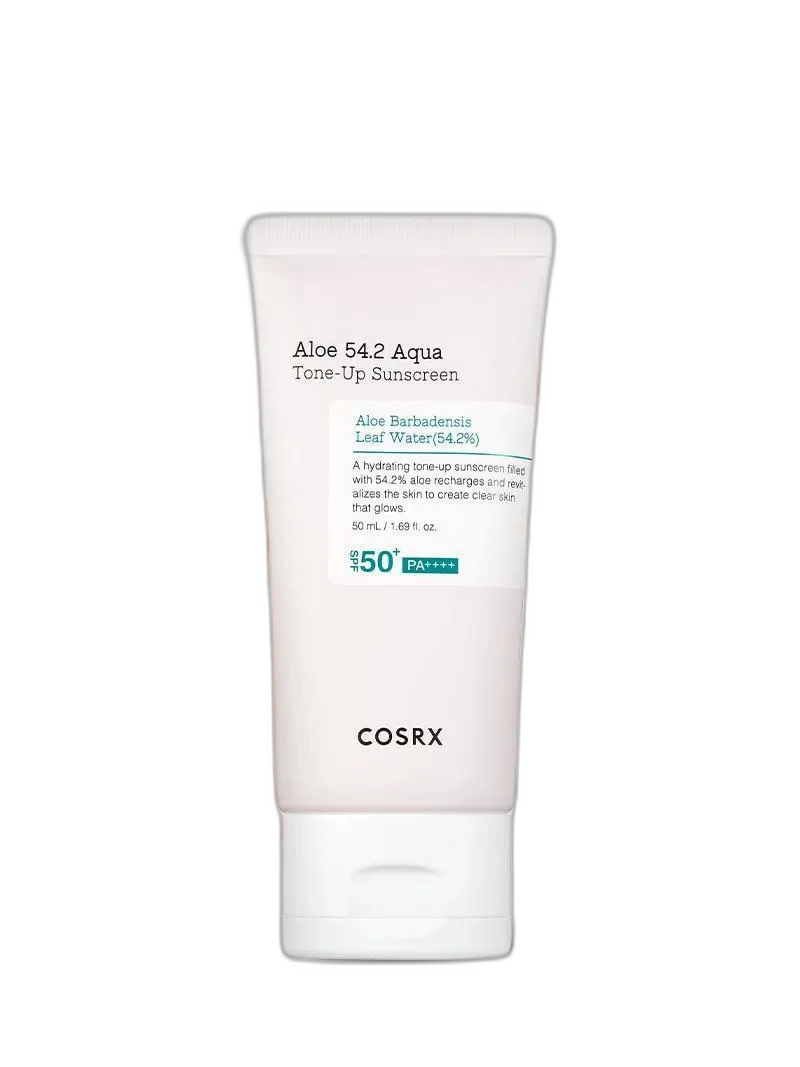
Aloe 54.2 Aqua Tone-up Sunscreen SPF 50+
K-Beauty SPF Staple
 Verified reviewer
Pros & cons.
- +Next-generation UV filter system with Tinosorb S, Uvinul A Plus, and Mexoryl SX for superior photostability
- +54.2% aloe vera base provides genuinely soothing delivery vehicle for UV filters
- +Fragrance-free, alcohol-free formula suitable for reactive and sensitive skin
- +Subtle tone-up brightening effect works as a lightweight makeup primer
- +Hybrid mineral-organic filter system offers broader protection than single-type approaches
- +Niacinamide and sodium hyaluronate add skincare benefits beyond basic UV protection
- +Lightweight satin finish absorbs quickly without heavy greasiness
- −Small 50ml tube requires frequent repurchasing for daily sunscreen users
- −Tone-up effect can appear ashy on medium-to-dark skin tones due to titanium dioxide
- −Prone to pilling when layered over multiple serums or heavy moisturizers
- −Finish becomes tacky on oily skin types after several hours of wear
- −Insufficient moisture for very dry skin without a separate moisturizer underneath
The full review.
When COSRX retired Aloe Soothing Sun Cream and replaced it with Aloe 54.2 Aqua Tone-up Sunscreen, users assumed it was a packaging refresh. It was not. COSRX overhauled the filter system, using next-generation UV absorbers that most Western sunscreens at this price point lack. That upgrade makes this product worth noting.
The formula uses 54.2% aloe barbadensis leaf water as the primary solvent, not aloe extract diluted in water. This is more than marketing. Aloe vera has documented anti-inflammatory properties, and using it as the vehicle suspends every other ingredient in a soothing medium. This base matters for anyone whose skin reacts to chemical sunscreens.
The UV filter system is the most interesting part. COSRX uses a six-filter hybrid system of modern sunscreen chemistry. Tinosorb S provides photostable broad-spectrum coverage and stabilizes the older-generation homosalate and octisalate filters. Uvinul A Plus handles long-wave UVA. Mexoryl SX adds more UVA defense. Titanium dioxide provides mineral protection and creates the tone-up effect. This filter combination is more sophisticated than sunscreens at twice the price.
The tone-up effect varies by skin tone. On lighter skin, it creates subtle brightening that blurs pores and evens minor discoloration, acting like a no-makeup-makeup base. On medium skin, the effect depends on application amount. On deeper skin, titanium dioxide can look ashy, and blending cannot fully fix this. COSRX does not market this as a universal product, and this limitation is real.
The texture is a thin, lightweight cream with a salmon-pink tint from cyanocobalamin — vitamin B12, which also provides anti-inflammatory benefits. The tint disappears when blended. It absorbs in sixty to ninety seconds, leaving a satin finish that is neither dewy nor matte. It sits well under makeup without affecting foundation adherence, which is why many use it as a primer substitute in Korean skincare routines.
The formula includes niacinamide at a supporting concentration. It is not enough for the dramatic brightening of a 5% niacinamide serum, but it supports barrier function and tone-evening over time. Sodium hyaluronate, allantoin, and glycerin provide hydration, though dry skin types may still need a moisturizer in winter.
There are limitations. The 50ml tube is small. Applying a nickel-sized dollop daily means this tube lasts four to six weeks. At eighteen dollars, this is a significant recurring cost. The formula can pill if you layer too many products underneath, a common issue with tone-up sunscreens using polyacrylate crosspolymers. A streamlined morning routine works best; stacking four serums under it causes pilling.
Oily skin types may find the finish tacky by mid-afternoon. The aloe and glycerin base hydrates combination and dry skin, but that moisture can feel heavy on oily complexions. A mattifying powder helps but partially obscures the tone-up effect.
This sunscreen earns its score through an advanced filter system, a functional soothing base, and an accessible price. It is not for everyone—it is a lightweight, brightening, soothing daily SPF for people who want sunscreen to feel like skincare. For that audience, it delivers.
Ingredient analysis.
Full INCI list
Aloe Barbadensis Leaf Water, Homosalate, Butylene Glycol, Diethylamino Hydroxybenzoyl Hexyl Benzoate, Ethylhexyl Salicylate, Glycerin, Aqua, Bis-Ethylhexyloxyphenol Methoxyphenyl Triazine, C12-15 Alkyl Benzoate, Methyl Trimethicone, Niacinamide, Titanium Dioxide (CI 77891), Diisopropyl Sebacate, Terephthalylidene Dicamphor Sulfonic Acid, 1,2-Hexanediol, Potassium Cetyl Phosphate, Cetearyl Alcohol, Tromethamine, Glyceryl Stearate, Behenyl Alcohol, Polyacrylate Crosspolymer-6, Xanthan Gum, Sodium Polyacryloyldimethyl Taurate, Hydrogenated Lecithin, Poly C10-30 Alkyl Acrylate, Ethylhexylglycerin, Stearic Acid, Aluminum Hydroxide, Polyglyceryl-3 Methylglucose Distearate, Palmitic Acid, Iron Oxides (CI 77491), Disodium EDTA, Triethoxycaprylylsilane, Iron Oxides (CI 77492), Sodium Hyaluronate, Allantoin, Myristic Acid, Cyanocobalamin, Lauric Acid, Tocopherol
Skin match.
The science.
The Science
The UV filter system in this sunscreen combines six filters spanning both organic and mineral categories, an approach that provides broader spectral coverage than either type alone. The standout is Tinosorb S (bis-ethylhexyloxyphenol methoxyphenyl triazine), a broad-spectrum filter that absorbs across both UVA and UVB wavelengths. A study by Chatelain and Gabard published in Photochemistry and Photobiology (2001) demonstrated that Tinosorb S prevents photodegradation of co-formulated UV filters in a concentration-dependent manner, with 98.4% remaining intact even after exposure to 50 minimal erythemal doses — making it one of the most photostable UV filters available.
The inclusion of Uvinul A Plus (diethylamino hydroxybenzoyl hexyl benzoate) specifically targets long-wave UVA1 radiation, the wavelengths most responsible for photoaging and pigmentation. Paired with Mexoryl SX (terephthalylidene dicamphor sulfonic acid), the formula covers the full UVA spectrum more comprehensively than formulas relying solely on avobenzone.
The aloe vera base is more than cosmetic. Research by Puvabanditsin and Vongtongsri (2005) found that aloe vera gel significantly reduced UV-induced erythema after 48 hours of exposure, demonstrating anti-inflammatory effects that complement — though do not replace — the UV filters' direct protection. This makes the aloe vehicle particularly relevant for sensitive skin types who experience irritation from organic UV filters alone.
Niacinamide, present at a supporting concentration, has been shown to reduce UV-induced immunosuppression in research by Damian et al. published in the Journal of Investigative Dermatology (2008). While the concentration in this sunscreen is lower than what was studied, it contributes to the overall photoprotective strategy alongside its established benefits for skin barrier function and tone evening.
References
- Photostabilization of Butyl Methoxydibenzoylmethane (Avobenzone) and Ethylhexyl Methoxycinnamate by Bis-ethylhexyloxyphenol Methoxyphenyl Triazine (Tinosorb S), a New UV Broadband Filter — Photochemistry and Photobiology (2001)
- Topical Aloe Vera Gel for Accelerated Wound Healing and Anti-inflammatory Effects — Journal of the Medical Association of Thailand (2005)
- UV-Irradiated Human Skin: The Effect of Nicotinamide on Skin Immune Responses — Journal of Investigative Dermatology (2008)
Dermatologist Perspective
Dermatologists generally regard hybrid sunscreen formulations combining organic and mineral filters as among the most effective approaches to broad-spectrum protection. The inclusion of newer-generation filters like Tinosorb S and Uvinul A Plus, which are widely used in European and Asian sunscreen formulations, provides photostability advantages that older filter combinations lack. Board-certified dermatologists frequently note that the aloe vera base may offer additional comfort for patients who experience sensitivity to chemical sunscreens, though the UV filters themselves — not the aloe — provide the actual sun protection. For patients seeking a daily-use sunscreen that combines modern filter technology with a cosmetically elegant finish, this formulation represents a solid option at an accessible price point.
Where it fits in your routine.
Apply a generous amount as the last step of your morning skincare routine, after moisturizer and before makeup. Use about a nickel-sized amount (about 1/4 teaspoon) for the face, plus more for the neck and ears. Blend from the center of the face outward with fingertips. Let the formula set for one to two minutes before applying makeup or powder. Reapply every two hours during continuous sun exposure, or after swimming, sweating, or towel-drying. Keep underlying skincare layers minimal to prevent pilling.
At $18 for 50ml, this sunscreen is mid-range for K-beauty SPF products but runs out fast with daily use — plan to repurchase every four to six weeks. Each application costs roughly $0.40-0.60, which is reasonable because the next-generation filter system usually costs two to three times more in premium European sunscreens. No larger size exists, limiting value for heavy users. The price reflects formulation quality rather than brand markup for its six-filter hybrid system, soothing aloe base, and tone-up functionality. The main value complaint is that you will buy many tubes over a year.
This sunscreen works for normal, combination, or sensitive skin needing a lightweight daily SPF that acts as a subtle brightening primer. It provides modern UV filter technology and a fragrance-free formula at an accessible price.
Skip this if your oily skin turns tacky by midday, if titanium dioxide-based tone-up effects look ashy on deeper skin tones, or if you want one product that provides both heavy moisturization and sun protection.
Product details.
Unscented. It has no detectable fragrance, essential oils, or artificial scent.
White squeeze tube with a flip-top cap. The 50ml size is compact and travel-friendly, but daily users will repurchase it often.
The salmon-pink tint blends into a subtle brightening effect on first application. The formula absorbs in 1-2 minutes and leaves a soft, non-greasy film. It causes no tingling or stinging, even on sensitive skin. The tone-up effect shows most on lighter skin tones.
4-6 weeks with daily face application using proper sunscreen amounts
12 months
All Year
The backstory.
COSRX developed this as an evolution of their original Aloe Soothing Sun Cream, upgrading the UV filter system to include newer-generation broad-spectrum filters while maintaining the aloe-forward soothing approach. The reformulation addressed common complaints about the original's heavier texture while adding tone-up functionality for the Korean market's preference for brightening skincare-makeup hybrids.
About COSRX
Established Brand (5–20 years)COSRX launched in 2013 in South Korea. Its 'Cosmetics + Rx' philosophy combines clinical-grade formulations with accessible pricing. Over the last decade, the brand has become one of the most reviewed and trusted K-beauty lines globally, and multiple products have cult status among skincare communities.
Common myths.
The pink tint leaves a pink cast on skin.
Vitamin B12 (cyanocobalamin) provides the salmon-pink color and blends out completely on application. Titanium dioxide and iron oxides cause the slight brightening effect, not the B12 tint.
Aloe vera in the formula provides SPF protection on its own
Aloe vera has documented anti-inflammatory and skin-soothing properties that help UV-damaged skin, but it provides no meaningful UV blocking. The six UV filters (five organic plus titanium dioxide) provide all protection in this formula.
FAQ.
Does COSRX Aloe 54.2 Aqua Tone-up Sunscreen leave a white cast?
The formula uses titanium dioxide for a tone-up brightening effect, which looks ashy on medium-to-dark skin tones. On lighter skin tones, it provides subtle brightening without an obvious white cast. Iron oxides in the formula offset some whitening, but users with deeper complexions should patch-test first.
Can I use this sunscreen under makeup?
This sunscreen works well as a makeup primer because it has a lightweight satin finish and a tone-up effect. Use minimal skincare layers underneath; heavy serums or thick moisturizers cause the formula to pill when you apply makeup on top.
Is COSRX Aloe sunscreen reef-safe?
This formula lacks oxybenzone and octinoxate, the two UV filters most linked to coral reef damage. It uses titanium dioxide and other organic filters. No sunscreen is definitively "reef-safe" because regulations vary, but this formula avoids the most commonly restricted ingredients.
How does this compare to the original COSRX Aloe Soothing Sun Cream?
The Aloe 54.2 Aqua Tone-up is a reformulation. It uses upgraded UV filters, Tinosorb S and Uvinul A Plus, for better UVA protection and photostability. The formula is lighter, adds tone-up functionality, and includes niacinamide and vitamin B12, which the original lacked.
Is this sunscreen suitable for oily skin?
Users with oily skin report mixed results. The formula is lightweight and oil-free, but it becomes tacky on oily complexions after a few hours. For oily skin, use a mattifying primer underneath or set with a translucent powder.
Does this sunscreen contain alcohol?
No, this formula lacks drying alcohols (denatured alcohol, ethanol). It contains cetearyl alcohol and behenyl alcohol. These fatty alcohols act as emollients and thickeners; they are non-drying and support the skin barrier.
How often should I reapply this sunscreen?
Reapply all sunscreens every two hours during continuous sun exposure, or immediately after swimming, sweating, or towel-drying. You must reblend the tone-up effect with each application.
What the community says.
"Lightweight and comfortable for daily wear"
"Subtle tone-up effect that evens skin tone without looking cakey"
"Fragrance-free and gentle enough for sensitive skin"
"Works well as a makeup primer"
"Good broad-spectrum protection with modern UV filters"
"Can pill when layered over heavy serums or thick moisturizers"
"Tone-up effect may appear ashy on medium-to-dark skin tones"
"Becomes tacky on oily skin after a few hours"
"Small 50ml tube runs out quickly with daily use"
"Insufficient hydration for very dry skin in winter"
Featured in.
People also looked at.