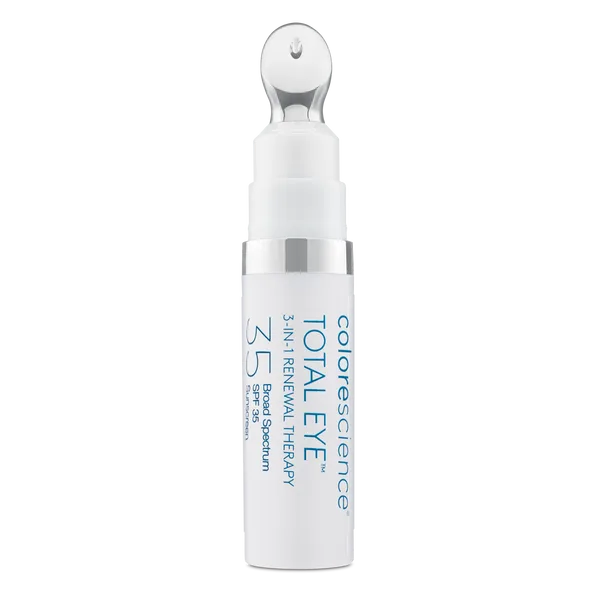
Total Eye 3-in-1 Renewal Therapy SPF 35
Derm Office Eye Essential
 Verified reviewer
Pros & cons.
- +100% mineral SPF 35 specifically formulated not to sting or irritate the eye area
- +Patented 3-in-1 formula genuinely combines eye treatment, sun protection, and concealer coverage
- +Cooling metal applicator provides real soothing benefit for morning puffiness
- +Ophthalmologist-tested and safe for contact lens wearers
- +Crease-resistant satin finish holds up throughout the day without settling into fine lines
- +Iron oxides provide supplemental visible light and blue light protection beyond UV filters
- +Fragrance-free and paraben-free with minimal sensitization risk for the delicate periorbital area
- −Extremely expensive at $79 for only 7 mL with no larger size option available
- −Only four shade options may not adequately match all skin tones
- −Anti-aging peptide benefits are subtle and may not satisfy those seeking dramatic wrinkle reduction
- −Metal applicator dispenser mechanism can break or malfunction with repeated use
- −Coverage may not fully conceal very dark or prominent under-eye circles
The full review.
There is a quiet conspiracy in skincare, and it involves the inch of skin directly below your eyebrows. Think about it: you dutifully apply sunscreen every morning, but how close do you actually get to your eyes? If you are like most people, you stop a generous centimeter away, because the last time you tried to push sunscreen up to your lash line, you spent twenty minutes blinking through tears and questioning your life choices. Meanwhile, that unprotected crescent of skin is arguably the thinnest, most UV-vulnerable real estate on your entire face. Colorescience, a brand founded by the woman who literally invented mineral makeup back in 1977, looked at this problem and decided to engineer their way out of it.
Total Eye 3-in-1 Renewal Therapy SPF 35 has been a fixture in dermatology offices since its 2018 launch, and it earned a US patent for doing something genuinely rare: combining ophthalmologist-tested mineral sunscreen, peptide-driven anti-aging treatment, and tinted concealer coverage in a single formula. The product arrives in a slim tube with a cooling metal roller-ball applicator that feels deliberate — like a tool designed for a specific job, not a generic squeeze tube with delusions of grandeur.
The formula centers on two mineral UV filters — titanium dioxide at 7.9% and zinc oxide at 6.7% — which together provide broad-spectrum SPF 35 protection without the stinging, watering, and general ocular misery that chemical filters inflict on the eye area. These are micronized and blended with iron oxides in four shade options (Fair, Medium, Tan, Deep), so the white cast that typically haunts mineral sunscreens is replaced by actual concealer-grade coverage. The iron oxides do double duty: beyond cosmetic coverage, they provide supplemental protection against visible light and high-energy blue light, wavelengths that mineral filters alone do not fully block.
Beneath the sun protection layer, Colorescience has loaded this formula with a targeted peptide complex. Palmitoyl Tripeptide-5 is the headliner — a signal peptide that mimics TGF-beta to stimulate collagen synthesis in the very area where collagen loss shows up earliest and most visibly. Clinical research on this peptide has demonstrated measurable wrinkle depth reduction of 7-12% over 84 days of consistent use. It is not going to rewind the clock a decade, but for a product that is also providing SPF and coverage, it represents a legitimate third function rather than a marketing afterthought.
Supporting the peptide work is a cast of marine-derived extracts that Colorescience has branded with proprietary names: Aldavine 5X (from red and brown algae) targets the microvascular congestion that creates dark circles, while hydrolyzed algin and tremella fuciformis extract provide supplemental hydration. Sodium hyaluronate, panthenol, and glycerin round out the moisture component, keeping the periorbital skin plumped without the heaviness that causes many eye products to migrate into fine lines by midday.
The application experience deserves its own paragraph because the cooling metal tip is not mere gimmick. It maintains a consistently cool temperature that genuinely helps with morning puffiness through mild vasoconstriction. You twist the base to dispense a small amount of tinted product onto the tip, then roll it gently along the orbital bone. The formula blends with light finger-tapping into a smooth, satin finish that most users report stays put throughout the day without creasing. For a tinted eye product, the crease resistance is notably good — the silicone base creates a flexible film that moves with expression lines rather than settling into them.
Now, the honest limitations. Seven milliliters is a very small amount of product, and at $79 with no larger size available, you are paying approximately $1.32 per day if you use it twice daily as recommended. The shade range, while covering fair to deep, offers only four options — adequate for many, but not the inclusive range that a product at this price point arguably owes its customers. And while the peptide and marine extract complex is promising, some long-term users report that the anti-aging benefits are subtle enough to question whether a dedicated eye treatment used separately would deliver more dramatic results.
The texture sits in a satisfying middle ground — rich enough to feel like legitimate skincare, light enough to not compete with makeup applied over it. It layers cleanly under foundation for those who want additional coverage, or works beautifully alone for those who prefer a minimalist morning routine. The complete absence of fragrance, parabens, and chemical sunscreen filters makes this one of the most sensitization-safe options for the eye area.
For the person who actually wants to protect the skin around their eyes from the sun — not just treat it after the damage is done — Total Eye represents a thoughtful, patent-worthy solution to a problem that most brands have simply ignored. It is expensive, it is small, and its anti-aging claims are modest. But it does the one thing that matters most for periorbital aging better than almost anything else: it gets mineral SPF onto skin that most people leave exposed every single day. That alone, applied consistently over years, may do more for the eye area than any retinol or peptide ever could.
Ingredient analysis.
Full INCI list
Active Ingredients: Titanium Dioxide 7.9%, Zinc Oxide 6.7%. Inactive Ingredients: Aqua/Water, Hydrogenated Polyisobutene, Cyclopentasiloxane, Caprylic/Capric Triglyceride, Lauryl Polyglyceryl-3 Polydimethylsiloxyethyl Dimethicone, Glycerin, Panthenol, Mica, Dimethicone Crosspolymer, Albizia Julibrissin Bark Extract, Sea Water, Sorbitol, Jojoba Esters, Sodium Hyaluronate, Palmitoyl Tripeptide-5, Tremella Fuciformis Sporocarp Extract, Hydrolyzed Algin, Ascophyllum Nodosum Extract, Betaine, Dunaliella Salina Extract, Asparagopsis Armata Extract, Sucrose, Darutoside, Pantolactone, Tocopherol, Sodium Chloride, Dimethicone/Vinyl Dimethicone Crosspolymer, Silica, Polyhydroxystearic Acid, Glyceryl Behenate/Eicosadioate, Dimethicone, Lauroyl Lysine, Dimethiconol, Ethylhexylglycerin, Triethoxycaprylylsilane, Alumina, Phenoxyethanol, Potassium Sorbate, Sodium Benzoate, Citric Acid, Iron Oxides (CI 77491, CI 77492, CI 77499)
Skin match.
The science.
The Science
Total Eye uses titanium dioxide (7.9%) and zinc oxide (6.7%) for mineral UV protection. These are two of the most studied, FDA-approved sunscreen actives. Titanium dioxide absorbs UVB strongly, while zinc oxide covers the UVA1 range. Together, they provide broad-spectrum protection without the sensitization risk of chemical UV filters, which matters for products applied near the conjunctival mucosa.
Iron oxides do more than provide a cosmetic tint. A 2014 study in the Journal of Investigative Dermatology (Dumbuya et al.) shows iron oxides protect better against visible light-induced pigmentation than mineral UV filters alone. This visible light protection adds photoprotective value to the periorbital area, where hyperpigmentation causes dark circles.
Palmitoyl Tripeptide-5 is the main anti-aging active and works as a collagen-stimulating signal peptide. Research in the International Journal of Cosmetic Science (2009) shows this peptide mimics thrombospondin-1 to activate TGF-beta signaling, which promotes types I and III collagen synthesis. In controlled studies, topical application reduced crow's feet wrinkle depth by 7-12% over 84 days. These improvements are modest compared to prescription retinoids, but the peptide's gentle mechanism suits the periorbital zone where retinoids often cause too much irritation for consistent use.
The marine extract complex contains Albizia julibrissin bark extract, which shows anti-glycation properties in vitro. This is relevant because glycation-induced collagen crosslinking contributes to periorbital skin laxity. Tremella fuciformis (snow mushroom) extract provides polysaccharide-based hydration. Its water-binding capacity rivals hyaluronic acid but feels lighter on thin periorbital skin.
References
- Photoprotection by window glass, automobile glass, and sunglasses — Journal of the American Academy of Dermatology (2009)
Dermatologist Perspective
Dermatologists often call the periorbital area the most under-protected zone on the face, and Colorescience Total Eye addresses this gap. Board-certified dermatologists note the mineral-only formula works well for post-procedure patients—those recovering from laser treatments, chemical peels, or injectables around the eyes—who need gentle, non-irritating sun protection. Ophthalmologist testing adds credibility for practitioners treating patients with ocular rosacea or chronic dry eye conditions. Many dermatologists stock this product in their offices to solve compliance issues: patients who refuse regular sunscreen near their eyes use this because it looks and feels like a concealer. The tinted formula also reduces the mineral white cast that drives some patients toward chemical sunscreens they cannot tolerate near the eyes.
Where it fits in your routine.
Twist the tube base to put a small amount of product on the cooling metal applicator tip. Roll the applicator in an arc along the orbital bone from the inner corner to the outer corner, then back under the eye. Tap and blend the tinted formula outward with your ring finger. Apply to the under-eye area and the upper lid for complete periorbital protection. Use morning and evening for anti-aging benefits; SPF protection only applies during the day. Remove thoroughly at night using a gentle cleansing oil or micellar water.
Colorescience Total Eye costs $79 for 7 mL, making it a premium product. The value changes because it replaces three products: eye cream, under-eye concealer, and eye-area sunscreen. Twice-daily use costs about $1.32 per day, which matches the price of many dedicated eye creams before adding concealer and SPF. The brand's two-decade history in mineral sun protection and the US patent on this specific formula justify the premium price. However, if you only need anti-aging treatment or coverage, single-purpose products outperform it in those categories at a lower price per function.
This works for people who stopped protecting their eye area because regular sunscreens sting, or those who want to combine eye treatment, SPF, and concealer into one morning step. It is useful for sensitive-eyed individuals, contact lens wearers, and post-procedure patients.
Choose this if you want maximum anti-aging potency around the eyes (a dedicated retinol eye cream delivers more dramatic results), need extensive shade matching for medium-to-full coverage, or want to save money by buying less expensive standalone products instead.
Product details.
Thick but lightweight tinted cream. The smooth, blendable consistency glides on without tugging the delicate eye area.
Fragrance-free; no detectable scent
Slim tube with a patented cooling metal roller-ball applicator tip for the orbital area; airless pump dispenser
The cooling metal tip feels soothing on puffy morning eyes during the first application. The tinted formula blends easily and covers dark circles in seconds. This product has no adjustment period and feels elegant from day one. The anti-aging peptide benefits develop over weeks.
60 days of twice-daily application around both eyes, per manufacturer's recommendation
12 months
All Year
The backstory.
Colorescience recognized that the eye area is often the most neglected zone in sun protection routines — standard sunscreens sting, and most eye creams skip SPF entirely. Total Eye was developed to fill that gap, combining the brand's mineral sunscreen expertise with eye-specific peptide technology. It earned a US patent for its unique multi-benefit approach and quickly became a staple in dermatology offices.
About Colorescience
Established Brand (5–20 years)Colorescience was founded in 2000 by Diane Ranger, who previously created Bare Escentuals and coined the term 'mineral makeup' in 1977. The brand specializes in mineral-based sun protection and is widely recommended by dermatologists and sold through medical offices. Its Total Eye product holds a US patent for its multi-benefit eye area formula.
Common myths.
Mineral sunscreen around the eyes always looks white and chalky
This formula uses micronized mineral filters and iron oxide tints to stop white cast and provide UV and visible light protection. The tinted base conceals the area instead of highlighting it.
Wearing sunscreen on your face removes the need for separate SPF for the eye area
Stinging and migration stop most people from applying facial sunscreen near the eyes. The periorbital area gets less sun protection than the rest of the face. A dedicated eye SPF like this one prevents photoaging and hyperpigmentation.
FAQ.
Can I wear Colorescience Total Eye under makeup?
Yes — the formula is designed to work as both a standalone concealer and a base under additional makeup. Its satin finish layers well under powder or foundation without pilling, and the mineral SPF remains effective underneath cosmetics.
Is Colorescience Total Eye safe for sensitive eyes and contact lens wearers?
Ophthalmologists tested the formula and approved it for contact lens wearers. It uses 100% mineral UV filters (titanium dioxide and zinc oxide), which sting or irritate less than chemical sunscreen filters. The fragrance-free, paraben-free formula minimizes sensitization risk.
How does Colorescience Total Eye compare to using separate eye cream and concealer?
Total Eye combines eye treatment, SPF, and concealer into one product. Dedicated eye creams often have higher concentrations of anti-aging actives, but few concealers provide SPF 35 mineral protection, and even fewer eye creams offer buildable coverage. You trade maximum potency in one category for convenience and guaranteed sun protection.
Will Colorescience Total Eye crease under my eyes?
Most reviewers report little to no creasing during the day, a notable trait for a tinted eye product. The silicone base creates a smooth film that resists settling into fine lines, though deep wrinkles may show some migration by end of day.
How long does a tube of Colorescience Total Eye last?
The 7 mL tube lasts about 60 days if applied twice daily around both eyes. At $79, the cost is roughly $1.32 per day — a premium price for its multi-tasking formula and clinical-grade mineral protection.
What the community says.
"Excellent coverage for dark circles without caking"
"Cooling metal applicator soothes puffiness"
"Does not crease or settle into fine lines throughout the day"
"Provides real SPF protection for the neglected eye area"
"Lightweight feel despite multi-benefit formula"
"Very expensive for a tiny 7 mL tube"
"Some users report minimal anti-aging improvement after months of use"
"Limited shade range may not match all skin tones"
"Dispenser mechanism can be fragile"
People also looked at.