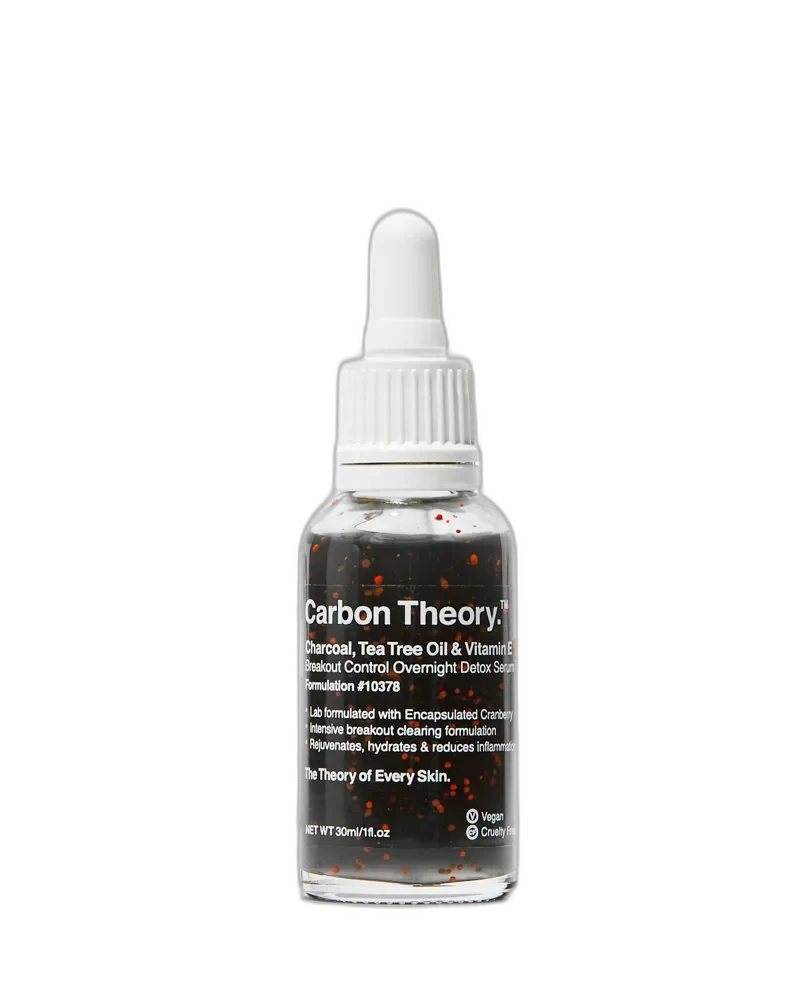
Breakout Control Overnight Detox Serum
Budget 2% BHA
 Verified reviewer
Pros & cons.
- +Delivers a full clinical-strength 2% salicylic acid at a budget price
- +5% niacinamide and zinc PCA buffer irritation and reinforce oil control
- +Water-thin texture absorbs in seconds with no residue
- +Cruelty-free and vegan certified
- +Meaningful blackhead and small-comedone reduction in 3-4 weeks
- +Thoughtful buffering ingredients keep barrier calmer than typical BHA serums
- −Persistent tea tree scent from a real essential oil dose
- −Contains linalool and limonene — not fragrance-sensitive-friendly
- −Not fungal-acne safe despite the low oil content
- −Small 30ml bottle runs out quickly with nightly use
- −Too active to stack with retinoids on the same night
The full review.
About Carbon Theory
Carbon Theory grew through one viral product: the charcoal and tea tree cleansing bar that briefly topped Boots UK demand. That bar has limits—as a rinse-off, its actives only touch skin for seconds. This Overnight Detox Serum answers the next logical question: what if the brand offered a leave-on treatment that stays on the skin all night?
Reality
The formulation is the highlight. 2% salicylic acid is the main active, providing full clinical-strength BHA—the same dose in Paula’s Choice’s famous liquid exfoliant, but at less than half the cost. It differs from cheap BHA knockoffs via its supporting ingredients: 5% niacinamide for sebum regulation and inflammation buffering, zinc PCA to reinforce oil control, panthenol and allantoin to protect the barrier, and a glycerin-and-propanediol base instead of the drying alcohol found in many older BHA serums. The tea tree oil remains the brand’s signature, but it is a minor player compared to the salicylic-acid-plus-niacinamide axis.
Texture
The serum disappears in ten seconds upon application. It is water-thin, not the silicone-thickened gel-serum texture many brands use. A faint tingle occurs on active breakouts or recent extractions and settles within a minute. The tea tree scent is present—familiar to anyone using the Carbon Theory range—but without shea butter or an occlusive to hold it, the scent fades faster than in the moisturiser.
Works for
Over the following weeks, 2% BHA performs as expected. Small comedones on the forehead and chin break up. Blackheads loosen. A small purge often occurs in week one as the serum pulls clogged pores to the surface; this is expected, not a reason to stop. By week three or four, oily-combination users usually see smoother texture, fewer whiteheads, and less midday shine from the niacinamide and zinc. Deeper inflammatory cysts do not respond like they do to a prescription retinoid, and BHA will not treat hormonal jawline acne; for those cases, this is only adjunct therapy.
Not ideal for
The limit is the irritation budget. A leave-on serum with 2% salicylic acid, tea tree, linalool, and limonene is not for everyone. If you use a retinoid, have rosacea, or feel skin tightness after micellar water, this will cause irritation. It is not for use during pregnancy. Fungal-acne sufferers should check their reaction to the tea tree, and those who dislike essential oil scents should choose a fragrance-free BHA. These are not formulation flaws, but the result of a high dose.
Value
The product earns its place through value. Twenty dollars for 30ml of a 2% salicylic acid and 5% niacinamide serum with buffering ingredients is cheap. The Paula’s Choice equivalent costs over $30, and The Ordinary’s 2% BHA lacks both niacinamide and zinc. For the right user, this is a viable acne treatment a student on a budget can afford to use consistently. For others, calmer, unscented alternatives work better.
Ingredient analysis.
Full INCI list · pH 4
Aqua (Water), Propanediol, Niacinamide, Glycerin, Salicylic Acid, Panthenol, Allantoin, Sodium Hyaluronate, Zinc PCA, Melaleuca Alternifolia (Tea Tree) Leaf Oil, Citric Acid, Sodium Citrate, Xanthan Gum, Hydroxyethylcellulose, Phenoxyethanol, Ethylhexylglycerin, Linalool, Limonene
Skin match.
The science.
The Science
Evidence for 2% salicylic acid in acne treatment is robust. Dermatology reviews from the last two decades show leave-on 2% BHA reduces comedonal and mildly inflammatory acne. It works by penetrating the follicular unit to dissolve sebum plugs and accelerate keratinocyte turnover. Studies also look at combining salicylic acid and niacinamide. A 2012 trial in the Journal of Clinical and Aesthetic Dermatology found topical 5% niacinamide reduced inflammatory lesions as much as 1% clindamycin over 8 weeks. Zinc PCA's mechanism is less certain, but in vitro and small clinical studies suggest it has a modest 5-alpha-reductase inhibition and sebostatic effect. This formulation uses three complementary mechanisms: follicular unblocking, anti-inflammatory sebum regulation, and antimicrobial pressure from tea tree. No trials exist for this specific combination at these specific doses. Results follow the evidence for individual ingredients rather than combination-specific data.
Dermatologist Perspective
Dermatologists often recommend 2% leave-on BHA serums for mild-to-moderate comedonal acne in oily or combination skin. Board-certified dermatologists note that pairing salicylic acid with niacinamide improves tolerability, as B3 reduces the irritation and erythema that usually limit use. Derms often advise pregnant patients, sensitive-skin patients, and those on prescription retinoids to avoid products like this, suggesting azelaic acid or alternate-night scheduling instead. This serum works as an appropriate adjunct rather than a standalone treatment for moderate or severe cases.
Where it fits in your routine.
Apply 3-4 drops to clean, dry skin at night, avoiding the immediate eye area. If new to leave-on BHAs, use twice weekly for the first 2 weeks, then move to every other night and finally nightly as tolerated. Follow with a plain ceramide or hyaluronic acid moisturiser, and wear sunscreen the next morning — daily salicylic acid modestly raises photosensitivity. Do not use with retinoids, additional BHAs, or benzoyl peroxide on the same night.
At about $20 for a 30ml dropper, the per-ml cost is cheap drugstore pricing for a serum with clinical-strength BHA and a high niacinamide dose. Competing 2% salicylic acid serums from mid-tier derm brands cost 50-100% more. The lack of a larger size is the only value issue; a 60ml option would make this a budget winner. The indie branding makes this price point easier to trust.
Oily and combination skin with mild-to-moderate comedonal acne, blackheads, enlarged pores, and rough texture. Budget-conscious users seeking a 2% BHA treatment without prestige brand markups. Users who tolerate tea tree products and prefer a water-thin serum over a gel.
Dry, sensitive, rosacea-prone, or eczema-prone skin. Pregnant users, people using a nightly retinoid, and anyone with a known fragrance allergy. Fungal acne sufferers who reacted to tea tree before.
Product details.
Clear, water-thin liquid that absorbs in seconds
Distinct tea tree and herbal notes
Frosted glass bottle with dropper
A brief tingle upon application is common. This is a 2% leave-on BHA and does not sting sharply. Expect small comedones to purge during weeks 1-2 before the skin settles.
About 2 months with nightly use
12 months
All Year
The backstory.
Built as the overnight partner to Carbon Theory's cleansing bar and moisturiser, this serum was the brand's attempt to give its acne-focused audience a proper leave-on treatment step. It launched after the brand's Boots distribution expanded and Henke had the margin to invest in a more active formulation.
About Carbon Theory
Emerging Brand (2–5 years)Rachael Henke founded the UK indie brand Carbon Theory in 2018. The brand is best known for its viral charcoal and tea tree cleansing bar at Boots. While anecdotal traction is strong, independent clinical validation for individual products is limited.
Common myths.
A 2% BHA serum is always going to dry you out.
This formulation uses propanediol and glycerin as a base instead of alcohol. 5% niacinamide and panthenol buffer irritation, making it gentler than older drying BHA toners.
FAQ.
Can beginners use this or is it too strong?
It has a full 2% BHA dose. Beginners should use it twice weekly and build up instead of nightly use. The niacinamide and panthenol cushion irritation, but the salicylic acid concentration is at the upper end of the leave-on range.
Can I layer this with retinol?
Do not use them on the same night. Alternate — use a retinoid one night and this serum the next. Stacking both causes flaking and over-exfoliation, even on resilient skin.
Will this help with blackheads specifically?
Yes. Salicylic acid is oil-soluble and physically dissolves the sebum and dead cells forming blackheads, and at 2% it's the most effective over-the-counter tool for this. Expect visible reduction in 3-4 weeks.
Is it safe in pregnancy?
No. 2% leave-on salicylic acid exceeds the dose typically cleared for pregnancy. Tea tree oil is another ingredient many OB-GYNs suggest avoiding. Use an azelaic acid product instead.
Why does it smell so strongly of tea tree?
The tea tree oil is a functional dose, not a cosmetic fragrance masking. The scent is noticeable on first use but dissipates within a few minutes of application.
Can I use it in the morning?
We don't. 2% BHA increases photosensitivity and this formulation works overnight. Use niacinamide and sunscreen in the mornings. ---
What the community says.
"noticeable reduction in blackheads"
"great price for a 2% BHA"
"doesn't dry skin out like other BHA serums"
"strong tea tree smell"
"too active for first-time BHA users"
"small bottle"
People also looked at.