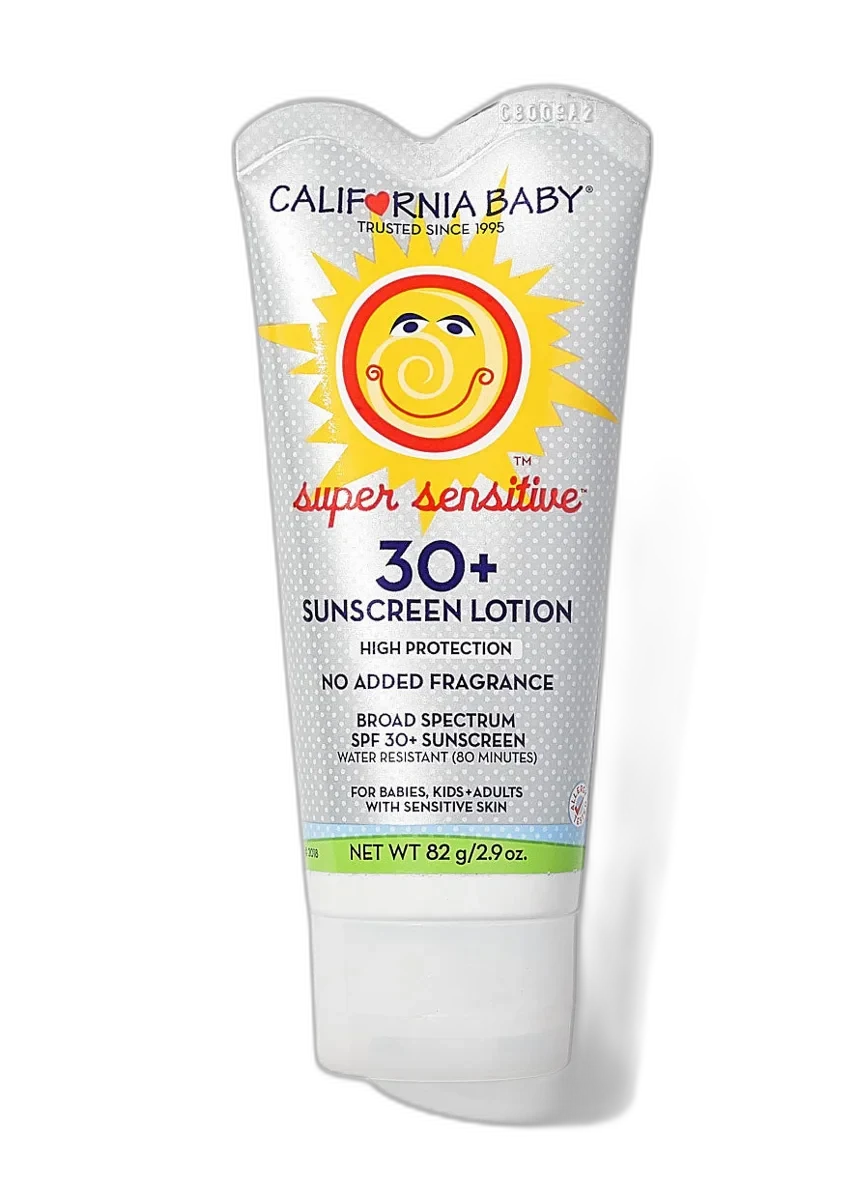
Super Sensitive Sunscreen SPF 30+
The Zero-Compromise Sensitive Skin Sunscreen
 Verified reviewer
Pros & cons.
- +Truly fragrance-free with no essential oils, botanicals, or masking scents
- +Allergen-free formulation excludes gluten, soy, dairy, sesame, oat, and nuts
- +Non-nano titanium dioxide stays on skin surface without penetration
- +EWG Safe Sunscreen Guide recommended for 14+ consecutive years
- +Soothing allantoin and panthenol calm reactive and eczema-prone skin
- +Available in four sizes including a trial-size sample for testing
- +80-minute water resistance meets FDA maximum standard
- −Premium price of $25.99 for 2.9 oz with a very simple ingredient list
- −Thick texture requires patient blending and can feel heavy
- −Noticeable white cast persists on medium to deep skin tones
- −Titanium dioxide alone offers less UVA1 protection than zinc oxide formulas
- −Can pill when layered under makeup or other skincare products
The full review.
Parents with children whose skin reacts to even “gentle” products face unique frustrations. California Baby responded by creating the Super Sensitive line, removing the essential oils that provide the lemongrass scent in their Everyday formula. The result is a functional product that is nearly nothing-but-sunscreen.
The formula is minimal. Titanium dioxide at 12% provides all UV protection. The inactive ingredient list is short: water, plant-derived emollients (safflower oleosomes, caprylic/capric triglyceride, squalane, coconut oil), candelilla wax, glycerin, panthenol, allantoin, tapioca starch, and two gentle preservatives. It contains no botanical extracts, no essential oils, no fragrance, no chemical UV filters, and no silicones.
Texture
This thick mineral sunscreen does not pretend to be lightweight. Because it lacks the essential oils found in the Everyday formula, the Super Sensitive version requires more patience to apply. Use deliberate, circular motions to work it into the skin until the white cast fades to a subtle sheen. It becomes nearly invisible on lighter skin tones after one or two minutes. On medium to deep skin tones, a residual cast remains. This is the trade-off for non-nano titanium dioxide, and California Baby does not use tints or nanoparticles to fix it.
Scent
This product has no smell. It is not a “clean” or “subtle” scent; it is nothing. For those whose skin reacts to “unscented” products that actually contain masking fragrances, this total absence of odor is notable and reassuring.
Best for
The allergen-free formulation distinguishes this product. It is free of gluten, oat, soy, sesame, dairy, and nuts (except coconut). Families managing severe food allergies can use it without fearing topical cross-contamination. This is a practical concern, as children with severe nut allergies can react to topical almond oil or shea butter, which many sunscreens include without clear labeling.
Works for
Allantoin and panthenol provide subtle soothing. They do not offer the cooling sensation of menthol or the visible calming of niacinamide. Instead, they reduce transepidermal water loss and promote skin comfort. With consistent use, irritated or eczema-prone skin feels less angry. This cumulative effect matters for a sunscreen applied two or three times daily during summer.
Not ideal for
Titanium dioxide alone provides less UVA1 coverage than formulas combining titanium dioxide with zinc oxide. SPF 30+ broad-spectrum is adequate for daily incidental exposure. However, families managing photosensitivity or a history of skin cancer might prefer a zinc oxide-containing alternative for extended outdoor time in intense sun.
Common Complaints
The size range is practical: a 0.5 oz sample for $3.99 allows testing, while the 6 oz tube at $42.99 lowers the per-ounce cost from roughly $9 to about $7. This remains expensive for a mineral sunscreen with few ingredients. You pay a premium for what the product lacks rather than what it contains. But for families who have wasted months on sunscreens that caused irritation, the cost of finding a working product is rarely the main complaint.
About California Baby Super Sensitive sunscreen
California Baby’s Super Sensitive sunscreen is not elegant or exciting. It aims to be invisible—to sit on skin without announcing itself, to protect without irritating, and to exist without causing a reaction. For its target skin types, that lack of drama is the goal.
Ingredient analysis.
Full INCI list
Active Ingredient: Titanium Dioxide 12%. Inactive Ingredients: Water, C12-15 Alkyl Benzoate, Carthamus Tinctorius (Safflower) Oleosomes, Caprylic/Capric Triglyceride, Polyhydroxystearic Acid, Coco-Caprylate, Glycerin, Euphorbia Cerifera (Candelilla) Wax, Polyglyceryl-2 Dipolyhydroxystearate, Tapioca Starch, Rosmarinus Officinalis (Rosemary) Leaf Extract, Polyglyceryl-3 Diisostearate, Squalane, Magnesium Stearate, Cocos Nucifera (Coconut) Oil, Levulinic Acid, Allantoin, Panthenol, Caprylhydroxamic Acid, Glyceryl Caprylate
Skin match.
The science.
The Science
Titanium dioxide at 12% concentration provides UVB and partial UVA protection by scattering and reflecting UV radiation. Compared to zinc oxide, titanium dioxide has narrower UVA coverage; it protects UVA2 (320-340 nm) well but offers less protection in the UVA1 range (340-400 nm), which causes deep skin damage and photoaging. A 2011 study in the Journal of the American Academy of Dermatology compared mineral UV filters and found zinc oxide provides broader UVA coverage, while titanium dioxide offers better UVB protection per unit concentration.
The non-nano particle specification matters for safety and cosmetics. A 2009 review in the International Journal of Cosmetic Science confirmed non-nano titanium dioxide particles do not penetrate past the stratum corneum of intact skin, even with repeated application. This safety data is relevant for pediatric use when the skin barrier is less mature.
The formula uses allantoin and panthenol to support skin barrier function. The skin converts panthenol (provitamin B5) to pantothenic acid, which increases stratum corneum hydration and reduces transepidermal water loss. A 2002 study in the American Journal of Clinical Dermatology reviewed panthenol's dermatological uses and confirmed its moisturizing, wound-healing, and anti-inflammatory properties at topical concentrations.
The preservation system uses caprylhydroxamic acid and glyceryl caprylate. This paraben-free, formaldehyde-free approach ensures microbiological stability. These preservatives are among the gentlest available and work well for sensitive and eczema-prone skin.
References
- Broad Spectrum Protection Against Ultraviolet Radiation by Zinc Oxide and Titanium Dioxide — Journal of the American Academy of Dermatology (2011)
- Panthenol in Dermatological Preparations: Skin Hydration and Wound Healing — American Journal of Clinical Dermatology (2002)
Dermatologist Perspective
Pediatric dermatologists view fragrance-free mineral sunscreens as the gold standard for children with atopic dermatitis and contact sensitivity. California Baby's Super Sensitive formula follows this guidance; it lacks essential oils, botanical extracts, and chemical UV filters, removing most common contact sensitizers. Board-certified dermatologists note that while the titanium dioxide-only approach provides adequate broad-spectrum protection for daily wear, patients with a personal or family history of melanoma or photosensitive conditions may benefit from formulas with zinc oxide for more UVA1 coverage. Pediatric practices value the allergen-free manufacturing for patients with concurrent food allergies and eczema.
Where it fits in your routine.
Shake gently before use. Apply liberally to all exposed skin 15 minutes before sun exposure. Use circular motions to blend until the white cast fades. Reapply at least every two hours, and immediately after swimming, sweating, or towel-drying. Consult a pediatrician before use for infants under 6 months. The 0.5 oz sample size works well for patch-testing before buying a full tube. Store in a cool, dry place.
At $25.99 for 2.9 oz ($8.96/oz), this premium-priced sunscreen uses a simple formula. The 6 oz tube at $42.99 ($7.17/oz) provides better value for frequent users. The price covers allergen-free manufacturing, U.S.-based production, and ingredient sourcing that avoids common allergens — factors that increase manufacturing complexity. For families who failed with cheaper alternatives that caused reactions, the premium is justified by the product's near-universal tolerability. Users without specific allergy or sensitivity needs can find similar mineral protection at lower price points from pharmacy brands.
Families with children who have eczema, contact dermatitis, or multiple food allergies need a sunscreen that removes almost all common irritants and allergens. It also works for adults with fragrance sensitivity, rosacea, or post-procedure skin who need reliable mineral protection without irritation risk.
This sunscreen feels heavy and does not blend invisibly for those prioritizing cosmetic elegance. People with photosensitive conditions needing maximum UVA protection should use zinc oxide-containing formulas. Families on a budget without specific allergy needs can find effective mineral sunscreens for much less.
Product details.
Thick, creamy mineral lotion that needs patient blending. It is denser than the Everyday version because it lacks essential oils that aid spreadability. It leaves skin feeling moisturized and slightly filmy.
Unscented — no fragrance, no essential oils, and no masking scent. This sunscreen smells like nothing.
Squeezable plastic tube with a flip-top cap. Four sizes range from a 0.5 oz sample to a 6 oz value size. The simple, clean design matches the brand's botanical illustration aesthetic.
It leaves a white cast that needs thorough blending. It has no tingling, stinging, or sensation, which helps skin that reacts to most products. The thick texture makes application slower than chemical sunscreens, but it has zero scent.
Apply to the face daily for 2-3 months; full body use and frequent reapplication takes less time.
12 months
All Year
The backstory.
Born from the same kitchen-table origin story as all California Baby products, the Super Sensitive line was developed specifically for children whose skin reacted even to the essential oils in the brand's Everyday formula. It represents California Baby's acknowledgment that truly sensitive skin needs truly minimal formulation — and that even plant-based fragrances are too much for some.
About California Baby
Established Brand (5–20 years)Jessica Iclisoy founded California Baby in 1995. The brand leads in plant-based, allergen-conscious personal care. EWG's Safe Sunscreen Guide has recommended its sunscreens for over 14 consecutive years. Pediatricians and dermatologists widely endorse California Baby for sensitive and allergy-prone skin.
Common myths.
Scented sunscreens work better than fragrance-free sunscreens.
Titanium dioxide provides all the UV protection. Both the Everyday and Super Sensitive formulas use a 12% concentration. Removing essential oils does not change sun protection; it only removes potential irritants.
If a sunscreen doesn't sting, it probably isn't strong enough.
Stinging and tingling signal irritation, not efficacy. This SPF 30+ formula gives the same broad-spectrum protection as sunscreens that cause sensation, but without irritating the skin.
FAQ.
What is the difference between California Baby Everyday and Super Sensitive sunscreen?
Both use 12% titanium dioxide as the only UV filter. Everyday contains lemongrass and gardenia essential oils for fragrance. Super Sensitive is fragrance-free and has no essential oils or botanical extracts. Super Sensitive works for skin that reacts to plant-based fragrances.
Can I use California Baby Super Sensitive sunscreen on a newborn?
The FDA and AAP recommend no sunscreens for infants under 6 months. For babies over 6 months, this fragrance-free mineral formula with non-nano titanium dioxide is one of the gentlest options. The allergen-free formulation reduces reaction risks on developing skin.
Is California Baby Super Sensitive sunscreen safe for eczema-prone skin?
Yes — the fragrance-free, minimal formula uses allantoin and panthenol to soothe reactive and eczema-prone skin. It lacks essential oils, botanical extracts, and chemical UV filters, removing common eczema triggers found in other sunscreens.
Does California Baby Super Sensitive sunscreen contain nanoparticles?
No — California Baby uses non-nano titanium dioxide. These particles are large enough to sit on the skin's surface instead of penetrating. This causes the white cast, but it also adds safety for pediatric and sensitive skin.
Why is California Baby sunscreen so expensive?
The price covers allergen-free manufacturing in a dedicated, solar-powered U.S. facility, plant-derived ingredient sourcing, and the brand's choice to exclude common sensitizers. The 6 oz size ($42.99) costs about $7.17/oz, which is better value than the 2.9 oz tube at $8.96/oz.
Community ---
What the community says.
"Truly fragrance-free with no hidden scent"
"Gentle enough for babies with eczema"
"No stinging or burning on reactive skin"
"Parents trust it for children with multiple allergies"
"Water resistant and stays put during play"
"Expensive for the amount you get"
"Thick texture can be difficult to spread evenly"
"Noticeable white cast especially on darker skin tones"
"Can pill under makeup or other products"
"Limited UVA protection compared to zinc oxide sunscreens"
Featured in.
People also looked at.