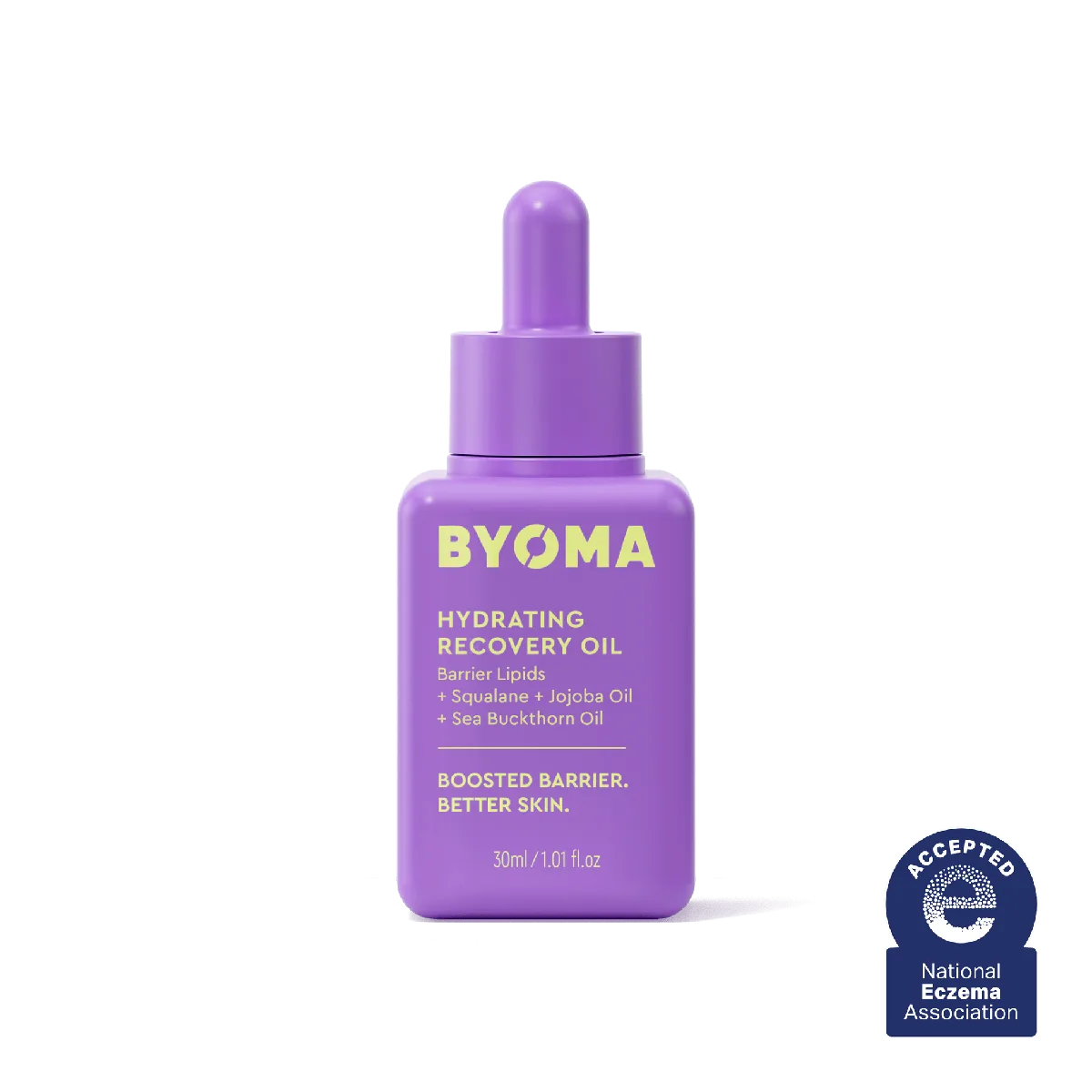
Recovery Oil
Botanical Barrier Booster
 Verified reviewer
Pros & cons.
- +Ceramide NP and sphingolipids deliver genuine barrier repair in an oil-compatible format
- +Eight curated botanical oils provide a broad spectrum of essential fatty acids
- +Sea buckthorn and rosehip add potent antioxidant and brightening benefits
- +Lighter texture than expected — absorbs without heavy greasy residue
- +Squalane improves absorption and provides skin-identical lipid compatibility
- +Effective final-step sealant that enhances the performance of underlying products
- −Contains blue tansy essential oil — not truly fragrance-free despite marketing
- −Olive fruit oil may trigger breakouts in acne-prone individuals
- −Small 30 mL bottle at $17.99 is pricier per ounce than basic face oils
- −Limited review base makes long-term efficacy data still developing
- −Not moisturizing enough as a standalone product for very dry skin
The full review.
Face oils occupy a strange niche. People either love them as skin-transforming rituals or dismiss them as expensive grease that a moisturizer already handles. Formulation is the deciding factor. Most cheap face oils are simple carrier oils—essentially the same jojoba you buy at a health food store. Byoma’s Recovery Oil differs by including ceramide NP and sphingolipids in its botanical blend, turning a face oil into a barrier-repair treatment.
This distinction matters. The stratum corneum is a lipid structure. Delivering ceramides in an oil base uses a format compatible with the barrier’s chemistry—no emulsifiers or water phase required. Sunflower seed oil leads the formula, providing a linoleic acid-rich base that research shows supports barrier integrity. Macadamia and jojoba follow, contributing palmitoleic acid and wax esters. Then come the antioxidants: sea buckthorn oil with its golden color and omega-7 fatty acids, and rosehip oil with natural trans-retinoic acid for gentle skin renewal.
The eight-oil blend is varied. Each oil contributes a different fatty acid profile to create a broad-spectrum lipid supplement. Sunflower and rosehip are high in linoleic acid, which acne-prone and barrier-damaged skin often lacks. Macadamia and sea buckthorn provide palmitoleic acid, which skin produces less of as it ages. Jojoba mimics sebum. Sweet almond and olive oils add oleic acid. Squalane, listed sixth, is a skin-identical lipid that improves the blend’s absorption.
The texture is surprisingly fluid for a formula with seven heavy botanical oils before squalane. The golden color from sea buckthorn’s carotenoids looks striking in the bottle but disappears on application. It absorbs in a few minutes, which is normal for a face oil, but it lacks the heavy, sheeny residue of many multi-oil blends. The finish is luminous, not greasy: a soft glow that looks like hydrated skin.
One ingredient choice deserves attention. Tanacetum annuum flower oil — blue tansy — is at the end of the list. Blue tansy has documented anti-inflammatory properties and is usually well-tolerated, but as an essential oil, this is not a fragrance-free product. The concentration is likely minimal, but those with essential oil sensitivities should be aware. This departs from the minimalist approach of the rest of the Byoma range.
Olive fruit oil, also in the Rich Cream, is the main comedogenicity concern. This may be a dealbreaker for acne-prone skin. However, the formula is labeled non-comedogenic and dermatologist-tested, suggesting the concentration works for most skin types.
Application is simple. Press three to five drops into the face and neck after serum and moisturizer for immediate luminous softness. Evening use is best, giving the oil all night to deliver its ceramide payload without competing with makeup or sunscreen. It also mixes well into moisturizer. In winter, adding two drops to the Byoma Gel Cream creates an enriched texture between the Gel Cream and Rich Cream.
The value is nuanced. At $17.99 for 30 mL, this is affordable for a ceramide-containing face oil, though more expensive than $5-$10 single-oil options. You pay for the formulation: ceramide NP, the fatty acid spectrum, squalane for absorption, and the antioxidant-rich sea buckthorn and rosehip. The price premium over jojoba depends on whether you want a moisture-sealer or a barrier-repair delivery vehicle.
The review base is limited—about 150 reviews across retailers—so real-world data is still growing. The 4.6-star average is encouraging but based on a small sample size. Reviews consistently show the oil absorbs well and delivers a glow, though some users find it lacks enough moisture to serve as a standalone treatment for very dry skin.
If you want a face oil that does more than sit on the surface, Byoma’s Recovery Oil is a smart choice. It delivers ceramides in a lipid matrix alongside beneficial botanicals. It does not replace a moisturizer, but it works as a final sealing and nourishing step in a barrier-repair routine.
Formula
Ingredient analysis.
Full INCI list
Helianthus Annuus (Sunflower) Seed Oil, Macadamia Ternifolia Seed Oil, Simmondsia Chinensis (Jojoba) Seed Oil, Hippophae Rhamnoides Oil, Dipropylene Glycol, Squalane, Sphingolipids, Hydroxyacetophenone, Olea Europaea (Olive) Fruit Oil, Rosa Canina Fruit Oil, Prunus Amygdalus Dulcis (Sweet Almond) Oil, Caprylyl Glycol, Ceramide NP, Ethylhexylglycerin, Tocopherol, Dipotassium Glycyrrhizate, Tanacetum Annuum Flower Oil
Skin match.
The science.
The Science
The Byoma Recovery Oil uses a principle cosmetic chemists know well: oil-soluble barrier lipids like ceramides deliver most efficiently through oil-based vehicles. Ceramide NP, the specific ceramide in this formula, is a lipophilic molecule. It integrates into the stratum corneum's lipid lamellae more easily in an oil matrix than in an oil-in-water emulsion.
Sunflower seed oil acts as the primary carrier and has evidence for barrier support. A 2013 study in Pediatric Dermatology found sunflower seed oil improved skin barrier function in neonates more than olive oil due to its high linoleic acid content. Linoleic acid is a component of ceramide 1 (linoleoylceramide), which maintains the barrier's water permeability.
Sea buckthorn oil provides a high source of palmitoleic acid (omega-7), carotenoids, tocopherols, and phytosterols. Research in the Journal of Ethnopharmacology documented sea buckthorn's anti-inflammatory and wound-healing properties via its bioactive lipids. The carotenoids also provide natural photoprotective antioxidant activity.
Rosehip oil contains linoleic acid, alpha-linolenic acid, and natural trans-retinoic acid. A 2015 study in Clinical Interventions in Aging found rosehip powder supplementation improved skin elasticity and moisture content, supporting topical rosehip oil for skin renewal. Natural retinoids in rosehip oil add gentle pro-renewal activity without the irritation of synthetic retinoids.
Jojoba oil's wax esters mimic human sebum. This allows it to penetrate the stratum corneum efficiently and helps regulate skin oil production. This mechanism makes this blend better for combination skin than formulas heavy in only oleic acid.
References
- Effect of Olive Oil and Sunflower Seed Oil on the Adult Skin Barrier — Dermatitis (2013)
Dermatologist Perspective
Dermatologists know oil-based delivery of barrier lipids helps patients with severely dry or barrier-compromised skin. Board-certified dermatologists note face oils with ceramides and skin-identical lipids work as effective adjuncts to moisturizers, especially in winter or during treatments that compromise the barrier. The multi-oil approach — combining linoleic acid-rich oils with skin-identical lipids — matches the dermatological understanding that barrier repair requires a spectrum of fatty acids, not just one ingredient.
Where it fits in your routine.
Apply 3-5 drops to your palms, warm them, and press into the face and neck. Use this as the final step in your evening routine — after serum and moisturizer. The oil creates an occlusive seal to lock in previous layers. You can also mix 2-3 drops with moisturizer for a thicker application. For daytime use, apply before sunscreen and wait 3-5 minutes to absorb. Do not rub — pressing helps the oil absorb evenly and prevents disrupting underlying product layers.
At $17.99 for 30 mL, the Byoma Recovery Oil costs about $17.81 per fluid ounce. This price is higher than pure jojoba ($6-$8 per ounce) but lower than prestige ceramide-containing face oils ($40-$80 per ounce). The value comes from the formulation architecture: ceramide NP, sphingolipids, and an eight-oil botanical blend with sea buckthorn and rosehip. The ceramide inclusion justifies the premium if you buy a face oil for barrier-repair benefits. Single oils work fine if you only want a basic emollient seal.
This works for dry, normal, or barrier-compromised skin. It suits users who want face oils that do more than provide basic emolliency. It works well as a winter skin rescue, a final step in a multi-product barrier-repair routine, or for anyone wanting the glow and nourishment of botanical oils plus ceramide-based barrier benefits.
Oily skin types may find this unnecessary or too heavy. The olive fruit oil content makes it a risk for acne-prone individuals. Blue tansy is present for those with essential oil sensitivities. This product is not strictly fragrance-free.
Product details.
Lightweight to medium-weight face oil with a golden hue from the sea buckthorn. It is more fluid than heavy botanical oils like argan or marula. It absorbs within a few minutes and leaves a soft luminous finish instead of a heavy oily sheen.
The plant oils create a faint natural botanical scent, mostly a subtle herbal note from the blue tansy oil. It has no added fragrance.
Small glass bottle with dropper cap matches Byoma's brand aesthetic. The 30 mL size is standard for face oils. The dropper offers good dispensing control — a slight improvement over the Byoma serum dropper.
The first application provides an immediate luminous glow and softer skin. This multi-botanical blend absorbs faster than expected. It causes no adjustment period or purging. The sea buckthorn gives it a golden color that does not stain or leave visible color on skin. Apply it at night to ensure full absorption without interfering with makeup.
2-3 months with nightly use of 3-5 drops
6 months
fall winter
The backstory.
The Recovery Oil extended Byoma's barrier-first philosophy into the face oil category, recognizing that oil-based delivery is actually one of the most efficient ways to supply ceramides and barrier lipids directly to the stratum corneum. The curated botanical blend — featuring eight different plant oils — was designed to provide a spectrum of fatty acids that complement the ceramide NP, with sea buckthorn and rosehip adding antioxidant and brightening benefits.
About Byoma
Emerging Brand (2–5 years)Byoma was founded in 2022 by Marc Elrick in Glasgow, UK, with a focus on barrier-first skincare at accessible prices. The brand's products are dermatologist-tested and clinically validated, and it rapidly gained traction through social media, reaching $30–50 million in sales by 2023. While the formulations use well-studied ingredients, the brand's independent clinical portfolio is still developing.
Common myths.
Face oils are too heavy and will clog pores
Comedogenicity depends on oil composition, not the category. This blend uses primarily non-comedogenic oils like jojoba (a wax ester) and squalane (skin-identical lipid). Olive fruit oil is the main concern and can cause issues for acne-prone skin, but the overall formula is non-comedogenic.
Oils don't actually hydrate — they only seal in moisture
Oils act as emollients and occlusives, but this formula uses ceramide NP and sphingolipids to repair the barrier's moisture-retention capacity. This combination of barrier repair and occlusive sealing improves hydration long-term instead of just lubricating the surface.
FAQ.
Is Byoma Recovery Oil good for acne-prone skin?
This oil is non-comedogenic, but olive fruit oil can cause acne. The jojoba and squalane base works well for most. If olive oil causes your breakouts, patch test first. The brand's Gel Cream is a safer choice for acne-prone skin.
Can I use Byoma Recovery Oil in the morning?
Yes, but it works best at night. For AM use, apply 2-3 drops after serum and before sunscreen, then wait a few minutes to absorb. The oil affects how matte foundations sit on the skin. Evening use is optimal for overnight barrier recovery.
Does Byoma Recovery Oil contain fragrance?
The formula has no added synthetic fragrance. It includes Tanacetum Annuum (blue tansy) flower oil, which has a natural herbal scent. This essential oil irritates very sensitive skin, but it is in a small concentration at the end of the ingredient list.
How is this different from Byoma's other products?
The Recovery Oil is the only Byoma product that uses a pure oil base to deliver ceramide NP. This provides direct lipid-to-lipid delivery to the skin barrier. It works as a final sealing step after Byoma serums and moisturizers, adding an occlusive botanical layer that water-based products lack.
Can I mix Byoma Recovery Oil with my moisturizer?
Yes — mix 2-3 drops into your moisturizer to boost nourishment without an extra step. This works well in winter when skin needs more barrier support. The ceramide NP in the oil complements any ceramide-based moisturizer.
What the community says.
"Lightweight for a face oil — absorbs without heavy greasiness"
"Delivers noticeable glow and radiance after application"
"Non-comedogenic despite being an oil blend"
"Fragrance-free-adjacent with only a faint natural botanical scent"
"Effective for calming dry, irritated skin"
"Some users find the oil doesn't absorb well and sits on the surface"
"Not hydrating enough for very dry skin as a standalone product"
"Small bottle for the price compared to some competing face oils"
"A few users experienced reactions or increased dryness"