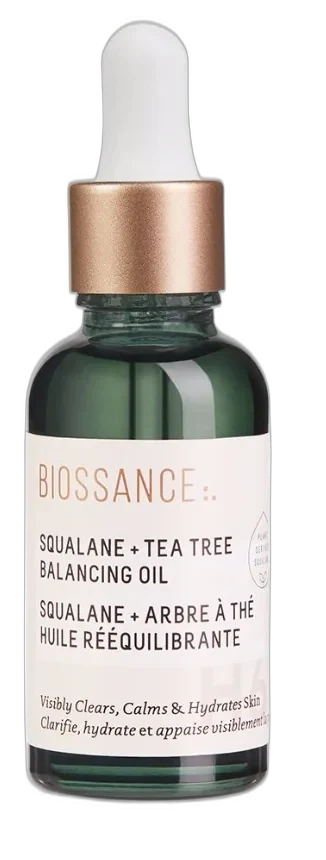
Squalane + Tea Tree Balancing Oil
Clean Beauty Blemish Fighter
 Verified reviewer
Pros & cons.
- +Exceptionally lightweight texture absorbs in under a minute without greasiness
- +Biotech-fermented squalane closely mimics skin's natural lipids for better tolerance
- +Tea tree and willow bark provide dual antibacterial and mild exfoliating action
- +Minimalist 13-ingredient formula with no water, emulsifiers, or preservatives needed
- +Effective at reducing surface-level blemishes within 1-3 days for most users
- +Silicone-free, paraben-free, and cruelty-free with Leaping Bunny certification
- +Can be used as a full-face treatment or as a targeted spot treatment
- −Contains lavender oil, limonene, and linalool — potential irritants and allergens
- −Now discontinued and only available through secondary resale markets
- −Tea tree and herbal scent is polarizing and may be too strong for some
- −Premium pricing relative to the simplicity of the ingredient list
- −Not suitable for sensitive skin or compromised barrier conditions
The full review.
There is a particular kind of skincare courage required to slather oil on a face that already looks like it lost a fight with a glazed donut. Biossance understood this, and the Squalane + Tea Tree Balancing Oil was their argument that oil-phobic, acne-prone consumers had been thinking about it wrong. Born in the labs of Amyris — a biotech company whose scientists originally developed their sugarcane fermentation technology to produce affordable antimalarial drugs — Biossance took that same innovation and pivoted it toward vanity. The result was a brand built entirely around one ingredient: plant-derived squalane.
The Tea Tree Balancing Oil is one of the purest expressions of that philosophy. The ingredient list reads like a minimalist manifesto: thirteen ingredients total, led by squalane and supported by tea tree, willow bark, sunflower, and a handful of botanical extracts. There is no water, no emulsifiers, no preservatives needed. It is, at its core, a delivery system — squalane carrying tea tree oil and willow bark extract directly to troubled skin in a format that speaks the skin’s own biochemical language.
Squalane is structurally identical to squalene, a lipid your skin produces naturally as part of its sebum. The theory, backed by reasonable evidence, is that providing skin with a familiar lipid can help regulate its own oil production rather than triggering the overcompensation that heavier oils or stripping cleansers cause. For people with oily, acne-prone skin who have been conditioned to fear anything with the word “oil” on the label, this is a meaningful distinction.
The tea tree oil component does the heavy lifting on the antibacterial front. Melaleuca alternifolia has decades of research supporting its efficacy against Cutibacterium acnes, the bacterium most associated with inflammatory acne. A landmark 1990 study in the Medical Journal of Australia found that 5% tea tree oil was comparable to 5% benzoyl peroxide in reducing acne lesions, though it acted more slowly. This formula does not disclose its tea tree concentration, but the oil’s position as the fifth ingredient suggests a meaningful but moderate amount — enough to be therapeutically relevant without overwhelming the squalane base.
Willow bark extract adds a layer of gentle exfoliation. Salix alba contains salicin, which the skin converts into salicylic acid upon contact. It is not the same as applying a dedicated BHA product — the conversion is slower and the concentration lower — but within this formula, it contributes a mild pore-clearing action that complements the tea tree’s antibacterial work. Think of it as a supporting actor doing excellent character work rather than a lead.
The texture is where this product wins converts. It applies like water — thin, immediately absorbing, leaving behind a satin finish rather than the slick, sit-on-top-of-skin feeling that makes many face oils unwearable for oily types. Two to three drops spread easily across the entire face and neck. Within 60 seconds, it has disappeared into the skin. If you did not apply it yourself, you would not know it was there. This is not the experience most people associate with face oils, and it is the primary reason the product built its following.
The limitations are real and worth noting. Lavender oil is in the formula, and while it contributes to the pleasant herbal scent, it is a known sensitizer. Limonene and linalool — fragrance components from the essential oils — appear at the end of the ingredient list and are required allergen disclosures in many markets. For truly sensitive skin, or for anyone following a strict fragrance-free protocol, these inclusions are disqualifying. It is a strange tension in a product that otherwise takes a clean, minimal approach to formulation.
The herbal scent itself is a love-it-or-leave-it proposition. Tea tree is assertive. Lavender adds a floral sweetness. Together they create something that smells distinctly like a wellness ritual, which some users adore and others find overpowering, even if it fades within minutes. If you have strong scent preferences, this is worth sampling before committing.
Performance-wise, users consistently reported visible blemish reduction within one to three days, with overall skin balance improving over two to four weeks. The oil appeared to work best for mild to moderate breakouts — surface-level blemishes, occasional hormonal flare-ups, congestion. Severe cystic acne is beyond what a topical oil of this simplicity can address, and the product never claimed otherwise.
The elephant in the room: this product has been discontinued. Biossance quietly removed it from their lineup, and it is no longer available on the official website or at Sephora. Remaining stock circulates on resale platforms at variable markups. This review exists to document what it was and how it performed for those who used it and those who are encountering it secondhand.
Value is difficult to assess for a discontinued product. At its original price point — premium for one ounce of oil — it was a tough sell for budget-conscious consumers, especially given the simple ingredient list. You were paying for the biotech squalane sourcing and the Sephora shelf placement more than for formulation complexity. Whether that was worthwhile depended on how much you valued the specific texture and delivery format, which genuinely had few competitors in the clean beauty space.
For what it was, the Squalane + Tea Tree Balancing Oil did something uncommon: it made a compelling case that face oils belong in acne-prone routines. The execution was thoughtful, the ingredient selection purposeful, and the texture nearly flawless for its target audience. Its departure from the market leaves a small but distinct gap that Biossance’s remaining lineup does not quite fill.
About BrandName
About Biossance
Texture
The texture is where this product wins converts. It applies like water — thin, immediately absorbing, leaving behind a satin finish rather than the slick, sit-on-top-of-skin feeling that makes many face oils unwearable for oily types. Two to three drops spread easily across the entire face and neck. Within 60 seconds, it has disappeared into the skin. If you did not apply it yourself, you would not know it was there. This is not the experience most people associate with face oils, and it is the primary reason the product built its following.
Scent
The herbal scent itself is a love-it-or-leave-it proposition. Tea tree is assertive. Lavender adds a floral sweetness. Together they create something that smells distinctly like a wellness ritual, which some users adore and others find overpowering, even if it fades within minutes. If you have strong scent preferences, this is worth sampling before committing.
Best for
Performance-wise, users consistently reported visible blemish reduction within one to three days, with overall skin balance improving over two to four weeks. The oil appeared to work best for mild to moderate breakouts — surface-level blemishes, occasional hormonal flare-ups, congestion. Severe cystic acne is beyond what a topical oil of this simplicity can address, and the product never claimed otherwise.
Common Complaints
The limitations are real and worth noting. Lavender oil is in the formula, and while it contributes to the pleasant herbal scent, it is a known sensitizer. Limonene and linalool — fragrance components from the essential oils — appear at the end of the ingredient list and are required allergen disclosures in many markets. For truly sensitive skin, or for anyone following a strict fragrance-free protocol, these inclusions are disqualifying. It is a strange tension in a product that otherwise takes a clean, minimal approach to formulation.
Not ideal for
For truly sensitive skin, or for anyone following a strict fragrance-free protocol, these inclusions are disqualifying.
Ingredient analysis.
Full INCI list
Squalane, C13-15 Alkane, Caprylic/Capric Triglyceride, Oryza Sativa (Rice) Bran Extract, Melaleuca Alternifolia (Tea Tree) Leaf Oil, Salix Alba (Willow) Bark Extract, Helianthus Annuus (Sunflower) Seed Extract, Helianthus Annuus (Sunflower) Seed Oil, Physalis Angulata Extract, Lavandula Angustifolia (Lavender) Oil, Rosmarinus Officinalis (Rosemary) Leaf Extract, Tocopherol, Limonene, Linalool
Skin match.
The science.
The Science
This formula uses two researched pillars: squalane as a biomimetic delivery vehicle and tea tree oil as an antimicrobial agent. Squalane is the hydrogenated, shelf-stable form of squalene—a triterpene that makes up roughly 12% of human sebum. Its structure integrates into the skin's lipid matrix without disrupting barrier function. This makes it an ideal carrier for active botanicals in acne-prone skin that cannot tolerate heavier occlusives.
Tea tree oil's antimicrobial properties are among the most studied in botanical dermatology. A randomized, double-blind, placebo-controlled study in the Indian Journal of Dermatology, Venereology and Leprology (2007) found that 5% tea tree oil gel significantly reduced total acne lesion count and acne severity index compared to placebo in patients with mild to moderate acne. A 1990 comparative study in the Medical Journal of Australia by Bassett, Pannowitz, and Barnetson showed that 5% tea tree oil works as effectively as 5% benzoyl peroxide to reduce inflamed lesions, but with a slower onset and fewer side effects like scaling, dryness, and irritation.
Willow bark extract acts as a gentler analog to salicylic acid. Salix alba bark contains salicin, which converts enzymatically to salicylic acid on the skin surface. The exfoliating potency is lower than pharmaceutical-grade BHA, but the gradual release mechanism may be better tolerated in an oil-based formula on compromised acne-prone skin. Combining tea tree's antibacterial action with willow bark's mild keratolytic effect creates a dual-action approach to acne management—addressing both bacterial proliferation and the follicular hyperkeratinization that traps bacteria.
References
- The efficacy of 5% topical tea tree oil gel in mild to moderate acne vulgaris: a randomized, double-blind placebo-controlled study — Indian Journal of Dermatology, Venereology and Leprology (2007)
- A comparative study of tea-tree oil versus benzoylperoxide in the treatment of acne — Medical Journal of Australia (1990)
Dermatologist Perspective
Dermatologists recognize tea tree oil as a reasonable adjunctive treatment for mild acne, though they rarely recommend it first. Board-certified dermatologists note the squalane base in this formula is a smart choice for acne-prone skin—it is non-comedogenic and helps maintain barrier integrity, which often breaks down in patients who overuse stripping acne treatments. However, dermatologists caution that the lavender oil and fragrance components make this unsuitable for patients with contact dermatitis history or highly reactive skin. For patients seeking a natural-leaning approach to mild breakouts who tolerate essential oils, this formula is a reasonable option. Dermatologists typically recommend it to complement, rather than replace, established acne treatments like benzoyl peroxide or retinoids.
Where it fits in your routine.
Apply 2-3 drops to clean skin after your evening routine. Warm the oil between fingertips, then press it into the face and neck. You can layer it over serums and lightweight moisturizers. For targeted treatment, apply one drop directly to emerging blemishes. Avoid the eye area. Use nightly. If using for the first time, start every other night to test tolerance to the tea tree and essential oil components.
At its original retail price, this was a premium product for a simple oil blend. Biotech-sourced squalane and Sephora Clean certification raised the cost, but thirteen ingredients in a one-ounce bottle means high price per active. Biossance fans who valued the brand's sustainability and the irreplaceable texture found the cost justifiable. Results-focused consumers could find comparable antibacterial and squalane-based formulations for less. Since the product is discontinued, resale prices vary wildly and rarely offer good value.
Oily and combination skin types with mild to moderate breakouts want a lightweight, clean-formulated treatment oil. This works for users who tolerate tea tree and essential oils and seek an oil-based approach to blemish control.
This works for sensitive skin, rosacea, eczema, or a compromised skin barrier. Avoid this product if you have known allergies to tea tree, lavender, limonene, or linalool. It is also impractical for anyone unwilling to buy a discontinued product from secondary markets.
Product details.
Tea tree and lavender essential oils create a noticeable herbal scent. This scent fades within minutes of application.
Frosted glass bottle with a dropper applicator. The clean, minimalist design matches Biossance's branding. Finish lightweightnon-greasysatin
The oil feels light on first application and absorbs within 30-60 seconds. The tea tree and lavender scent is noticeable but fades fast. Some users see reduced redness on active blemishes overnight. Most users need no adjustment period, but tea tree sensitivity may cause mild tingling.
2-3 months with nightly use of 2-3 drops
12 months
All Year
The backstory.
Born from Amyris's biotech lab, Biossance built its entire brand identity around sugarcane-derived squalane. This oil was their answer to the question oily-skinned consumers kept asking: can an oil actually help my breakouts? It paired their signature squalane with tea tree and willow bark to create a treatment oil for the acne-prone crowd that traditional face oils had ignored.
About Biossance
Established Brand (5–20 years)Biossance launched in 2016 as a skincare offshoot of Amyris, a biotechnology company that uses sugarcane fermentation to engineer plant-derived squalane. The brand has credibility from its patented biotech ingredient sourcing, but specific formulations have less independent clinical validation than legacy derm-developed brands.
Common myths.
Applying oil to oily, acne-prone skin causes more breakouts.
Squalane is non-comedogenic and mimics skin's natural sebum. Providing oily skin with lightweight lipids can reduce sebum overproduction. This formula avoids heavy comedogenic oils.
Tea tree oil works on acne only at full strength.
Research shows 5% tea tree oil concentrations work against acne. Undiluted tea tree oil increases irritation risk without adding benefit. This formula uses a skin-compatible squalane base to deliver tea tree for sustained, gentle activity.
FAQ.
Is the Biossance Squalane + Tea Tree Balancing Oil discontinued?
Yes, Biossance discontinued this product. You cannot find it on the official Biossance website or at Sephora. Secondary marketplaces have some remaining stock, but availability is limited and declining.
Can I use this oil if I have oily skin?
This oil targets oily and combination skin. The sugarcane-derived squalane base is lightweight and non-comedogenic, while tea tree and willow bark extracts address excess oil and blemishes. Many oily-skinned users report it balances sebum production instead of adding to it.
Does the Biossance Tea Tree Balancing Oil help with acne?
The formula combines tea tree oil, which has antibacterial properties against acne-causing bacteria, with willow bark extract, a natural salicylic acid precursor. Users report visible blemish reduction within 1-3 days. It works best for mild to moderate breakouts, not severe cystic acne.
Is this product safe for sensitive skin?
This product contains tea tree oil, lavender oil, limonene, and linalool, which are known potential irritants and allergens. Avoid this for sensitive skin, rosacea-prone skin, or a compromised skin barrier. Patch testing is advised.
When should I apply this oil in my routine?
Apply 2-3 drops after serums and moisturizer as your final evening skincare step. The oil acts as a lightweight seal. Mix one drop into your moisturizer or use it as a targeted spot treatment on emerging blemishes.
What makes Biossance's squalane different from other squalane oils?
Biossance's squalane comes from sugarcane via a proprietary fermentation process from biotech company Amyris. This method produces a highly pure, sustainable squalane that mimics natural skin lipids better than squalane from olives or sharks.
Can I use this oil with retinol?
Yes, you can layer squalane-based oils over retinol products to buffer irritation. But the tea tree and willow bark in this formula add mild exfoliating and antibacterial activity. Watch for signs of over-exfoliation if you combine this with strong retinoids.
What the community says.
"Lightweight and non-greasy for an oil"
"Visibly reduces blemishes quickly"
"Absorbs fast without leaving residue"
"Helps balance oily skin without stripping"
"Lavender scent too strong for some users"
"Pricey for the amount of product"
"Now discontinued and hard to find"
"Tea tree scent not universally loved"
People also looked at.