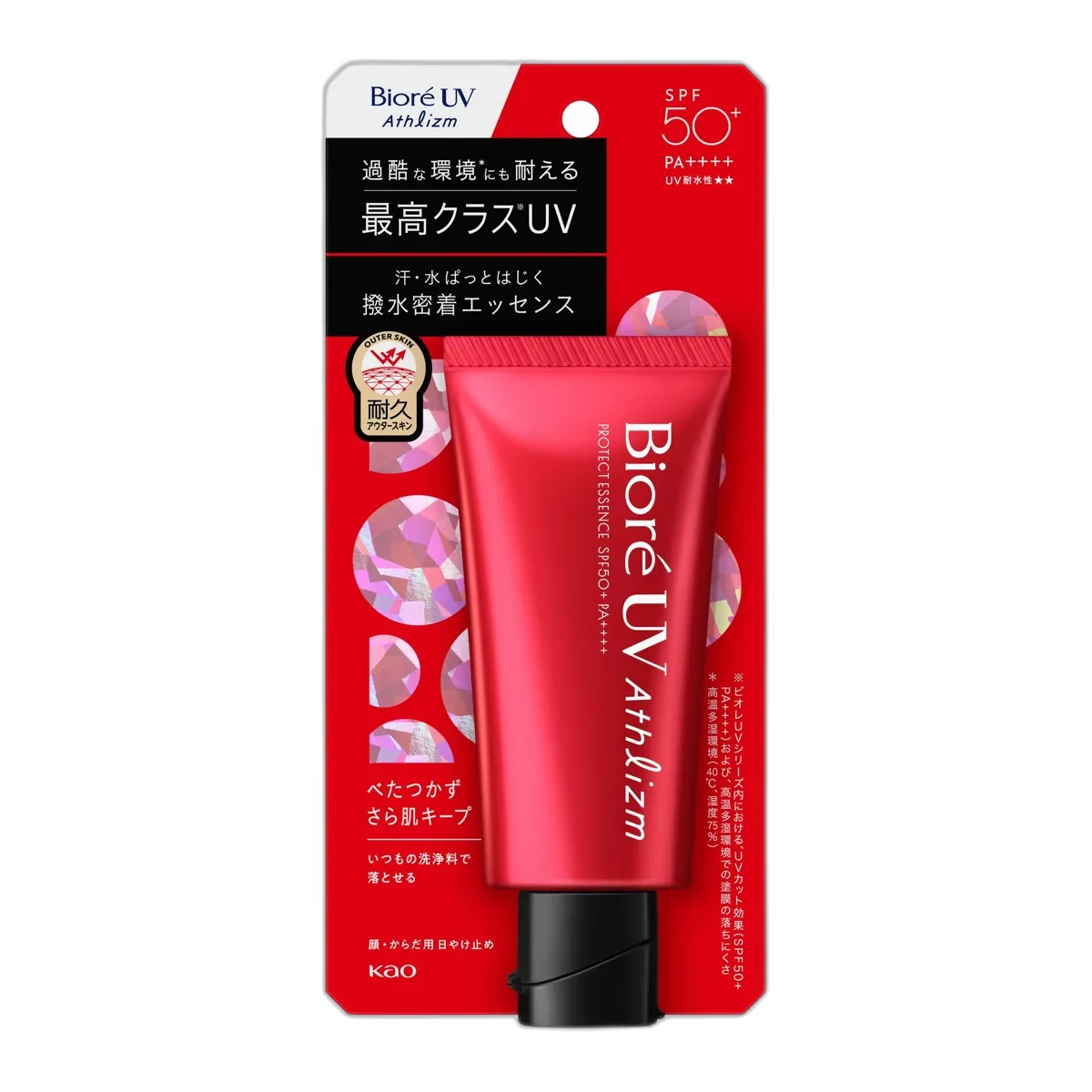
UV Athlizm Skin Protect Essence SPF 50+
J-Beauty Sport Sunscreen MVP
 Verified reviewer
Pros & cons.
- +Elite European filter system (Tinosorb S, Uvinul T 150, Uvinul A Plus)
- +Genuine waterproof and sweat-resistant performance in sport use
- +Velvety-matte finish with zero white cast on all skin tones
- +Washes off with regular soap — no double-cleanse required
- +Comfortable under makeup and sport gear
- +SPF 50+ PA++++ — highest UVA rating on the Japanese scale
- +Non-comedogenic tested and broadly oily-skin friendly
- −Alcohol as second ingredient can irritate sensitive barriers
- −Fragrance included — not for fragrance-reactive users
- −Not available at US drugstores; requires import
- −Price premium over the daily-wear Aqua Rich line
- −Contains royal jelly — not for bee-product allergies
The full review.
Japanese running and marathon culture shows a specific sunscreen obsession that lacks a US equivalent. Japanese runners avoid sunburn, white cast, oily residue, and the sticky film found in US sport sunscreens. Finding high UV protection, sweat and water resistance, and cosmetic elegance is hard in a US drugstore because the FDA has not approved the European filter generation required. Bioré launched the UV Athlizm line in 2020 for this niche: Japanese athletes needing a sunscreen for four hours of a marathon in August. Its popularity among outdoor enthusiasts, cyclists, and sport dermatology communities worldwide follows how well it solves that original problem.
The filter system defines this product. The three headline actives — Tinosorb S, Ethylhexyl Triazone (Uvinul T 150), and Uvinul A Plus — are among the best-studied and most photostable next-generation UV filters globally. Tinosorb S is a broad-spectrum workhorse with peak absorption around 310nm and 345nm that also stabilizes other filters on skin. Ethylhexyl Triazone is a highly efficient UVB filter with high molar extinction, allowing a formula to reach SPF 50+ without the thick, photo-heavy base US sunscreens often use for SPF 50. Uvinul A Plus is a highly photostable long-wave UVA filter peaking around 354nm — the part of the UV spectrum responsible for long-term photoaging and deep pigmentation that older US-approved avobenzone struggles to cover without degrading. These three, plus the Athlizm formula’s film-forming backbone, deliver the full Japanese PA++++ rating — the highest on the persistent pigment darkening scale — in a texture like a runny essence.
The film-forming backbone is the second half of the story. Bioré calls it ‘Tough Boost technology,’ which uses a lauryl methacrylate crosspolymer film system to create a flexible, water-repellent surface layer on skin. This distinguishes Athlizm from the daily-wear Aqua Rich formula. While Aqua Rich sits invisibly under a normal workday, Athlizm holds up when a sweaty T-shirt drags across your forehead, when you move sunglasses, or when you wipe your face with a towel at a water station. It holds. Swim testing and outdoor reviews show the protection survives conditions that peel off typical chemical sunscreens. Bioré engineered the film to wash off with regular soap; you do not need an oil cleanser or a double-cleanse to remove it, which matters to runners after a long day.
The formula feels comfortable for a technical product. It spreads like a slightly runny lotion. A brief cool, alcohol-tinged note fades within thirty seconds as volatiles flash off, leaving a velvety, almost imperceptible matte finish. It has no white cast on tested skin tones, no pilling, and no sticky residue. It works under makeup after drying for a couple of minutes and pairs with sports sunglasses and moisture-wicking gear. One caveat: alcohol is the second ingredient. It enables rapid dry-down, uniform film formation, and reduced stickiness, but it is a concern for anyone with eczema, rosacea, or a compromised barrier. Reactive skin should patch-test carefully or use Bioré’s non-alcohol UV formulas. Accessibility is another caveat: because the key filters are not FDA-approved, you cannot buy this at a US drugstore. You must order from importers, Japanese beauty retailers, or Amazon third-party sellers. The price is closer to $15-20 per tube rather than the $7-10 for Aqua Rich — a premium for the sport-specific engineering.
Value depends on your use case. For runners, cyclists, swimmers, or outdoor athletes, the answer is yes. Almost nothing in the US drugstore category competes with its technical performance for sport, making the import premium reasonable. For a daily-wear face sunscreen for office days and commutes, you do not need the extra film-former in the Athlizm formula; the regular Bioré UV Aqua Rich essence works for less money. Athlizm is a tool for a specific job, and for that job, it is one of the best options on the planet.
Formula
Ingredient analysis.
Full INCI list
Water, Alcohol, Ethylhexyl Methoxycinnamate, Ethylhexyl Triazone, Isopropyl Palmitate, Lauryl Methacrylate/Sodium Methacrylate Crosspolymer, Diethylamino Hydroxybenzoyl Hexyl Benzoate, Hydrogenated Polyisobutene, Ammonium Acrylates Copolymer, Bis-Ethylhexyloxyphenol Methoxyphenyl Triazine, Dextrin Palmitate, Butylene Glycol, Acrylates/C10-30 Alkyl Acrylate Crosspolymer, C12-15 Alkyl Benzoate, Glycerin, Propanediol, Potassium Hydroxide, Glyceryl Behenate, Hydroxyethylcellulose, Vinyl Dimethicone/Methicone Silsesquioxane Crosspolymer, Pullulan, Cetyl Alcohol, Sorbitan Distearate, Stearoyl Glutamic Acid, Arginine, Disodium EDTA, BHT, Royal Jelly Extract, Sodium Hyaluronate, Phenoxyethanol, Fragrance
Skin match.
The science.
The Science
This sunscreen's science relies on its filter system, which uses the best-characterized photostable UV actives in cosmetic chemistry. Bis-Ethylhexyloxyphenol Methoxyphenyl Triazine — marketed as Tinosorb S — has undergone extensive study since its EU approval in the early 2000s; its absorption spectrum peaks at roughly 310nm and 345nm, covering UVB and UVA with high molar extinction, and it photostabilizes other filters in combination products. Ethylhexyl Triazone (Uvinul T 150) is a high-efficiency UVB filter with absorption peaking around 314nm; a comparative review of UV filters in Photochemical & Photobiological Sciences (2018) documented how it enables high-SPF formulations with reduced total filter load. Diethylamino Hydroxybenzoyl Hexyl Benzoate (Uvinul A Plus) is a long-wave UVA filter with a peak near 354nm. It is more photostable than avobenzone, which helps formulas maintain UVA protection during extended sun exposure.
The 'Tough Boost' waterproofing uses established film-forming polymer chemistry. Lauryl methacrylate/sodium methacrylate crosspolymer and similar acrylate film-formers create water-repellent films that keep UV filters on skin during sweating and water exposure. Their use in sport sunscreens meets water-resistance testing for the Japanese PA rating system and the US FDA 'water resistant 80 minutes' standard.
Japan's PA rating system (Persistent Pigment Darkening) uses a four-tier scale from PA+ to PA++++, where PA++++ indicates the highest measured UVA protection. This system is more rigorous and UVA-specific than older US labeling, and research shows UVA exposure is the main driver of long-term photoaging and deep pigmentation.
References
- Sunscreens: An overview and update — Journal of Clinical and Aesthetic Dermatology (2017)
Dermatologist Perspective
Dermatologists who follow international sun-care literature view the next-generation European filters in this product — Tinosorb S, Ethylhexyl Triazone, and Uvinul A Plus — as some of the most effective and photostable UV actives globally. Board-certified dermatologists often recommend Japanese and European sunscreens for sport use because the FDA-approved US filter list has not updated in decades and lacks some of the best international UVA coverage. For athletic use, dermatologists favor formulations like this one that combine high-efficiency filters with water-resistance technology. They note that alcohol-forward sport sunscreens are generally well-tolerated by non-reactive skin because the alcohol evaporates rapidly and serves a functional rather than drying role. Clinicians still caution rosacea-prone or compromised-barrier patients to choose a non-alcohol alternative.
Guidance
Where it fits in your routine.
Shake the tube gently before use. Apply at least a quarter-teaspoon to the face alone. Use it on completely dry skin as the last step of your morning routine, once moisturizer has fully absorbed. Let it dry for 2-3 minutes before applying makeup or going outside. Reapply every 2 hours during active sun exposure or after heavy sweating, swimming, or towel drying. Wash it off at the end of the day with a normal face cleanser or gentle soap; no special remover is needed. Carry the tube for mid-day top-ups during long outdoor days.
Importing a 70g tube costs roughly $15-20. This sunscreen costs more than Bioré Aqua Rich, but stays reasonable against American prestige sport sunscreens that cost $30-40 for similar sizes and use inferior filter technology. For athletes using this product for long runs, cycling, swimming, or outdoor training, the per-use cost is low compared to the UV protection provided, making the value excellent. Casual daily users do not need sport-specific performance, so the price premium over Aqua Rich is not justified; they pay for technical features they won't use. The Bioré brand and FDA-level Japanese regulatory oversight of the UV filter system justify the price.
Runners, cyclists, swimmers, and outdoor athletes need high-SPF protection that resists sweat and water. Oily and combination skin types prefer a matte finish. Japanese-beauty enthusiasts can import products outside the US regulatory system.
Sensitive, eczema-prone, or rosacea-prone skin that reacts to alcohol-heavy formulas. Fragrance-sensitive users. People who want a simple daily-wear face sunscreen without sport-specific technical features — the lighter Aqua Rich line is a better, cheaper fit.
Product details.
All Year Certifications SPF 50+ PA++++Non-comedogenic tested
The backstory.
Bioré launched the UV Athlizm line in 2020 as a sport-focused extension of its massively popular Aqua Rich franchise, targeting runners, cyclists, and outdoor enthusiasts who needed real waterproof performance without sacrificing the Japanese market's high standards for sunscreen elegance. The 'Tough Boost' technology and Athlizm positioning were direct responses to the growing Japanese marathon and outdoor recreation communities.
About Biore
Legacy Brand (20+ years)Bioré is a Kao Corporation brand founded in Japan in 1980. It is a top name in Japanese sun care. Its UV franchise — including the Aqua Rich and Athlizm lines — uses latest-generation European filters (Tinosorb S, Uvinul T 150) and appears often in Japanese beauty and sport dermatology literature.
Common myths.
Japanese SPF 50+ PA++++ is the same as US SPF 50 sunscreen.
Japanese sunscreens like this one use next-generation European filters (Tinosorb S, Uvinul T 150, Uvinul A Plus) that the FDA has not approved for US sale. The UVA protection in PA++++ products is meaningfully broader and more photostable than most US chemical sunscreens.
You cannot remove waterproof sunscreens without special cleansers.
Bioré engineered this formula to wash off with normal soap or gentle cleanser. It stays water-resistant during wear, so sport users skip double-cleansing after workouts.
FAQ.
How is Athlizm different from Bioré's Aqua Rich line?
Aqua Rich is optimized for daily wear — ultra-lightweight, fast-absorbing, designed to layer under makeup. Athlizm is optimized for sport — heavier on film-formers, more aggressive water and sweat resistance, and a tougher 'Tough Boost' surface film that holds up under abrasion from clothing or equipment. Athlizm is what you want for running, swimming, or cycling; Aqua Rich is what you want for an office day.
Does it really stay on during swimming?
Yes — the lauryl methacrylate crosspolymer film-former creates a water-repellent surface that lasts through extended water exposure better than most chemical sunscreens. All sport sunscreens require reapplication every two hours of active exposure, and you must reapply after heavy towel-drying.
Can I use it on my face under makeup?
Yes, and it performs well under makeup once fully dry. The finish is velvety-matte, not dewy, so it works better with powder-based or long-wear liquid foundations than with glowy or dewy formulas. Let it set for 2-3 minutes before applying anything on top.
Is the alcohol content a problem?
Alcohol is the second ingredient. This is a red flag for very sensitive, eczema-prone, or compromised-barrier skin. For most normal to oily skin users, the alcohol helps the formula apply thinly and dry quickly without damaging the barrier. If you are reactive, use Bioré's non-alcohol formulas instead.
How does it remove?
Most waterproof sport sunscreens require special removal, but this one washes off with regular soap or a standard face cleanser. You do not strictly need an oil cleanser or double-cleanse, though a gentle oil cleanser cleans most thoroughly after a sweaty day.
Is it available in the US?
Major US drugstores do not carry it. Buy it from Japanese beauty importers, Amazon third-party sellers, or shops like YesStyle and Stylevana. It lacks FDA approval for its filters, so CVS and Target do not stock it.
Is it good for oily, acne-prone skin?
It works well for oily skin. The matte film resists heat and sebum, and Bioré markets the formula as non-comedogenic tested. However, isopropyl palmitate and cetyl alcohol have moderate comedogenic ratings, so breakout-prone users should patch test. ---
What the community says.
"Holds up through heavy sweat and water"
"Completely invisible finish with no white cast"
"Comfortable under makeup and outdoor gear"
"Washes off easily with regular cleanser"
"Alcohol scent is noticeable on application"
"Not available at US drugstores — must be imported"
"Contains fragrance"
"Price is higher than Aqua Rich line"
People also looked at.