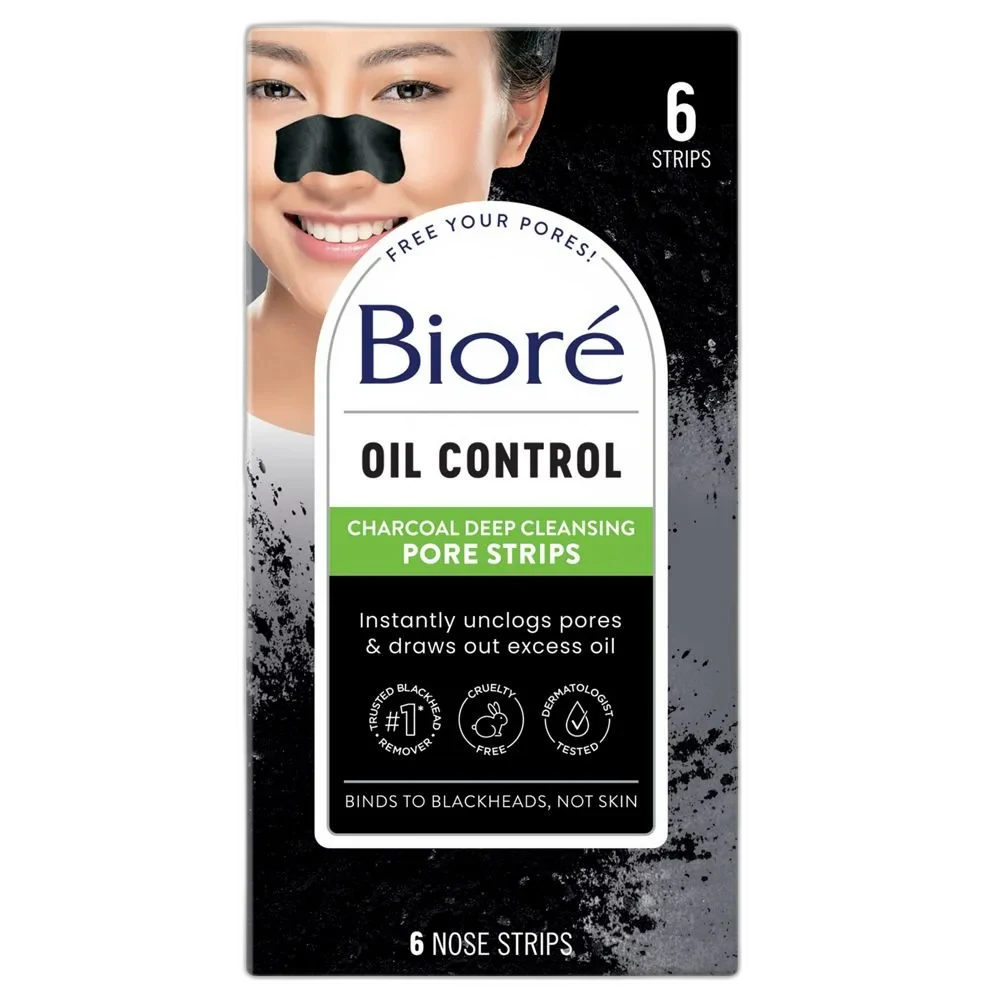
Deep Charcoal Pore Strips
Drugstore Pore Strip OG
 Verified reviewer
Pros & cons.
- +Visibly extracts blackheads and sebaceous filaments in a single 10-minute session
- +Patented C-Bond Technology provides electrostatic bonding that targets debris over skin
- +Fragrance-free formulation reduces unnecessary irritation risk on sensitive nasal skin
- +Cooling menthol sensation provides a satisfying sensory experience during wear
- +Affordable at roughly $1.33 per strip for accessible at-home pore maintenance
- +Cruelty-free and vegan-certified for ethically conscious consumers
- +Minimal ingredient list with no unnecessary filler compounds or fragrances
- −Results are strictly temporary — blackheads return within one to two weeks
- −Charcoal powder can leave dark residue requiring a second cleanse after removal
- −Adhesive can cause irritation, redness, or micro-tears on sensitive skin types
- −Only designed for the nose — does not address blackheads on chin or forehead
- −Contains methylparaben, which some consumers prefer to avoid in skincare products
The full review.
Pore strips offer a specific satisfaction. You press one onto a wet nose, wait ten minutes as it hardens into a rigid bridge, and peel it away to see extracted plugs on the adhesive. It is gross and gratifying. Bioré has sold this experience since the mid-1990s, when the Japanese brand created the at-home pore strip category.
The Deep Cleansing Charcoal Pore Strips update the original formula with activated charcoal powder from the 2016 charcoal beauty boom. The packaging says charcoal draws out dirt and oil, while C-Bond Technology—a positively charged polymer that electrostatically attracts negatively charged gunk—handles the extraction. It sounds like a science experiment, but it feels like putting tape on your nose.
The ingredient list is short. Polyquaternium-37 acts as the adhesive backbone to do the bonding. Silica adds structural rigidity so the strip holds its shape while drying. Glycerin prevents the skin from drying out. Menthol provides a tingly coolness. Charcoal powder adds black color and, theoretically, oil-absorbing properties.
Clinical evidence for topical activated charcoal is limited. Charcoal is an excellent adsorbent in medical contexts, like emergency room poisonings, but the amount on a pore strip sitting on the skin for ten minutes won’t meaningfully draw impurities from deep within pores. The work is mechanical. The adhesive bonds to oxidized sebum plugs (blackheads) and the top layer of sebaceous filaments at the pore opening; they come off during the peel.
They do peel. The extraction works for surface-level blackheads on the nose. After removal, pores look cleaner, skin feels smoother, and the strip shows visual proof. For oily or combination skin types with persistent nose blackheads, the gratification is immediate.
The texture experience is simple. Wet your nose thoroughly—a dry strip won’t adhere and will peel in fragments—press the strip firmly across the nose bridge, and wait ten minutes. The strip turns from flexible and damp to rigid and dry, molding to your nasal contours. Pull from the edges inward during removal. Ripping it off fast risks irritation. Menthol feels cool, though sensitive skin may feel a sting.
Charcoal can leave dark residue on the skin if the strip tears or the nose is too wet. It washes off easily, but you may need to re-cleanse your nose after use.
The main limitation is inherent to all pore strips: results are temporary. Sebum production is continuous, and pores refill within days. The strip doesn’t change pore size, alter oil production, or prevent new blackheads. It is a maintenance tool, like mowing a lawn that grows back. It is not a permanent fix. It works as a quick cosmetic reset, a weekend ritual, or a complement to a BHA routine.
The fragrance-free formulation is a positive for a mass-market product. Many competitors use artificial fragrances that add nothing and risk irritation. Bioré keeps it simple; menthol provides sensory feedback without extra fragrance compounds.
At $7.99 for six strips, each use costs about $1.33—less than a cup of coffee and much less than a professional extraction. The 18-count box has better per-strip value. For temporary mechanical blackhead removal, the price is fair.
This is not a sophisticated treatment. It lacks actives to retrain skin, won’t reduce oil production, and the charcoal is more marketing than a functional powerhouse. But Bioré didn’t promise that. Over thirty years ago, the brand promised a fast, visible, drugstore-priced way to clean pores at home. The charcoal variant delivers exactly that, with the proof stuck on the strip.
Formula
PM routine
Ingredient analysis.
Full INCI list
Polyquaternium-37, Silica, Water, Glycerin, Polysilicone-13, Iron Oxides, PEG-12 Dimethicone, Menthol, Charcoal Powder, Styrene/Stearyl Methacrylate Crosspolymer, Methylparaben
Skin match.
The science.
The Science
The core technology behind Bioré pore strips is the C-Bond adhesive system, built on Polyquaternium-37 — a cationic (positively charged) polymer. The principle is straightforward electrochemistry: sebum, dead skin cells, and the oxidized lipid plugs that constitute blackheads carry a net negative charge. When the strip is wetted and applied, the positively charged polymer creates an electrostatic attraction that preferentially bonds to this negatively charged debris rather than to the skin surface itself.
Activated charcoal's role in this formulation is more modest than marketing suggests. Charcoal is a well-documented adsorbent — its highly porous microstructure gives it an enormous surface area relative to its mass, allowing it to trap organic molecules. In medical settings, activated charcoal is used orally for certain types of poisoning. However, topical applications for skin are far less studied. The contact time (approximately 10 minutes) and the quantity present on a single strip limit how much adsorption can realistically occur at the skin surface.
A broader question in dermatology is whether mechanical extraction via pore strips constitutes effective blackhead management. Dermatological consensus holds that pore strips provide temporary cosmetic improvement by physically removing the superficial portion of comedonal plugs. However, they do not address the underlying factors driving blackhead formation: excess sebum production, abnormal keratinocyte desquamation within the follicular canal, and the oxidation of lipids at the pore opening. For sustained improvement, most dermatologists recommend chemical exfoliants — particularly salicylic acid (BHA), which is oil-soluble and can penetrate into the pore lining to dissolve sebum and normalize cell turnover.
The glycerin in this formulation provides a modest barrier-protective effect during application, which is relevant because the mechanical peel action inherently disrupts the stratum corneum to some degree. Studies on adhesive tape stripping — the research analog closest to pore strip use — show that repeated mechanical stripping increases transepidermal water loss (TEWL) and can impair barrier function with overuse.
Dermatologist Perspective
Dermatologists generally view pore strips as a cosmetically satisfying but clinically limited tool. Board-certified dermatologists frequently note that while strips can provide instant visual improvement, they do not treat the root cause of blackhead formation. The American Academy of Dermatology does not include pore strips in its recommended acne treatment guidelines, instead emphasizing salicylic acid, benzoyl peroxide, and retinoids as first-line approaches for comedonal acne. Dermatologists typically advise patients that pore strips are acceptable for occasional use on non-irritated skin but should not replace a consistent chemical exfoliant routine. Overuse — more than once or twice weekly — is cautioned against, as repeated adhesive removal can compromise the skin barrier and trigger reactive inflammation.
Where it fits in your routine.
Cleanse your face to remove makeup, sunscreen, and surface oil. Wet your nose well; the strip won't stick to dry skin. Peel the strip from its backing and press it onto your nose, smoothing air bubbles from the center outward. Leave it for 10-15 minutes until the strip feels stiff and dry. Slowly peel from the edges inward with gentle pulls instead of ripping. Rinse residue with lukewarm water. Use a hydrating toner or serum after. Use no more than once or twice per week. Do not use on sunburned, windburned, or broken skin, or on areas treated with retinoids or exfoliating acids within the past 24 hours.
At $7.99 for six strips (about $1.33 per application), these are among the most affordable at-home blackhead removal options. The 18-count value pack lowers the per-strip cost. Compared to professional extractions ($75-150 per facial session), the cost efficiency is clear. But because results are temporary and pore strips do not prevent new blackheads, you must buy them regularly. A $10 bottle of salicylic acid toner lasts months and treats the underlying cause — so the real value depends on whether you want instant visible results (strips win) or long-term improvement (BHA wins). Both have a place in many routines.
Oily and combination skin types with visible nose blackheads want fast, satisfying at-home extractions. It works for quick cosmetic resets before events or as a complement to a BHA-based routine.
Avoid adhesive removal if you have sensitive, dry, or eczema-prone skin. Skip this on the nose if you use prescription retinoids or strong chemical exfoliants to prevent irritation and barrier damage.
Product details.
Thin, flexible adhesive strip has a dark charcoal-infused surface that turns tacky when wet
Fragrance-free with a faint menthol coolness during application
Flat sealed pouch holds individually wrapped strips; buy in 6-count or 18-count boxes
Wet your nose, apply the strip, and wait 10 minutes for it to dry and harden. Removal pulls visibly; extracted plugs show on the strip. Expect mild redness that fades within 30 minutes. Sensitive skin types may feel stinging or tightness.
6-count box lasts 3-6 weeks with recommended 1-2x weekly use
36 months
spring summer
The backstory.
When Bioré launched pore strips in Japan in the mid-1990s, it created an entirely new product category that bridged the gap between professional facials and at-home skincare. The charcoal version arrived in 2016 during the activated charcoal beauty boom, adding the ingredient to the already established strip format. The product remains the bestselling pore strip in the United States by a wide margin.
About Biore
Legacy Brand (20+ years)Kao Corporation, a top Japanese consumer goods company, launched Bioré in 1980. The brand started the pore strip category in the 1990s. Bioré has been a mass-market skincare staple for over four decades, focusing on convenience and accessibility instead of clinical sophistication.
Common myths.
Charcoal in pore strips detoxifies skin and pulls toxins from deep within pores
Charcoal powder sits on the strip's surface and has limited pore penetration. The C-Bond adhesive technology does the actual extraction by mechanically bonding to oxidized sebum plugs at the pore opening. Charcoal adsorbs some surface oil, but the C-Bond adhesive technology does the heavy lifting.
Regular pore strip use will permanently shrink your pores
Genetics determine pore size; adhesive strips cannot permanently change them. Pore strips temporarily remove contents that make pores look larger, but sebum refills them within days. Consistent BHA or retinoid use manages long-term pore appearance better.
FAQ.
Do Biore Charcoal Pore Strips actually remove blackheads?
Yes — the strips use Bioré's C-Bond adhesive technology to mechanically extract oxidized sebum plugs (blackheads) and sebaceous filaments from pore openings. The extracted material shows on the strip after removal. Results are temporary: pores refill with sebum within 1-2 weeks, making this a maintenance tool rather than a permanent solution.
***
How often should I use Biore Charcoal Pore Strips?
Bioré recommends using the strips no more than once or twice per week. Overuse irritates the delicate skin on the nose, compromises the skin barrier, and causes micro-tears. On days you don't use strips, a BHA (salicylic acid) product keeps pores clear between applications.
***
Are Biore Charcoal Pore Strips safe for sensitive skin?
These strips are not ideal for sensitive skin. Removing the adhesive creates mechanical stress that causes redness, irritation, and micro-tears on delicate skin. The menthol also acts as an irritant. For sensitive skin, a gentle BHA exfoliant or oil-cleansing method manages blackheads more safely.
***
Why do Biore Charcoal Pore Strips leave black residue on my nose?
The charcoal powder in the strip leaves dark marks on skin, especially if the strip breaks during removal or if skin is very wet. Rinsing with warm water after removal clears the residue. Using a damp cloth before peeling also reduces charcoal transfer.
Can I use Biore Pore Strips with retinol or acids?
Do not use pore strips on the same day as retinoids, AHAs, or BHAs. These active ingredients thin the stratum corneum, which increases the risk of tearing and irritation from the adhesive strip. Use pore strips at least 24-48 hours apart from strong exfoliant or retinoid application.
***
What is the difference between Biore Charcoal and Original Pore Strips?
The charcoal variant adds activated charcoal powder to the adhesive matrix. Bioré claims this improves oil absorption. Both versions use the same base C-Bond adhesive technology. Most users report similar blackhead removal efficacy. The charcoal version absorbs slightly more oil but sometimes leaves dark residue.
***
Community
What the community says.
"Visibly pulls out blackheads and sebaceous filaments on first use"
"Satisfying to see removed debris on the strip"
"Cooling menthol sensation feels refreshing"
"Easy 10-minute at-home treatment"
"More affordable than professional extractions"
"Results are temporary — blackheads return within days"
"Can be painful to remove on sensitive skin"
"Charcoal leaves dark residue that requires re-washing"
"Doesn't work well on dry or flaky skin"
"Doesn't address root cause of blackheads"
People also looked at.