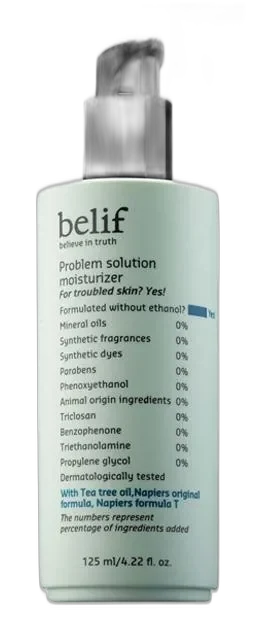
Problem Solution Moisturizer
K-Beauty Tea Tree Staple
 Verified reviewer
Pros & cons.
- +Tea tree oil at a meaningful concentration for mild acne
- +Soothing botanical blend including centella, licorice and oat
- +Glycerin and squalane keep the formula comfortably hydrating
- +Non-greasy matte finish suits oily skin well
- +Long-running product with a solid track record
- +Fragrance-free in the classic no-added-perfume sense
- +Reasonable mid-range price for a K-beauty acne moisturizer
- −Tea tree, lavender and rosemary essential oils can irritate sensitive skin
- −Not suitable for reactive, rosacea or compromised-barrier skin
- −Tea tree scent is noticeable and divisive
- −Not strong enough for moderate-to-severe acne
- −belif is not currently certified cruelty-free
The full review.
Tea tree oil occupies an unusual spot in the acne skincare conversation. On one hand it is a botanical ingredient with an Australian folk-medicine backstory and all the suspicion that usually attaches to plant-based actives in dermatology. On the other hand it is one of the very few botanicals with genuine peer-reviewed clinical evidence behind its use in mild to moderate acne — a 1990 study in the Medical Journal of Australia compared 5% tea tree oil with 5% benzoyl peroxide over three months and found comparable efficacy with significantly less irritation, and subsequent work has broadly supported that initial finding. This is the specific lineage belif is drawing on with the Problem Solution range, and it is part of why this moisturizer has quietly survived in the brand’s catalogue since around 2015 while many flashier acne-focused K-beauty launches have come and gone.
The formulation is an interesting snapshot of mid-2010s K-beauty at its more thoughtful end. Water and glycerin at the top handle hydration, a simple emulsifier system structures the cream, and tea tree leaf oil sits at the seventh INCI position — a meaningful concentration, probably around 1-2% based on where similar formulas declare percentages. Behind the tea tree comes the extended Napiers herbal blend that defines belif’s brand identity: calendula, catnip, oat kernel, raspberry leaf, chickweed, baptisia, echinacea, burdock, lavender, rosemary, soy sprout, magnolia, centella, Japanese knotweed, skullcap, licorice, green tea and chamomile, all tumbling down the middle of the INCI in roughly descending order. Most of these are present at concentrations where the individual effect is modest, but a few — Centella asiatica, oat kernel, licorice, green tea — are well studied enough to contribute meaningful soothing and mild brightening effects.
The supporting cast of squalane, panthenol and dimethicone appears further down the list, and these are the ingredients doing the unglamorous work of keeping the formula comfortable on skin. Squalane provides lightweight emollient support without the pore-clogging risk of heavier oils, panthenol adds humectant and barrier benefits, and dimethicone gives the cream the satin dry-down that lets it layer under SPF and makeup without pilling. It is a modestly sophisticated acne moisturizer, built around the idea that tea tree will deliver the antibacterial punch while the botanical and barrier-support ingredients keep the skin hydrated enough to avoid the dryness-driven rebound oiliness that plagues so many acne routines.
On skin, the tea tree is the immediate signal. Open the jar and you get a clean, medicinal herbal scent that is unmistakable but not overpowering, and as you spread the cream it sits as a medium-light emulsion that absorbs to a slightly matte finish within about a minute. The scent fades over the next few minutes, though sensitive noses will still catch a faint herbal note for a while after application. There is no tingling, no warmth, no sting for most users — the tea tree here is buffered by the rest of the formulation rather than dumped on the skin as a neat oil, and tolerability is generally good. Active breakouts tend to calm over a week or two of consistent use, and the most noticeable benefit is usually the reduction in small forehead and chin bumps that would otherwise bloom into larger spots.
What this moisturizer is not is a one-product solution for serious acne. The tea tree oil sits at a concentration where it helps with mild breakouts and keeps new ones from escalating, but it is not strong enough to clear established cystic acne, fade deep-set post-inflammatory hyperpigmentation, or replace a prescription adapalene or tretinoin routine. Users who show up expecting that level of performance tend to leave the disappointed reviews. Used as one piece of a thoughtful mild-acne routine — paired with a gentle salicylic acid cleanser, a niacinamide or azelaic acid serum, and diligent SPF — it contributes a useful middle layer that takes the edge off active breakouts and keeps the overall routine comfortable.
The limitations are structural and mostly about fit. Essential oils in general — and tea tree, lavender and rosemary specifically — are well-documented contact allergens for a minority of users, and anyone with a history of reactive skin, rosacea, compromised barrier, or eczema should be cautious. This is not the moisturizer for very sensitive skin, and dermatologists who work with reactive patients typically recommend fragrance-free acne moisturizers instead. It is also not fungal-acne safe — the plant oils and emollient esters can feed Malassezia — so anyone with that specific condition should look at different formulations. And while the soothing botanical blend is a genuinely nice addition, at the concentrations present these ingredients are supporting rather than starring, and shoppers expecting a transformative Centella or licorice effect should calibrate their expectations accordingly.
Value sits in the reasonable mid-range. At $30 for 75ml, this is priced in the middle of the Sephora K-beauty aisle — not a budget option, not a luxury one. The 75ml size is generous for the category and gives a good three months of twice-daily use. On a pure per-ingredient-dollar basis, cheaper drugstore acne moisturizers with salicylic acid or benzoyl peroxide can deliver more aggressive acne effects. What belif is charging for is the specific tea-tree-plus-botanicals formulation philosophy, the brand’s Napiers heritage, and the slightly elevated sensory experience of a K-beauty cream. For shoppers who specifically want a gentler, botanical-forward alternative to pharmacy acne creams, that trade-off is defensible.
Where Problem Solution really fits best is as a daily moisturizer for someone whose acne is mild, whose skin is oily-to-combination, and who likes the K-beauty approach to skincare enough to pay a small premium for the experience. It is not the most exciting product belif makes, and the category has moved on in some directions since this product launched — there are now K-beauty acne moisturizers using centella and mugwort as starring ingredients at similar price points, and the mainstream Western market has adopted azelaic acid and low-dose retinoids in ways that make tea tree oil feel slightly old-fashioned. But within its specific lane it still performs honestly and has the long track record to back its claims.
Ingredient analysis.
Full INCI list
Water, Glycerin, Glyceryl Stearate, Cetyl Ethylhexanoate, 1,2-Hexanediol, PEG-40 Stearate, Melaleuca Alternifolia (Tea Tree) Leaf Oil, Calendula Officinalis Flower Extract, Nepeta Cataria Extract, Avena Sativa (Oat) Kernel Extract, Rubus Idaeus (Raspberry) Leaf Extract, Stellaria Media (Chickweed) Extract, Baptisia Tinctoria Root Extract, Echinacea Angustifolia Extract, Arctium Lappa Root Extract, Lavandula Angustifolia (Lavender) Flower Extract, Rosmarinus Officinalis (Rosemary) Leaf Extract, Glycine Soja (Soybean) Sprout Extract, Magnolia Kobus Bark Extract, Centella Asiatica Extract, Polygonum Cuspidatum Root Extract, Scutellaria Baicalensis Root Extract, Glycyrrhiza Glabra (Licorice) Root Extract, Camellia Sinensis Leaf Extract, Chamomilla Recutita (Matricaria) Flower Extract, Cetearyl Alcohol, Squalane, Triethylhexanoin, Panthenol, Dimethicone, Sorbitan Stearate, Butylene Glycol, Tromethamine, Betaine
Skin match.
The science.
The Science
Tea tree oil (Melaleuca alternifolia) has one of the better evidence bases of any botanical acne active. A landmark 1990 study published in the Medical Journal of Australia compared 5% tea tree oil gel with 5% benzoyl peroxide lotion over three months in participants with mild to moderate acne, reporting comparable reductions in inflammatory and non-inflammatory lesion counts with significantly fewer side effects in the tea tree group. A 2007 Australasian Journal of Dermatology study reinforced those findings with a placebo-controlled design. The proposed mechanism combines direct antibacterial effects against Cutibacterium acnes, anti-inflammatory activity, and a reduction in sebum-derived irritation. At the likely 1-2% concentration in a finished moisturizer, effects are more modest than in a concentrated 5% treatment but still meaningful, particularly paired with supporting ingredients.
Centella asiatica has peer-reviewed literature supporting its triterpene components — madecassoside, asiatic acid, madecassic acid — in wound healing and anti-inflammatory effects. Licorice root extract has emerging evidence for inhibiting tyrosinase activity and reducing post-inflammatory hyperpigmentation through its glabridin content. Oat kernel extract has decades of dermatological literature supporting its use in soothing reactive skin, and is an active ingredient in many medical-grade moisturizers. Green tea's polyphenols have documented antioxidant effects on skin.
The long Napiers herbal tail — chickweed, baptisia, echinacea, burdock, yarrow, violet and the rest — has considerably less peer-reviewed dermatology literature. Most of the evidence for these ingredients is in traditional herbalism or in vitro studies, and their contribution to this moisturizer is best understood as part of the brand's narrative identity rather than the clinical efficacy driver.
The glycerin, squalane and panthenol backbone is supported by well-established literature for humectant and barrier-support effects, and in an acne-focused moisturizer this matters as much as the anti-acne active — over-drying the skin is one of the most common causes of acne routine failure, and this formula is designed to avoid that trap.
References
- A comparative study of tea-tree oil versus benzoyl peroxide in the treatment of acne — Medical Journal of Australia (1990)
Dermatologist Perspective
Dermatologists generally view tea tree oil as a useful but limited option for mild acne, particularly for patients who cannot tolerate benzoyl peroxide or prefer a botanical-forward routine. Board-certified dermatologists often recommend it as part of a broader acne strategy rather than as a standalone treatment, and typically caution against expecting it to replace prescription treatments for moderate or severe cases. The supporting botanical blend in this formulation would generally be viewed favourably in the sense that Centella, oat and licorice have real evidence behind them, though dermatologists would probably point out that most of the other extracts are present at insignificant concentrations. The essential oil content would prompt most dermatologists to advise against this product for patients with rosacea, eczema-prone skin, or known contact allergies — but for robust oily-to-combination skin without fragrance sensitivity, it falls within what most would consider a reasonable over-the-counter option.
Guidance
Where it fits in your routine.
Apply to clean skin morning and night after serums and before SPF. Use a clean finger or spatula to scoop a small amount, warm it between fingertips, and press it onto the face and neck using upward strokes. Do not apply to broken or weeping breakouts, as essential oils can sting. Always follow with a broad-spectrum SPF 30 or higher in the morning; acne-prone skin is often sun-sensitised and needs photoprotection. Use with a gentle salicylic acid cleanser and a niacinamide or azelaic acid serum for best results.
At $30 for 75ml, this moisturizer sits in the mid-range K-beauty acne category. Pharmacy brands like CeraVe and La Roche-Posay offer fragrance-free acne-friendly moisturizers at lower prices with dermatology-led formulations; these offer better value based on ingredients alone. The price for belif covers the tea tree oil concentration, the Napiers botanical heritage, and the brand's sensory experience. The 75ml size lasts about three months with twice-daily use, making the daily cost reasonable. For shoppers seeking a botanical-forward acne moisturizer from an established K-beauty brand, the value is defensible.
Oily and combination skin with mild to moderate acne seeking botanical-forward drugstore acne moisturizer alternatives and who tolerate essential oils. This works for K-beauty fans wanting a daily moisturizer that also provides light acne support.
Skip this if you have sensitive, rosacea-prone, eczema-prone, or compromised-barrier skin; use a fragrance-free acne moisturizer instead. Also skip if you have moderate to severe acne requiring prescription treatment, or known contact sensitivity to tea tree, lavender or rosemary oils.
Product details.
Light-to-medium cream with a slightly matte dry-down
Distinct herbal tea tree scent, no added perfume
Jar with screw lid in belif's signature pale blue-green
The first use smells strongly of tea-tree; this herbal medicinal scent fades minutes after application. The cream spreads easily, absorbs to a slightly matte finish, and feels hydrating without being heavy. Most users feel no tingling or stinging, but essential oils cause mild warmth for sensitive skin. Active breakouts calm over 1-3 weeks of consistent use.
Approximately 3 months with twice-daily use
12 months
All Year
The backstory.
The Problem Solution range has been in belif's catalogue since roughly 2015 and represents the brand's original expression of the Napiers herbalist tradition applied to acne-prone skin. Tea tree oil is central because of its long traditional use and solid clinical track record, and the broader botanical blend — most of it drawn from the Napiers library — is positioned as a complementary calming and balancing act around that central active.
About belif
belif is a Korean skincare brand owned by LG Household & Health Care. It launched in 2010 through a licensing deal with Napiers, a 19th-century Scottish herbalist. The Problem Solution range targets oily and acne-prone skin and is one of the brand's oldest lines. belif has a strong market presence and sells widely at Sephora, but its clinical research portfolio is limited.
Common myths.
Tea tree oil is a natural, safe alternative to benzoyl peroxide.
Tea tree oil has evidence and often tolerates better than benzoyl peroxide. However, it is a recognized contact allergen for some users and irritates at higher concentrations. Natural ingredients are not automatically safer.
Effective acne-focused moisturizers feel drying.
Dehydrated skin often produces more oil in response, which worsens breakouts. A well-formulated acne moisturizer feels hydrating while its actives work; this formula does that using glycerin and squalane.
FAQ.
Is belif Problem Solution Moisturizer good for acne?
Yes, for mild to moderate acne-prone skin. The tea tree oil concentration has clinical evidence for reducing mild breakouts, and the soothing botanical blend calms active spots. It does not replace prescription treatment for severe or cystic acne.
How does it compare to belif True Cream Moisturizing Bomb?
The Moisturizing Bomb is a thick, hydrating cream for normal to dry skin without acne-focused actives. Problem Solution is a lighter matte-finish cream using tea tree oil for oily, acne-prone skin. Different products suit different needs.
Can I use this with benzoyl peroxide?
Yes, but use different steps. Apply benzoyl peroxide spot treatment first. Let it absorb for 15-20 minutes, then apply the moisturizer. Applying them together immediately increases irritation, especially because of the essential oil content.
Does it contain fragrance?
The formula has no added perfume, but tea tree, lavender and rosemary essential oils create a distinct herbal scent. It is fragrance-free by the common definition (no parfum listed) but is not scent-neutral on application.
Is it suitable for sensitive skin?
Not really. The tea tree, lavender and rosemary essential oils can irritate reactive skin. People with confirmed sensitivity to these oils should use a different acne moisturizer. Robust oily skin usually tolerates them fine.
Will it help with dark spots from acne?
Yes, slightly. Licorice root extract shows evidence for reducing post-inflammatory hyperpigmentation, and the anti-inflammatory botanical blend helps prevent new marks. Significant pigmentation requires a dedicated serum with higher-concentration actives.
Is belif Problem Solution pregnancy-safe?
Yes — this formula contains no actives that dermatologists flag as contraindicated in pregnancy. Because this product contains essential oils, ask your OB-GYN if you have concerns about tea tree or lavender oils during pregnancy.
What the community says.
"Calms active breakouts over a few weeks"
"Lightweight non-greasy finish"
"Fragrance-free relative to other belif lines"
"Reasonable mid-range price"
"Helps with post-inflammatory marks"
"Tea tree scent is strong"
"Not suited to sensitive or dry skin"
"Less hydrating than Moisturizing Bomb"
"Essential oils concern some users"
"Not cruelty-free"