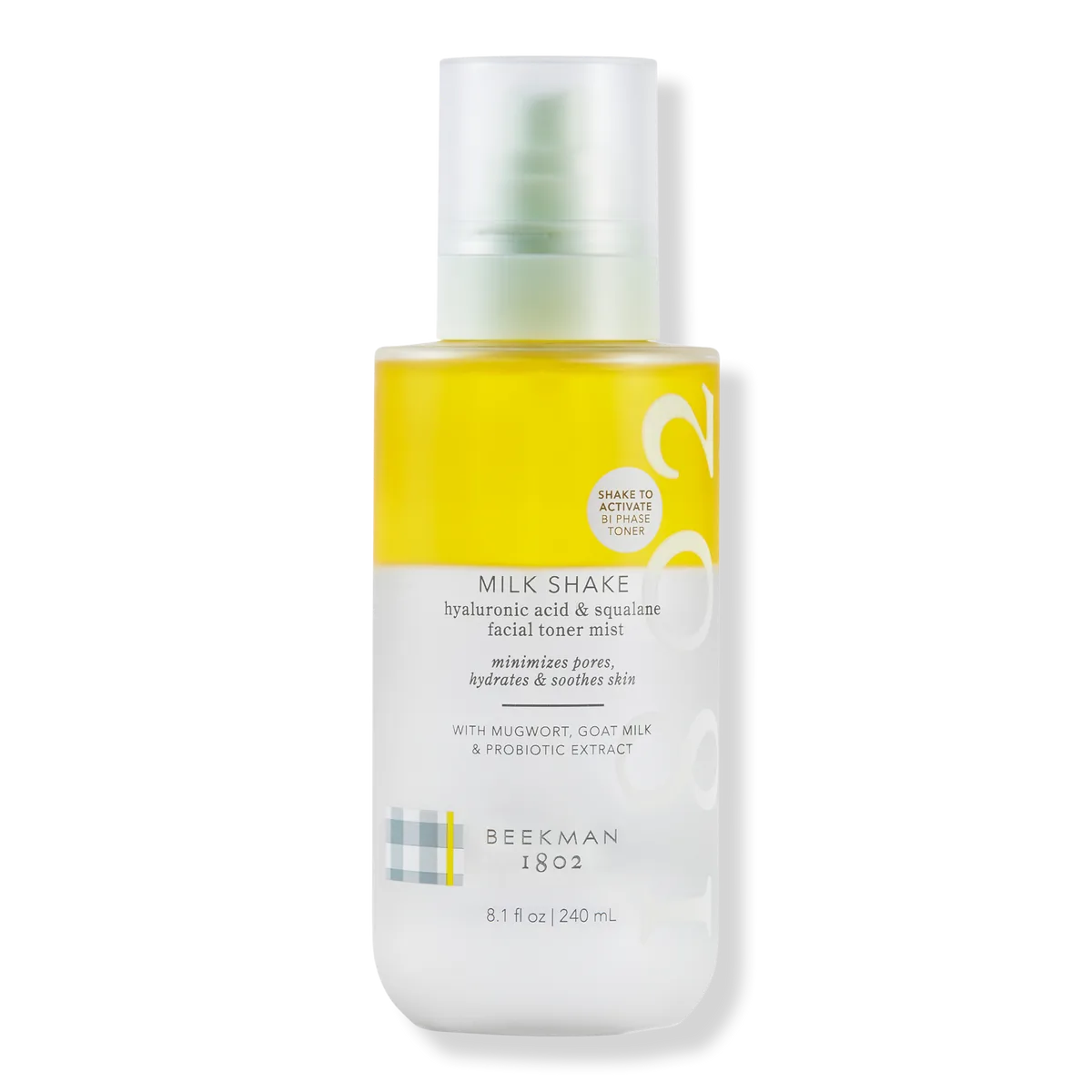
Milk Shake Toner Mist
Award-Winning Bi-Phase Mist
 Verified reviewer
Pros & cons.
- +True bi-phase formulation with real oil content — not just water and glycerin
- +Goat milk, colostrum, and Bifida ferment lysate deliver substantive microbiome story
- +Fragrance-free, alcohol-free, and friendly to sensitive skin
- +Soothing botanical roster (mugwort, chamomile, aloe, blue thistle) supports the actives
- +Squalane and sea buckthorn oil provide barrier and antioxidant work in the oil phase
- +Award-winning with over 1,400 reviews and a 4.7-star average
- +Works as a refreshing setting spray over makeup with proper technique
- −Bi-phase format requires shaking before each use
- −Spray nozzle can sputter or be uneven on some bottles
- −8.1 oz bottle is bulky for travel
- −Oil phase may be too rich for very oily skin if used liberally
- −Goat milk content rules it out for vegan users
The full review.
Most facial mists are useless. This isn’t a hot take, it’s basic surface chemistry: when you spray pure water onto your face, the water has nothing to bind to, it sits on the skin briefly, and then it evaporates — and as it evaporates, it can actually pull additional water out of the upper layers of the skin through osmotic migration. The end result is a brief refreshing moment followed by a slightly drier face than you started with. Most water-and-glycerin mists in the drugstore aisle do exactly this. They feel good for thirty seconds and then they’re gone, and your skin is mildly worse for the experience. The whole category developed a reputation for being placebo skincare for a reason.
The way around this problem is to put real lipids in the formula. If the mist contains an oil phase, the oils stay on the skin after the water evaporates, sealing the hydration that the water-binding ingredients have delivered and giving the spray something to actually do beyond a momentary cooling sensation. This is the chemistry insight behind bi-phase mists, which originated in K-beauty and have slowly migrated into Western skincare. Beekman 1802’s Milk Shake is one of the better examples of the format on the U.S. market, and it’s been earning awards and accumulating a 4.7-star rating across more than 1,400 Ulta reviews since its 2022 launch.
The bi-phase structure is visible the moment you look at the bottle: a clear water layer below, a golden oil layer above, the two naturally separating because oil and water don’t mix. You shake the bottle to emulsify them temporarily, spray, and the fine mist delivers both phases to your skin in a single application. The water layer carries Beekman’s goat milk story (goat milk, colostrum, Bifida ferment lysate, lactose, milk protein, mugwort, hyaluronic acid, aloe water, blue thistle, chamomile, honey, comfrey), and the oil layer carries the lipid work (jojoba seed oil, squalane, sea buckthorn oil, vitamin E). Both phases have substance — neither is a token addition to make the marketing pop.
The goat milk content is, of course, central to the brand. Beekman started as a goat milk soap operation on a Sharon Springs farm in 2008, parlayed the business into a Cooking Channel reality show, and turned the whole thing into a microbiome research program. Goat milk shows up second in the water phase here, with colostrum and Bifida ferment lysate immediately below. The Bifida ferment lysate is particularly notable — it’s the same ingredient class behind several luxury barrier-repair serums, with published evidence for DNA repair following UV stress and barrier reinforcement in compromised skin. Layering it into a leave-on toner format makes it accessible at a much lower price point than the luxury serums where it usually appears.
The mugwort, blue thistle, chamomile, and aloe round out a coherent soothing botanical roster, and the sea buckthorn oil contributes vivid orange-toned antioxidant carotenoids and omega-7 fatty acids alongside the squalane. The whole formulation is fragrance-free, alcohol-free, and avoids essential oils, which puts it within reach of users with sensitive skin, rosacea, or fragrance-related contact dermatitis. The naturally faint herbal-dairy aroma comes from the actives themselves and is part of the appeal for users who like to know their skincare smells like its ingredients.
Texture
The experience is meaningfully different from a typical water mist. The spray feels cushioned rather than wet — there’s a perceptible softness on contact that comes from the oil phase, and within a minute the skin feels hydrated and slightly dewy rather than damp-and-evaporating. The mist also works over makeup with proper technique: hold the bottle 6-8 inches from the face and use a fine, even spray, and the oil phase will actually soften powder makeup and prevent the cakey look that develops through the day. Used as a refresh through the day, it’s one of the few mists that actually delivers visible benefit rather than placebo cooling.
Common Complaints
The honest caveats are short. The bi-phase format means you have to shake the bottle before every use, which is a small ritual but a real friction for users who’d rather just spray. The spray nozzle can sputter or be uneven on some bottles — Ulta reviews mention this, and it’s worth knowing before purchase. The 8.1 oz bottle is bulky for travel, though Beekman offers a smaller 2 oz mini for that purpose. The oil phase is too rich for some users with very oily skin, particularly if used twice daily on the full face — a pat-onto-the-driest-areas approach works better in that case. And the milk-derived ingredients rule the product out for vegan users, which is a permanent feature of the brand.
Who Should Buy
For someone asking whether to buy this, we’d say yes if you have sensitive, dry, or dehydrated skin and you’ve been disappointed by typical facial mists, or if you want a real hydrating toner-essence hybrid that does meaningful work in your routine. Skip it if you find shake-before-use friction annoying, if you have very oily skin and don’t want extra lipids, or if vegan certification matters to you. Beekman has earned its position in the goat milk niche, and Milk Shake is one of the smartest products in the line.
Ingredient analysis.
Full INCI list
Water (Aqua), Ethylhexyl Palmitate, Caprylic/Capric Triglyceride, Coco-Caprylate/Caprate, 1,2-Hexanediol, Simmondsia Chinensis (Jojoba) Seed Oil, Caprae Lac (Goat Milk), Colostrum, Bifida Ferment Lysate, Lactose, Milk Protein, Artemisia Capillaris (Mugwort) Extract, Hyaluronic Acid, Squalane, Aloe Barbadensis Leaf Water, Eryngium Alpinum (Blue Thistle) Flower Extract, Chamomilla Recutita (Matricaria) Flower Extract, Honey Extract, Hippophae Rhamnoides (Sea Buckthorn) Oil, Symphytum Officinale (Comfrey) Leaf Extract, Hydrolyzed Jojoba Esters, Glycerin, Sodium Chloride, Hydroxyacetophenone, Pentaerythrityl Tetra-di-t-butyl Hydroxyhydrocinnamate, Ethylhexylglycerin, Propanediol, Tocopherol, Whey Protein, C10-18 Triglycerides, Lecithin
Skin match.
The science.
The Science
Bi-phase mists use different chemistry than the water-and-glycerin mists common in drugstores. Water-only mists create an osmotic gradient when they evaporate, which pulls moisture from the upper epidermal layers and leaves skin drier. An oil phase changes this: lipids stay on the skin after water evaporates, sealing in the water-binding actives and providing measurable barrier support. This occlusion chemistry is why properly formulated facial mists deliver hydration instead of just placebo coolness. The water phase contains hyaluronic acid (a humectant with robust evidence for surface hydration), goat milk and colostrum (emerging evidence for microbiome support and barrier function), and Bifida ferment lysate — a probiotic-derived ingredient with the strongest evidence base in the microbiome group, including published work on UV-induced DNA repair and barrier reinforcement in compromised skin. Mugwort (Artemisia capillaris) extract has growing evidence for soothing inflammatory conditions, while chamomile, aloe, and blue thistle have well-established evidence for topical anti-inflammatory effects. The oil phase contains jojoba seed oil (a liquid wax that mimics human sebum), squalane (a skin-identical lipid with robust evidence for emollience and barrier integrity), sea buckthorn oil (rich in omega-7 fatty acids and antioxidant carotenoids), and vitamin E (an antioxidant that stabilizes unsaturated oils against rancidity). The formulation works because each phase does what the other cannot do alone, supported by the soothing botanical roster. This is a hybrid toner-essence in a sprayable format.
Dermatologist Perspective
Dermatologists favor bi-phase facial mists over pure water-and-glycerin mists because the oil component solves the evaporation problem that makes water-only mists potentially counterproductive. Board-certified dermatologists often recommend mist or essence formats with real lipid content for patients with compromised barriers, sensitive skin, or chronic dehydration — these formats fit into existing routines without major restructuring. Opinions on the microbiome angle vary: some practitioners follow the growing evidence for Bifida ferment lysate and similar ingredients, while others wait for larger controlled trials. Dermatologists also remind patients that no toner or mist replaces a properly chosen moisturizer — these products supplement a routine rather than substitute for it.
Where it fits in your routine.
Shake the bottle vigorously for several seconds to emulsify the oil and water phases. Hold the bottle 6-8 inches from your face and mist evenly across the skin after cleansing, or onto your palms and pat into the face. Let it absorb for thirty seconds, then apply serums and moisturizer. Use as a refreshing mist or a hydrating top-up over makeup during the day — the oil phase helps it set without disturbing makeup. Use morning and night as a regular toner step. Store upright; bi-phase separation is normal and shows the formula works as designed.
At $32 for the 8.1 oz size, Milk Shake costs about $5-$8 per month if used twice daily with occasional refresh sprays. This price is fair for an award-winning specialty mist with real bi-phase formulation work. The 2 oz mini size has worse per-ml value but works for testing or travel. Milk Shake has better value than luxury bi-phase mists from K-beauty or Western luxury brands, which often cost $50-$80 for similar formulation work. It has less value than simpler hydrating mists from drugstore brands, which cost $10-$20 but lack this formulation. Beekman's established brand status, genuine ingredient sourcing, and four-year track record of strong consumer reception justify the price.
This works for sensitive, dry, or dehydrated skin if typical facial mists fail. It suits anyone wanting a hybrid toner-essence in a spray format. It is good for fragrance-sensitive users who cannot tolerate most fragranced toners and for fans of K-beauty essence chemistry.
Skip this if shake-before-use friction annoys you, if very oily skin makes extra lipids unwanted, if vegan certification matters, or if you want a simpler, cheaper mist for less specific skin needs.
Product details.
Bi-phase mist has a clear water layer and a golden oil layer. Shaking it creates a fine cushioned spray.
Goat milk and botanicals create a faint herbal-dairy aroma; there is no added fragrance.
Clear glass bottle with fine-mist spray nozzle to show the bi-phase separation
The first use feels cushioned and softening instead of just wet. The oil phase separates it from typical water-based facial mists. It has no tingling, no stinging, and no fragrance. Users switching from drying alcohol-based toners feel the difference on day one.
4-6 months of use for the 8.1 oz size with twice-daily application and occasional refresh sprays
12 months
All Year
The backstory.
Beekman 1802 launched Milk Shake in 2022 as a way to give users access to the brand's microbiome-supportive ingredients in a format more flexible than a serum or moisturizer. The bi-phase mist concept came from the K-beauty world, and the product became one of Beekman's award-winning hero items, regularly featured in best-of lists for facial mists and toners.
About Beekman 1802
Established Brand (5–20 years)Beekman 1802 launched in 2008 from a Sharon Springs, NY goat farm. The brand uses published in-house research to build its microbiome-focused skincare line. Milk Shake is an award-winning hero product with over 1,400 user reviews.
Common myths.
Facial mists are pointless — they just evaporate
Water-only mists evaporate and can pull water out of the skin. Bi-phase mists like this one deliver lipids and hydrators that stay on the skin and work with the rest of your routine.
Toners are an unnecessary step
In K-beauty and dermatologically informed routines, hydrating toners add a layer of water-binding actives between cleanser and serum. They are optional but not pointless — and this bi-phase format is closer to an essence than a traditional astringent toner.
FAQ.
Is this safe for oily or acne-prone skin?
Mostly yes — the oils are non-comedogenic and lightweight. Users with very oily skin may find the oil phase too thick for daytime use; if so, mist onto your hands first and pat onto the driest areas. Fungal acne sufferers should be cautious, as the oils can feed Malassezia.
Can I use it as a setting spray over makeup?
Yes — many users do. The oil phase helps it set instead of disrupting makeup like a pure water mist. Hold the bottle 6-8 inches from the face and use a fine, even spray. The dewy finish softens powder makeup.
Is this safe during pregnancy?
Yes. It has no flagged actives—no salicylic acid, no retinoids, and no essential oils. It is fragrance-free. The mist is fully pregnancy-compatible.
How does it compare to other hydrating mists?
Most facial mists contain only water, glycerin, and some botanical extracts. They feel refreshing but lack lasting hydration. Milk Shake uses a bi-phase formula with real lipids. This makes Milk Shake more like a hybrid toner-essence than a typical mist.
Will it work over my makeup without messing it up?
Yes, if you use the right technique. Hold the spray 6-8 inches from the face and use a fine, even mist instead of soaking the skin. The oil phase helps powder makeup look natural and prevents a cakey look during the day.
How long does the bottle last?
The 8.1 oz size lasts most users four to six months using it twice daily and occasional refresh sprays. This costs roughly $5-$8 per month, a reasonable price for an award-winning specialty mist.
What the community says.
"Users consistently praise how hydrating it feels for a mist"
"Bi-phase texture finishes cushioned, not wet"
"Fragrance-free and well-tolerated on sensitive skin"
"Refreshing throughout the day"
"Bi-phase requires shaking before each use"
"Spray nozzle can sputter or be uneven"
"Some find the oil phase too rich for oily skin"
"Bottle is bulky for travel"