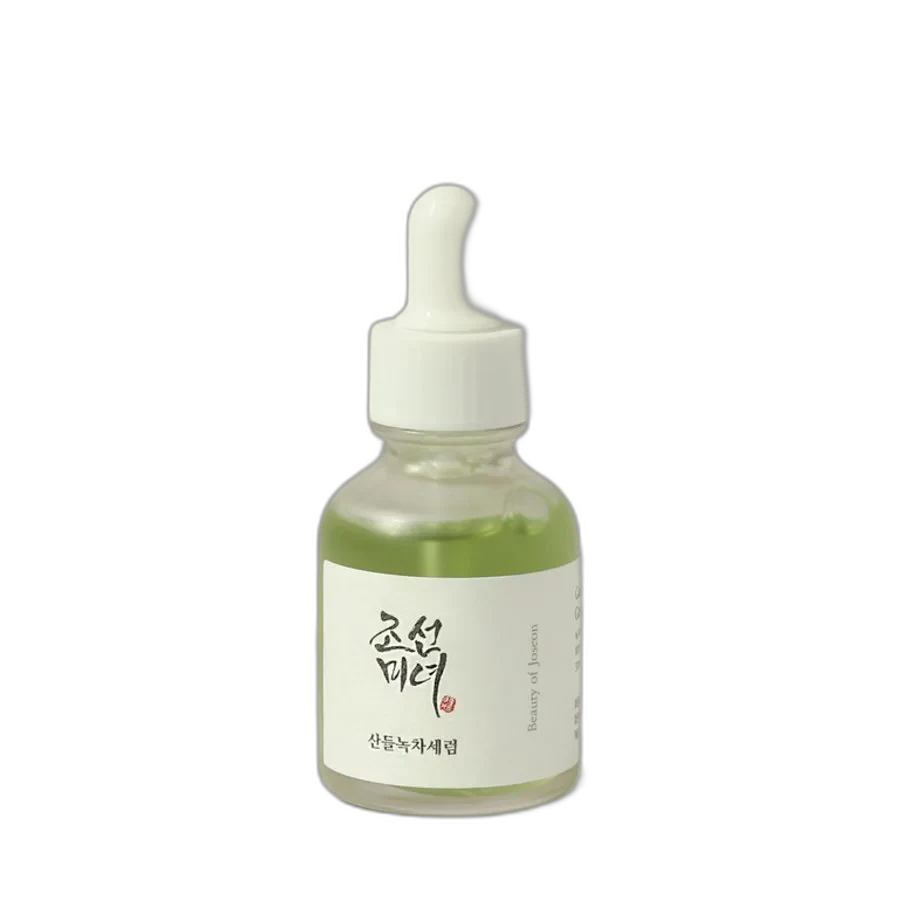
Calming Serum: Green Tea + Panthenol
K-Beauty Calming Hero
 Verified reviewer
Pros & cons.
- +50% green tea leaf water and 30% mugwort provide powerful dual-botanical anti-inflammatory action
- +5% panthenol at therapeutic concentration actively repairs compromised skin barrier
- +Ultra-lightweight watery texture absorbs instantly with zero residue or stickiness
- +Vegan, fragrance-free, silicone-free, oil-free, and fungal acne safe
- +Exceptional value at under $15 for disclosed active concentrations
- +Excellent post-retinol and post-exfoliation recovery serum
- −30 ml bottle is small and runs out within 1-2 months of daily use
- −Very watery texture may feel too light for very dry skin types without a moisturizer on top
- −Can pill slightly under certain thicker cream formulations
- −Only available in one size with no larger economy option
- −Dropper packaging exposes serum to air with each use potentially degrading antioxidants
The full review.
The Donguibogam is a medical encyclopedia from Korea’s Joseon Dynasty in 1613. Its pages document mugwort as a skin-calming and wound-healing herb alongside digestive remedies and acupuncture points. Four hundred years later, Beauty of Joseon built a serum around that ingredient. They added modern dermatological actives at concentrations Western brands usually reserve for luxury pricing and priced it under fifteen dollars. This creates one of the most compelling value propositions in skincare.
The formula uses 50% camellia sinensis leaf water as the primary solvent, not green tea extract mixed into a water base. This delivers EGCG and other catechins in a gentle, sustained manner. EGCG is a well-studied antioxidant in dermatology with documented anti-inflammatory, anti-UV, and antimicrobial properties. Using it for half the formula makes the product fundamentally anti-inflammatory.
Panthenol at 5% makes this a serious treatment product. Most serums and moisturizers list panthenol at one to two percent—enough for the label, but not enough for full therapeutic potential. At five percent, panthenol repairs the skin barrier by stimulating lipid synthesis, attracts and retains moisture like dedicated humectants, and accelerates wound healing. This concentration is clinically meaningful for anyone recovering from overexfoliation, retinol irritation, or environmental damage.
Artemisia capillaris — mugwort — is the second-most abundant active at a reported 30% concentration, following the green tea water. Traditional Korean medicine has used mugwort topically for centuries to calm inflammation and support skin healing. Modern research shows its flavonoids and terpenoids act as anti-inflammatory compounds that inhibit pro-inflammatory cytokines. The combination of mugwort and green tea creates a dual-botanical calming system that attacks inflammation from multiple angles.
Dipotassium glycyrrhizate adds a third anti-inflammatory pathway by inhibiting prostaglandin synthesis via licorice-root-derived mechanisms. Allantoin supports cell-proliferation and wound healing. Sodium hyaluronate provides a final layer of hydration. Every ingredient works to calm, hydrate, or repair; nothing in this formula contradicts its purpose.
The texture changes how you think about serums. It is nearly water-like—a thin liquid that absorbs in seconds and leaves nothing behind. There is no stickiness, film, or residue. This is liberation for people with oily or acne-prone skin who dread heavy serums. It layers under moisturizer, sunscreen, or makeup without interference. You can apply it in three seconds and continue your routine.
The calming effect is visible. If you have active redness from rosacea, acne inflammation, sun exposure, or post-exfoliation irritation, this serum reduces redness within minutes. It is not a cosmetic miracle, but it is consistent enough that regular users report it as a reliable product for managing reactive skin.
This serum earns cult status as a post-retinol recovery product. Panthenol repairs barrier damage, green tea and mugwort calm retinol-triggered inflammation, and hyaluronic acid replenishes moisture lost to retinoid-induced transepidermal water loss. Using it on nights after retinol or on alternate nights during a retinol initiation phase makes the adjustment period more tolerable.
The clean formula is notable. It is vegan, fragrance-free, silicone-free, oil-free, and fungal acne safe. The ingredient list reads like a dermatologist’s wish list for a calming treatment—no unnecessary additives, no potential sensitizers, and no fragrance hidden behind “natural” essential oils. This level of formulation discipline is right for a product designed to calm irritated skin.
The 30 ml size is the main limitation. At typical application rates, a bottle lasts one to two months. While fourteen dollars is reasonable, you will reorder frequently if this is a daily staple. A 50 ml option would be welcome, though the small size is practical for travel and keeps the formula fresh.
Users with very dry skin may find the watery texture insufficient alone. This is a treatment serum, not a moisturizer; dry skin types should layer a richer cream on top. This is expected for such a lightweight product and does not detract from a formulation that does exactly what a calming serum should do.
At under fifteen dollars, this serum delivers ingredient quality and disclosed concentrations that outperform many forty to sixty dollar Western serums. It makes you reconsider skincare costs and what you have been overpaying for. Beauty of Joseon took a four-hundred-year-old remedy and improved it. That is not marketing—it is just good skincare.
Ingredient analysis.
Full INCI list
Camellia Sinensis Leaf Water, Water, Panthenol, Glycerin, Butylene Glycol, 1,2-Hexanediol, Methylpropanediol, Acrylates/C10-30 Alkyl Acrylate Crosspolymer, Tromethamine, Betaine, Ethylhexylglycerin, Allantoin, Dipotassium Glycyrrhizate, Artemisia Capillaris Extract, Glyceryl Acrylate/Acrylic Acid Copolymer, Melia Azadirachta Leaf Extract, Polyquaternium-51, Malt Extract, Melia Azadirachta Flower Extract, Coptis Japonica Root Extract, Sodium Hyaluronate
Skin match.
The science.
The Science
Green tea's EGCG (epigallocatechin-3-gallate) is one of the most studied polyphenols in dermatology. A 2019 review in Nutrients shows EGCG inhibits NF-kB activation, reduces inflammatory cytokine production, and provides photoprotection against UV-induced DNA damage. This serum uses 50% green tea leaf water, so EGCG delivery is higher than products using trace amounts of green tea extract.
Panthenol at 5% reaches the clinical efficacy range found in dermatological literature. A 2002 study in the American Journal of Clinical Dermatology confirmed that topical panthenol (dexpanthenol) at 2-5% stimulates fibroblast proliferation, accelerates re-epithelialization, and improves stratum corneum hydration by activating lipid synthesis. The study shows panthenol's dual mechanism — acting as a humectant and a barrier-repair stimulant — works well for compromised skin.
Artemisia species have healed skin in traditional Korean and Chinese medicine for centuries, and modern research validates this. A 2014 study in the Journal of Ethnopharmacology shows Artemisia extracts inhibit pro-inflammatory cytokines IL-6 and TNF-alpha in skin cells, supporting their use for redness and irritation.
Polyquaternium-51 — also known as lipidure — is a biomimetic polymer that mimics cell membrane structures to enhance skin hydration and reduce irritation. It adds a moisture-retention mechanism that complements the panthenol and hyaluronic acid.
Dermatologist Perspective
Dermatologists often recommend calming, barrier-repair serums for patients with sensitive skin, rosacea, or side effects from active treatments like retinoids and chemical peels. Board-certified dermatologists note that combining 5% panthenol, green tea polyphenols, and hyaluronic acid creates a solid approach to post-inflammatory recovery. Dermatologists often advise patients to use this type of calming serum on nights between active treatments to maintain barrier integrity and reduce cumulative irritation.
Where it fits in your routine.
Cleanse and tone first, then dispense 3-4 drops onto clean fingertips or the face. Press and pat gently into the skin instead of rubbing. The serum absorbs in seconds. Use moisturizer and sunscreen in the AM. Apply more liberally when skin is irritated or after exfoliation. For post-retinol use, apply generously after retinol absorbs, or use on alternate nights as a recovery treatment.
At about $14 for 30 ml, this serum provides high value for its ingredient quality and disclosed active concentrations. The 50% green tea, 30% mugwort, and 5% panthenol formulation usually costs $35-60 from premium Western brands. One bottle lasts 1-2 months with twice-daily use, making the monthly cost $7-14 — low for a treatment-level serum. This has one of the strongest price-to-performance ratios in the calming serum category.
This works for sensitive, reactive, or easily irritated skin needing daily calming. It helps those using retinol, AHAs, or BHAs recover, and suits acne-prone skin types seeking soothing without clogging pores. K-beauty enthusiasts and ingredient-conscious shoppers will like the transparent, clean formulation.
People with very dry skin needing thick, occlusive hydration will find this too lightweight as a standalone product. Those seeking anti-aging actives like retinol, vitamin C, or peptides should look elsewhere — this is a focused calming and repair serum, not an anti-aging treatment.
Product details.
Green tea and mugwort provide a faint natural herbal aroma—no added fragrance. The scent disappears seconds after application.
30 ml frosted glass dropper bottle. The dropper allows precise dispensing. The minimalist design uses Joseon Dynasty aesthetics.
The green tea and mugwort provide an immediate calming sensation on irritated skin. It does not sting, tingle, or feel warm. Skin looks less red within minutes. The ultra-light texture absorbs completely, so you can layer other products easily. ***
1-2 months with twice-daily use (using 3-4 drops per application) ***
12 months ***
All Year ***
The backstory.
Beauty of Joseon drew from the Donguibogam — a 17th-century Korean medical encyclopedia — which documents mugwort's use as a skin-calming and wound-healing herb. The brand combined this traditional hanbang ingredient with modern dermatological actives like panthenol and green tea polyphenols, bridging centuries of Korean herbal wisdom with contemporary cosmetic science.
About Beauty of Joseon
Established Brand (5–20 years)Beauty of Joseon launched in 2016 and relaunched in 2019 using traditional Korean hanbang ingredients from the Joseon Dynasty. The brand has gained global popularity for its effective, affordable formulations and has cult status in the K-beauty community, despite a shorter track record than legacy skincare brands.
Common myths.
Calming serums work only for people with sensitive skin conditions.
Normal, resilient skin still benefits from anti-inflammatory and antioxidant protection. This serum works as a post-sun recovery product, a buffer after chemical exfoliation or retinol use, and a daily shield against environmental inflammation. Calming ingredients prevent inflammation rather than just reacting to it.
K-beauty products focus on multi-step routines and unnecessary layering.
This serum is a single-purpose treatment. Its disclosed active concentrations rival products costing three to four times more. It replaces multiple calming products, simplifying your skincare routine.
FAQ.
Is Beauty of Joseon Calming Serum good for acne-prone skin?
Yes — the oil-free, silicone-free formula is non-comedogenic and fungal acne safe. EGCG in the green tea and soothing mugwort calm acne-related redness and irritation without clogging pores. The 5% panthenol supports barrier repair often compromised in acne-prone skin using drying treatments.
Can I use this serum with retinol?
This is a top recovery serum to pair with retinol. Apply it after retinol to buffer irritation, or use it on alternate nights as a calming recovery treatment. The panthenol and mugwort counteract the dryness and redness retinol causes, making retinol therapy more tolerable long-term.
What is mugwort and why is it in this serum?
Mugwort (Artemisia capillaris) is a traditional Korean herbal medicine ingredient. The 17th-century Donguibogam medical text documents its skin-calming and wound-healing properties. Modern research confirms its anti-inflammatory and antioxidant activity. This makes Mugwort (Artemisia capillaris) effective at reducing redness, soothing irritation, and supporting compromised skin barrier recovery.
How does this compare to the Beauty of Joseon Glow Serum?
The Calming Serum uses green tea, mugwort, and panthenol to soothe and repair the barrier—ideal for reactive, irritated, or post-treatment skin. The Glow Serum uses propolis and niacinamide to brighten and fight aging. Choose based on your primary concern: calming vs. brightening.
Is this serum vegan and cruelty-free?
Yes, the Calming Serum is certified vegan and cruelty-free. The formula has no animal-derived ingredients, and Beauty of Joseon does not test on animals. It is also fragrance-free, paraben-free, sulfate-free, and silicone-free.
Community ---
What the community says.
"Dramatically calms redness and irritation within days"
"Lightweight watery texture absorbs instantly with no residue"
"Incredible value at under $15 for the ingredient quality"
"Perfect recovery serum after retinol or exfoliation nights"
"30 ml size runs out quickly if used liberally"
"Some wish for a larger bottle option"
"Very watery consistency may feel insufficient for very dry skin types"
"Can pill slightly under certain heavy cream moisturizers"
Featured in.
People also looked at.