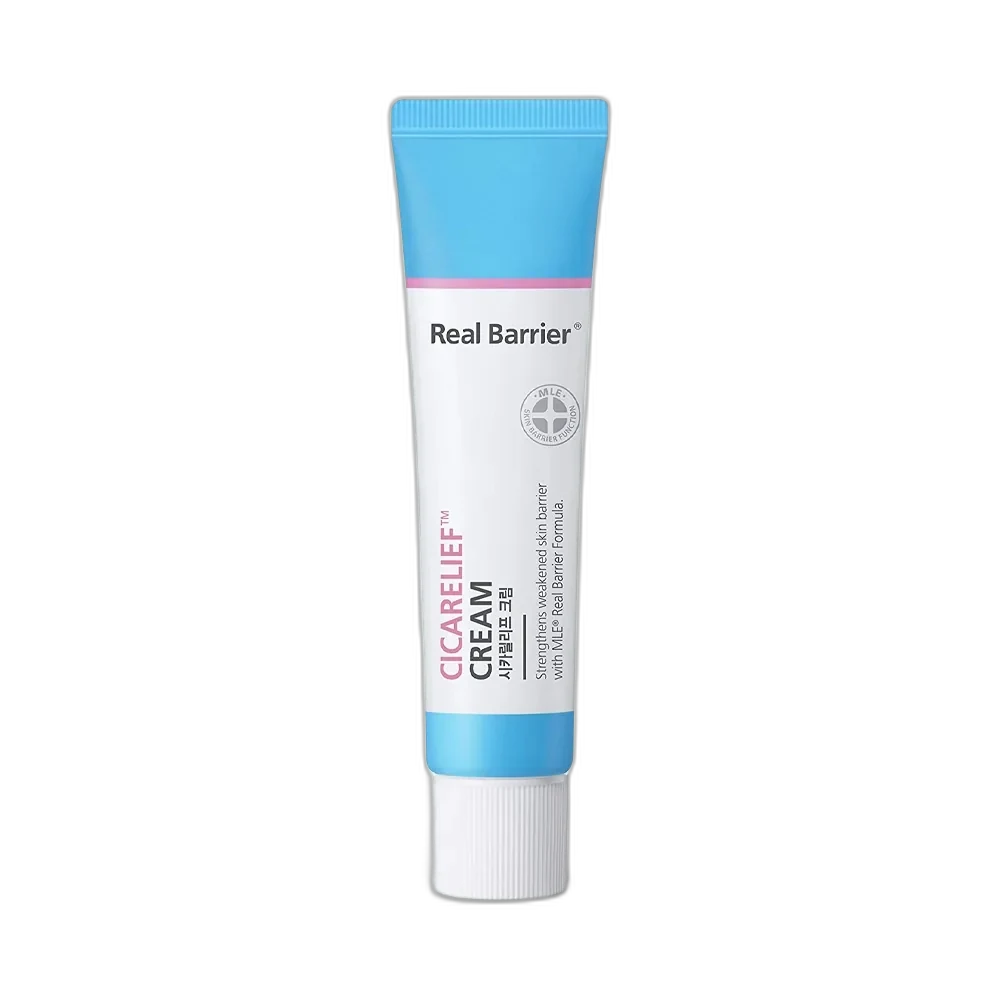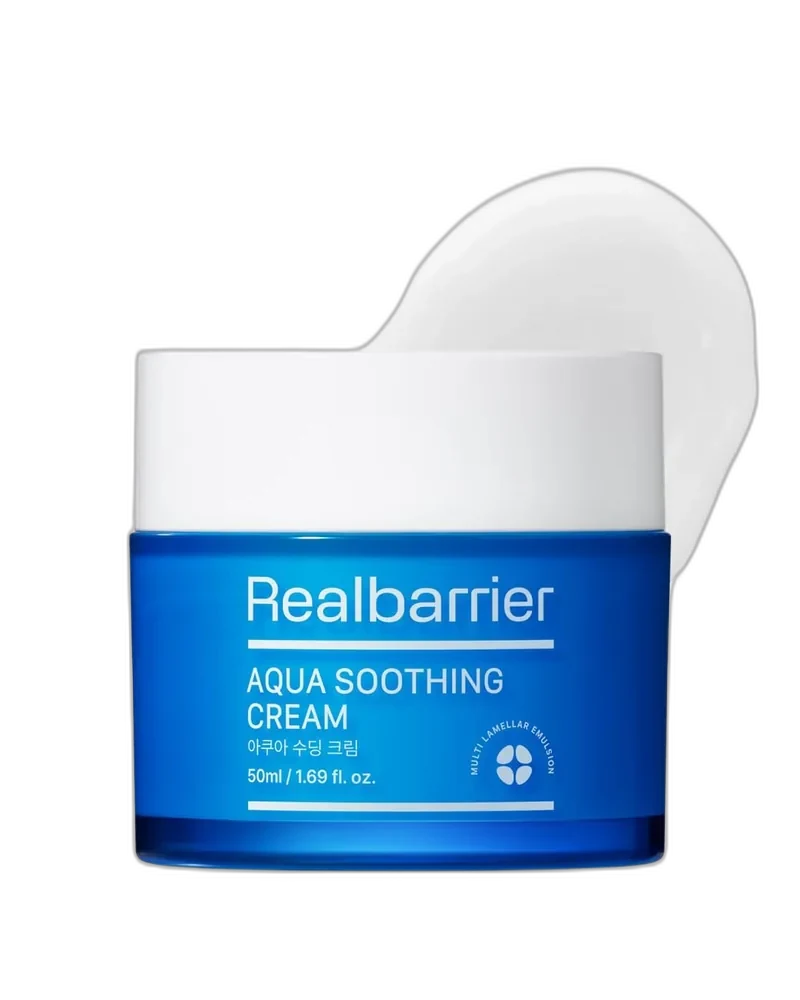
Real Barrier Aqua Soothing Gel Cream
K-Beauty Barrier Staple
 Verified reviewer
Pros & cons.
- +Patented MLE ceramide delivery technology with clinical pedigree
- +Madecassoside and centella for genuine anti-inflammatory support
- +Lightweight gel-cream texture works on oily and combination skin
- +Fragrance-free, essential-oil-free, and fungal-acne-safe
- +Excellent for post-procedure and compromised skin recovery
- +Niacinamide drives endogenous ceramide synthesis in parallel
- +Strong value at mid-range k-beauty pricing
- −Not rich enough for very dry winter skin
- −Tub packaging exposes ceramides to gradual degradation
- −Limited availability in some Western retailers
- −Gel-cream format is a moisturizer, not a treatment
The full review.
Most Korean gel-creams at Olive Young or on skincare Reddit follow a standard formula: hyaluronic acid, botanical extracts, niacinamide, a little ceramide for marketing, and a cooling water-gel texture. These work fine as daily moisturizers for normal skin. The Real Barrier Aqua Soothing Gel Cream differs, despite its similar price and category. Its origin sets it apart. Real Barrier comes from NeoPharm, a Korean pharmaceutical research company founded in 1999. NeoPharm developed MLE — Multi-Lamellar Emulsion — as a structured ceramide delivery system for atopic dermatitis and severely compromised skin. Clinics licensed this technology before it entered the cosmetic market, giving this gel-cream clinical heritage.
MLE is the most important feature of this product. The skin’s stratum corneum uses a structured lipid matrix in the intercellular space, consisting of lamellar (layered) sheets of roughly equal parts ceramides, cholesterol, and free fatty acids. When this matrix breaks, water escapes and irritants enter. Most ceramide creams just disperse ceramides in an emulsion; they deliver some ceramide but do not replicate the functional, structured architecture. MLE arranges ceramide NP, cholesterol, palmitic acid, and stearic acid into a lamellar structure that mimics the native skin lipid matrix. Published research on MLE dates to the early 2000s and supports its use in clinical atopic dermatitis care in Korea. This is a pharmaceutical approach, not marketing.
The texture is the second surprise. You expect something heavy or waxy from a moisturizer with ceramide and cholesterol. Instead, the Aqua Soothing Gel Cream is a lightweight gel-cream that glides on cool and absorbs in thirty seconds to a subtle dewy finish. It works under sunscreen, makeup, in humid climates, on oily skin, and for combination users who dislike heavy ceramide creams. The cooling effect helps after sun exposure, a mild chemical peel, or on hot, reactive skin. This gel-cream format also suits oily skin, a group often ignored by barrier repair moisturizers.
The ingredients are thoughtful. Madecassoside and centella asiatica extract provide anti-inflammatory and wound-healing support. Centella is a clinically validated botanical, and it works well with ceramide delivery for sensitive, compromised skin. Panthenol adds hydration and soothing effects. Niacinamide is high enough on the INCI list to drive endogenous ceramide synthesis alongside the topical MLE delivery, providing both exogenous and endogenous ceramide work. Baicalin (Scutellaria root) adds anti-inflammatory support. Sodium hyaluronate handles surface hydration. The formula is fragrance-free, alcohol-free, essential-oil-free, and fungal-acne-safe, which is restrained for a mid-range k-beauty moisturizer.
Results are fast. Most users feel immediate cooling hydration and calm skin on the first application. Redness reduction and barrier recovery usually appear within one to two weeks, matching MLE-based pharmaceutical research. Full barrier resilience—where skin stops reacting to stressors and tolerates actives better—takes four to six weeks of consistent use. For those recovering from over-exfoliation, retinoid burn, or sunburn, recovery is faster than with generic hydrating gel-creams.
Criticisms are limited. The gel-cream is not rich enough for very dry winter skin; users in northern climates or with chronically dehydrated skin should layer a heavier product or use the Real Barrier Extreme Cream variant. The tub packaging with an inner seal is not airless, exposing the ceramide payload to some degradation; use a spatula or clean hands and finish within twelve months of opening. The product is a moisturizer, not a treatment; it does not fade dark spots, refine pores, or treat active acne. For barrier repair, it is one of the most effective products in its price range globally.
Brand context is a strength. NeoPharm has operated since 1999, making it an established company. The clinical use of MLE in Korean dermatology provides a track record beyond marketing. Real Barrier has been on the market since the mid-2010s with thousands of reviews on Olive Young, YesStyle, and Amazon. This score reflects the technology and real-world validation. If flashy k-beauty brands have failed you, Real Barrier is a reliable choice backed by pharmaceutical research.
About Honest Beauty
Established Brand (5-20 years)
Formula
Ingredient analysis.
Full INCI list · pH 5.5
Water, Butylene Glycol, Glycerin, Methylpropanediol, Dipropylene Glycol, Betaine, Pentylene Glycol, Niacinamide, 1,2-Hexanediol, Sorbitan Stearate, Glyceryl Stearate, Panthenol, Madecassoside, Centella Asiatica Extract, Ceramide NP, Cholesterol, Hydrogenated Lecithin, Stearic Acid, Palmitic Acid, Sodium Hyaluronate, Allantoin, Portulaca Oleracea Extract, Scutellaria Baicalensis Root Extract, Glycyrrhiza Glabra Root Extract, Camellia Sinensis Leaf Extract, Tocopherol, Xanthan Gum, Carbomer, Ethylhexylglycerin, Disodium EDTA, 1,2-Hexanediol
Skin match.
The science.
The Science
The core technology — Multi-Lamellar Emulsion, or MLE — is a pharmaceutically legitimate delivery system. NeoPharm developed MLE in the late 1990s to arrange ceramides, cholesterol, and free fatty acids into a structured lamellar arrangement. This mimics the intercellular lipid matrix of healthy stratum corneum. Research in dermatology journals shows MLE-based creams improve barrier function metrics (transepidermal water loss, skin hydration) in atopic dermatitis patients better than conventional ceramide-containing vehicles. Atopic skin has low ceramide content and disrupted lamellar organization; adding ceramides without restoring lamellar structure only offers partial benefit. The inclusion of centella asiatica and isolated madecassoside adds more evidence — centella has multiple published studies for its anti-inflammatory, wound-healing, and collagen-synthesis properties, and dermatologists have used it for decades to aid barrier repair. Topical niacinamide has well-established data for upregulating endogenous ceramide synthesis in keratinocytes. This creates a dual mechanism: MLE delivers exogenous structured ceramides while niacinamide drives the skin to make more of its own. Panthenol, aloe, and Scutellaria extract provide further anti-inflammatory evidence. This is a well-supported mid-price range moisturizer with formulation choices based on pharmaceutical research rather than cosmetic trends.
Dermatologist Perspective
Dermatologists familiar with Korean skincare recognize the Real Barrier line as a clinically credible option for sensitive, atopic, or barrier-compromised skin. Board-certified dermatologists note that MLE-based ceramide creams have stronger published support for barrier restoration than simple ceramide dispersions. The gel-cream format makes this specific product suitable for oily and combination skin types that normally cannot tolerate barrier repair creams. The centella and panthenol content makes it a reasonable post-procedure moisturizer; many Korean dermatology clinics include it in post-laser and post-peel recovery protocols.
Where it fits in your routine.
Apply a nickel-sized amount to clean, damp skin after toning or essence, morning and evening. Press into the face, neck, and décolleté for thirty to sixty seconds until absorbed. Follow with sunscreen in the AM. In the PM, use this as the final step or layer it under a thicker cream during dry winter weather. For post-procedure use, apply generously and reapply for soothing hydration. Keep the lid tightly closed and use clean fingers or a spatula to dispense; use within twelve months of opening to preserve ceramide integrity.
At $26 for 50ml, this gel-cream offers high technology and ingredient quality for the price. One bottle lasts two to three months using it twice daily. This makes the per-use cost reasonable for a moisturizer with pharmaceutical-grade barrier repair credentials. Most retailers only sell the 50ml size, but larger kits and bundles sometimes lower the per-unit price. It competes well against Western ceramide creams in the same format — like mid-range gel-creams from La Roche-Posay or Eucerin — using slightly more sophisticated delivery technology despite slightly less widespread availability. This is one of the best-value ceramide moisturizers on the market for oily-to-combination users.
Oily, combination, normal, and sensitive skin users want a lightweight, serious barrier repair moisturizer. It works well for rosacea, post-procedure recovery, mild eczema, or over-exfoliating skin needing resilience. It also suits warm climates and humid seasons when thicker ceramide creams feel too heavy.
Users with very dry skin in winter climates may need a thicker formula — try the Real Barrier Extreme Cream or layer a heavier cream on top. Users with uncomplicated skin who do not need barrier repair can use simpler, cheaper basic moisturizers. Anyone expecting treatment-level effects on pigmentation, acne, or deep wrinkles should pair this with a targeted serum.
Product details.
Light gel-cream that glides on with a cooling feel and absorbs quickly
Fragrance-free with a very subtle neutral scent
Plastic tub with inner seal
The gel-cream texture is cool and hydrating. It calms warm or irritated skin immediately. It absorbs in about 30 seconds and leaves a subtle dewy finish. It causes no tingling, stinging, or purging. Users often see visible redness reduction within the first few days of use.
2 to 3 months with twice-daily face use
12 months
spring summer
The backstory.
NeoPharm developed MLE technology in the late 1990s as a Korean pharmaceutical response to atopic dermatitis and barrier-compromised skin, and Real Barrier was launched as the consumer-facing extension of that research. The Aqua Soothing Gel Cream is the summer-weight variant of the line and has become a quiet Korean dermatology staple.
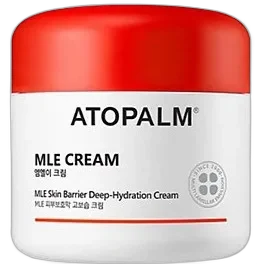
About Atopalm
Established Brand (5–20 years)Korean company NeoPharm founded in 1999 produces Atopalm and its Real Barrier sub-line. NeoPharm is known for its patented MLE (Multi-Lamellar Emulsion) ceramide delivery technology. The brand has more than two decades of research and Korean dermatologists widely use it for barrier-compromised skin.
Common myths.
Gel-cream formats are less effective than thick creams for barrier repair.
Active ingredients and the delivery system determine effectiveness, not viscosity. The MLE ceramide complex delivers barrier repair despite the light gel texture.
All ceramide creams are basically the same.
Ceramide delivery depends on formulation. Listing ceramide NP on an INCI does not guarantee absorption; the MLE lamellar structure used here has published pharmaceutical research behind it.
FAQ.
What is MLE technology?
Multi-Lamellar Emulsion is NeoPharm's patented ceramide delivery system. It arranges ceramides, cholesterol, and fatty acids into a lamellar structure that mimics the skin's native lipid matrix. This structure lets ceramides integrate into the stratum corneum more efficiently than simple ceramide dispersions.
Is this rich enough for dry skin in winter?
The gel-cream format works for summer, oily, and combination skin. Dry users in winter can layer it under a thicker cream or use the Real Barrier Extreme Cream for heavier seasons.
Can I use this after a chemical peel or microneedling?
Yes — the madecassoside, centella, and MLE ceramide complex make this a top post-procedure moisturizer for barrier recovery. Many dermatology clinics in Korea use the Real Barrier line for this reason.
Is it fungal-acne safe?
Yes. The formula lacks the fatty acid, ester, and polysorbate triggers that feed malassezia. This makes it safe for users with fungal acne or pityrosporum folliculitis.
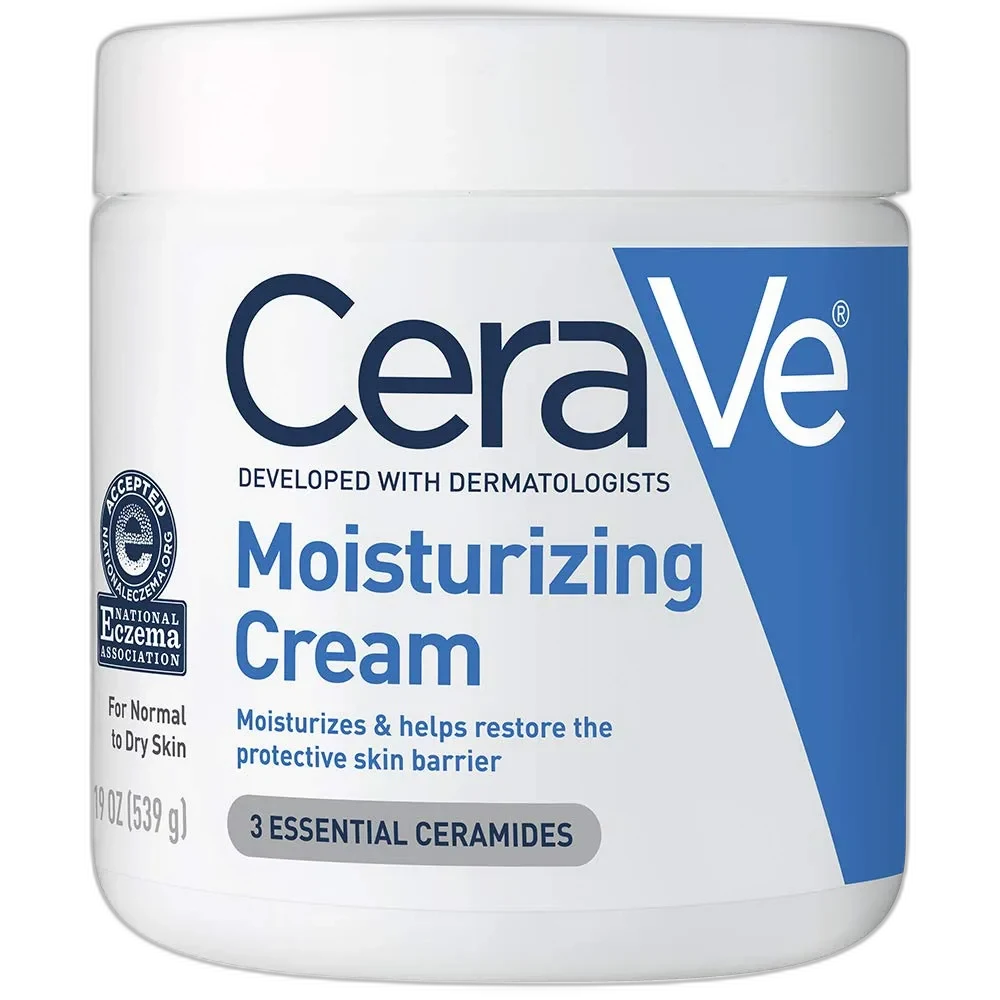
How does this compare to CeraVe moisturizers?
Both brands use ceramides in structured delivery systems. CeraVe uses MVE (multi-vesicular emulsion) technology, while Real Barrier uses MLE. Both work well. Real Barrier has a lighter, more elegant texture; CeraVe is cheaper and more widely available.
Is it safe for rosacea?
Yes. This fragrance-free, centella-rich, ceramide-supported formulation works well for rosacea-prone skin. Korean dermatology often recommends it for that condition.
Community
What the community says.
"calms redness quickly"
"lightweight but hydrating"
"non-comedogenic"
"not rich enough for very dry winter skin"
"packaging can be hard to dispense last drops"