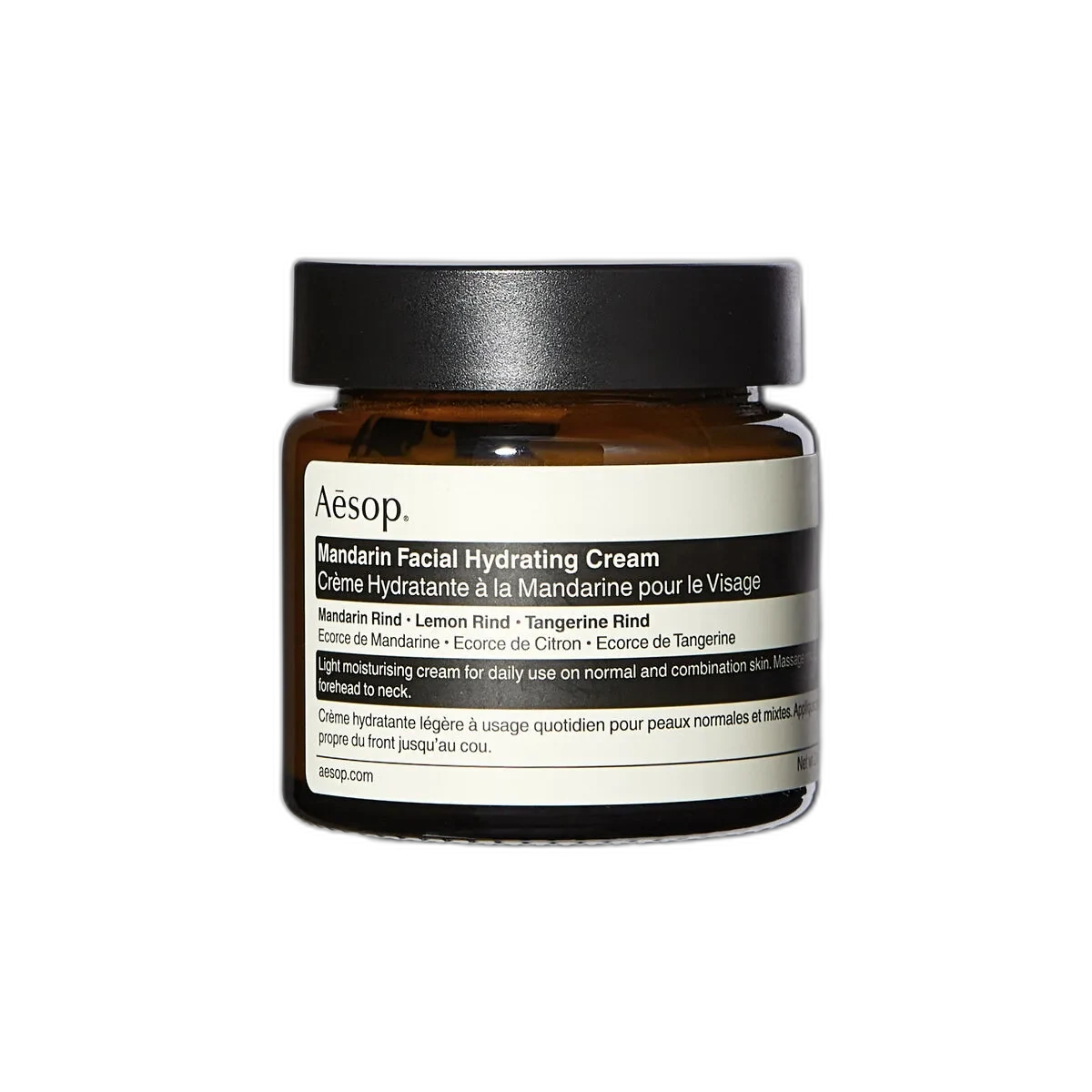
Mandarin Facial Hydrating Cream
The Citrus Cult Classic
 Verified reviewer
Pros & cons.
- +Lightweight texture absorbs quickly without residue
- +Bright citrus scent provides a sensorial daily ritual
- +Layers cleanly under sunscreen without pilling
- +Well-suited to combination and oily skin types
- +Simple, non-overengineered humectant and oil blend
- +Long-running formula with consistent reformulation discipline
- +Vegan and cruelty-free certified
- −Heavy citrus essential oil load excludes sensitive skin
- −Open-jar packaging exposes oils to oxidation
- −Insufficient lipid content for true dry skin types
- −Premium price for a relatively basic active profile
- −No barrier-repair, antioxidant, or treatment claims
The full review.
There is something almost nostalgic about Mandarin Facial Hydrating Cream in 2026. It belongs to an earlier era of Aesop, before the brand’s catalog started speaking the language of modern actives, when a daytime moisturizer could lead with citrus essential oils and call that the entire pitch. Open the amber jar and the cream announces itself with mandarin and tangerine before any other detail registers — there is no question what you’ve just bought. For better and worse, that olfactory boldness is the whole point.
The formula itself is straightforward. Water and a fast-absorbing emollient ester sit at the top, followed by glycerin doing humectant duty and a stack of plant oils — hazelnut, sesame, sunflower, rosehip, soybean, wheat germ — that together build out a modest lipid layer. There’s saccharide isomerate to extend the hydration window, a touch of witch hazel water for the slightly astringent quality the brand is known for, beta-carotene and carrot root extract for color and antioxidant flavor, and then the citrus oils that give the cream both its name and its single most divisive feature. It is, in the most literal sense, a competent combination-skin moisturizer dressed in citrus. Nothing in here is groundbreaking. Nothing in here pretends to be.
Where it earns its place is in texture. Aesop has always known how to formulate a cream that disappears, and Mandarin is one of their lightest. It applies almost like a thin lotion, breaks down with the slightest friction, and leaves behind a finish that lands somewhere between satin and matte — never tacky, never shiny, and perfectly compatible with sunscreen layered over the top. For oily and combination skin types who have been burned by heavier daytime moisturizers that pill under SPF or leave a sebaceous sheen by lunchtime, the absorption profile here is genuinely satisfying. You feel the cooling sensation on application, watch it sink in within a minute, and then the cream more or less vanishes into the morning routine.
And then there is the smell, which is half the experience and half the controversy. Mandarin and tangerine peel oils carry a particular brightness — citrusy, slightly green, almost effervescent on first contact — and the cream amplifies that with a small lemon peel inclusion for sharpness. People who love this product describe it as their daily mood-lift, the small moment in the morning that makes them actually look forward to applying moisturizer. People who do not love it find it overpowering, occasionally medicinal, and entirely wrong on a face product. There is no neutral position. Aesop has not designed this one to please everyone, and that’s worth understanding before you put down the money.
The more pressing question for skin health is what those citrus oils actually do. Mandarin and tangerine are on the gentler end of citrus essential oils — they are far less photoreactive than bergamot, expressed lime, or angelica root, all of which can cause genuine phototoxic reactions. But they still contain limonene, citral, geraniol, and linalool, and the INCI dutifully lists each of those as standalone allergens at the bottom of the formula. For skin that is reliably non-reactive to fragrance, this is a non-issue. For skin that flushes around the nose, breaks out in tiny bumps after using a new fragranced product, or has any history of contact dermatitis, this cream is a genuine risk. Aesop is not hiding any of this — the ingredient list is fully transparent — but the brand is also not in the business of warning you off, and a casual shopper picking up the jar in a beautifully merchandised storefront might miss what they’re agreeing to.
Where the cream undeniably struggles is across the spectrum of skin types. Combination and oily skin will find it weight-perfect. Normal skin will get along fine. Dry skin will likely walk away wishing they’d chosen something richer — there isn’t enough lipid here to address true dryness, and the absence of ceramides, cholesterol, or any structured barrier-repair components means it’s strictly hydration without repair. Sensitive skin should look at the essential oil profile and walk away. The result is a moisturizer that is genuinely excellent for one skin profile and genuinely wrong for several others, which is a narrower target than the marketing copy implies.
Value is the other place where the conversation gets honest. Sixty milliliters for around sixty-three dollars is firmly in luxury daytime-moisturizer territory, and the actives in here — glycerin, plant oils, a humectant, witch hazel water — are not what you’d call rare or expensive. The premium you’re paying is for the Aesop experience: the jar, the scent, the brand identity, and the shopping ritual. Whether that math works depends entirely on what your morning routine means to you. There is a perfectly decent argument for spending the money on a product you actually look forward to using. There is also a perfectly decent argument for buying a thirty-dollar pharmacy moisturizer with a more sophisticated active profile and skipping the ritual altogether. Both can be right.
What Mandarin doesn’t do is age particularly well as a treatment product. There are no peptides, no niacinamide, no ceramides, no retinoid-buffering ingredients, no meaningful antioxidant complex beyond the trace tocopherol and beta-carotene. Its job is hydration, and it does that job — but in a market where many drugstore moisturizers now include three or four functional actives in addition to hydration, Mandarin’s resume looks slim by comparison. This isn’t a criticism of the formula’s intent so much as an honest framing of its scope. You buy this cream because you want a beautifully sensorial daytime hydrator, not because you want your moisturizer to fight pigmentation or fine lines.
The practical recommendation lands somewhere narrow. If you have combination or oily skin, you are not fragrance-reactive, you wear sunscreen religiously, and the citrus scent makes you happy, Mandarin is a lovely pick that will reward you with a pleasant daily ritual for as long as you keep using it. If any of those conditions doesn’t hold, there are better fits in Aesop’s own catalog, starting with the Parsley Seed Anti-Oxidant Hydrating Cream for fragrance-cautious skin or the richer cream options for drier types. Mandarin earns its long-running status, but it is more particular about who it’s for than the brand sometimes lets on.
Ingredient analysis.
Full INCI list
Water (Aqua), Coco-Caprylate/Caprate, Glycerin, Cetearyl Alcohol, Behenyl Alcohol, Polyglyceryl-3 Stearate, Corylus Avellana (Hazelnut) Seed Oil, Rosa Canina Seed Extract, Citrus Medica Limonum (Lemon) Peel Oil, Glyceryl Stearate Citrate, Euphorbia Cerifera (Candelilla) Wax, Saccharide Isomerate, Hydroxyacetophenone, Sesamum Indicum (Sesame) Seed Oil, Hamamelis Virginiana (Witch Hazel) Water, Helianthus Annuus (Sunflower) Seed Wax, Tocopherol, Citrus Tangerina (Tangerine) Peel Oil, Silica, Microcrystalline Cellulose, Glycine Soja (Soybean) Oil, Xanthan Gum, Glyceryl Caprate, Benzyl Alcohol, Sodium Dehydroacetate, Triticum Vulgare (Wheat) Germ Oil, Citrus Nobilis (Mandarin Orange) Peel Oil, Sodium Gluconate, Sodium Citrate, Citric Acid, Cellulose Gum, Ascorbyl Palmitate, Helianthus Annuus (Sunflower) Seed Oil, Benzoic Acid, Beta-Carotene, Daucus Carota Sativa (Carrot) Root Extract, Limonene, Citral, Linalool, Geraniol, Citronellol.
Skin match.
The science.
The Science
Mandarin uses a straightforward hydration mechanism. Glycerin is the primary humectant, appearing high on the INCI. This small molecule draws water from the dermis and atmosphere into the upper stratum corneum; decades of evidence support its role in surface hydration and barrier function. Saccharide isomerate adds a second, longer-lasting humectant. It binds to skin's keratin via carbohydrate residues and resists rinse-off, extending hydration past the initial absorption window. The lipid backbone — hazelnut, sesame, sunflower, soybean, and wheat germ oils — provides essential fatty acids and a soft occlusive layer that slows transepidermal water loss without the heaviness of butters. Hazelnut oil contains high linoleic acid and acts as one of the more astringent plant oils, so Aesop chose it as the first listed lipid for a combination-skin target. The citrus essential oil triad is the most debatable component. Mandarin, tangerine, and lemon peel oils contain limonene as their dominant constituent, plus smaller amounts of citral, linalool, and geraniol. Limonene shows antioxidant activity in vitro, but published work focuses on its role as a skin sensitizer when oxidized. Limonene's oxidation products are documented contact allergens, so finished products containing the ingredient must declare it on the label in the EU. Lemon peel oil contains coumarins that can be mildly photoreactive, though at lower concentrations than bergamot or lime oils. Carrot root extract and beta-carotene further down the list provide a small antioxidant contribution and create the cream's faint warm tone. None of these components perform pharmacological-level work. The formula focuses on comfortable hydration rather than active treatment, and the science supports this role.
Dermatologist Perspective
Dermatologists view Mandarin Facial Hydrating Cream as a serviceable lightweight moisturizer for combination skin types who tolerate fragrance well. Board-certified dermatologists note that hydration alone is a legitimate formulation goal. Not every moisturizer needs to be a treatment; a well-formulated humectant-and-oil cream serves a purpose when actives come from separate serums. The standard dermatologic caveat is the essential oil profile. Dermatologists flag formulas containing limonene, linalool, citral, and geraniol as suboptimal for patients with rosacea, eczema, contact dermatitis, or fragrance sensitization. Photoreactivity is less of a concern with mandarin and tangerine oils than with bergamot, but daily SPF use remains important, especially for patients prone to pigmentation. Most dermatologists suggest Aesop's Parsley Seed line as the more conservative choice for sensitive or reactive skin.
Where it fits in your routine.
Apply a pea-sized amount after cleansing and treatment serums. Warm the product between fingertips, then press it into the face and neck. Use morning and evening. In the morning, always follow with a broad-spectrum SPF 30 or higher; the citrus oils make consistent sun protection more important. Do not apply directly to the eye area. If you have a history of fragrance sensitivity, patch test on the inner forearm for 48 hours before first full use. Finish the jar within twelve months of opening to minimize oxidation of the citrus oils.
At around $63 for the 60 ml jar, with a 120 ml option offering better per-milliliter value, Mandarin is a luxury daytime moisturizer. The actives — glycerin, plant oils, saccharide isomerate, witch hazel water — are common, inexpensive ingredients. Equivalent humectant-plus-lipid formulas exist at pharmacy prices. You pay for the Aesop experience: the scent, the jar, the brand ritual, and decades of texture refinement. If you value morning skincare as a daily pleasure and tolerate fragrance, the premium works. If you optimize strictly for ingredient cost or active sophistication, Mandarin is hard to justify on a spreadsheet.
People with combination or oily skin who tolerate fragrance, wear sunscreen consistently, and want a lightweight, sensorial daytime moisturizer for a daily ritual. It is also a good pick for normal skin types seeking a non-greasy, citrus-forward warm-weather cream.
People with sensitive, rosacea-prone, or fragrance-reactive skin should avoid this — the essential oil load is high. Dry skin types will find this lacks enough hydration, and those seeking treatment-level actives like ceramides, peptides, or niacinamide should buy a more functional moisturizer at this price point.
Product details.
Mandarin, tangerine, and lemon peel oils provide bright, juicy citrus notes and a slight herbaceous undertone.
Aesop's signature amber glass jar with a screw lid. Beautiful, but the open-jar format exposes the formula to air and fingers with each use, which is not ideal for the unstable citrus oils inside. Finish non-greasylightweightfast-absorbingsatin What to Expect on First Use First application is cool and unmistakably fragrant — the citrus notes hit before anything else. Skin feels softer within minutes and the formula disappears with no residue. There is no purging period, but anyone with reactive skin should patch test for 48 hours given the essential oil load.
Approximately 2-3 months with twice-daily face and neck application.
12 months
spring summer
The backstory.
Mandarin Facial Hydrating Cream is one of Aesop's longest-running skin products, dating back to the early 2000s when the brand was still building out its core hydrator range. It has remained essentially unchanged for over twenty years, with only minor reformulation tweaks, and it represents an earlier era of Aesop philosophy when essential oils were celebrated rather than minimized.
About Aesop
Legacy Brand (20+ years)Aesop launched in Melbourne in 1987 and has formulated botanically-leaning skincare for nearly four decades. Mandarin Facial Hydrating Cream is part of the brand's longest-running daytime moisturizer lineup. Consistent reformulation and a wide global retail presence support its prestige category credibility.
Common myths.
Citrus essential oils make skin glow because they are 'natural vitamin C.'
Expressed citrus oils have negligible vitamin C content compared to a dedicated vitamin C serum. Surface hydration and the fragrance-driven psychology of feeling refreshed drive most of the brightening effect.
Do not wear products containing citrus oils during the day.
Mandarin and tangerine oils are less photoreactive than bergamot or expressed lime, but you still need consistent SPF. This formula works for daytime wear if you use sun protection.
FAQ.
Is Aesop Mandarin Facial Hydrating Cream good for oily skin?
The lightweight texture and quick absorption suit oily and combination skin. Hazelnut and sunflower oils are light plant lipids, so the formula does not feel heavy or slick on the skin.
Does the citrus scent cause sun sensitivity?
Mandarin and tangerine peel oils are less photoreactive than bergamot, but they still require daily broad-spectrum SPF 30 or higher. This formula works for daytime wear; just use sunscreen.
Is this moisturizer hydrating enough for dry skin?
No. The texture is light and the lipid content is modest. People with persistently dry or dehydrated skin need a thicker formula or must layer this over a humectant serum.
Can I use this if I have sensitive skin?
Use caution. The formula contains lemon, mandarin, and tangerine peel oils, limonene, linalool, citral, geraniol, and citronellol. People with confirmed fragrance allergies or chronically reactive skin should use Aesop's fragrance-light options instead.
How does Mandarin compare to Aesop's Parsley Seed cream?
The Parsley Seed Anti-Oxidant Hydrating Cream is built around antioxidant claims with a slightly richer texture, while Mandarin is the lighter, fresher daytime option oriented toward combination skin. Anyone whose skin doesn't get along with citrus oils will be better served by the Parsley Seed cream.
Is it pregnancy-safe?
The active profile contains no ingredients typically restricted during pregnancy. The cream works for daily use during pregnancy and breastfeeding. Patch test if your skin is more reactive.
How long does the 60 ml jar last?
Apply to the face and neck twice daily for roughly two to three months. Use within twelve months of opening because the citrus oils oxidize.
What the community says.
"Lightweight texture absorbs quickly"
"Bright, uplifting citrus scent"
"Doesn't leave a greasy finish under makeup"
"Well-suited to combination skin"
"Pleasant cooling sensation on application"
"Citrus essential oils irritate sensitive skin"
"Photoreactive concerns require diligent SPF use"
"Not hydrating enough for true dry skin"
"Expensive for what is essentially a basic combination-skin moisturizer"