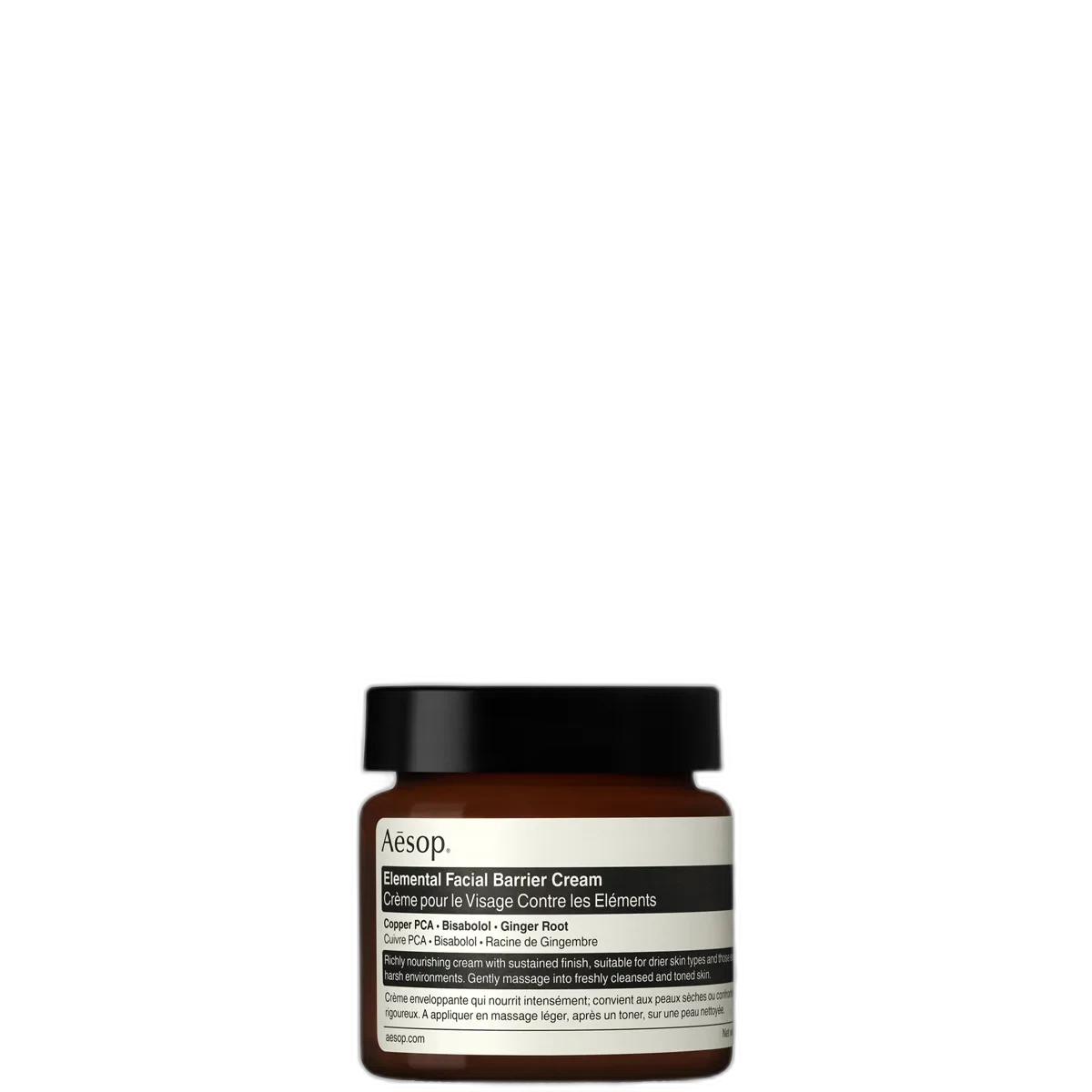
Elemental Facial Barrier Cream
Aesop Aromatic Ritual
 Verified reviewer
Pros & cons.
- +Rich shea-and-castor-oil base delivers real barrier occlusion
- +Distinctive Aesop aromatic identity with a woody-herbal-citrus profile
- +Glycerin and rosehip seed oil add meaningful humectant and EFA support
- +Cushiony, velvety texture that feels substantial without being greasy
- +Long-serving formulation with a track record across global climates
- −Extremely heavy essential oil load inappropriate for sensitive skin
- −Premium price far exceeds comparable shea-based moisturizers
- −Contains multiple declared allergens: linalool, limonene, eugenol, farnesol
- −Not fungal-acne safe due to shea butter and castor oil
- −Fragrance intensity can overpower shared spaces or pillowcases
The full review.
Aesop never claims skincare is only about efficacy. Since the brand emerged from Melbourne in 1987, it has focused on the sensorial: the smell, texture, typography, bottle shape, and the ritual of twice-daily application. Elemental Facial Barrier Cream best expresses this philosophy in the Aesop lineup. This cream treats moisturizing as an aromatic ceremony, using formulation choices that prioritize that ritual.
The scent is immediate upon opening the tube. A dense woody-herbal-citrus cocktail of lavender oil, rosemary oil, clove oil, tangerine peel oil, and sandalwood arrives before the texture. Some users love this; others react negatively within thirty seconds. If you use fragrance-free moisturizers because your skin or nose cannot tolerate heavy aromatic blends, this cream is not for you.
Beneath the aroma, the formula is more interesting than skeptics suggest. The base uses shea butter, castor oil, pentaerythrityl tetraisostearate, and caprylic/capric triglyceride—a thick occlusive-emollient stack that delivers the barrier-seal performance promised by the name. Glycerin is third on the INCI list, providing a humectant layer beneath the oils, while rosehip seed oil adds essential fatty acids and trace compounds for overnight recovery. Bisabolol soothes the essential oil content, and trace zinc PCA and copper PCA provide the ‘mineral complex’ marketing hook. This is not groundbreaking. It is solidly constructed for its target: moisturizing dry, non-reactive skin in cool-to-cold weather.
The skin experience matches the packaging. The cream is thick and cushiony from the tube, softens with fingertip warmth, and spreads into a satin-velvet finish that feels substantial but not greasy. The aroma pulses during application, then settles after two minutes into a quiet background note that lasts about an hour. The barrier effect is immediate, cushioning dry patches from the first use. Over one week, users typically report improved resilience against tightness and flaking caused by winter indoor heating.
The cost-benefit math is where the assessment lands. At $75 for 60ml, this cream costs roughly five times more than a comparably effective shea-based occlusive moisturizer from a drugstore brand. You can match the clinical work—occlusive sealing, humectant support, and barrier lipids—at a fraction of the price. You cannot replicate the Aesop sensorial identity, the aromatic blend, or the brand’s ritual. That value works for some customers. However, you are buying brand experience and aroma, not pharmacological superiority.
The essential oil content is another factor. Dermatological literature shows sensitization risks for lavender, clove, tangerine peel, and related essential oils. The presence of linalool, limonene, eugenol, and farnesol as declared allergens at the bottom of the INCI list signals this formula is not for reactive or compromised-barrier skin. Aesop follows its category norms by using heavy essential-oil formulations, but this means a cream marketed for barrier support is contraindicated for patients who need barrier support most. This is a contradiction.
This product suits people with dry, healthy, non-reactive skin who want the Aesop aesthetic and a sensory ritual. Used nightly in winter, it makes a routine feel intentional. Everyone else—those with sensitive, acne-prone, or fungal-acne-prone skin, budget-conscious buyers, or those preferring unscented formulations—has better options at every price point. Elemental Facial Barrier Cream is distinctive, not universal.
Formula
Ingredient analysis.
Full INCI list
Water (Aqua), Ricinus Communis (Castor) Seed Oil, Glycerin, Pentaerythrityl Tetraisostearate, Butyrospermum Parkii (Shea Butter), Cetearyl Alcohol, Stearic Acid, Hydrogenated Castor Oil, PEG-20 Stearate, Ceteareth-20, Glyceryl Stearate, Rosa Canina Fruit Oil, Coco-Caprylate, Phenoxyethanol, Fusanus Spicatus Wood Oil, Disodium EDTA, Euphorbia Cerifera (Candelilla) Wax, Caprylic/Capric Triglyceride, Helianthus Annuus (Sunflower) Seed Oil, Tocopherol, Copernicia Cerifera (Carnauba) Wax, Bisabolol, Rosmarinus Officinalis (Rosemary) Leaf Oil, Lavandula Angustifolia (Lavender) Oil, Zinc PCA, Benzoic Acid, Eugenia Caryophyllus (Clove) Flower Oil, Decyl Glucoside, Dehydroacetic Acid, Copper PCA, Sodium Citrate, Ormenis Multicaulis Oil, Ethylhexylglycerin, Citrus Tangerina (Tangerine) Peel Oil, Pentylene Glycol, Zingiber Officinale (Ginger) Root Extract, Farnesol, Eugenol, Linalool, D-Limonene
Skin match.
The science.
The Science
The barrier-support mechanism in this cream is well-supported. Decades of dermatological literature show Shea butter works as an effective occlusive and emollient; its stearic and oleic acids support stratum corneum lipids. Glycerin's humectant role is among the most documented in skincare, and at the third-ingredient position, it binds water. Rosehip seed oil has a smaller, growing evidence base for barrier support through essential fatty acid delivery. The evidence weakens regarding the essential oil content. Multiple dermatology reviews identify lavender, clove, and related essential oils as contact sensitizers. The inclusion of declared EU allergens (linalool, limonene, eugenol, farnesol) confirms the formulation contains known sensitizing compounds. Literature shows these ingredients can trigger cumulative irritation in susceptible users, especially with daily use on compromised skin—the exact population the cream targets. Copper PCA is likely at a trace concentration with no clinical efficacy, making its inclusion a brand signature rather than an active driver.
Dermatologist Perspective
Dermatologists often caution patients with reactive skin or compromised skin barriers against heavy essential oil formulations. Board-certified dermatologists note that lavender, clove, and citrus peel oils are recognized contact sensitizers; using them in products marketed for barrier repair creates a clinical contradiction. For patients with healthy, non-reactive dry skin, this shea-based occlusive works as an effective winter moisturizer, though dermatologists generally prefer fragrance-free alternatives for recovering barriers. This cream is not typically recommended for patients with eczema, rosacea, perioral dermatitis, or a history of fragrance contact allergy.
Where it fits in your routine.
Warm a pea-size amount between fingertips until soft. Press and smooth it over clean, slightly damp skin morning and night. Do not layer this with retinoids or acid exfoliants due to the essential oil content; use them at different times. In the AM, wait 60-90 seconds for the cream to settle before applying sunscreen to prevent pilling. People with a history of fragrance reactivity should patch test on the inner arm for at least seven days before daily face use.
At $75 for 60ml, this is a premium product. The price reflects brand identity rather than formulation superiority. Several $10-20 drugstore creams match or beat the clinical performance of the shea-and-castor-oil base, and some omit sensitizing essential oils. You pay more for the Aesop aesthetic, the aromatic experience, and the brand's skincare ritual. If the smell, the tube, the typography, and the application act matter to your skincare purchase, the premium is defensible. If you focus only on clinical outcomes, you overpay.
Dry, non-reactive, healthy skin that enjoys a sensorial, ritual-focused skincare experience. It works well for cold-climate winter use and Aesop devotees who tolerate the brand's essential oil approach. Users who like woody-herbal aromatic profiles will find it distinctive.
Avoid this cream if you have sensitive, reactive, rosacea-prone, eczema-prone, or acne-prone skin. People with fragrance allergies or history of essential oil contact reactions should choose other products. Budget-conscious buyers can find comparable occlusive performance for less with fragrance-free options.
Product details.
Rich, dense cream that feels substantial on the skin and softens with warmth
Lavender, rosemary, clove, tangerine, and sandalwood create an intense woody-herbal-citrus aroma.
60ml white plastic tube with Aesop's signature typographic label
The scent leads the first impression — a strong cedar-and-herb aroma that users either love or reject. It feels cushiony and substantial on the skin, leaving a velvety finish after a few minutes. Some first-time users report mild warmth or tingling from the essential oil content.
3-4 months with twice-daily face and neck application
12 months
fall winter
The backstory.
Aesop was founded in Melbourne in 1987 and built its identity on high-design apothecary aesthetics, sensorial formulations, and a signature botanical-and-essential-oil approach to skincare. Elemental Facial Barrier Cream is one of the longer-serving products in the line, aimed at the brand's customers in colder climates who want a substantial moisturizer that still fits the Aesop aromatic identity.
About Aesop
Established Brand (5–20 years). Aesop was founded in Melbourne in 1987 and has become a global luxury skincare brand known for its signature botanical-and-essential-oil aromatic style. Its formulations prioritize sensory identity over clinically validated actives, and independent dermatological research on specific Aesop products is limited.
FAQ.
Is it safe for sensitive skin?
Unlikely. The ingredient list includes lavender, rosemary, clove, tangerine peel, and sandalwood oils, along with linalool, limonene, eugenol, and farnesol. People with reactive skin or fragrance allergies should patch test for at least a week.
Does it work as a night cream for retinol routines?
Use only cautiously. The essential oil content can increase irritation from retinoids. Use this on rest nights and choose a calmer moisturizer on retinol nights. The emollient layer supports the barrier; the fragrance load creates the risk.
Is this cream fungal-acne safe?
No. It contains shea butter, castor oil, sunflower seed oil, and caprylic/capric triglyceride. These ingredients feed Malassezia. Skip it if you have fungal acne or seborrheic dermatitis.
Will it work under sunscreen?
Yes, but the thick texture takes an extra minute to settle before SPF application. In the AM, use a smaller amount under a lightweight sunscreen to avoid pilling.
Is it worth the price?
Only if you value the Aesop brand identity and aromatic experience. Shea-based creams costing a quarter as much match the occlusive performance. You pay for ritual, not superior formulation.
Does the fragrance fade after application?
It softens significantly within 5-10 minutes but stays at low intensity for a while. Scent-sensitive users or those sharing a bed with partners who dislike strong essential oils should note this.
What the community says.
"beautiful scent"
"deeply moisturizing"
"luxurious feel"
"overpowering fragrance"
"expensive"
"broke out sensitive users"