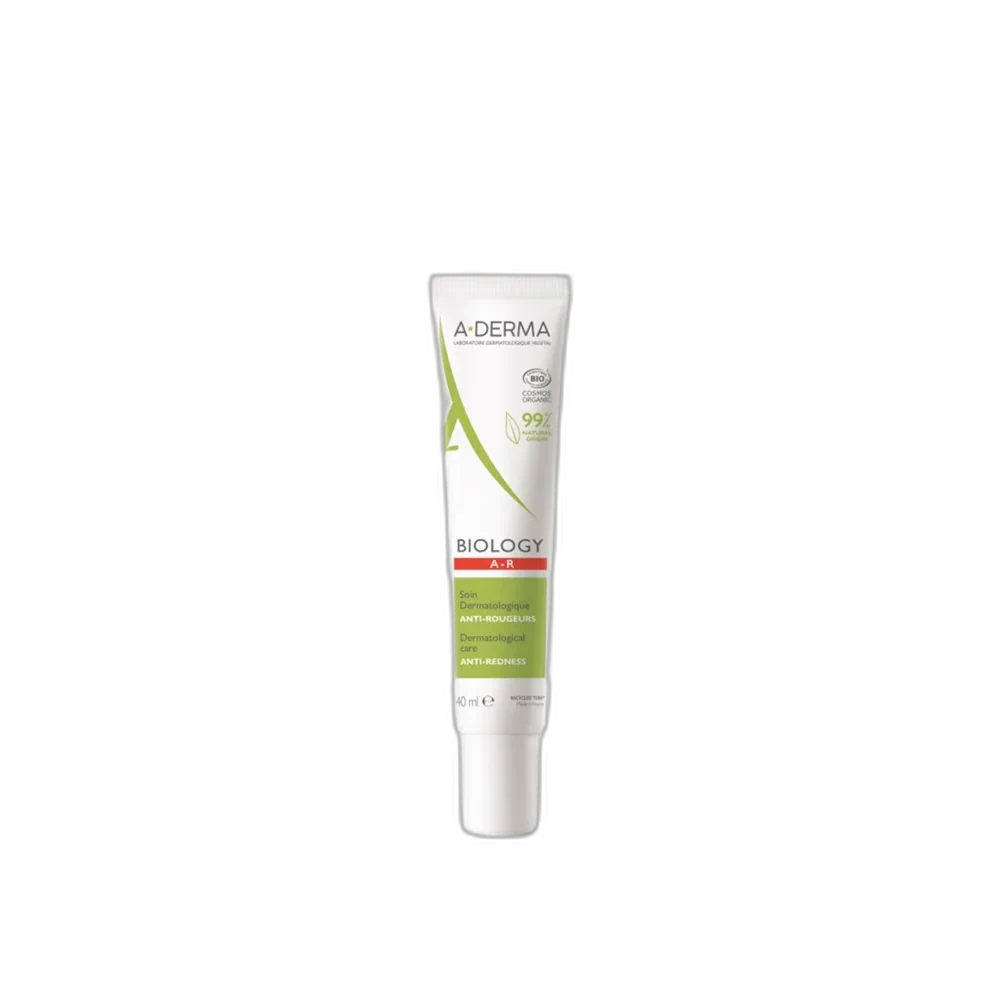
Biology A.R Anti-Redness Dermatological Cream
French Pharmacy Rosacea Pick
 Verified reviewer
Pros & cons.
- +Proprietary Rhealba oat extract backed by published Pierre Fabre research
- +Fully fragrance-free and essential-oil-free formula for reactive skin
- +Noticeable calming of baseline redness within 2 to 4 weeks
- +Cushioning texture that layers well under sunscreen and makeup
- +Airless pump packaging protects the oxidation-sensitive active
- +Non-comedogenic enough for combination rosacea-prone skin
- +Pregnancy-safe with no contraindicated actives
- −40ml tube is small relative to the price point
- −Limited availability outside European pharmacy channels
- −Not rich enough for very dry skin in harsh winter conditions
- −Does not address papulopustular rosacea or active breakouts
- −Subtle effect may feel slow for users expecting dramatic results
The full review.
Most oat skincare uses colloidal oatmeal, which is fine-ground mature oat added to moisturizer for soothing. A-Derma’s Biology A.R cream uses something different: Avena Rhealba. Pierre Fabre grows this specific oat variety in its own fields in the Tarn region of southern France. They harvest it as a twenty-day-old juvenile plantlet—before grain forms or gluten proteins develop—when saponins and flavonoids are at their peak. This level of detail is typical of the European pharmacy segment. This agricultural specificity sets this cream apart from standard drugstore ‘oat moisturizers.’
The cream targets a specific face: one with persistent, patchy pinkness across the cheeks and nose that flushes from hot coffee, warm rooms, wine, workouts, or stress. Dermatologists call this rosacea subtype one, a state between ‘just sensitive’ and ‘needs prescription intervention.’ Biology A.R targets this middle ground. The airless tube contains a medium-weight, fragrance-free cream that cushions the skin without feeling heavy. It absorbs to a soft satin finish that works under sunscreen or makeup. Application causes no tingling, heat, or perfume, and contains no menthol for cooling. The calming effect is quiet and real.
The ingredient list is short and disciplined, like many pharmacy-brand formulations. Rhealba oat extract is at the top, followed by emollient scaffolding—caprylic/capric triglyceride, shea butter, squalane, and glycerin—plus a stabilizing polymer, dimethicone for slip, tocopherol as an antioxidant, and bisabolol as a secondary soother. The excipient list avoids common triggers: no fragrance, no essential oils, no alcohol denat, and no hidden sensitizers under ‘natural’ labels. It is an intentional exercise in using fewer ingredients.
The texture earns the cream its reputation. Reactive, rosacea-prone skin often rejects both ends of the moisturizer spectrum: thin watery gels feel insufficient, while heavy occlusive creams trigger heat and flushing. Biology A.R sits in the middle: thick enough to cushion skin and seal hydration, but light enough to wear under mineral sunscreen without pilling. Used twice a day, most users see baseline redness soften within two weeks. Red patches do not vanish overnight—this is a slow, cumulative calming effect, not a cover-up—but flare-up frequency and intensity drop. Skin that reacted to weather shifts tolerates them better. Skin that stung during its routine starts to tolerate more actives.
There are honest limitations. This is a 40ml tube, and the price is not generous for the volume. A-Derma distributes primarily through European pharmacies and specialty retailers, so US shoppers often pay a premium via import channels. The hydration level suits normal to moderately dry skin, but for deep winter or very dehydrated rosacea skin, you may need to layer an occlusive like petrolatum or a cicaplast-style balm over it at night. Oily skin may find it too rich. This is not a treatment for full papulopustular rosacea; if you have breakouts with redness, see a dermatologist rather than using a moisturizer.
The cream works because it respects what reactive skin needs: fewer ingredients. Current skincare trends push stacking actives and complex multi-step routines, which often harms rosacea-prone skin. Biology A.R is a pharmacy brand’s reminder that sometimes the best move for inflamed skin is applying something calming twice a day and stopping irritation. If that is your required routine, this cream delivers more reliably than most competitors. It is not glamorous or innovative. It is a well-engineered tool for a specific job, backed by research, made by a company that has studied oat longer than most Instagram-marketing brands have existed.
Formula
Texture
The texture earns the cream its reputation. Reactive, rosacea-prone skin often rejects both ends of the moisturizer spectrum: thin watery gels feel insufficient, while heavy occlusive creams trigger heat and flushing. Biology A.R sits in the middle: thick enough to cushion skin and seal hydration, but light enough to wear under mineral sunscreen without pilling. Used twice a day, most users see baseline redness soften within two weeks. Red patches do not vanish overnight—this is a slow, cumulative calming effect, not a cover-up—but flare-up frequency and intensity drop. Skin that reacted to weather shifts tolerates them better. Skin that stung during its routine starts to tolerate more actives.
Ingredient analysis.
Full INCI list
Avena Rhealba Leaf Extract, Aqua, Caprylic/Capric Triglyceride, Propanediol, Glycerin, Butyrospermum Parkii Butter, Pentylene Glycol, Cetearyl Alcohol, Cetyl Alcohol, Hydroxyethyl Acrylate/Sodium Acryloyldimethyl Taurate Copolymer, Coco-Caprylate/Caprate, Glyceryl Stearate, Bisabolol, Dimethicone, Tocopherol, Disodium EDTA, Citric Acid, Squalane, PEG-100 Stearate, Polysorbate 60, Sodium Hydroxide, Phenoxyethanol
Skin match.
The science.
The Science
Rhealba oat drives this cream's efficacy. Pierre Fabre published several studies on how this extract affects inflammatory pathways. A 2008 paper in Experimental Dermatology showed that saponin-rich oat plantlet extract reduces neurogenic inflammation markers in cultured skin cells. Later work showed it modulates prostaglandin and histamine release in reactive skin models. Unlike mature oat, juvenile plantlets harvested before grain formation have more flavonoids and saponins per gram of extract. They also contain no gluten protein, which matters for reactive skin that reacts topically to wheat-family proteins.
Bisabolol is the secondary active and has more established evidence. A 2014 paper in the Journal of Inflammation Research reviewed how bisabolol affects TNF-alpha and interleukin-6 release; it found a consistent anti-inflammatory signal at standard dermatological concentrations. Combining Bisabolol with Rhealba targets vascular reactivity specifically, using two calming actives with different mechanisms to reach the same endpoint.
The emollient scaffolding makes this formula clinically thoughtful. Squalane is a non-comedogenic lipid that mimics skin's native sebum. Shea butter provides triterpenes with a mild anti-inflammatory profile. The formula lacks fragrance, essential oils, and ethanol, matching dermatology literature recommendations for rosacea-prone skin: minimize everything that isn't directly therapeutic. Pierre Fabre designed this formula as a drug-adjacent product rather than a cosmetic, so the ingredients reflect tolerability research instead of sensory trends.
Dermatologist Perspective
Dermatologists often recommend A-Derma products for patients with erythematotelangiectatic rosacea, the subtype with persistent facial redness and visible small blood vessels but no significant papules. French dermatology practice frequently cites The Biology A.R cream as a first-line emollient for this subtype, usually alongside prescription treatments like topical ivermectin or brimonidine. Board-certified dermatologists note the fragrance-free base and targeted anti-inflammatory profile make it a safe over-the-counter option for patients starting a rosacea routine. It is commonly prescribed as a twice-daily moisturizer in minimal routines that include a non-soap cleanser and mineral sunscreen to reduce skin reactivity before adding more active treatments.
Where it fits in your routine.
Apply a pea-to-dime-sized amount to clean, dry skin morning and night. Smooth it gently over the face, focusing on the cheeks, nose, and chin where redness concentrates. In the morning, always follow with a mineral sunscreen. UV triggers rosacea flushing, and skipping SPF undoes the cream's work. At night, use it as the final step or layer it under a heavier occlusive balm in winter. Avoid high-strength exfoliants during flare periods.
At approximately 28 US dollars for a 40ml tube, the price per milliliter exceeds general-purpose drugstore moisturizers but stays below most Western luxury anti-redness creams. The targeted pharmacy-grade formula lasts roughly two to two-and-a-half months with twice-daily facial use, making the monthly cost reasonable. The cream only comes in the 40ml size, so no larger value option exists. For someone with mild to moderate rosacea subtype one, this is one of the more cost-effective targeted creams on the market — the cost per symptom-free day is low once the calming effect stabilizes.
This works for anyone with mild to moderate rosacea subtype one, persistently reactive skin, or chronic facial flushing who wants a fragrance-free, pharmacy-grade cream with an evidence base. It suits those building a minimal routine focused on tolerance instead of layering actives.
This works for oily non-reactive skin, multitasking anti-aging moisturizer users, and people with full papulopustular rosacea who need prescription treatment instead of a topical soother. Budget shoppers may want larger-format calming creams.
Product details.
All Year Certifications cruelty-freefragrance-free Background
The backstory.
A-Derma spent years researching Avena Rhealba — a specific variety of oat grown in Pierre Fabre's own fields in the Tarn region of France, harvested before the gluten-forming grain stage to preserve its anti-inflammatory saponins. The Biology A.R cream represents the application of that research to rosacea subtype 1, the category of persistent facial redness that sits between purely sensitive skin and full papulopustular rosacea.
About A-Derma
Legacy Brand (20+ years)Pierre Fabre Dermo-Cosmétique created A-Derma in 1988, the same French dermatological laboratory that makes Avène and Ducray. The brand uses Rhealba oat extract, which multiple in-house and independent studies show works on inflammation and skin barrier repair.
Common myths.
Oat in skincare is just a soothing gimmick.
This specific juvenile Rhealba oat has a documented profile of saponins and flavonoids. These affect inflammatory pathways differently than standard colloidal oatmeal.
Anti-redness creams just cover up flushing.
This cream has no color-correcting pigments. It reduces visible redness by calming vascular reactivity, which shows more slowly but lasts longer.
FAQ.
Does A-Derma Biology A.R actually reduce rosacea redness?
Users with mild to moderate rosacea subtype 1 (persistent flushing without papules) report less baseline redness after 2 to 4 weeks of twice-daily use. It does not replace prescription rosacea treatment for papules and pustules.
How does Rhealba oat differ from regular colloidal oatmeal?
Rhealba is an oat variety harvested as a juvenile plantlet before gluten proteins develop. A-Derma's research shows its calming effect comes from a specific saponin and flavonoid profile that standard colloidal oatmeal lacks at those concentrations.
Can I use this cream with retinol?
Yes, but offset the applications. Apply your retinol at night. Use the Biology A.R cream on alternate nights or in the morning as a buffer. The Biology A.R cream calms reactivity, which helps skin tolerate retinoids without flaring.
Is this moisturizing enough for very dry skin?
This works for normal to moderately dry skin. In winter or for very dry rosacea-prone skin, layer an occlusive like Cicaplast Baume or a plain petrolatum product on top at night.
Is A-Derma Biology A.R safe during pregnancy?
Yes. The formula has no retinoids, salicylic acid, or essential oils flagged during pregnancy. Its anti-inflammatory design works for pregnancy-related flushing.
How long does one tube last?
A 40ml airless tube lasts about 2 to 2.5 months if applied to the face twice daily. The average monthly cost is reasonable for a pharmacy-grade targeted treatment.
Can men with rosacea use this cream?
Yes — the cream is fragrance-free, absorbs without residue, and works well under an SPF. It is gender-agnostic and men with facial flushing use it often.
What the community says.
"noticeably calms flushing"
"comfortable for sensitive skin"
"fragrance-free with no sting"
"absorbs without residue"
"small tube for the price"
"limited availability in the US"
"may not be rich enough for very dry skin in winter"