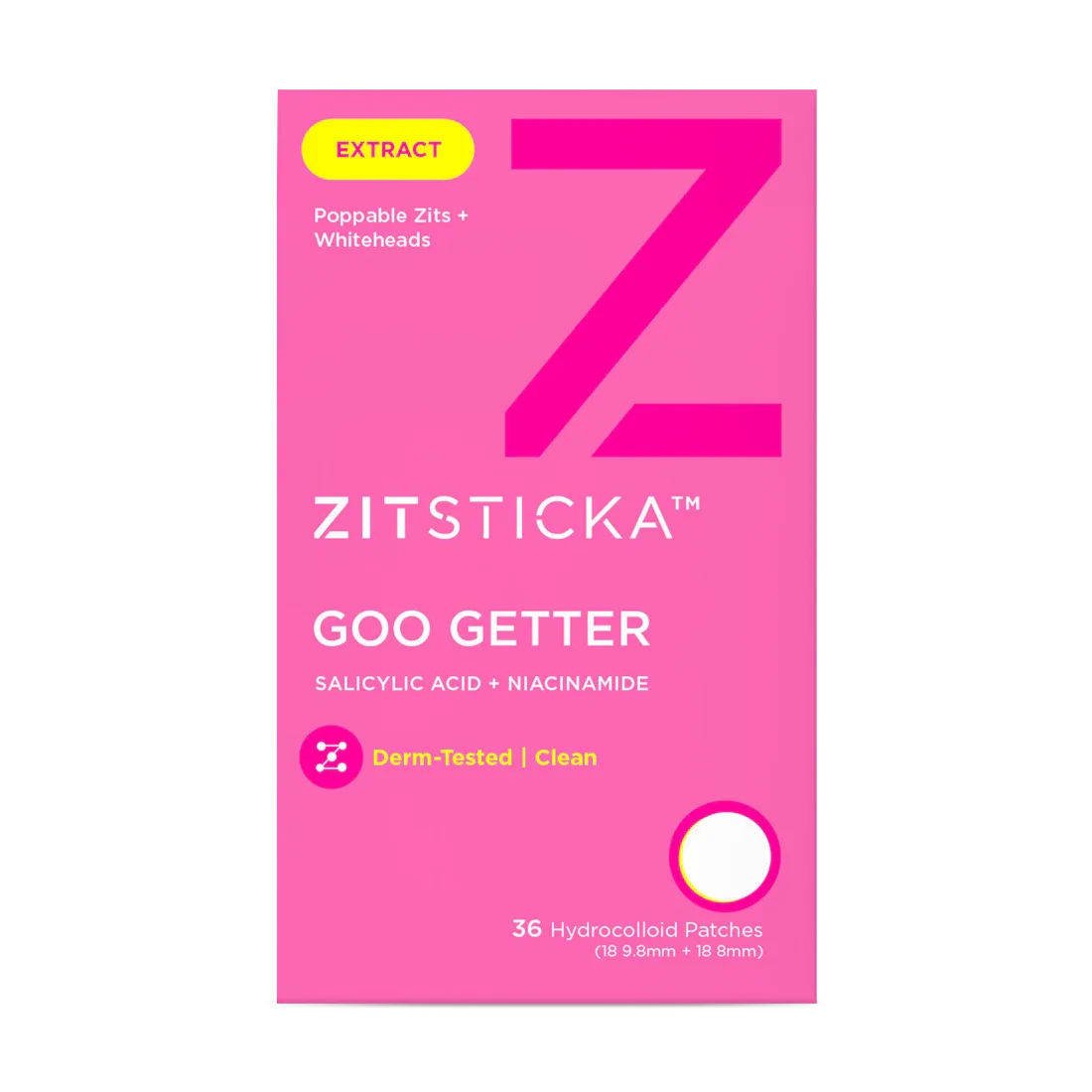
GOO GETTER Pore Clarifying Pimple Patch
Acne Patch Overachiever
 Verified reviewer
Pros & cons.
- +Active ingredients sealed under hydrocolloid provide sustained-release delivery
- +Visibly flattens whiteheads and reduces redness overnight
- +Physical barrier prevents picking — arguably the most important anti-acne function
- +Strong adhesive stays put through sleep without slipping or peeling
- +Salicylic acid, niacinamide, vitamin C, and tea tree oil are evidence-backed actives
- +Simple nine-ingredient formula with no unnecessary filler
- −Only effective on surface-level blemishes with a visible head
- −Price per patch is higher than basic drugstore hydrocolloid patches
- −Tea tree oil may irritate very sensitive or reactive skin
- −Some users report adhesive residue on oily skin types
- −Contains mineral oil, which some consumers prefer to avoid
The full review.
Hydrocolloid patches use simple wound care technology for skincare. These moisture-absorbing stickers draw fluid from a blemish, protect it from bacteria and fingers, and create the moist wound-healing environment dermatologists have recommended for decades. It works.
ZitSticka’s GOO GETTER builds on this premise. If a patch sits on a pimple for eight hours, why not add ingredients to treat the blemish? The product uses a hydrocolloid matrix infused with salicylic acid, niacinamide, vitamin C, and tea tree oil. These four ingredients deliver through an occlusive sustained-release system.
The delivery method matters more than the individual ingredients. Salicylic acid in a face wash contacts skin for sixty seconds before rinsing. Salicylic acid in a spot treatment sits on the surface, losing potency as it oxidizes or rubs against a pillow. Salicylic acid under a hydrocolloid patch stays in direct, sustained contact with the blemish for six to eight hours in an occlusive environment that enhances penetration. The same applies to the niacinamide, the vitamin C, and the tea tree oil. The patch format is a more efficient delivery mechanism for topical acne actives than convenience alone.
The tea tree oil is a calculated choice. Melaleuca alternifolia has documented antimicrobial activity against Cutibacterium acnes, but volatile terpene compounds evaporate quickly in open-air treatments. Under the hydrocolloid matrix, the oil maintains contact with the blemish and its resident bacteria for the full wear time. For users sensitive to tea tree oil, this sustained exposure can cause sustained irritation.
The patches work on surface-level whiteheads and pustules that have a visible head. Apply the translucent patch to clean, dry skin, press firmly, and continue your evening. Over six to eight hours, the center turns opaque white as the hydrocolloid absorbs pus and fluid. When you peel it off in the morning, the blemish is flatter, less red, and less angry. It works for the right blemish type.
GOO GETTER does not work on deep cystic acne, hormonal nodules, or blind pimples. The hydrocolloid needs something to absorb, and the actives must reach the lesion; neither happens if inflammation is deep in the dermis. ZitSticka’s KILLA patch uses microdarts for deeper delivery in those cases. GOO GETTER is a surface specialist.
The adhesive is effective. The patches stick through sleep, pillowcase friction, and face-touching. They peel off cleanly, though some users report minor adhesive residue on oily skin. The patches are thin and inconspicuous for a night in or a work-from-home day.
The behavioral benefit is significant. In ZitSticka’s consumer study, ninety-two percent of users said the patch stopped them from touching their breakout. Picking, squeezing, and touching blemishes turns a three-day pimple into a three-week scar. A physical barrier that prevents picking may do more for acne outcomes than the medicated ingredients.
At roughly sixteen dollars for thirty-six patches, the price-per-patch is higher than basic drugstore hydrocolloid patches. Whether the four active ingredients justify the premium depends on your value calculation. The actives are real and their delivery through the patch is more efficient than open-air application. However, a cheaper patch also performs the core hydrocolloid functions of absorbing fluid and protecting the spot. You pay for the treatment layer on top of the protection layer.
The ingredient list is short with nine ingredients total. This is a simple delivery concept. Paraffinum liquidum and styrene/isoprene copolymer provide the adhesive and structural matrix while the actives work within it. The transparency is part of the brand’s appeal.
For those with regular surface-level breakouts wanting a hands-off overnight treatment that combines physical protection with active ingredients, GOO GETTER is an effective product. It delivers on its specific promise with consistent reliability.
Formula
Formula
Ingredient analysis.
Full INCI list
Cellulose Gum, Glyceryl Hydrogenated Rosinate, Paraffinum Liquidum, Styrene/Isoprene Copolymer, Pentaerythrityl Tetra-di-t-butyl Hydroxyhydrocinnamate, Niacinamide, Salicylic Acid, Ascorbic Acid, Melaleuca Alternifolia (Tea Tree) Leaf Oil
Skin match.
The science.
The Science
Medical settings have used hydrocolloid wound dressings since the 1980s; applying them to acne uses established wound-healing science. A study in the Journal of the American Academy of Dermatology (Koo et al., 2018) shows hydrocolloid patches significantly reduce acne lesion size and erythema compared to untreated controls. This works even without active ingredients, as the absorption and occlusion mechanism alone provides therapeutic benefit.
Salicylic acid's efficacy against acne is well-documented. As a lipophilic beta-hydroxy acid, it penetrates the pilosebaceous unit to dissolve the sebum-keratin plug that forms comedones. A review in Clinical, Cosmetic and Investigational Dermatology (Arif, 2015) confirmed its keratolytic, comedolytic, and anti-inflammatory properties. Sustained-contact delivery via a hydrocolloid patch maximizes these effects by keeping the BHA in direct contact with the lesion for extended periods.
Tea tree oil (Melaleuca alternifolia) shows in-vitro antibacterial activity against Cutibacterium acnes. A randomized controlled trial in the Medical Journal of Australia (Bassett et al., 1990) found 5% tea tree oil gel effectively reduced inflamed and non-inflamed acne lesions, though it acts slower than benzoyl peroxide. Sustained delivery within a sealed patch environment may increase tea tree oil's contact time with target bacteria.
Niacinamide's anti-inflammatory and sebum-regulating properties are validated for acne treatment. A study in the International Journal of Dermatology (Draelos et al., 2006) shows that topical 4% niacinamide significantly reduced sebum production and inflammatory acne lesions over eight weeks.
References
- A randomized double-blind trial comparing 5% tea tree oil gel with benzoyl peroxide in acne — Medical Journal of Australia (1990)
- Salicylic acid as a peeling agent: a comprehensive review — Clinical, Cosmetic and Investigational Dermatology (2015)
Dermatologist Perspective
Dermatologists view hydrocolloid patches as a useful acne treatment adjunct, especially because they prevent picking and provide a moist wound-healing environment. Board-certified dermatologists note that medicated patches like GOO GETTER offer the advantage of sustained active ingredient delivery, but they emphasize that patches treat individual lesions rather than the underlying causes of acne. Dermatologists typically recommend using pimple patches with a comprehensive acne regimen — a consistent BHA or benzoyl peroxide product, plus retinoids if appropriate — instead of using patches as a standalone treatment. The tea tree oil component may concern dermatologists treating patients with contact dermatitis sensitivities.
Where it fits in your routine.
Cleanse the area and pat dry. Adhesion requires dry skin; moisture prevents it. Peel a patch from the sheet and press it onto the blemish for 5-10 seconds. Leave it on for 6-8 hours or overnight. The patch turns white and opaque as it absorbs fluid. Peel from one edge to remove. Apply a fresh patch if fluid remains. Do not apply over other skincare products; the patch must touch the skin directly.
At about $16 for 36 patches (~$0.44 per patch), GOO GETTER costs more than basic drugstore hydrocolloid patches ($3-8 for 36-40 patches, ~$0.08-0.20 per patch) but less than premium microdart options. The four active ingredients provide therapeutic value beyond plain hydrocolloid, and the sustained-release delivery works more efficiently than traditional spot treatments. A 36-pack lasts months for occasional breakouts, making the cost negligible. For frequent acne, the cost increases—and a consistent leave-on BHA product addresses the root cause more effectively.
This works for anyone with occasional whiteheads seeking a hands-off overnight treatment that combines protection with active ingredients. It helps habitual pickers by providing a physical barrier to stop touching, and it treats blemishes without drying the surrounding skin.
The patch cannot reach subsurface inflammation in deep cystic or hormonal acne. It is not for people with tea tree oil sensitivities or those seeking a comprehensive acne treatment instead of a spot-by-spot solution.
Product details.
A faint tea tree oil scent is detectable up close, but it dissipates once the patch is applied and sealed against the skin.
Individual patches sit on a peel-away sheet inside a compact, resealable pouch. This packaging works for on-the-go use and keeps unused patches hygienic.
Press the patch firmly onto a clean, dry blemish for a few seconds to ensure adhesion. The patch feels lightweight and barely noticeable once applied. Over 6-8 hours, the patch center turns white as it absorbs fluid — this is the hydrocolloid working. Upon removal, the blemish appears flatter with reduced redness.
Depends on breakout frequency — a 36-pack lasts weeks for frequent acne or several months for occasional breakouts.
24 months ``` ```markdown
All Year ``` ```markdown
The backstory.
ZitSticka built its reputation on the KILLA microdart patch for deep, underground pimples. GOO GETTER was launched in 2020 as the surface-level counterpart — designed specifically for blemishes that have already come to a head and are ready to be drained. The name reflects both the product's fluid-absorbing function and the brand's irreverent, Gen Z-friendly marketing voice.
About ZitSticka
Emerging Brand (2–5 years)Daniel Kaplan and Robbie Miller founded ZitSticka in 2018. Heyday acquired the brand in 2022. ZitSticka pioneered microdart acne patches and grew a loyal following via social media and DTC marketing. The formulations use well-studied individual ingredients, but clinical validation relies on self-reported consumer studies.
Common myths.
Pimple patches treat acne; they are a treatment, not just a bandage.
Hydrocolloid patches work by absorbing fluid and sealing the area to prevent bacteria and picking. The medicated ingredients in GOO GETTER add therapeutic value, but the patch manages surface-level blemishes rather than the root cause of acne. You still need a consistent skincare routine with proper actives.
Pop the pimple before applying the patch for it to work.
The patch works on blemishes with a visible head, but popping them increases the risk of scarring, deeper infection, and post-inflammatory hyperpigmentation. Apply the patch directly over the intact whitehead; the hydrocolloid draws the fluid out safely.
FAQ.
Does GOO GETTER work on cystic acne?
No — GOO GETTER is designed specifically for surface-level blemishes with a visible head (whiteheads, pustules). It cannot reach deep cystic or nodular acne beneath the skin. For blind, underground pimples, ZitSticka's KILLA microdart patch is designed to deliver ingredients deeper.
How long should I leave the patch on?
Leave the patch on for 6-8 hours or overnight. The patch turns white and opaque as it absorbs fluid from the blemish; this visual indicator shows it works. Remove the patch when it is saturated or after 8 hours, whichever comes first. Apply a fresh patch if the blemish still has fluid.
Can I wear the patch under makeup?
The thin, translucent design lets you apply concealer over the patch, but the matte finish shows through full-coverage foundation. Many users wear them overnight and remove them before their morning routine. The daytime patches work best on bare skin.
Are these better than regular hydrocolloid patches?
Salicylic acid, niacinamide, vitamin C, and tea tree oil add active treatment that basic hydrocolloid patches lack. The core fluid-absorption and protective-seal functions remain the same. Whether the active ingredients justify the price premium depends on the benefit seen versus a basic patch.
Can I use these while on prescription acne medication?
Yes, but do not apply the patch directly over areas where you just applied prescription retinoids or benzoyl peroxide. The occlusive seal intensifies these actives and causes irritation. Apply prescription treatments to the surrounding skin and use the patch only on the blemish itself.
---
What the community says.
"Visibly flattens whiteheads overnight"
"Prevents picking and touching blemishes"
"Draws out pus and fluid effectively"
"Adhesive stays on throughout the night"
"Does not work on deep cystic acne"
"Price per patch is higher than basic hydrocolloid patches"
"Tea tree oil may irritate very sensitive skin"
"Some patches leave adhesive residue"
People also looked at.