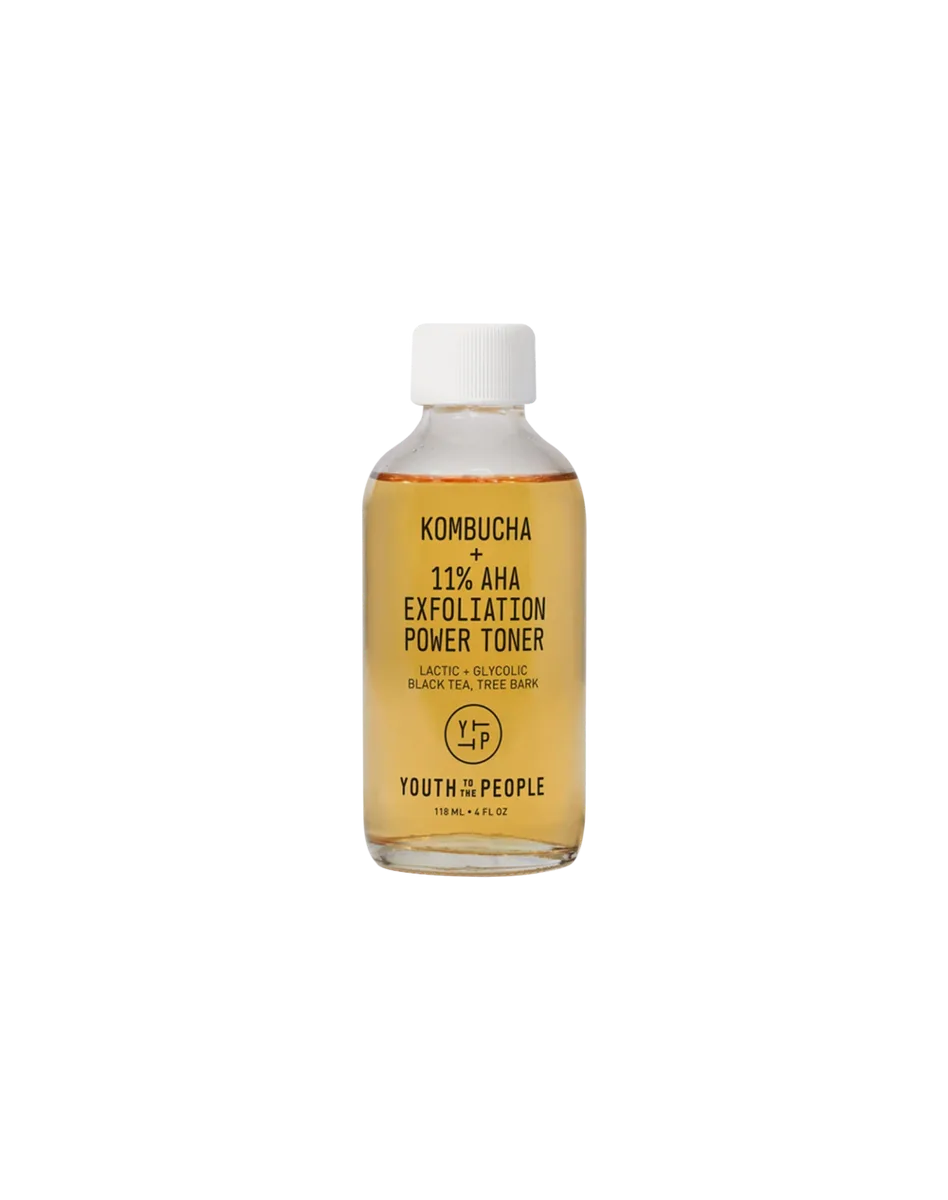
Kombucha + 11% AHA Exfoliation Power Toner
Clean Exfoliant Cult Favorite
 Verified reviewer
Pros & cons.
- +L-arginine time-release system moderates AHA irritation effectively
- +Dual lactic-glycolic acid blend provides multi-depth exfoliation
- +Completely fragrance-free with no essential oils or botanical scents
- +Kombucha and pichia ferments add genuine skin-conditioning benefits
- +Vegan, cruelty-free, and Leaping Bunny certified
- +Immediate visible brightening after first application
- +Clean, minimalist formula with no unnecessary filler ingredients
- −Stinging on application is common, especially for acid beginners
- −Thirty-eight dollars is steep for a fifteen-ingredient formula
- −No barrier-supportive ingredients like ceramides or niacinamide included
- −Not suitable for sensitive, rosacea-prone, or compromised skin
- −Some users report persistent tackiness after application
The full review.
Most AHA toners introduce themselves to your face like an overeager handshake — a sudden, sharp greeting that leaves you wondering if you made a mistake. Youth to the People’s Kombucha + 11% AHA Exfoliation Power Toner takes a subtler approach, and the reason lives near the top of the ingredient list: L-arginine, listed second, right before the acids themselves.
This amino acid does something genuinely clever in the formulation. By partially neutralizing the lactic and glycolic acids, it creates what cosmetic chemists call a buffered system — essentially a time-release mechanism that unfolds the exfoliation gradually rather than dumping it all on your skin at once. It is the difference between a controlled descent and a free fall, and it is the primary reason this toner manages 11% total AHAs without sending most users scrambling for their heaviest moisturizer.
The acid blend itself is thoughtfully proportioned. Lactic acid at 8% does the heavy lifting — it is a larger molecule than glycolic, so it works primarily on the skin’s surface, dissolving the protein bonds that keep dead cells clinging past their welcome. But lactic acid has a second talent that glycolic does not share: it is a humectant, actively drawing moisture to the skin even as it exfoliates. The 3% glycolic acid plays a supporting role, slipping deeper into the stratum corneum with its smaller molecular size to encourage cellular turnover at a level the lactic acid cannot quite reach. Together, they create a multi-depth resurfacing effect that feels more thorough than either acid would deliver alone.
Then there is the kombucha. In a market where fermented ingredients often function more as marketing hooks than meaningful actives, the Saccharomyces/Xylinum/Black Tea Ferment here occupies a middle ground. It delivers organic acids, B vitamins, and antioxidants that genuinely condition the skin, and the Pichia Ferment Lysate Filtrate further downstream adds microbiome-supportive properties. Are these the star performers? No — the AHAs are doing the transformative work. But the ferments add a layer of skin-conditioning sophistication that elevates this above a simple acid-and-water formula.
The texture is essentially water. It pours like a very thin tea — faintly amber from the kombucha and caramel — and spreads across the face without any slipperiness or residue. Some users report a mild tackiness as it dries, but this dissipates once you layer your next product. There is no added fragrance, which is increasingly rare in the clean beauty space where botanical scents often masquerade as functional ingredients. Youth to the People deserves credit for resisting that temptation entirely.
On application, expect a tingle. At pH 3.5 with 11% combined AHAs, some sensation is unavoidable, and anyone telling you otherwise is selling something. The arginine buffering system genuinely moderates this — the sting builds slowly rather than hitting immediately — but it is still present, especially in the first few weeks of use. If you have truly sensitive skin, this is your cue to look elsewhere. The formula does not pretend to be gentle; it pretends to be less aggressive than it actually is, which is an important distinction.
Results follow a predictable AHA timeline. An immediate brightening effect after the first use is common — that characteristic post-exfoliation glow that makes AHA toners so addictive. Within two weeks of consistent use (two to three nights per week), texture improvements become tangible: smoother skin, less visible roughness, a general refinement that shows the acids are doing their job. The longer-term benefits — reduced hyperpigmentation, visible pore minimization, more even tone — typically manifest around the six-to-eight-week mark, assuming consistent use with proper sun protection.
The formula’s simplicity is both a strength and a vulnerability. With only fifteen ingredients, there is very little filler and virtually no potential irritants beyond the acids themselves. But it also means you are paying thirty-eight dollars for what is essentially a well-buffered acid solution with some ferment extracts. There are no ceramides to help with barrier recovery, no niacinamide for pore refinement, no additional antioxidants beyond what the ferments provide. The formula trusts the acids to do the work and asks you to handle the rest with your subsequent products.
This is where the value proposition gets complicated. At thirty-eight dollars for four ounces, used two to three times per week, you are looking at roughly two to three months per bottle. That is not unreasonable for a well-formulated treatment product, but the sparse ingredient list makes the premium harder to justify when comparable acid concentrations exist at lower price points. What you are paying for is the arginine delivery system, the clean and vegan credentials, and the brand’s commitment to transparency — whether those premiums matter to you is a personal calculation.
The product works best as part of a carefully structured nighttime routine: cleanser, this toner, then a hydrating serum and moisturizer to replenish what the acids strip. Morning sunscreen is non-negotiable — AHAs dramatically increase photosensitivity, and skipping SPF would undo whatever brightening benefits you earned the night before.
For oily, combination, and normal skin types dealing with dullness, texture, or stubborn dark spots, this toner delivers honest, measurable results backed by the two most-studied AHAs in dermatology. It respects your skin’s intelligence by releasing its actives gradually rather than carpet-bombing the surface, and the kombucha ferment adds a thoughtful layer of conditioning that most acid toners do not bother with. It is not a revolutionary product, but it is a well-executed one — and in a category crowded with overpriced acid water, that counts for something.
Formula
Texture
The texture is essentially water. It pours like a very thin tea — faintly amber from the kombucha and caramel — and spreads across the face without any slipperiness or residue. Some users report a mild tackiness as it dries, but this dissipates once you layer your next product.
Scent
There is no added fragrance, which is increasingly rare in the clean beauty space where botanical scents often masquerade as functional ingredients. Youth to the People deserves credit for resisting that temptation entirely.
How to Use
On application, expect a tingle. At pH 3.5 with 11% combined AHAs, some sensation is unavoidable, and anyone telling you otherwise is selling something. The arginine buffering system genuinely moderates this — the sting builds slowly rather than hitting immediately — but it is still present, especially in the first few weeks of use. If you have truly sensitive skin, this is your cue to look elsewhere. The formula does not pretend to be gentle; it pretends to be less aggressive than it actually is, which is an important distinction.
Results
Results follow a predictable AHA timeline. An immediate brightening effect after the first use is common — that characteristic post-exfoliation glow that makes AHA toners so addictive. Within two weeks of consistent use (two to three nights per week), texture improvements become tangible: smoother skin, less visible roughness, a general refinement that shows the acids are doing their job. The longer-term benefits — reduced hyperpigmentation, visible pore minimization, more even tone — typically manifest around the six-to-eight-week mark, assuming consistent use with proper sun protection.
Common Complaints
The formula’s simplicity is both a strength and a vulnerability. With only fifteen ingredients, there is very little filler and virtually no potential irritants beyond the acids themselves. But it also means you are paying thirty-eight dollars for what is essentially a well-buffered acid solution with some ferment extracts. There are no ceramides to help with barrier recovery, no niacinamide for pore refinement, no additional antioxidants beyond what the ferments provide. The formula trusts the acids to do the work and asks you to handle the rest with your subsequent products.
Value
This is where the value proposition gets complicated. At thirty-eight dollars for four ounces, used two to three times per week, you are looking at roughly two to three months per bottle. That is not unreasonable for a well-formulated treatment product, but the sparse ingredient list makes the premium harder to justify when comparable acid concentrations exist at lower price points. What you are paying for is the arginine delivery system, the clean and vegan credentials, and the brand’s commitment to transparency — whether those premiums matter to you is a personal calculation.
AM routine
The product works best as part of a carefully structured nighttime routine: cleanser, this toner, then a hydrating serum and moisturizer to replenish what the acids strip. Morning sunscreen is non-negotiable — AHAs dramatically increase photosensitivity, and skipping SPF would undo whatever brightening benefits you earned the night before.
Best for
For oily, combination, and normal skin types dealing with dullness, texture, or stubborn dark spots, this toner delivers honest, measurable results backed by the two most-studied AHAs in dermatology. It respects your skin’s intelligence by releasing its actives gradually rather than carpet-bombing the surface, and the kombucha ferment adds a thoughtful layer of conditioning that most acid toners do not bother with. It is not a revolutionary product, but it is a well-executed one — and in a category crowded with overpriced acid water, that counts for something.
Ingredient analysis.
Full INCI list · pH 3.5
Aqua/Water/Eau, L-Arginine, Lactic Acid, Glycolic Acid, Pentylene Glycol, Glycerin, Betaine, Phenoxyethanol, Potassium Sorbate, Zingiber Officinale (Ginger) Water, Citrus Limon (Lemon) Fruit Water, Saccharomyces/Xylinum/Black Tea Ferment, Tetrasodium Glutamate Diacetate, Pichia Ferment Lysate Filtrate, Caramel
Skin match.
The science.
The Science
The two AHAs in this formula — lactic acid and glycolic acid — represent the most extensively researched chemical exfoliants in dermatology. Glycolic acid, the smallest alpha-hydroxy acid by molecular weight (76 Da), penetrates the stratum corneum efficiently and has been shown to promote both exfoliation and collagen synthesis. A landmark study published in the Journal of the American Academy of Dermatology (Stiller et al., 1996) demonstrated that topical glycolic acid application significantly improved photodamaged skin with increases in epidermal thickness, dermal collagen density, and skin quality.
Lactic acid, with its slightly larger molecular size (90 Da), exfoliates more superficially but offers a dual mechanism that glycolic acid lacks: it functions simultaneously as a humectant, binding water molecules to the skin surface. A double-blind vehicle-controlled clinical trial published in JAMA Dermatology (Stiller et al., 1996) comparing 8% glycolic acid and 8% lactic acid creams for photodamaged skin found both acids produced statistically significant improvements in skin smoothness, discoloration, and overall appearance.
The L-arginine buffering system is particularly noteworthy. When an amino acid partially neutralizes an AHA, it creates what is known as a partially neutralized acid — the AHA remains effective but releases its free acid form gradually as it interacts with the skin's natural pH. This time-release mechanism has been explored in cosmetic chemistry research as a way to deliver effective exfoliation while reducing the peak irritation response that fully free-acid formulas produce.
A comprehensive review published in Cosmetics (2023) examining AHA formulations, mechanisms of action, and efficacy confirmed that combination AHA products can achieve synergistic exfoliation effects, with the different molecular sizes of glycolic and lactic acids enabling multi-level desquamation of the stratum corneum.
References
- Effects of alpha-hydroxy acids on photoaged skin: a pilot clinical, histologic, and ultrastructural study — Journal of the American Academy of Dermatology (1996)
- Topical 8% Glycolic Acid and 8% L-Lactic Acid Creams for the Treatment of Photodamaged Skin — JAMA Dermatology (1996)
- Topical AHA in Dermatology: Formulations, Mechanisms of Action, Efficacy, and Future Perspectives — Cosmetics (2023)
Dermatologist Perspective
Dermatologists frequently recommend AHA-based exfoliants for patients dealing with dullness, textural irregularities, and mild hyperpigmentation, and a combination of lactic and glycolic acids is considered well-supported by clinical evidence. Board-certified dermatologists note that the partially buffered delivery system in this formula — achieved through L-arginine complexation — represents a practical approach to reducing the irritation spike associated with higher AHA concentrations while maintaining efficacy. Dermatologists typically advise that 11% total AHAs is moderate-to-strong for at-home use and recommend starting with once-weekly application, building tolerance gradually. Daily broad-spectrum sunscreen is considered mandatory when using any AHA product, as these acids thin the stratum corneum and significantly increase UV sensitivity.
Where it fits in your routine.
Apply to clean, dry skin at night using a cotton pad or fingertips. Avoid damp skin; it increases acid penetration and irritation. Use once per week for the first 2-3 weeks, then move to 2-3 nights weekly as tolerated. Follow immediately with a hydrating serum and moisturizer. Do not use with retinoids, other direct acids, or vitamin C in the same routine. Apply broad-spectrum SPF 30+ every morning. Avoid the eye area and any broken or irritated skin.
At $38 for 4 oz, this toner is a premium AHA exfoliant. Using it 2-3x weekly lasts 2-3 months, costing about $13-19 per month—a fair price for an active treatment. The L-arginine buffering system and kombucha ferment add sophistication that simpler acid toners lack, but the fifteen-ingredient list makes the premium hard to justify by complexity alone. Youth to the People's clean, vegan, cruelty-free credentials add to the cost, which consumers prioritizing those values may find worth it. For those seeking acid efficacy per dollar, lower price points offer comparable concentrations.
Oily, combination, and normal skin types use this weekly chemical exfoliant to target dullness, texture, and uneven tone. It suits users seeking clean beauty credentials and a buffered AHA formula for gentler delivery.
The 11% AHA concentration is too strong for sensitive, rosacea-prone, or barrier-compromised skin, even with the buffering system. Acid beginners who have never used chemical exfoliants should start with a lower-concentration lactic acid product first.
Product details.
Thin, water-like liquid with a faint amber tint from the kombucha ferment and caramel. It applies smoothly and leaves no residue once absorbed, though some users report slight tackiness before it dries.
It is unscented with no added fragrance or essential oils. A faint fermented note from the kombucha is barely detectable.
Frosted glass bottle uses a controlled-pour cap. The clean, minimalist design matches the brand's aesthetic. The glass is recyclable but slips when hands are wet.
Expect mild tingling or stinging on first application; this is normal for an 11% AHA concentration. Start once per week and build to 2-3 nights weekly. If stinging is intense or lasts beyond 2-3 minutes, rinse off and use less often. Visible brightening shows after the first use.
2-3 months with 2-3x weekly use
12 months
All Year
The backstory.
Youth to the People launched this toner in 2019 as part of their expanding treatment line, combining their superfood ethos with serious actives. The kombucha ferment was a deliberate choice to bridge the gap between trendy fermented skincare and evidence-based AHA exfoliation, and the product has since been reformulated to a 10% version, making the original 11% formula a legacy formulation.
About Youth to the People
Established Brand (5–20 years)Greg Gonzalez and Joe Cloyes founded Youth to the People in 2015, using their family's 40-year professional skincare legacy. The brand makes vegan, cruelty-free formulations with superfood ingredients, but uses ingredient-transparency positioning instead of independent clinical research.
Common myths.
The kombucha in this toner works like drinking kombucha for gut health.
Topical kombucha ferment delivers organic acids and antioxidants to the skin surface. It does not affect the gut microbiome. It works as a conditioning and mild resurfacing agent, not a traditional probiotic.
Stinging indicates it works — more stinging means better results.
11% AHAs cause some tingling, but intense or long stinging means irritation, not efficacy. The L-arginine buffering system in this formula reduces that initial spike. If it burns, use it less often instead of pushing through.
FAQ.
How often should I use the Youth to the People Kombucha AHA Toner?
Use this once per week so your skin adjusts to the 11% AHA concentration. After 2-3 weeks, increase use to 2-3 nights per week. Apply to dry skin at night and use sunscreen the next morning, as AHAs increase photosensitivity.
Can I use this toner with retinol?
Don't use them on the same night. The 11% AHA concentration in this formula plus retinol causes excessive irritation and compromises the skin barrier. Alternate nights: use this toner 2-3 nights per week and retinol on off nights, using a hydrating moisturizer both evenings.
Is this toner safe for sensitive skin?
This formula has an 11% combined AHA concentration (8% lactic + 3% glycolic), which is strong for sensitive skin. The L-arginine buffering system moderates the acid intensity, but people with reactive, rosacea-prone, or easily irritated skin should use a lower-concentration exfoliant.
What does the kombucha do in this toner?
The Saccharomyces/Xylinum/Black Tea Ferment — the kombucha component — provides organic acids, amino acids, and antioxidants to support the skin's microbiome during exfoliation. It works as a conditioning agent that reduces irritation from the dual AHAs and provides mild resurfacing benefits.
Why does this toner sting when I apply it?
An 11% AHA product with a low pH (~3.5) causes mild tingling. The L-arginine in this formula uses a time-release effect to lower the initial spike, but some sensation occurs, especially during the first few uses. If stinging is intense or lasts more than a few minutes, rinse it off and use it less often.
Is this the same as the reformulated 10% AHA version?
No — the original formula has 8% lactic acid and 3% glycolic acid (11% total). Youth to the People now sells a reformulated version with 7% lactic and 3% glycolic (10% total). The original 11% version exfoliates slightly more intensely.
What the community says.
"Visible brightening after first use"
"Smooths rough texture effectively"
"Fragrance-free and clean formula"
"Lightweight liquid texture absorbs quickly"
"Can sting or burn on application"
"Feels sticky on some skin types"
"Too strong for sensitive skin"
"Expensive for the amount of product"
People also looked at.