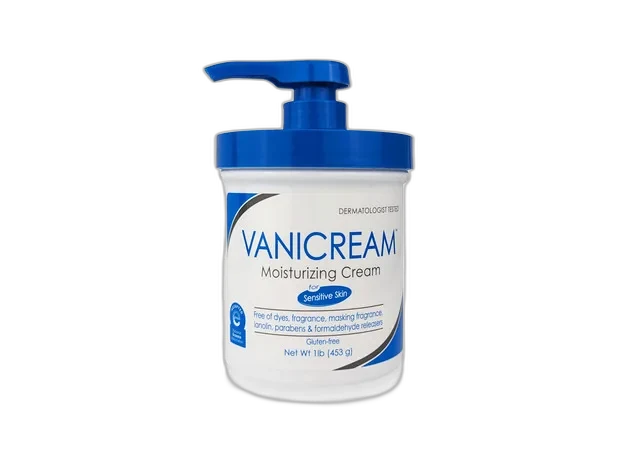
Moisturizing Skin Cream
Pharmacy-Counter Legend
 Verified reviewer
Pros & cons.
- +Flagship formula unchanged for 45 years — proven stability and reliability
- +National Eczema Association Seal of Acceptance for eczema-prone skin
- +Petrolatum reduces transepidermal water loss by up to 99% while upregulating barrier proteins
- +Only 11 ingredients — one of the most minimal effective moisturizers available
- +Exceptional value at around fifteen dollars for 16 ounces lasting 4-6 months
- +Dermatologist-recommended baseline for contact dermatitis investigation
- +Sold in Mayo Clinic Store — quasi-medical endorsement
- +30,000+ positive reviews across platforms with 4.7 average rating
- −Thick texture requires 30-60 seconds to absorb and feels heavy on facial skin
- −Contains propylene glycol, a recognized contact allergen for a small population
- −No active ingredients for anti-aging, brightening, or targeted skin concerns
- −Cetearyl alcohol and PEG-30 stearate may not suit fungal acne-prone skin
- −Jar packaging without pump is less hygienic for repeated daily use
- −Too occlusive for oily skin types, especially in warm and humid climates
The full review.
Every skincare brand has an origin story. Most involve a celebrity epiphany, a market gap, or a persuasive venture capital pitch. Vanicream’s origin story starts in a Rochester, Minnesota hospital pharmacy. Two pharmacists received the same request from dermatologists down the hall: our patients can’t use anything.
In 1975, Conrad Thompson and Ed Mansfield compounded custom formulations for dermatology patients who reacted to every commercial moisturizer. Fragrance set them off. Lanolin set them off. Preservatives set them off. The pharmacists stripped ingredients, removing everything unnecessary, until they reached a formula so minimal it felt like a dare: can we make a cream with eleven ingredients that does everything a moisturizer needs and nothing else?
They did. In 1980, Pharmaceutical Specialties, Inc. launched this cream. Forty-five years later, the formula is unchanged. The company isn’t lazy; there is nothing to improve. Every ingredient in this cream is necessary, and every ingredient left out was unnecessary.
Petrolatum is the engine, listed second after water. Petrolatum has a PR problem—it sounds industrial, looks boring on an ingredient lists, and lacks the cachet of ceramides or hyaluronic acid. But a 2016 study in the Journal of Allergy and Clinical Immunology shows petrolatum isn’t an inert barrier. It penetrates the stratum corneum interstices, upregulates antimicrobial peptides by as much as 13-fold, induces expression of barrier proteins filaggrin and loricrin, and reduces inflammatory T-cell infiltration in atopic dermatitis patients. This isn’t a passive ingredient. It actively repairs your skin barrier while looking like the most boring thing in your medicine cabinet.
Sorbitol and propylene glycol work as humectants, pulling moisture into the upper skin layers where the petrolatum seal prevents evaporation. Cetearyl alcohol provides the cream’s thick texture and stabilizes the emulsion. That is the formulation: four functional categories—occlusive, humectant, emollient, emulsifier—executed with economy.
Texture
The texture is thick. If you use gel-creams that vanish on contact, this cream will feel heavy. It takes thirty to sixty seconds to fully absorb. During that window, a slight tackiness makes you wonder if you applied too much. You probably did—a little goes a long way. Once it absorbs, the finish is smooth, non-greasy, and protective. You can feel the cream working, which is reassuring for dry skin sufferers.
Packaging
The sixteen-ounce pump bottle is best. The jar version works but requires dipping fingers into the product, which dermatologists avoid for hygiene reasons. The pump dispenses a controlled amount and keeps the remaining product uncontaminated. At around fifteen dollars for sixteen ounces, this is excellent value—you get four to six months of daily face and body moisturization for the cost of a mediocre cocktail.
Common Complaints
One limitation is propylene glycol. It is the fifth ingredient and was named ACDS Allergen of the Year in 2018. For most people, this is harmless—sensitization rates are low, and at these concentrations, propylene glycol is a reliable humectant. But for the small percentage of patients with a confirmed propylene glycol contact allergy, this cream is off the table. This is an ironic limitation for a brand built on avoiding allergens. Those patients can use the Vanicream Moisturizing Ointment instead, which omits propylene glycol entirely.
Best for
The National Eczema Association Seal of Acceptance is not handed out casually. Products must be free of fragrances, dyes, and common sensitizers, and they must be suitable for eczema-compromised skin. This cream carries that seal. It is sold in the Mayo Clinic Store. Dermatologists recommend it as a baseline moisturizer when investigating contact dermatitis—strip the patient’s routine to this cream and water, then add products back one at a time to identify the trigger. That diagnostic utility is the strongest endorsement any moisturizer can receive.
Not ideal for
If you want ceramides, peptides, niacinamide, or the ingredient-of-the-month, this cream feels like a step backward. It doesn’t brighten, plump, or smooth fine lines. It doesn’t photograph well on a shelfie. It moisturizes, protects, and causes no harm—which is everything for millions of sensitive skin patients.
Vanicream Moisturizing Skin Cream is not a trend. It is infrastructure. It existed before twelve-step routines, before serums-within-serums, and before skincare became content. It will be here after those fade, doing exactly what it has done since 1980: keeping your skin barrier intact with eleven ingredients and zero apologies.
Ingredient analysis.
Full INCI list
Purified Water, Petrolatum, Sorbitol, Cetearyl Alcohol, Propylene Glycol, Ceteareth-20, Simethicone, Glyceryl Stearate, PEG-30 Stearate, Sorbic Acid, BHT
Skin match.
The science.
The Science
This cream relies on petrolatum, the most clinically validated moisturizer in dermatology. A 2016 study in the Journal of Allergy and Clinical Immunology (Czarnowicki et al.) showed petrolatum is not inert. The study found petrolatum application upregulated antimicrobial peptides S100A8 by 13-fold and S100A9 by 11-fold, induced filaggrin and loricrin expression, increased stratum corneum thickness, and reduced T-cell infiltration in atopic dermatitis patients. These are active therapeutic effects, not passive barrier function.
The cream's humectant-occlusive architecture follows evidence in Clinical Medicine & Research (2017), which confirmed that combining humectants (like sorbitol and propylene glycol) with occlusives (like petrolatum) works better than either alone. Humectants draw water into the epidermis; occlusives stop evaporation. This two-layer mechanism is the core principle of all effective moisturizers, and Vanicream's formula uses it directly—without intermediary ingredients or secondary delivery systems.
A 2022 review in Cutis confirmed petrolatum reduces transepidermal water loss by nearly 99%, outperforming other occlusive agents. The review also noted petrolatum's use in wound healing and post-procedure care, where dermatologists frequently recommend Vanicream Moisturizing Skin Cream.
References
- Petrolatum: Barrier repair and antimicrobial responses underlying this 'inert' moisturizer — Journal of Allergy and Clinical Immunology (2016)
- The Role of Moisturizers in Addressing Various Kinds of Dermatitis: A Review — Clinical Medicine & Research (2017)
- Petrolatum Is Effective as a Moisturizer, But There Are More Uses for It — Cutis (2022)
Dermatologist Perspective
Dermatologists use this cream as a foundational clinical tool. Board-certified dermatologists recommend it as a diagnostic baseline for contact dermatitis—patients use only Vanicream and water for a period, then reintroduce products one by one to find triggers. This works because the 11-ingredient formula removes almost all potential confounders. Dermatologists also prescribe it to buffer tretinoin and reduce irritation, as a layer over topical steroids, and as a post-procedure moisturizer where the lack of fragrances and active ingredients lowers complication risks on healing skin.
Where it fits in your routine.
Apply a generous amount to face and body after bathing. Apply while skin is still slightly damp to lock in hydration. Use the pump dispenser for a controlled, hygienic dose. A pea-sized amount covers the face; a walnut-sized amount covers each limb. Use twice daily: in the morning before sunscreen, and in the evening as the final skincare step. For eczema management, apply within three minutes of bathing. Layer it over prescription topicals like tretinoin or topical steroids.
At about fifteen dollars for sixteen ounces, this cream lasts four to six months of daily face and body use. This makes the monthly cost roughly three to four dollars. The 4 oz tube costs around seven dollars, which is a lower commitment for first-time users. The product carries the National Eczema Association seal, sells in the Mayo Clinic Store, and has over 30,000 reviews. Premium sensitive-skin moisturizers with shorter ingredient lists and similar occlusive profiles cost three to five times more per ounce.
People with eczema, contact allergies, or chronically sensitive skin need a moisturizer they can trust. This works for patients starting prescription retinoids who need a reliable buffer cream, post-procedure patients needing a zero-risk moisturizer during healing, and anyone who reacts to ingredients in other products.
People with oily or acne-prone skin will find this too heavy for daily facial use — the Vanicream Moisturizing Lotion is a better match. Users wanting active ingredients for anti-aging, brightening, or acne treatment must layer those separately. The small population with confirmed propylene glycol allergies should use the Vanicream Moisturizing Ointment instead.
Product details.
Completely unscented — no fragrance, no masking fragrance, and no detectable smell.
Choose from a 16 oz jar with optional pump dispenser, a 16 oz jar without pump, a 4 oz squeeze tube, or a 2 oz travel tube. Most users pick the pump version for hygiene. The white clinical packaging has clean branding.
The cream feels thick on first application—heavier than most facial moisturizers. It absorbs in 30-60 seconds and feels slightly tacky during that time. Once absorbed, the finish is smooth and protective, not greasy. There is no tingling, stinging, or adjustment period. The experience is deliberately uneventful.
4-6 months with twice-daily face and body application from the 16 oz size
24 months
All Year
The backstory.
In 1975, Rochester pharmacists Conrad Thompson and Ed Mansfield kept getting the same request from local dermatologists: their patients with contact allergies couldn't tolerate any commercial moisturizer. The pharmacists began compounding custom formulations, eventually developing the cream that would launch Pharmaceutical Specialties, Inc. in 1980. The cream's simplicity was its innovation — every ingredient was chosen because it was necessary, and every potential irritant was removed because it wasn't. Forty-five years later, it remains the company's anchor product.
About Vanicream
Legacy Brand (20+ years)Vanicream Moisturizing Skin Cream launched Pharmaceutical Specialties, Inc. in 1980. Two Rochester, Minnesota pharmacists developed it after local dermatologists requested a hypoallergenic moisturizer for contact allergy patients. The brand is now the #1 dermatologist-recommended brand for sensitive skin and the Mayo Clinic Store sells its products.
Common myths.
Effective moisturizers use ceramides, hyaluronic acid, or peptides.
This cream's petrolatum-based formula reduces transepidermal water loss by up to 99% and upregulates barrier proteins. Many complex formulations fail to match these effects. Research in the Journal of Allergy and Clinical Immunology (2016) shows petrolatum induces filaggrin and loricrin expression. Effective barrier repair does not require a long ingredient list.
Creams that do not absorb quickly clog your pores.
Vanicream Moisturizing Skin Cream is dermatologist-tested as non-comedogenic despite its thick texture. The slow absorption shows the petrolatum forming a protective occlusive layer—its intended mechanism. This is a feature, not a flaw.
FAQ.
What is the difference between Vanicream Moisturizing Skin Cream and Vanicream Moisturizing Lotion?
The Cream is thicker and more occlusive—better for very dry skin, winter, and targeted use. The Lotion is lighter and absorbs faster, which suits warm weather and full-body daily use. Both use the same 11-ingredient, fragrance-free philosophy. The INCI lists are nearly identical, but The Cream has more petrolatum and sorbitol for higher occlusive power.
Can I use Vanicream Moisturizing Skin Cream on my face?
Yes — it is dermatologist-tested as non-comedogenic, and many dermatologists recommend it for dry and sensitive facial skin. The texture is thicker than typical facial moisturizers; users with oily or acne-prone skin may prefer the Vanicream Moisturizing Lotion for facial use instead.
Is Vanicream Moisturizing Skin Cream good for eczema?
Yes — it has the National Eczema Association Seal of Acceptance and is a top recommended moisturizer for eczema management. The petrolatum-rich formula provides the heavy occlusion eczema-compromised skin needs, and the minimal ingredient list avoids common eczema triggers. Dermatologists often recommend applying it within three minutes of bathing.
Does Vanicream Moisturizing Skin Cream contain propylene glycol?
Yes — propylene glycol is the fifth ingredient. It was the ACDS Allergen of the Year in 2018, but sensitization rates are low and most users tolerate it. Those with a confirmed propylene glycol allergy should use Vanicream Moisturizing Ointment instead, which does not contain propylene glycol.
Can I use Vanicream Moisturizing Skin Cream with tretinoin?
Yes — many dermatologists recommend this cream as a buffer over or under tretinoin to reduce irritation and dryness. The petrolatum-based formula provides the occlusive protection retinoid-treated skin needs without adding sensitizing active ingredients. Apply tretinoin first, wait a few minutes, then layer this cream over it.
Is Vanicream Moisturizing Skin Cream safe during pregnancy?
Yes — this cream lacks retinoids, salicylic acid, or other ingredients of concern during pregnancy. Its minimal, well-studied formula makes it one of the safest moisturizer options for pregnant and breastfeeding individuals. OB-GYNs and dermatologists widely recommend it for use during pregnancy.
Why has Vanicream Moisturizing Skin Cream not changed its formula in over 40 years?
The formula works. The 11-ingredient composition includes only what moisturizes effectively and excludes everything that causes reactions. With 30,000+ positive reviews, National Eczema Association certification, and decades of dermatologist trust, there is no clinical reason to change it. Simplicity is the innovation.
---
What the community says.
"Extremely gentle on sensitive, eczema-prone, and reactive skin"
"Dermatologist-recommended and trusted for over four decades"
"No fragrance, no dye, no irritating preservatives"
"Excellent value — 16 oz at a drugstore price point"
"Non-greasy for a cream this thick and protective"
"Works as a protective barrier for dry, cracking winter skin"
"Thick texture takes time to absorb and can feel heavy on the face"
"May feel sticky or sit on top of skin before fully absorbing"
"Too rich and occlusive for oily or acne-prone skin types"
"Plain formulation with no ceramides, peptides, or trendy actives"
"Jar packaging without pump is less hygienic for daily use"