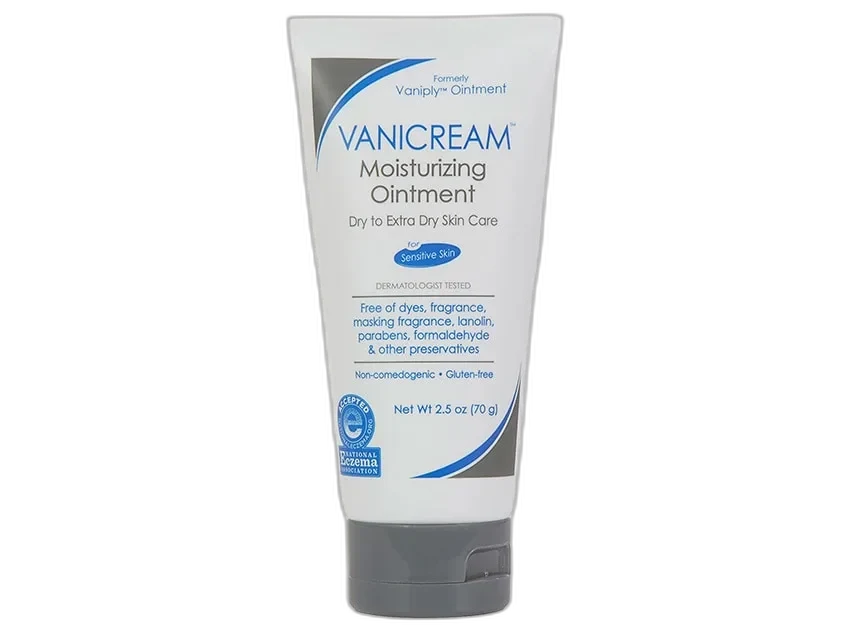
Moisturizing Ointment
Barrier Repair Essential
 Verified reviewer
Pros & cons.
- +Only seven ingredients — one of the most minimal occlusive ointments commercially available
- +Petrolatum-free barrier protection, a rare alternative for patients who can't tolerate petrolatum
- +National Eczema Association Seal of Acceptance and SkinSAFE 100 rating
- +No stinging on cuts, cracks, or damaged skin upon application
- +Less greasy and more spreadable than straight petrolatum-based ointments
- +Fungal acne safe — no esters, fatty acids, or oils that feed Malassezia
- +Suitable for infants, post-procedure skin, and the most reactive skin types
- −Very heavy texture limits practical use to nighttime or targeted application
- −Can feel sticky or tacky when over-applied — a little goes a long way
- −Currently being reformulated with uncertain future availability
- −No active or treatment ingredients — provides occlusion only
- −More expensive per ounce than petrolatum-based alternatives like Vaseline
The full review.
Here is a question that rarely gets asked in skincare: what do you do when you need an occlusive ointment but you can’t tolerate any of them? Aquaphor has lanolin. CeraVe Healing Ointment has ceramides and fatty acids. Vaseline is pure petrolatum, which a small but real population of contact allergy patients cannot use. For those patients, the options list was essentially empty.
Vanicream’s Moisturizing Ointment exists to fill that void. Formerly sold as Vaniply — a name that managed to be even less glamorous than Vanicream — this product was renamed to bring it under the unified brand umbrella, but the formula hasn’t changed. And what a formula it is: seven ingredients. Not seven hero actives. Seven ingredients total. You can read the entire INCI list in a single breath.
The most notable thing about the ingredient list is what isn’t on it. No petrolatum. This is an occlusive ointment — thick, sealing, protective — that achieves its barrier function entirely through hydrogenated polydecene, microcrystalline wax, and dimethicone. Hydrogenated polydecene is a high-purity synthetic emollient with exceptional oxidation stability, meaning it doesn’t break down or go rancid. Microcrystalline wax forms the structural matrix, creating the semi-solid body that makes this feel and behave like a traditional healing ointment. Dimethicone adds a breathable occlusive layer and improves spreadability.
Texture
The texture is exactly what you’d expect from an ointment: thick, semi-solid, and deliberately heavy. It’s not trying to be a cream. It’s not trying to sink in. It sits on the skin and forms a protective seal, which is precisely its job. That said, it’s notably less greasy than straight Vaseline. The polydecene base gives it a smoother, more workable consistency than petrolatum, and it doesn’t leave the same oily sheen. Users consistently note that it spreads more easily than they expected and feels less oppressive than other ointments in the category.
Best for
The absence of petrolatum is this product’s defining characteristic. Petrolatum sensitivities are uncommon but real, and for dermatologists managing patients with multiple contact allergies, having a petrolatum-free occlusive option is clinically valuable. The formula also avoids every other common contact allergen: no lanolin, no fragrance, no parabens, no propylene glycol, no botanical extracts, no coconut derivatives. The SkinSAFE database rates it 100 out of 100 for hypoallergenic safety, and the EWG Skin Deep database scores it a 1 — the lowest possible hazard rating.
Practically, this works best as a targeted treatment rather than a whole-body moisturizer. Apply it to cracked heels, cuticles, elbows, knees, and lips. Use it as the final step in a nighttime slugging routine. Dab it on eczema patches during flares. Parents use it for diaper rash prevention. Post-procedure patients use it to protect healing skin without risking irritation from additives. These are the contexts where a seven-ingredient ointment with zero sensitizers earns its keep.
Packaging
The price is reasonable though not remarkable. At around eight dollars for 2.5 ounces, it’s more expensive per ounce than Vaseline or Aquaphor, but you’re paying for the deliberate absence of potential irritants — a formulation constraint that’s harder to achieve than it sounds. The 13-ounce jar offers better per-ounce value for heavier users.
Common Complaints
There is one elephant in the room worth addressing: Vanicream’s official website lists this product as out of stock and notes that it’s being reformulated. Existing inventory remains available at some third-party retailers, but the long-term availability is uncertain. For users who rely on this product, this is concerning — and it echoes the same anxiety that followed the discontinuation of the Vanicream Lip Protectant SPF 30. Niche products for sensitive skin populations have a tendency to disappear, which is deeply frustrating for the patients who depend on them.
Not ideal for
The limitations are the limitations of all heavy ointments: this is not a daytime facial product for most people, it can feel tacky if over-applied, and it provides occlusion without active ingredients. If your skin needs ceramides, niacinamide, or hyaluronic acid, those will need to come from products layered underneath. This seals and protects. It does not treat.
Vanicream Moisturizing Ointment is the skincare equivalent of a very good lock on a very important door. It doesn’t furnish the room. It doesn’t decorate the walls. It just keeps everything safe inside, using seven ingredients and nothing more.
Ingredient analysis.
Full INCI list
Hydrogenated Polydecene, Microcrystalline Wax, Polyethylene, Silica Dimethyl Silylate, Dimethicone, C30-45 Alkyl Methicone, C30-45 Olefin
Skin match.
The science.
The Science
This formula uses non-petrolatum ingredients to repair the occlusive barrier. Most healing ointments use petrolatum—which research in the Journal of the American Academy of Dermatology (Ghadially et al., 1992) shows penetrates stratum corneum interstices and speeds barrier recovery—but this formula uses hydrogenated polydecene and microcrystalline wax to reach a similar result.
A 2003 review in the Journal of the American Academy of Dermatology characterized hydrogenated polydecene as a high-purity emollient with better oxidation stability than mineral oils. Its molecular structure prevents skin penetration, so it stays on the surface to form a conditioning film—acting like petrolatum's barrier function through a different mechanical pathway.
Dimethicone adds more occlusion. A 2023 review in PMC on silicone applications in dermatology confirmed dimethicone forms a breathable barrier that reduces transepidermal water loss while allowing water vapor exchange. The study found protection lasts at least 48 hours from one application, which matters for overnight use.
A 2024 review in the Journal of Cosmetic Dermatology (Madnani et al.) looked at barrier repair moisturizers and concluded that occlusive agents like waxes and silicones effectively reduce transepidermal water loss and support barrier repair in atopic dermatitis. The review stated the critical factor is keeping skin hydrated long enough for underlying barrier lipids to reorganize—a task this ointment's sealing layer performs whether the occlusive base is petrolatum or synthetic hydrocarbons.
References
- Effects of petrolatum on stratum corneum structure and function — Journal of the American Academy of Dermatology (1992)
- Silicone in Dermatology: An Update — PMC (2023)
- Revitalizing the skin: Exploring the role of barrier repair moisturizers — Journal of Cosmetic Dermatology (2024)
Dermatologist Perspective
Dermatologists value this ointment because it provides occlusive barrier protection without petrolatum—a distinction that matters when managing patients with multiple contact allergies. Board-certified dermatologists note that while petrolatum is an excellent occlusive, some patients cannot tolerate it or prefer to avoid petroleum-derived ingredients. This seven-ingredient alternative has no known contact allergens, so dermatologists can recommend it to even their most reactive patients. Pediatric dermatologists also recommend this product for infants, as the SkinSAFE Baby SAFE rating shows its high tolerability.
Where it fits in your routine.
Apply a thin layer to dry areas like lips, cuticles, elbows, knees, or cracked heels as needed. For nighttime slugging, apply a thin layer over your moisturized face as the final PM routine step. For eczema flares, apply to affected areas after bathing while skin is damp, then layer this ointment over to seal in moisture. Use sparingly; applying too much causes tackiness without extra benefit.
At about eight dollars for 2.5 ounces, this costs more per ounce than petrolatum-based alternatives — a tub of Vaseline costs less and provides more product. The value comes from the formulation's lack of sensitizers, which raises the price in the hypoallergenic category. The 13-ounce jar at around nineteen dollars offers better per-ounce value for heavy users. This ointment goes far; even the smaller tube lasts three to four months with nightly targeted use.
Patients with contact allergies who cannot tolerate petrolatum-based ointments have few options; this is the best one. It works for severe eczema flares, cracked or fissured skin, or post-procedure healing where zero irritation risk is essential. Parents seeking a hypoallergenic ointment for infants will find this a safe choice.
If your skin tolerates petrolatum, Aquaphor or Vaseline offer similar occlusion for less. These are too heavy to use as a standalone daytime facial moisturizer. People with oily or acne-prone skin should use these only on targeted areas, not on the full face.
Product details.
Unscented. It has no fragrance, no masking fragrance, and no odor.
A 2.5 oz squeeze tube allows targeted application, while a 13 oz jar works for whole-body use. The clinical white packaging features Vanicream branding. A 0.32 oz travel tube is also available.
The ointment spreads easier than its heavy appearance suggests. It leaves a visible sheen on the skin, showing the barrier is protected. It causes no stinging, tingling, or warmth, even on damaged or cracked skin. The feel seals and protects rather than moisturizing in the traditional sense. ***
3-4 months if you use the 2.5 oz tube nightly on target areas; 4-6 months if you use the 13 oz jar on the body.
12 months ***
fall winter ***
The backstory.
Originally marketed as Vaniply Ointment, this product was renamed Vanicream Moisturizing Ointment to bring it under the unified Vanicream brand umbrella. The formula was developed for patients who needed the occlusive barrier protection of a petrolatum-based ointment but couldn't tolerate petrolatum or the additives found in other healing ointments. With only seven ingredients, it may be the most minimal occlusive ointment in commercial production.
About Vanicream
Legacy Brand (20+ years)Pharmacists at Pharmaceutical Specialties, Inc. in Rochester, Minnesota developed Vanicream in 1975. They worked with dermatologists to make products for contact allergy patients. This ointment used to be called Vaniply before a brand name change. Multiple Vanicream products carry the NEA Seal of Acceptance.
Common myths.
All ointments contain petrolatum — they are basically Vaseline.
This ointment uses hydrogenated polydecene and microcrystalline wax as an occlusive base instead of petrolatum. It provides similar barrier protection via a different mechanism. This offers an alternative for patients with petrolatum sensitivities or preferences against petroleum-derived ingredients.
Heavy ointments clog pores and cause breakouts.
Dermatologists tested this product as non-comedogenic. The silicone and wax-based formula sits on the skin surface to form a protective barrier instead of penetrating follicles. Use it on acne-prone facial skin with caution and on a targeted basis.
FAQ.
Does Vanicream Moisturizing Ointment contain petrolatum?
No — unlike Aquaphor, Vaseline, and CeraVe Healing Ointment, this formula uses hydrogenated polydecene and microcrystalline wax as its occlusive base instead of petrolatum. This works for patients who must avoid petrolatum-based products.
Can I use Vanicream Moisturizing Ointment on my face?
It's dermatologist-tested as non-comedogenic and can be used on the face, but its heavy texture makes it most practical for nighttime use or targeted application on very dry areas. For daytime facial moisturizing, the Vanicream Moisturizing Lotion or Cream are better suited options.
Is Vanicream Moisturizing Ointment good for slugging?
Yes — its thick, occlusive texture works well for slugging, where an occlusive layer seals in nighttime skincare. Apply a thin layer as the final step in your PM routine. The petrolatum-free formula offers an alternative for slugging without petroleum-based products.
Is Vanicream Moisturizing Ointment safe for babies?
The product has a SkinSAFE Baby SAFE rating and uses only seven ingredients with no known sensitizers. Pediatric dermatologists frequently recommend it for diaper rash prevention and infant dry skin patches. Consult your pediatrician for specific concerns.
Why is Vanicream Moisturizing Ointment out of stock?
Vanicream's official website says the product is undergoing reformulation. Some third-party retailers still sell existing inventory. Vanicream has not shared specific details about the planned reformulation. Check major pharmacy retailers for current availability.
Is Vanicream Moisturizing Ointment fungal acne safe?
Yes — the formula lacks esters, fatty acids, or oils that feed Malassezia yeast. The base uses only synthetic hydrocarbons, waxes, and silicones. This makes it one of the few occlusive ointments safe for fungal acne-prone skin.
What the community says.
"Extremely effective for severely dry and cracked skin with visible healing within hours"
"Excellent as a lip balm and for targeted dry areas like elbows, knees, and cuticles"
"No stinging on cuts or damaged skin"
"Less greasy than expected for an ointment"
"Fragrance-free and free of all common irritants"
"Ideal for eczema flares and post-procedure healing"
"Can feel sticky or tacky when too much is applied"
"Very heavy texture unsuitable for daytime facial use for most people"
"Easy to over-apply since a little goes a long way"
"Limited availability and sometimes out of stock"
"Currently being reformulated which creates supply uncertainty"