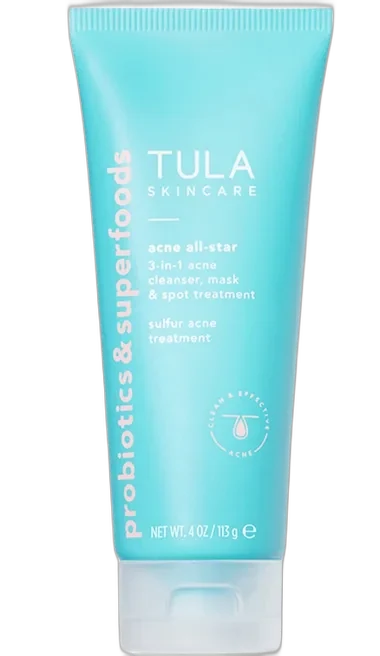
Acne All-Star 3-in-1 Acne Cleanser
3-in-1 Sulfur Workhorse
 Verified reviewer
Pros & cons.
- +3% sulfur at maximum OTC concentration — proven efficacy
- +Versatile cleanser, mask, and spot treatment use cases
- +Probiotic ferment supporting cast supports microbiome balance
- +Fungal-acne safe — works on both bacterial and Malassezia flares
- +Pregnancy-safe ingredient profile
- +Bentonite clay adds sebum-absorbing power
- +Cruelty-free and vegan
- +Visible improvement within 1-2 weeks on inflammatory acne
- −Distinct sulfur smell during application
- −Can be drying with daily cleanser use
- −Not powerful enough for severe cystic acne
- −$32 is premium for an OTC sulfur treatment
- −Long extract list may be unnecessary noise for some users
The full review.
About Tula
The Acne All-Star uses proven sulfur efficacy but fixes the wearability problem, succeeding on most counts.
Myth
Sulfur has credibility and smell problems as an acne ingredient. The credibility claim is unfair—sulfur is one of the longest-studied and best-validated OTC acne actives. It works on inflammatory lesions through three different mechanisms simultaneously.
Reality
It softens and lifts surface dead skin, reduces sebum production, and has direct antimicrobial activity against acne-driving bacteria. The smell claim is fairer—older medical-grade sulfur products like De La Cruz and Sulfur 8 have a distinct eggy aroma that is hard to sell.
How to Use
The 3-in-1 use case is truly novel. The same product works as a daily cleanser (brief contact, mild action), a 5-to-10-minute mask (longer contact, more aggressive treatment), or an overnight spot treatment dabbed onto active lesions. The active concentration stays the same in all three uses; only contact time scales. This formulation choice lets users with mild ongoing congestion get maintenance benefits from the cleanser while using the mask format only during active flare-ups. It avoids the typical acne kit’s need for three separate products and a complicated layering schedule.
Texture
The texture is a thick beige-grey lotion that thins when it touches water, with a clay-like feel from the bentonite.
Scent
The smell is a legitimate caveat—a noticeable sulfur note appears upon application, which most users call eggy or mildly sulfuric. It dissipates minutes after rinsing, but the scent is strong enough that some users will dislike the experience. This is a category-wide issue for sulfur products; the Tula version is milder than older medical-grade options but is not odorless.
Best for
This is one of the better OTC options for mild-to-moderate inflammatory acne, mixed congestion, and fungal acne crossover cases that benzoyl peroxide doesn’t reach.
Works for
Most users see visible reduction in active surface inflammation and oil within one to two weeks of consistent cleanser use. Cystic and inflammatory acne typically improves at four to six weeks.
Not ideal for
The product lacks the power for severe nodular or cystic acne, which usually requires prescription oral or topical treatment. However, for mild-to-moderate inflammatory acne, mixed congestion, and the fungal acne crossover cases that benzoyl peroxide doesn’t reach, this is one of the better OTC options available.
Common Complaints
The drying issue is real. Sulfur can dry skin out over time, even at well-formulated concentrations like this, especially if used as both a daily cleanser and a frequent mask.
Pairs Well With
The smartest pattern is to alternate—use as a daily cleanser most days and a mask once or twice per week—then follow with a hydrating, non-comedogenic moisturizer containing niacinamide and ceramides.
Conflicts With
Users with dry or sensitive skin should use this as an episodic mask only, not a daily cleanser.
Price
The price is mid-range for this format. Thirty-two dollars for four ounces costs more than older drugstore sulfur products but less than most prestige acne treatments. You pay for the wearability, the cleaner ingredient surround, the brand’s customer experience polish, and the 3-in-1 format’s usability. For users wanting serious acne care without a five-step routine, this delivers more than its price suggests.
Ingredient analysis.
Full INCI list
Active: Sulfur 3%. Inactives: Water (Aqua), Glycerin, Bentonite, Sodium Cocoyl Isethionate, Propanediol, Sodium Cocoyl Glycinate, 1,2-Hexanediol, Magnesium Aluminum Silicate, Acacia Senegal Gum, Sea Water, Salix Alba (Willow) Bark Extract, Lactococcus Ferment Lysate, Lactobacillus, Lactobacillus Ferment, Camellia Oleifera Leaf Extract, Betula Alba Bark Extract, Scrophularia Nodosa Extract, Betula Alba Juice, Pinus Densiflora Leaf Extract, Aspalathus Linearis Leaf Extract, Panthenol, Curcuma Longa (Turmeric) Root Extract, Beta Vulgaris (Beet) Root Extract, Alpha-Glucan Oligosaccharide, Polymnia Sonchifolia Root Juice, Inulin, Lactic Acid, Leuconostoc/Radish Root Ferment Filtrate, Ananas Sativus (Pineapple) Fruit Extract, Citrus Aurantium Dulcis (Orange) Fruit Extract, Citrus Limon (Lemon) Peel Extract, Eugenia Caryophyllus (Clove) Flower Extract, Pyrus Communis (Pear) Fruit Extract, Pyrus Malus (Apple) Fruit Extract, Salvia Officinalis (Sage) Leaf Extract, Vanilla Planifolia Fruit Extract, Sodium Chloride, Sorbitan Oleate Decylglucoside Crosspolymer, Maltodextrin, Butylene Glycol, Sodium Benzoate, Dipropylene Glycol, Hydroxypropyl Cyclodextrin, Potassium Sorbate, Citric Acid, Quartz, Chlorophyllin-Copper Complex, Sodium Cocoate, Coconut Acid, Sodium Isethionate, Titanium Dioxide
Skin match.
The science.
The Science
Dermatology has used sulfur for over a century; it is a well-validated OTC acne active. It works through multiple pathways: it acts as a keratolytic by breaking disulfide bonds in surface keratin, kills Cutibacterium acnes directly, and reduces sebum production through mechanisms still being studied. Dermatological literature shows sulfur works for both inflammatory acne and Malassezia folliculitis (fungal acne), bridging both conditions.
Research on 3% sulfur preparations for adult and adolescent acne is extensive. Studies in the Journal of Drugs in Dermatology show its tolerability compared to benzoyl peroxide and salicylic acid. Sulfur often tolerates better in patients with sensitive skin or those who find BPO too irritating, while providing comparable efficacy on mild-to-moderate inflammatory lesions.
The willow bark extract provides salicin, which the skin metabolizes into salicylate compounds with mild keratolytic activity. It is less potent than synthetic salicylic acid, but provides a surface-peeling effect that supports the sulfur. Green tea polyphenols, specifically EGCG, show anti-inflammatory and sebum-reducing activity in acne research, including studies in dermatology journals on topical green tea formulations.
The probiotic ferment ingredients have the least evidence. Research on topical microbiome modulation for acne is emerging and shows mixed results in published trials. These ingredients fit Tula's brand positioning and may offer ancillary benefits, but sulfur drives most of the formula's acne efficacy.
Dermatologist Perspective
Dermatologists often recommend sulfur-based acne products for patients who cannot tolerate benzoyl peroxide or have mixed bacterial-and-fungal acne. Board-certified dermatologists note that 3% sulfur has documented efficacy on mild-to-moderate inflammatory acne and is one of the few OTC acne actives considered acceptable during pregnancy. This formula combines sulfur with bentonite clay, willow bark, and green tea to go beyond a single active. The probiotic positioning differentiates the brand, though dermatologists see sulfur as doing the primary clinical work. The 3-in-1 use case (cleanser, mask, spot treatment) is unusual but practical for patients wanting a simpler routine than a typical multi-product acne regimen.
Where it fits in your routine.
As a cleanser: apply to wet skin, lather briefly, and rinse. Use daily, AM and/or PM, for general acne maintenance. As a mask: apply a thick layer to clean dry skin, leave for 5-10 minutes until tacky, and rinse with warm water. Use 2-3 times per week for active flare-ups. As a spot treatment: dab a small amount onto active lesions and leave overnight. Always follow with a hydrating, non-comedogenic moisturizer with niacinamide and ceramides to offset drying. Wear daily SPF — sulfur can mildly increase photosensitivity. Do not layer with retinoids or strong AHA/BHA products in the same routine.
At $32 for 4oz, this costs more than most OTC sulfur acne treatments. Drugstore sulfur products like De La Cruz use the same active for less money, but they smell, feel, and formulate worse. You pay for the wearability, the cleaner ingredient list, and the 3-in-1 format. Only one size is offered. The price is justified for users who want one product for cleansing, masking, and spot treatment without a complicated routine. Cheaper options exist for users who only want the active and accept cosmetic compromises.
Oily and combination skin types with mild-to-moderate inflammatory acne, blackheads, or mixed bacterial-and-fungal acne use this. It works well for users wanting simple, serious acne care, those who find benzoyl peroxide too irritating, or pregnant users seeking a safe topical option.
Sulfur dries and irritates dry, sensitive, or rosacea-prone skin. Skip this if you have severe cystic or nodular acne (which usually requires prescription treatment), if the sulfur smell is a deal-breaker, or if your barrier is currently compromised.
Product details.
Thick beige-grey lotion with a clay-like consistency that thins when wet
Distinct sulfur smell — milder than most sulfur treatments but unmistakable
White plastic tube with flip cap, 4oz
The first use feels slightly drying after rinse-off. The sulfur smell is noticeable but fades within minutes. Normal use causes no tingling or stinging. Using it as a mask reduces active redness within 2-3 days and improves skin tone over the following weeks.
2-4 months depending on usage (daily cleanser vs occasional mask vs spot treatment)
12 months
All Year
The backstory.
Released in 2022 as part of Tula's expansion into more clinical acne care, after the brand had built its reputation on probiotic-positioned moisturizers and brightening products. The 3-in-1 format was designed for the brand's customer base of users who don't want a complicated acne routine but still want measurable results.
About Tula Skincare
Established Brand (5–20 years)Gastroenterologist Dr. Roshini Raj founded Tula Skincare in 2014. The brand focuses on probiotics. Its formulations use prebiotic and probiotic ferments with conventional actives and have a moderate base of independent clinical evidence.
Common myths.
Sulfur acne treatments smell too bad and feel too old-fashioned to use.
The sulfur smell exists but is milder here than in older medical-grade sulfur lotions, and it dissipates within minutes after use. Sulfur is one of the better-tolerated OTC acne actives for users who cannot handle benzoyl peroxide or salicylic acid.
FAQ.
Does the Tula Acne All-Star 3-in-1 actually work on acne?
Yes — 3% sulfur is the maximum OTC concentration and works on inflammatory acne. Most users see less surface acne and oil within 1-2 weeks. Consistent use improves cystic and inflammatory lesions at 4-6 weeks. It lacks the strength for severe nodular acne, which usually requires prescription treatment.
How is the 3-in-1 use supposed to work?
Use as a cleanser by applying, lathering briefly, and rinsing for gentle daily maintenance. Use as a mask by applying a thicker layer and leaving for 5-10 minutes before rinsing for aggressive treatment 2-3 times per week. Use as a spot treatment by dabbing a small amount onto active lesions and leaving overnight. The same product works via contact time.
Is sulfur smell really that bad?
The scent is noticeable but not overwhelming. Most users report a slight eggy or sulfuric smell for the first few seconds, which dissipates quickly after rinsing. It is milder than older medical-grade sulfur products like Sulfur 8 or De La Cruz.
Can I use this with retinol?
Use them on alternate nights. Sulfur and retinoids both dry the skin; using them together often causes barrier irritation. Many users apply retinol on weeknights and the Tula sulfur mask on weekends.
Is it safe for fungal acne?
Yes — the formula is fungal-acne safe. Sulfur is one of the best-studied actives for Malassezia folliculitis. This makes it a good choice for users with both bacterial acne and fungal flares.
Is it safe during pregnancy?
Yes — sulfur is one of the few OTC acne actives dermatologists generally accept during pregnancy. As always, check with your OB or dermatologist before starting any new acne product while pregnant.
How does it compare to De La Cruz Sulfur Ointment?
De La Cruz is a thick petrolatum-based sulfur ointment with higher concentrations. It works more aggressively but is harder to layer into a routine. The Tula 3-in-1 uses a cosmetic format with probiotic and botanical support. It works better as a daily cleanser than an episodic spot treatment.
What the community says.
"Fast results on inflamed acne"
"Versatile cleanser-mask-spot use"
"Doesn't dry skin out as much as other sulfur products"
"Probiotic positioning feels less harsh"
"Visible improvement in 1-2 weeks"
"Distinct sulfur smell"
"Can be drying with daily cleanser use"
"Premium price for an OTC sulfur treatment"
"Not powerful enough for severe cystic acne"
People also looked at.