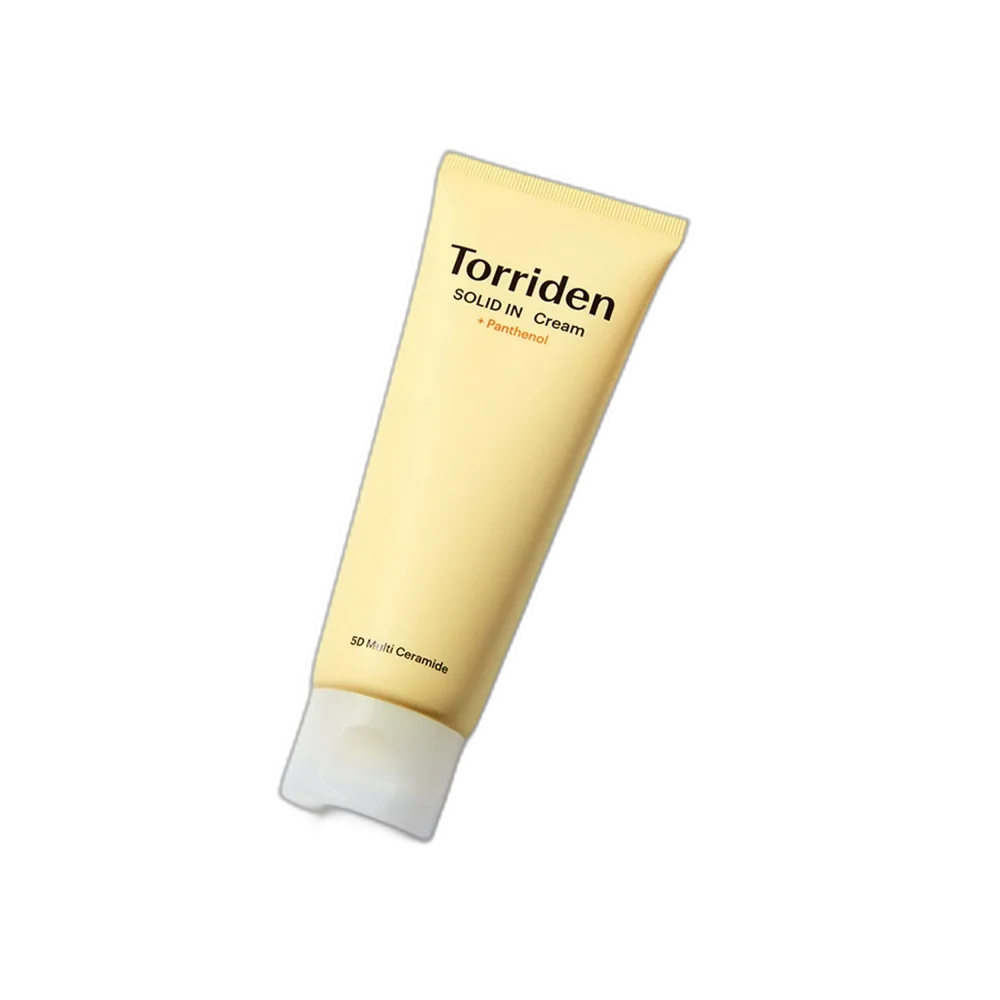
SOLID-IN Cream
Barrier Repair Workhorse
 Verified reviewer
Pros & cons.
- +Full multi-ceramide (NP, AP, EOP) plus cholesterol and fatty acid architecture
- +Phytosphingosine and niacinamide stack supports endogenous ceramide production
- +Fragrance-free and comfortable on reactive and eczema-prone skin
- +Rich enough for winter damage without being greasy or waxy
- +Clean emulsion system with no alcohol, parabens, or essential oils
- +Well-priced compared to Western clinical barrier-repair creams
- +Pairs perfectly with retinoids as a soothing buffer layer
- −Too rich for oily skin as a year-round moisturizer
- −Not fungal-acne safe due to shea butter and fatty ester content
- −Tub packaging with spatula is less hygienic than an airless pump
- −No additional actives (peptides, antioxidants) — strictly a barrier cream
The full review.
Generic “rich moisturizers” fail certain skin conditions. After months of layering actives and seasonal shifts, users face flaking around nostrils and chins alongside cheek flushing. These users need structural lipid replacement, not more water, because their stratum corneum lacks the ceramide, cholesterol, and fatty acid ratio healthy skin uses for integrity. For decades, clinical brands like CeraVe, EpiCeram, and ingredient-led derm office lines addressed this. Torriden built SOLID-IN Cream because Korean barrier-repair options were too thin, and DIVE-IN Watery Cream users wanted a winter version that wasn’t just a thicker water gel.
The ingredient architecture justifies the cream. Ceramide NP, ceramide AP, and ceramide EOP appear together; these are the three most clinically studied ceramide types in barrier research. Cholesterol is present, which matters because skin barrier function depends on a specific ratio of ceramides to cholesterol to fatty acids. The formula explicitly lists free fatty acids (palmitic, stearic, linoleic, oleic) further down. Phytosphingosine, a sphingoid base that feeds into the skin’s own ceramide biosynthesis, provides topical replacement now and supports endogenous production later. Niacinamide sits alongside these because niacinamide upregulates the skin’s own ceramide synthesis. The formula stacks three mechanisms to rebuild lipids, using the same logic as medical-grade barrier-repair creams.
Texturally, SOLID-IN is cushioned with a satin finish—thick enough for winter but lacks the heaviness of shea-butter-dominant creams. The emulsion uses glyceryl stearate and cetearyl olivate instead of old-school PEGs, so the slip stays smooth without waxy drag. It absorbs within a minute on dry skin and leaves a faint sheen that looks “well-moisturized” rather than “greasy.” On compromised skin, the tight, pinched feeling subsides almost immediately after the first application. By the end of the first week, red patches calm and surface roughness smooths.
The limitations are predictable. It is too rich for oily skin to use as a primary year-round moisturizer. It is not strictly fungal-acne safe, as shea butter and the formula’s fatty esters can feed Malassezia in prone individuals. The tub packaging is less hygienic than the airless pump Torriden uses for DIVE-IN, though the included spatula helps. While thoughtful, the formula lacks “more-is-more” sophistication—no peptide complex, no fancy delivery system, and no niche active. It is a cleanly executed lipid-repair cream.
That is its strength. SOLID-IN Cream provides a specific clinical mechanism—physiological lipid replacement—without derm-office brand prices. At roughly $25 for 70ml from a brand that reads the research, it is an easy recommendation in the Korean barrier-cream space. Pair it with the DIVE-IN Watery Cream in summer to cover the full hydration-versus-lipids spectrum year-round. This is the choice for eczema-prone skin, retinol irritation, post-procedure recovery, or winter peeling.
Ingredient analysis.
Full INCI list · pH 5.5
Water, Glycerin, Cetyl Ethylhexanoate, Butylene Glycol, Dipropylene Glycol, Shea Butter, Niacinamide, 1,2-Hexanediol, Pentaerythrityl Tetraethylhexanoate, Glyceryl Stearate SE, Cetearyl Olivate, Sorbitan Olivate, Cetyl Alcohol, Stearyl Alcohol, Cholesterol, Ceramide NP, Ceramide AP, Ceramide EOP, Phytosphingosine, Fatty Acids (Palmitic, Stearic, Linoleic, Oleic), Squalane, Hydrogenated Lecithin, Hydrogenated Phosphatidylcholine, Panthenol, Allantoin, Madecassoside, Centella Asiatica Extract, Dimethicone, Tocopherol, Carbomer, Arginine, Ethylhexylglycerin, Disodium EDTA, Phenoxyethanol
Skin match.
The science.
The Science
Dermatologists like Peter Elias established the basis for multi-ceramide plus cholesterol plus fatty acid formulations. He found skin barrier lipids exist in a specific 3:1:1 ratio (ceramides:cholesterol:fatty acids) and that restoring this ratio speeds barrier repair in damaged skin.
A 2002 paper in the Journal of the American Academy of Dermatology shows that topical ceramide-dominant mixtures recover barrier function in atopic dermatitis patients faster than petrolatum alone. Studies show Phytosphingosine acts as a ceramide precursor with anti-inflammatory activity; a 2010 International Journal of Cosmetic Science paper documented how it supports ceramide synthesis in keratinocyte models. Multiple studies confirm Niacinamide upregulates ceramide production, including a 2000 Dermatologic Surgery paper showing measurable increases in epidermal ceramide content after topical niacinamide application. This formulation combines three mechanisms—topical ceramide replacement, phytosphingosine precursor delivery, and niacinamide-driven endogenous production—at concentrations that look meaningful based on ingredient list position. No published study has specifically tested SOLID-IN, but the approach mirrors strategies used in validated clinical barrier-repair creams.
Dermatologist Perspective
Dermatologists regularly recommend ceramide-cholesterol-fatty acid creams for patients with atopic dermatitis, retinoid-induced irritation, and post-procedure recovery.
Board-certified dermatologists note that while prescription barrier-repair products like EpiCeram remain the gold standard for severe cases, well-formulated over-the-counter creams using the full multi-ceramide complex with cholesterol work for milder presentations and maintenance after active disease is controlled. Patients often cite this product as a Korean alternative if they prefer fragrance-free, cosmetically elegant formulations over the heavier, waxier texture of some clinical creams. Dermatologists typically pair it with a gentle cleanser and recommend applying it to damp skin within three minutes of washing to maximize barrier benefit.
Where it fits in your routine.
Apply a pea-to-nickel sized amount to damp skin after cleansing and treatment serums. Warm the product in your palms and press it into your face, neck, and dry patches. Use sunscreen in the morning. At night, use this as your final step or layer a thin occlusive like Aquaphor on top during dry nights. Use twice daily in fall and winter, or nightly year-round if your skin stays dry. For retinol irritation, apply a thin layer before the retinoid to buffer or over it to seal.
At around $25 for 70ml, SOLID-IN Cream is competitively priced for a cream of its complexity. Comparable Korean ceramide creams from Dr. Jart and Sulwhasoo cost $40-80 for smaller sizes; Western clinical brands with similar lipid architecture often cost more. There are no alternate sizes, but 70ml lasts most users about 2-3 months with twice-daily full-face use. Torriden is a relatively young brand, so you're not paying a heritage premium — just for a clean formulation decision. Factoring in the fragrance-free base and the phytosphingosine-niacinamide pairing, this is one of the stronger value picks in K-beauty barrier creams.
Dry, sensitive, or compromised-barrier skin; eczema-prone skin looking for a Korean alternative to clinical barrier creams; retinol users needing a soothing lipid layer; anyone with winter-damaged skin wanting a fragrance-free workhorse cream.
Oily skin types that find thick cream triggering; people prone to fungal acne, because shea butter and fatty esters feed Malassezia; anyone seeking an active-led anti-aging cream, as this is a barrier-repair formula without peptides or antioxidants at meaningful levels.
Product details.
Rich, cushioned cream with a slight slip and a satin finish
None
White jar with spatula — tub format matches the SOLID-IN line
Immediate relief of tight, flaking skin on first application. During the first week, red and rough patches calm visibly. Occasional mild warmth on very compromised skin is normal and passes quickly.
About 2-3 months with twice-daily face-and-neck use
12 months
fall winter
The backstory.
Torriden created SOLID-IN specifically because DIVE-IN customers with very dry or winter-damaged skin kept asking for a richer counterpart. Rather than just thicken the original formula, the brand rebuilt around a physiological lipid replacement model, borrowing the multi-ceramide-plus-cholesterol ratio that shows up in medical-grade barrier-repair creams.
About Torriden
Emerging Brand (2–5 years)Torriden launched in 2018. The SOLID-IN line provides ceramides and lipids to counter the brand's DIVE-IN hydration range. Formulations meet Korean low-irritation standards, but SOLID-IN lacks long-term independent clinical validation.
Common myths.
Rich creams always clog pores.
Comedogenicity depends on the specific lipid and delivery system, not on perceived richness. This cream is not tested as comedogenic on most skin types, though it's still not ideal for oily or acne-prone skin.
Ceramides in a moisturizer make it suitable for sensitive skin.
Ceramides help, but supporting emulsifiers and occlusives matter too. The fragrance-free, alcohol-free base makes this formula reactive-skin-friendly.
FAQ.
What's the difference between SOLID-IN Cream and DIVE-IN Watery Cream?
DIVE-IN is a lightweight water-based hydration gel-cream using a five-weight hyaluronic acid cascade. SOLID-IN is a thicker, lipid-based barrier cream using a multi-ceramide-plus-cholesterol complex. Use DIVE-IN for oily skin or humid climates; use SOLID-IN for dry, compromised, or winter-damaged skin.
Is SOLID-IN Cream good for eczema?
Yes, the ceramide-NP-AP-EOP stack, cholesterol, fatty acids, and fragrance-free base make it a strong pick for eczema-prone and barrier-compromised skin. It isn't a medical-grade prescription cream, but it's one of the better K-beauty options for this use case.
Can I use SOLID-IN Cream on oily skin?
It is not an ideal match — the shea butter and fatty alcohols create a thicker finish than oily skin needs. Torriden's DIVE-IN Watery Cream works better for oily skin types. However, using SOLID-IN only on dry patches or during winter months works.
Is this cream safe during pregnancy?
Yes. The formula lacks retinoids, high-dose salicylic acid, or other pregnancy-cautious ingredients. This fragrance-free, mild formula is generally safe during pregnancy and breastfeeding.
Does SOLID-IN Cream contain fragrance?
No. It is fragrance-free and contains no essential oils, masking scents, or added fragrance ingredients.
Can I use SOLID-IN Cream with retinol?
Yes — these pair well. The ceramide-cholesterol-fatty acid complex treats retinol-irritated skin, and the fragrance-free base prevents the stinging some thicker creams cause on sensitized skin.
What the community says.
"Stops winter flaking fast"
"Fragrance-free"
"Rich without being greasy"
"Calms eczema patches"
"Too heavy for oily skin"
"Tub packaging can be less hygienic"
"Slight sheen finish"