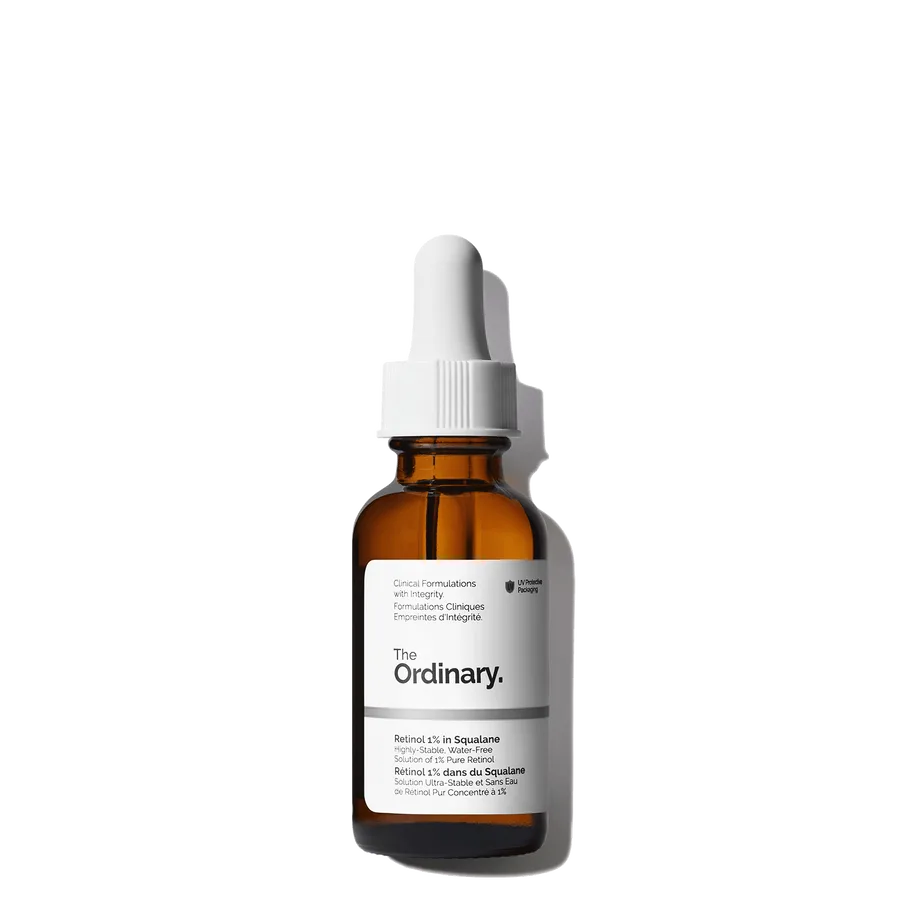
Retinol 1% in Squalane
High-Potency Budget Powerhouse
 Verified reviewer
Pros & cons.
- +Highest OTC retinol concentration available at an almost absurdly low price point
- +Published research supports 1% retinol for measurable collagen synthesis improvement
- +Anhydrous squalane vehicle maximizes retinol stability in the formula
- +Results approach prescription retinoid territory for some users with consistent use
- +Same formula as the 0.2% and 0.5%, making the progression predictable
- +Bottles last 4-6 months when used at the recommended starting frequency
- +Cruelty-free, vegan, fragrance-free, and silicone-free
- −Significant adjustment period with peeling, redness, and potential purging lasting 2-4 weeks
- −No built-in barrier support — requires a robust supporting routine to tolerate
- −Too strong for retinol beginners and many intermediate users
- −Dropper packaging is the worst design choice for the most oxidation-sensitive formula in the line
- −Three-month shelf life creates tension with a product used only 2-3 times weekly initially
- −Not suitable for dry or sensitive skin types without extensive tolerance building
The full review.
The Ordinary Retinol 1% in Squalane is a test. The product itself is straightforward. It uses eight ingredients, the same as the 0.2% and 0.5% versions. It uses the same amber dropper and the same squalane base. The test is whether your skin can handle it. For many retinol users who think they are ready, the answer is no.
This is not a criticism. It is the reality of a 1% pure retinol concentration, and The Ordinary does not pretend otherwise. The product page calls this high-strength with medium irritation potential. This feels like an understatement after the first week. You may see flaking and redness. On day four, you might wonder if you made a mistake. This is retinization. It is temporary and is the price for what this product does.
The results are significant. Research on 1% topical retinol shows measurable increases in procollagen I and procollagen III protein expression—the building blocks skin uses to construct new collagen fibers. A study by Kafi et al., published in the Archives of Dermatology, showed that retinol application to aged skin reduced fine wrinkling and increased glycosaminoglycan expression after 24 weeks. At 1%, the conversion to retinoic acid is substantial enough to accelerate anti-aging, not just nudge it.
The user experience reflects this. People who finish the adjustment period describe skin changes that lower concentrations do not match—firmness, bounce, and clarity that go beyond surface smoothing. Fine lines do not just soften; some users report they visibly diminish. Hyperpigmentation fades faster. Pores appear tighter. After three months of consistent use, the cumulative effect often feels like the closest over-the-counter result to a prescription.
The adjustment period is real and requires support. The Ordinary’s formula contains retinol, squalane, and antioxidants. That is it. It has no ceramides to rebuild what the retinol temporarily disrupts, no centella to soothe inflammation, and no hyaluronic acid to replenish moisture lost by your barrier. You must add those yourself—a thick ceramide moisturizer, a hydrating serum, and daily sunscreen. Without that infrastructure, 1% retinol can leave your skin worse than before.
Application requires strategy. Most dermatologists and experienced users recommend the sandwich method for the first few weeks: moisturizer, then The Ordinary Retinol 1% in Squalane, then more moisturizer. This buffers direct contact and helps skin adapt without a revolt. Start with two nights a week. Not three, and not every other night—just two. Wait a full month before increasing frequency. Users who move too fast often report retinol burning their face.
The texture and application are identical to the 0.2% and 0.5%—the same lightweight oil, quick absorption, and barely-there finish. The difference appears in the hours and days that follow, as the higher retinol concentration triggers a skin response.
At $9.90 for 30ml, the value is high. Because you likely use this 2-3 times per week initially, one bottle can last 4-6 months. That is potentially half a year of high-strength retinol treatment for the price of a mediocre burrito. The full journey through The Ordinary’s retinol line—starting at 0.2%, moving to 0.5%, and arriving at 1%—costs less than $30 total and covers a year or more of progressive retinoid use.
This product is not for most people, which is a feature. It is for committed skincare users and retinol veterans who understand the adjustment period is a process. For them, this is the best value in serious anti-aging skincare on the market.
Ingredient analysis.
Full INCI list
Squalane, Caprylic/Capric Triglyceride, Simmondsia Chinensis (Jojoba) Seed Oil, Retinol, Solanum Lycopersicum (Tomato) Fruit Extract, Rosmarinus Officinalis (Rosemary) Leaf Extract, Hydroxymethoxyphenyl Decanone, BHT
Skin match.
The science.
The Science
At 1% concentration, retinol reaches the range where human studies show measurable molecular changes in the skin. A landmark study by Kafi et al. (2007) in the Archives of Dermatology applied retinol to naturally aged skin in elderly subjects. After 24 weeks, they found significant reductions in fine wrinkling scores compared to vehicle, plus increased glycosaminoglycan expression and procollagen I immunostaining — direct markers of dermal matrix rebuilding. A separate investigation in the Journal of Investigative Dermatology showed that topical application of 1% retinol for 7 days reduces matrix metalloproteinase (MMP) expression while increasing fibroblast growth and collagen synthesis. This shows the molecular anti-aging cascade begins rapidly at this concentration.
The conversion pathway from retinol to its active form, retinoic acid, involves sequential oxidation: retinol → retinaldehyde → retinoic acid, losing potency at each step. Even at 1%, topical retinol produces less retinoic acid in the skin than prescription tretinoin at 0.025%. However, a 2015 comparative study in the British Journal of Dermatology found that retinol induced similar changes in skin histology and gene expression as retinoic acid, but with smaller magnitude — meaning the biological pathways are the same, just less intensely stimulated.
The squalane vehicle is important at this concentration. Higher retinol levels mean more molecules face oxidative degradation, and the anhydrous environment removes the primary aqueous degradation pathway. Additionally, squalane acts as a penetration enhancer for lipophilic compounds, which may improve the bioavailability of this high-dose retinol at the dermal-epidermal junction where collagen remodeling occurs.
References
- Improvement of naturally aged skin with vitamin A (retinol) — Archives of Dermatology (2007)
- A comparative study of the effects of retinol and retinoic acid on histological, molecular, and clinical properties of human skin — British Journal of Dermatology (2015)
- Antiaging action of retinol: from molecular to clinical — Skin Pharmacology and Physiology (2009)
Dermatologist Perspective
Board-certified dermatologists see 1% retinol as the upper limit for OTC retinoid products before prescription retinoids become the next step. Dermatologists note this concentration is not a starting point — even for patients with oily, resilient skin — and requires documented tolerance at lower strengths first. Because this formula lacks supporting ingredients, dermatologists typically recommend pairing it with a prescription-grade moisturizer or a ceramide barrier cream to prevent the excessive transepidermal water loss this strength causes. Dermatologists also note that patients using 1% retinol need the same photoprotection as those on prescription retinoids — daily SPF 50 with consistent reapplication is essential, not optional.
Where it fits in your routine.
Start with 2 nights per week, even if you use the 0.5% nightly. Apply 3-4 drops to clean, dry skin in the evening. For the first month, use the sandwich method: apply a thin layer of moisturizer, then the retinol drops, then a second layer of ceramide-rich moisturizer. Avoid the eye area, lips, nostrils, and broken or irritated skin. If no persistent irritation occurs after 4-6 weeks, increase to 3-4 nights per week. Only attempt nightly use after at least 2 months of successful tolerance building. Apply SPF 50 every morning. Refrigerate after opening.
At $9.90 for 30ml, this is the market's most cost-effective high-strength retinol product. Other brands' 1% retinol products cost $30-$80, and prescription retinoids add office visit costs to the medication. Using it 2-3 times weekly, one bottle lasts 4-6 months, making the monthly cost about $1.65-$2.50. The only value trade-off is the strict 3-month post-opening shelf life — but even with total waste, the loss is under ten dollars. The price-to-performance ratio is unmatched for these results.
Retinol users who have tolerated 0.5% retinol for 2-3 months and want to maximize anti-aging results without a prescription. People seeking the closest OTC approximation to prescription retinoid results at a lower cost.
Retinol beginners — start at 0.2% regardless of age or eagerness. This applies to anyone with sensitive, dry, or eczema-prone skin. It includes people with any skin barrier disruption. It is for those unwilling to use daily sunscreen and a robust moisturizing routine. Pregnant or breastfeeding individuals should also start here.
Product details.
Unscented. It has the same faint oil note as the rest of the retinol line, which vanishes on skin contact.
This 1% retinol uses the same amber glass dropper bottle as the 0.2% and 0.5% versions. Stability concerns peak at 1% retinol; air exposure from the dropper is the main packaging limitation in the lineup.
This line has the most pronounced adjustment period. Tingling or mild burning often occurs on first application. Visible peeling, flaking, and redness usually start within days 3-7 and last 2-4 weeks. Some users experience purging, where existing congestion surfaces as breakouts before clearing. This is normal but intense—if you haven't built tolerance with 0.5%, this product can overwhelm you.
Apply 2-3 times weekly for 4-6 months, or use nightly for 3 months once fully acclimated.
3 months
fall winter
The backstory.
Positioned as the final destination in The Ordinary's graduated retinol system, the 1% was always the product for users who'd earned their stripes. It represents The Ordinary's philosophy taken to its logical extreme — the highest effective OTC retinol concentration, in the simplest possible formula, at the lowest possible price, with zero marketing embellishment about what the adjustment period actually feels like.
About The Ordinary
Established Brand (5–20 years)The Ordinary launched in 2016 under DECIEM (now wholly owned by Estée Lauder Companies as of 2024). It is the most recognized name in affordable, no-nonsense skincare. The brand's transparent ingredient concentrations and pricing earned a massive following and widespread dermatologist acknowledgment. Its products use well-studied ingredients instead of proprietary clinical trials.
Common myths.
1% retinol works like prescription tretinoin, so you don't need a dermatologist.
1% retinol is potent, but it differs from tretinoin. The skin converts retinol to retinoic acid through several enzymatic steps, losing potency at each stage. Even at 1%, this product is less potent than the lowest prescription tretinoin (0.025%). It produces results, but it does not replace a prescription when one is warranted.
If the 0.5% worked for you, the 1% works faster without extra side effects.
Doubling the retinol concentration does more than double the speed of results; it increases irritation potential. Many users who tolerate 0.5% nightly experience peeling, redness, and purging when they move to 1%. The adjustment period is real and requires caution.
FAQ.
Is The Ordinary Retinol 1% too strong for daily use?
Most users aim for nightly use but should not start there. Begin with 2-3 applications per week, even if you currently use the 0.5% nightly. Increase frequency over 4-6 weeks as your skin acclimates. Users with resilient skin can eventually use it nightly, but others find 3-4 nights per week is their sustainable maximum at this concentration.
How does The Ordinary Retinol 1% compare to prescription tretinoin?
Even at high concentrations, 1% retinol is less potent than the lowest prescription tretinoin (0.025%). Retinol undergoes multiple enzymatic conversion steps in the skin to become active retinoic acid, losing significant potency at each step. Still, 1% retinol produces meaningful anti-aging results and suits users who find tretinoin too irritating or lack prescription access.
Is purging normal with The Ordinary Retinol 1%?
Yes — purging is common and expected at this concentration. Accelerated cell turnover pushes existing congestion (clogged pores, microcomedones) to the surface faster than normal. Purging usually happens in your usual breakout areas and resolves within 4-6 weeks. If breakouts appear in new locations or worsen after 6 weeks, stop use and consult a dermatologist.
Can I use The Ordinary Retinol 1% around my eyes?
No — 1% concentration retinol is too strong for the delicate periorbital area. The skin around the eyes is thinner and irritates easily. For crow's feet or under-eye concerns, use the 0.2% version or a dedicated retinol eye cream formulated for the eye contour.
Should I use The Ordinary Retinol 1% in summer?
You can, but use extra caution. Retinol increases photosensitivity, and 1% makes this effect stronger. If you use this product year-round, you must apply and reapply SPF 50 daily. Many dermatologists suggest using 0.5% during peak summer months or limiting use to 2 nights per week with enhanced sun protection.
What the community says.
"Dramatic improvement in skin texture and tone with consistent use"
"Remarkably affordable for a high-strength retinol"
"Visible results faster than lower concentrations"
"Plumping effect noticeable within first few weeks"
"Simple formula with no unnecessary additives"
"Significant irritation, peeling, and redness during the adjustment period"
"Can trigger purging that lasts several weeks"
"Too strong for many users even after building tolerance with lower strengths"
"Oily texture combined with peeling skin creates an uncomfortable combination"
"Three-month shelf life is stressful with a product you can only use 2-3 times per week initially"
People also looked at.