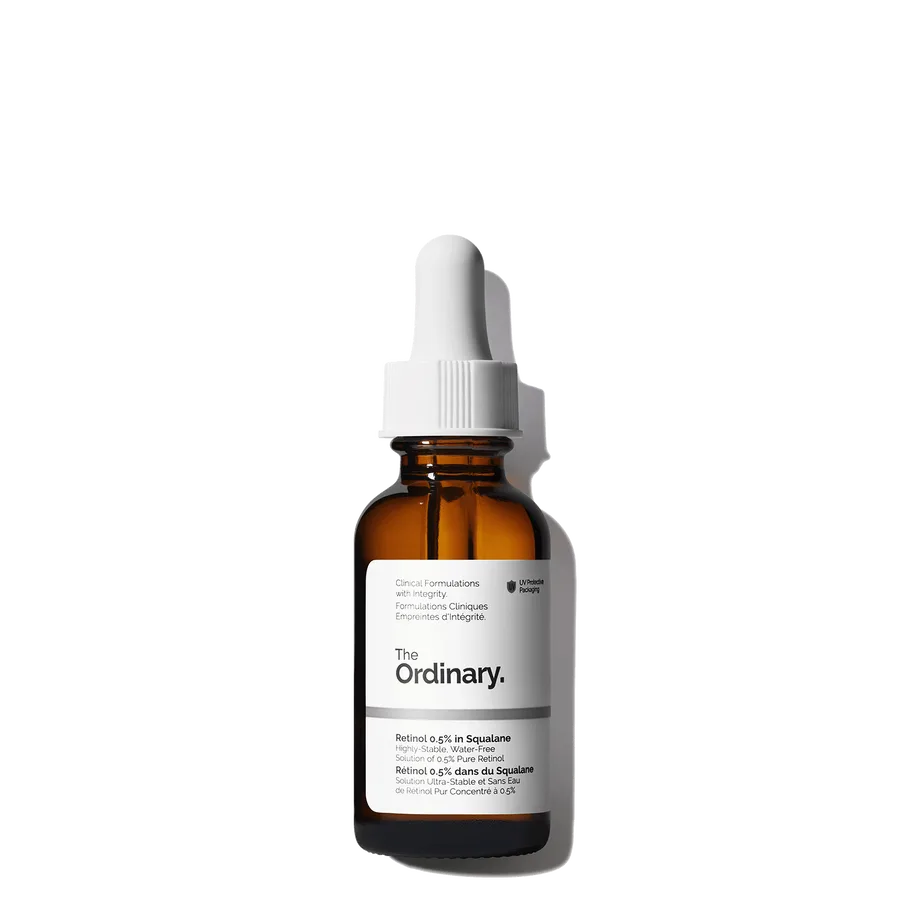
Retinol 0.5% in Squalane
Smart Step-Up Retinol
 Verified reviewer
Pros & cons.
- +Clinically studied 0.5% concentration with direct evidence for anti-aging efficacy
- +Identical formula to the 0.2%, making the step-up predictable and controlled
- +Remarkable value at $9.30 for 3-4 months of a validated retinol treatment
- +Anhydrous squalane base provides superior retinol stability and skin compatibility
- +Faster visible results than the 0.2% for fine lines, texture, and tone
- +Fragrance-free, silicone-free, and vegan with a minimal ingredient list
- +Simple formulation allows precise control over your retinol dose
- −More initial irritation, flaking, and dryness than the 0.2% during retinization
- −No supporting actives like ceramides or peptides to buffer barrier disruption
- −Dropper packaging introduces air to the light-sensitive retinol with each use
- −Three-month post-opening shelf life demands consistent use to avoid waste
- −Oil texture may feel excessive for oily and acne-prone skin types
- −Not suitable for retinol beginners who haven't built tolerance yet
The full review.
The Ordinary’s retinol line is comically efficient. Three products use identical formulas at different concentrations, priced between eight and ten dollars. No stories, limited-edition drops, or influencer collections. Just retinol, squalane, and a dropper. The 0.5% sits in the middle of this lineup. It is the most interesting of the three because its specific concentration has the most direct clinical evidence.
A 2020 study in Skin Pharmacology and Physiology tested 0.3% and 0.5% retinol serums head-to-head. By week twelve, both concentrations significantly improved skin moisture, texture, and overall condition, but the 0.5% outperformed on multiple parameters. A separate study found that 0.5% retinol combined with other actives produced statistically significant improvements in fine lines, radiance, and smoothness by week two. This concentration comes from scientific validation, not a marketing brainstorm.
The formula is a carbon copy of the 0.2% version. Eight ingredients. Squalane base. Jojoba oil. Antioxidant trio. Only the retinol level varies. This consistency is a feature. You know exactly what changed when you step up; any difference in skin response comes from the increased retinol, not a reformulated vehicle.
On the skin, it applies identically to the lower-strength version: a lightweight oil that spreads easily, absorbs within one or two minutes, and leaves a subtle dewy finish. The difference appears days after your first few applications. While the 0.2% is almost imperceptible to most skin, the 0.5% announces itself. You may feel light tightness or mild flaking around the nose or chin by day three. It is nothing dramatic and nothing like the “retinoid uglies” prescription tretinoin can cause, but it shows the active ingredient is working.
Users stepping up from the 0.2% after one or two months of consistent use typically have a smooth transition. Your skin has built retinol tolerance, and the squalane vehicle provides the same lipid buffer. Users jumping straight to 0.5%—perhaps due to prior experience with other retinol products—usually resolve the adjustment period within two to three weeks of every-other-night use.
Results at this concentration are more pronounced than the entry level. Users consistently report visible smoothing of fine texture within two weeks and measurable improvements in fine lines and uneven tone by week six. Stubborn hyperpigmentation and deeper expression lines take twelve weeks or more, but the trajectory is steeper than what the 0.2% delivers.
The limitations apply to the entire line. The formula is stripped down. It has no ceramides to repair your barrier if retinol irritation occurs, no peptides for anti-aging synergy, and no hyaluronic acid for hydration. You must build that support structure with the rest of your routine. A good moisturizer with ceramides, a hydrating serum, and a daily sunscreen are non-negotiable companions to this product.
The dropper packaging is a minor issue. Oxidation is retinol’s Achilles heel, and unscrewing the cap introduces air. The Ordinary’s refrigeration recommendation and three-month use window mitigate this, but an airless pump is the gold standard. At $9.30, however, complaining about packaging is minor.
The value is borderline absurd. $9.30 buys a clinically validated retinol concentration in a stable anhydrous vehicle, with enough product to last three to four months. The entire step-up journey from 0.2% to 0.5% to 1%—a six-to-twelve-month progressive retinoid education—costs less than one bottle of most prestige retinol serums.
This is the retinol for people who have graduated from the beginner class and want real work. It delivers clinically backed results without pretense, markup, or apology. It only requires a moisturizer, a sunscreen, and patience.
Ingredient analysis.
Full INCI list
Squalane, Caprylic/Capric Triglyceride, Simmondsia Chinensis (Jojoba) Seed Oil, Retinol, Solanum Lycopersicum (Tomato) Fruit Extract, Rosmarinus Officinalis (Rosemary) Leaf Extract, Hydroxymethoxyphenyl Decanone, BHT
Skin match.
The science.
The Science
The 0.5% retinol concentration has a stronger direct evidence base than lower OTC strengths. A 2020 clinically controlled trial published in Skin Pharmacology and Physiology by Shao et al. compared 0.3% and 0.5% retinol serums in subjects with photoaged skin. By week 12, both concentrations significantly improved skin moisture, overall condition, texture, and color alignment, with the 0.5% serum showing superior results on several parameters. A separate 2016 study published in the Journal of Drugs in Dermatology found that a retinol 0.5% formulation produced statistically significant improvements in fine lines and radiance as early as week 2, with wrinkles and hyperpigmentation improving by week 4.
The anhydrous delivery system remains scientifically important at this concentration. Retinol's instability is well-documented — it undergoes photodegradation and oxidation when exposed to UV light, air, and water. A squalane-based vehicle eliminates the aqueous degradation pathway entirely, meaning more of the 0.5% retinol declared on the label remains active throughout the product's shelf life. Squalane also functions as a penetration enhancer for lipophilic molecules, potentially improving retinol bioavailability at the dermal-epidermal junction where collagen remodeling occurs.
The retinization process — the initial period of irritation, peeling, and redness that many users experience — is more pronounced at 0.5% than 0.2%. Research published in the Journal of Investigative Dermatology has demonstrated that this response is a normal part of retinoid adaptation, reflecting increased epidermal turnover and temporary barrier disruption. It typically resolves within 2-4 weeks as the skin upregulates its natural retinoid-binding proteins.
References
- A Clinical Anti-Ageing Comparative Study of 0.3 and 0.5% Retinol Serums: A Clinically Controlled Trial — Skin Pharmacology and Physiology (2020)
- Efficacy and Tolerability of a Skin Brightening/Anti-Aging Cosmeceutical Containing Retinol 0.5%, Niacinamide, Hexylresorcinol, and Resveratrol — Journal of Drugs in Dermatology (2016)
Dermatologist Perspective
Board-certified dermatologists consider 0.5% retinol a clinically meaningful concentration that bridges the gap between introductory OTC products and prescription retinoids. Dermatologists frequently recommend this strength for patients who have successfully tolerated lower concentrations for at least one to two months and are ready for more aggressive anti-aging treatment without stepping up to prescription tretinoin. The simple, anhydrous formula is noted positively in dermatological circles because it eliminates potential interactions with water-soluble ingredients and reduces the number of potential sensitizers. Dermatologists emphasize that at this strength, concurrent use of a ceramide-rich moisturizer and daily broad-spectrum SPF 30+ is essential, not optional.
Where it fits in your routine.
Apply 4-5 drops to clean, dry facial skin at night. If switching from the 0.2%, use every-other-night for 2 weeks before moving to nightly. If new to this product line but experienced with retinol, start with 3 nights per week. Avoid the eye area, nostrils, and lip corners. Always follow with a ceramide or lipid-rich moisturizer. Do not use with AHAs, BHAs, vitamin C, or copper peptides in the same routine. Apply broad-spectrum SPF 30+ every morning. Refrigerate after opening and use within 3 months.
At $9.30 for 30ml, this product offers high value — just $1.20 more than the 0.2% version for a clinically validated potency increase. Monthly use costs about $2.50-$3.00, making it cheaper than daily coffee. The Ordinary's brand heritage and Estée Lauder backing ensure supply chain reliability at this price. The 3-month shelf life is the only value consideration — irregular use may waste product, but even a total loss has a negligible financial impact.
Users who have built retinol tolerance with the 0.2% version or other entry-level retinol products and want faster, visible anti-aging results. Budget-conscious consumers seeking clinically validated retinol potency without a price premium. People in their thirties to forties targeting fine lines, texture, and early sun damage.
Retinol beginners who have never used a retinoid product should start with 0.2%. People with active eczema, rosacea, or a compromised skin barrier should also start there. If 0.2% causes irritation, do not increase to this strength. Pregnant or breastfeeding individuals must avoid all retinol.
Product details.
This lightweight golden-tinted oil spreads easily and absorbs within minutes. It feels slightly thicker than the 0.2% version because the retinol concentration is higher.
It is unscented. A faint oil smell disappears immediately on application.
The amber glass dropper bottle is identical to the 0.2% version. The tinted glass protects the light-sensitive retinol from UV, but the dropper mechanism exposes the formula to air with each use.
This version has a longer adjustment period than the 0.2%. Many users feel mild tingling on first application and see flaking or dryness during the first week. This is normal retinization and usually resolves within 2-3 weeks. Users moving up from the 0.2% generally tolerate it well immediately.
3-4 months with nightly facial application using 4-5 drops
3 months
All Year
The backstory.
Designed as the second rung in The Ordinary's deliberate three-step retinol ladder (0.2% → 0.5% → 1%), this product exists to bridge the gap between retinol initiation and high-strength treatment. The 0.5% concentration was chosen because it aligns with concentrations used in published clinical anti-aging trials, giving it a direct evidence base that the entry-level 0.2% can only approximate.
About The Ordinary
Established Brand (5–20 years)The Ordinary launched in 2016 under DECIEM (now wholly owned by Estée Lauder Companies as of 2024) and quickly became the most recognized name in affordable, no-nonsense skincare. The brand's transparent ingredient concentrations and pricing earned a massive following and widespread dermatologist acknowledgment, though its products use well-studied ingredients instead of proprietary clinical trials.
Common myths.
Use the 0.2% before trying the 0.5% — starting here damages your skin.
The Ordinary recommends starting at 0.2%. Experienced users of other retinol or retinoid products can often start at 0.5% without issue. Prior retinol exposure matters more than this specific product line. True retinol beginners should start lower to assess tolerance.
The 0.5% is just the 0.2% with more retinol; results do not change.
The 2.5x concentration increase is significant. A 2020 clinical study in Skin Pharmacology and Physiology shows 0.5% retinol improves skin parameters more than 0.3% by week 12. The dose-response relationship with retinol is real and clinically documented.
FAQ.
What is the difference between The Ordinary Retinol 0.2% and 0.5%?
The ingredient list is identical; only the retinol concentration changes. The 0.5% delivers 2.5 times more retinol per application, which produces faster, more pronounced results for fine lines, texture, and tone. It also has a higher risk of initial irritation, dryness, and peeling. Use the 0.5% after building tolerance with the 0.2% for at least a month.
Can I use The Ordinary Retinol 0.5% every night?
If the 0.2% nightly use causes no irritation, switch to the 0.5% nightly within 1-2 weeks. For a first step up, use it every other night for 2-3 weeks then increase gradually. Always follow with a moisturizer and use SPF every morning.
Is The Ordinary Retinol 0.5% strong enough to treat wrinkles?
Yes — clinical trials show 0.5% retinol produces statistically significant improvements in fine lines, wrinkles, and skin texture within 12 weeks. This concentration is closer to levels used in published anti-aging research than the entry-level 0.2%, making it a clinically relevant treatment strength.
Why does The Ordinary Retinol 0.5% need refrigeration?
Heat, light, and oxygen degrade pure retinol. The anhydrous squalane base is more stable than water-based formulas, but refrigeration slows degradation further and keeps the 0.5% concentration stable during the 3-month post-opening window. Store it on your fridge's door shelf for easy access.
Can I use niacinamide with The Ordinary Retinol 0.5%?
Yes — niacinamide is a top active to pair with this retinol. Niacinamide strengthens the skin barrier, reduces inflammation, and counteracts retinol-induced irritation and dryness. Apply a niacinamide serum first, let it absorb, then use the retinol drops.
What the community says.
"Noticeable results faster than the 0.2% version"
"Still very affordable for a potent retinol"
"Simple formula with no unnecessary fillers"
"Good step-up for those who tolerated the entry-level version"
"Oil texture feels nourishing without being heavy"
"More irritation and peeling than the 0.2% during adjustment period"
"Oily texture can feel excessive for oily skin types"
"Dropper packaging exposes retinol to air"
"Short 3-month shelf life after opening requires commitment"
"Some users find the jump from 0.2% to 0.5% too aggressive"
People also looked at.