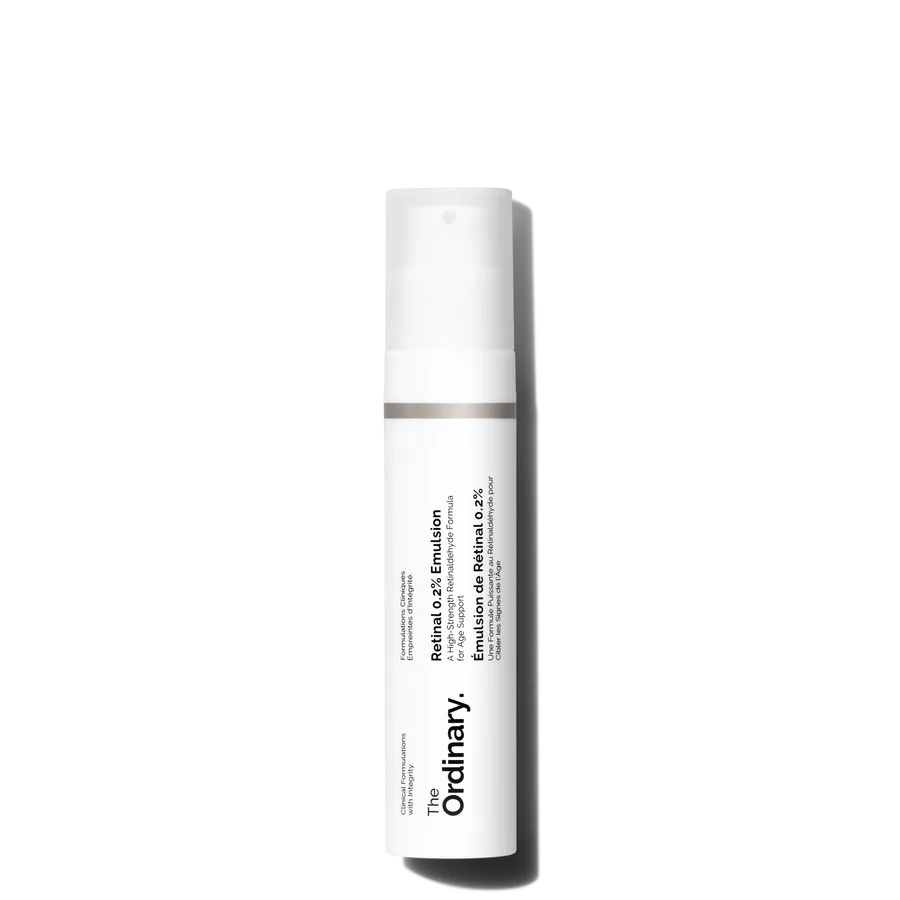
Retinal 0.2% Emulsion
The Retinoid Step-Up
 Verified reviewer
Pros & cons.
- +Retinaldehyde at 0.2% delivers significantly faster results than equivalent retinol concentrations
- +Innovative hydroxyapatite encapsulation provides sustained release and reduces irritation spike
- +Comprehensive soothing system with synthetic oat analogues, bisabolol, and ergothioneine
- +Exceptional value at $14.90 compared to competitor retinaldehyde products at $40-80+
- +Lightweight emulsion texture absorbs cleanly without heaviness or greasiness
- +Addresses aging, texture, dark spots, and pore appearance from a single potent active
- −Not suitable for retinoid beginners — 0.2% retinal is equivalent to advanced-strength retinol
- −Limited to once-to-twice-weekly application for most users — cannot be used nightly
- −Small 15ml bottle runs out in 2-3 months at the recommended usage frequency
- −Yellow-tinted formula can stain lighter pillowcases and fabrics
- −Significant irritation, peeling, and dryness expected during the retinization period
- −Contraindicated during pregnancy and breastfeeding
The full review.
There’s a hierarchy in the retinoid world that most skincare consumers eventually learn: retinyl esters at the bottom (gentle, slow), retinol in the middle (effective, established), retinaldehyde near the top (potent, underserved), and prescription retinoic acid at the summit (powerful, gatekeeper-controlled). For years, that hierarchy had a conspicuous gap. Retinol was everywhere — in every price range, every formulation, every brand. Retinaldehyde, despite being demonstrably more potent and sitting just one enzymatic conversion from the prescription form, was available from perhaps a handful of brands, mostly European, mostly expensive, and mostly unknown outside dermatology circles.
The Ordinary looked at that gap and did what The Ordinary does: filled it at a price that made every other retinaldehyde product’s margins suddenly uncomfortable.
The Retinal 0.2% Emulsion is not just retinaldehyde in a bottle. The formulation reveals a level of technological sophistication that goes beyond The Ordinary’s usual approach of “active ingredient plus minimal vehicle.” The retinaldehyde is encapsulated in hydroxyapatite — a biocompatible calcium phosphate mineral that’s a natural component of human bone and teeth. This isn’t decorative science. Free retinaldehyde on skin causes an irritation spike as the full concentration hits the surface at once. Hydroxyapatite encapsulation creates a sustained-release mechanism: the retinal is gradually liberated from the mineral matrix over time, delivering a steady dose rather than a burst. The peak irritation is lower while the cumulative efficacy is maintained.
Around this encapsulated retinal, The Ordinary has built a deliberate irritation-management system. Cetylhydroxyproline palmitamide — a synthetic oat analogue — mimics the barrier-soothing properties of colloidal oatmeal, directly counteracting the dryness and barrier disruption that retinoids cause. Bisabolol, derived from chamomile, provides anti-inflammatory support through a separate pathway. Ergothioneine, a potent amino acid antioxidant, protects both the retinaldehyde from oxidative degradation and the skin from the oxidative stress that accelerated cell turnover can generate. This isn’t a formula that delivers retinaldehyde and hopes for the best — it’s a formula that anticipates retinaldehyde’s problems and addresses them within the same bottle.
The potency deserves honest framing. Retinaldehyde is approximately 11 times more bioactive than retinol at equivalent concentrations, according to published research. At 0.2%, this emulsion delivers potency roughly comparable to 1-2% retinol — firmly in the advanced territory. The 0.2% number can be misleading: it sounds gentle, almost introductory. It is not. This is a product for people who have already spent months building retinoid tolerance with retinol and are ready for the next step. Using this as your first retinoid experience is like learning to drive in a sports car — technically possible, almost certainly unpleasant.
The texture is a pleasant surprise for a retinoid product. A lightweight, milky emulsion with a faint yellow tint from the retinaldehyde, it absorbs smoothly without the heaviness or greasiness that characterizes many retinoid creams. The emulsion base provides enough occlusion to support the retinoid’s delivery without sitting on the skin’s surface. Under a moisturizer — which you should absolutely apply after this product — it layers cleanly.
Results come faster than retinol. This is the primary argument for retinaldehyde: with one fewer enzymatic conversion required, the active form reaches retinoic acid receptors more efficiently. Texture refinement is visible within two weeks. Fine lines and firmness improvements appear at four to six weeks. Significant dark spot fading, pore refinement, and overall skin quality transformation at eight to twelve weeks. These timelines are approximately 30-40% faster than equivalent retinol results for most users — a meaningful acceleration for an active that traditionally requires patience.
The irritation is real and should not be minimized. Even with the hydroxyapatite encapsulation and soothing ingredients, 0.2% retinaldehyde will cause some degree of dryness, peeling, and redness during the retinization period (typically weeks 2-6). Starting at once weekly and progressing to twice weekly over a month is essential — not optional. The yellow tint can stain lighter pillowcases, which is a practical annoyance. And the 15ml bottle, while standard for a high-concentration retinoid, feels small when the product lasts only two to three months at the recommended twice-weekly usage.
At $14.90, the value proposition is striking. Comparable retinaldehyde products — from Avène, Medik8, and A313 — typically cost $40-80 for similar concentrations. The Ordinary delivers equivalent potency with arguably superior delivery technology (the hydroxyapatite encapsulation) and a more comprehensive soothing system at roughly one-third to one-fifth the price. For a retinoid that’s been inaccessible to most consumers due to pricing and availability, this democratization is significant.
The Retinal 0.2% Emulsion is not The Ordinary’s easiest product to use, its most universally suitable, or its most instantly gratifying. It’s their most scientifically ambitious — a high-potency retinoid with delivery technology that competes with formulations costing five times as much. For experienced retinoid users who’ve plateaued on retinol and want to progress without jumping to prescription tretinoin, this product fills a space that barely existed before it arrived.
Ingredient analysis.
Full INCI list
Aqua (Water), Coco-Caprylate/Caprate, Propanediol, Pentylene Glycol, Hydroxyapatite, Retinal, Cetylhydroxyproline Palmitamide, 4-t-Butylcyclohexanol, Hydroxyphenyl Propamidobenzoic Acid, Ergothioneine, Biosaccharide Gum-1, Bisabolol, Brassica Campestris Sterols, Zingiber Officinale Root Extract, Butylene Glycol, Isohexadecane, Hexyldecanol, Maltodextrin, Caesalpinia Spinosa Gum, Polyacrylate Crosspolymer-6, Hydroxyethyl Acrylate/Sodium Acryloyldimethyl Taurate Copolymer, Stearic Acid, Isoceteth-20, Polysorbate 60, Ascorbyl Palmitate, Tocopherol, Lactic Acid, Sodium Lactate, Sodium Hydroxide, Ethylhexylglycerin, Phenoxyethanol, Chlorphenesin
Skin match.
The science.
The Science
Retinaldehyde (retinal) sits uniquely in the vitamin A pathway. It is one oxidative step from retinoic acid—the biologically active form that binds to retinoid receptors in the skin. Retinal dehydrogenase enzymes convert retinaldehyde directly into this active form. Retinol requires two enzymatic steps: oxidation to retinaldehyde, then to retinoic acid. Comparative studies show this shorter pathway makes retinaldehyde approximately 11 times more bioactive than retinol at equivalent concentrations.
Creidi et al. (1998) published a study in Dermatology showing that daily topical retinaldehyde at 0.05% for 18 months improved fine wrinkles, roughness, and overall photodamage severity compared to vehicle. This used one-quarter the concentration found in The Ordinary's product. At 0.2%, the expected efficacy is substantial.
Retinaldehyde also has a unique property among retinoids: direct antibacterial activity against Cutibacterium acnes. Pechere et al. (1999) confirmed in Dermatology that retinaldehyde inhibits C. acnes growth at concentrations achievable topically. Retinol and retinyl esters do not share this benefit. This helps users address both aging and acne simultaneously.
The hydroxyapatite encapsulation system in this formula uses established drug delivery technology. Hydroxyapatite's crystalline structure creates a porous matrix that releases the encapsulated active through dissolution and diffusion. This controlled release reduces the peak concentration of free retinaldehyde on the skin surface, lowering acute irritation while maintaining cumulative efficacy over the application period.
Ergothioneine is the formula's primary antioxidant. Research in Free Radical Biology and Medicine shows ergothioneine accumulates in tissues exposed to oxidative stress and provides superior protection against UV-induced damage compared to glutathione. This is relevant in a retinoid formula that increases photosensitivity.
References
- Profilometric evaluation of photodamage after topical retinaldehyde and retinoic acid treatment — Dermatology (1998)
- Antibacterial activity of retinaldehyde against Propionibacterium acnes — Dermatology (1999)
Dermatologist Perspective
Dermatologists view retinaldehyde as an underutilized retinoid that bridges the gap between cosmetic retinol and prescription retinoic acid. Board-certified dermatologists note the 0.2% concentration in this formula puts it in the advanced retinoid category, matching the potency of high-strength retinol products many patients have outgrown. The hydroxyapatite delivery system is a clinically relevant innovation that manages retinaldehyde's instability and tendency to cause acute irritation. Dermatologists often recommend retinaldehyde to patients who have plateaued on retinol but cannot or will not use prescription tretinoin. The soothing ingredients are a plus, though dermatologists still emphasize gradual introduction and robust moisturization.
Where it fits in your routine.
Apply a pea-sized amount to a clean, dry face in the evening only. Start once per week, leaving 48-72 hours between uses. If you tolerate it well after 4-6 weeks, use it twice weekly. Follow immediately with a thick moisturizer to buffer dryness. Do not use other retinoids, direct acids, or vitamin C in the same routine. Apply broad-spectrum SPF 30+ every morning. Avoid the eye area. Stop use 2 weeks before waxing, laser treatments, or chemical peels.
At $14.90 for 15ml, this product uses a retinoid form usually found in premium European pharmacy brands priced at $40-80 for similar concentrations. The hydroxyapatite encapsulation technology adds value; this is a delivery-optimized formula with built-in soothing and stability systems, not just retinaldehyde in a cheap base. Applying it twice weekly costs roughly $1.15 per use—a reasonable price for a high-potency retinoid treatment. The small bottle size limits value; a 30ml option would improve the per-ml economics. Even so, this is the most affordable stabilized retinaldehyde currently available.
Retinoid users who built tolerance with retinol over 3-6+ months can use this to progress to a more potent form without switching to prescription tretinoin. It works for those addressing aging, texture, dark spots, and photodamage who want faster results than retinol delivers.
Retinoid beginners should start with 0.2-0.5% retinol. Build tolerance over months before using retinal. This includes anyone with sensitive, rosacea-prone, or barrier-compromised skin. Pregnant or breastfeeding individuals must avoid all retinoids. Do not use if you cannot use sunscreen consistently.
Product details.
Lightweight, milky emulsion with a slight yellow tint from the retinaldehyde — absorbs smoothly without grease or heavy residue
Very faint, barely perceptible scent — essentially unscented
Small frosted glass bottle with dropper — the 15ml size is compact and easy to travel with, but limits total use duration
Use a pea-sized amount for the first application. Mild tingling or warmth occurs within 5-10 minutes as the retinaldehyde activates on the skin. Redness and dryness can appear the next morning. Apply once weekly during the first month, waiting 48-72 hours between uses. Peeling and flaking can happen during weeks 2-4 because the retinoid accelerates cell turnover; this is expected retinization, not damage. Keep the area well-moisturized.
2-3 months with once-to-twice-weekly use
6 months
fall winter
The backstory.
Retinaldehyde has long been the retinoid form that dermatologists wished was more commercially available. More potent than retinol but gentler than prescription retinoic acid, it occupied an awkward middle ground — too expensive for mass-market brands, too unfamiliar for luxury brands to market effectively. The Ordinary's entry into the retinaldehyde space with hydroxyapatite encapsulation technology democratized access to a retinoid form that had previously been confined to European pharmacy brands charging $50-80 for similar concentrations.
About The Ordinary
Established Brand (5–20 years)DECIEM launched The Ordinary in 2016. It is now a top name in affordable, ingredient-focused skincare. The brand does not run proprietary clinical trials on its specific formulations, but it uses well-studied actives at transparent concentrations. This approach earns widespread dermatologist acknowledgment.
Common myths.
0. 2% retinal is a beginner-strength retinoid because the number sounds low.
Retinaldehyde is about 11 times more bioactive than retinol at the same concentrations. 0.2% retinal has roughly the same potency as 1-2% retinol—well above beginner levels. This product targets experienced retinoid users who have built retinol tolerance and want a more potent form.
Retinaldehyde doesn't cause as much irritation as retinol.
Retinaldehyde often shows less irritation than retinol, but that is because it usually uses lower concentrations. At 0.2%, the irritation potential is significant and matches a high-strength retinol product. The hydroxyapatite encapsulation and soothing ingredients in this formula reduce but do not eliminate this.
FAQ.
What's the difference between retinal and retinol?
Retinal (retinaldehyde) is one enzymatic conversion step closer to the active form of vitamin A (retinoic acid) than retinol, which needs two steps. This makes retinal about 11 times more bioactive at equivalent concentrations. The 0.2% retinal in this product has potency similar to 1-2% retinol and shows faster visible results.
Is The Ordinary Retinal 0.2% good for beginners?
No. Retinaldehyde is more potent than retinol at the same 0.2% concentration. This product targets experienced retinoid users who have built tolerance with retinol products over several months. Beginners should use The Ordinary's retinol products (0.2% or 0.5% retinol in squalane) before moving to retinal.
How often should I use The Ordinary Retinal 0.2%?
Use this once per week, with 48-72 hours between applications. If no significant irritation occurs after 4-6 weeks, use it twice weekly. Most users find twice-weekly application gives optimal results without excessive irritation. Most users, even experienced retinoid users, should not use this product nightly.
Can I use The Ordinary Retinal with niacinamide?
Do not use them in the same routine, per The Ordinary's guidance. You can use niacinamide in the morning and retinal in the evening. Niacinamide's barrier-strengthening and anti-inflammatory properties buffer retinoid irritation over time. This AM/PM split is an effective way to combine these actives.
Why does this product stain my pillowcase?
Retinaldehyde has a natural yellow-orange tint that transfers to light fabrics. Use a dark silk pillowcase, or wait 15-20 minutes for the product to absorb before bed. Applying moisturizer over the retinal also reduces transfer.
Is The Ordinary Retinal safe during pregnancy?
No. All vitamin A retinoids, including retinaldehyde, are contraindicated during pregnancy and breastfeeding because of potential teratogenic effects. Stop use before attempting to conceive and throughout pregnancy and nursing.
What the community says.
"Dramatically improved skin texture and refined pore appearance"
"Visible anti-aging results faster than retinol products"
"Excellent value for a retinaldehyde product compared to luxury alternatives costing $50-100+"
"Lightweight emulsion absorbs well without greasiness"
"Built-in soothing ingredients reduce retinoid irritation effectively"
"Not for nightly use — requires careful once-to-twice-weekly application"
"Small 15ml bottle size runs out quickly for the price"
"Can cause significant irritation, peeling, and dryness if overused"
"Product may yellow lighter-colored pillowcases and fabrics"
"Not suitable for retinoid beginners despite the seemingly low 0.2% concentration"
People also looked at.