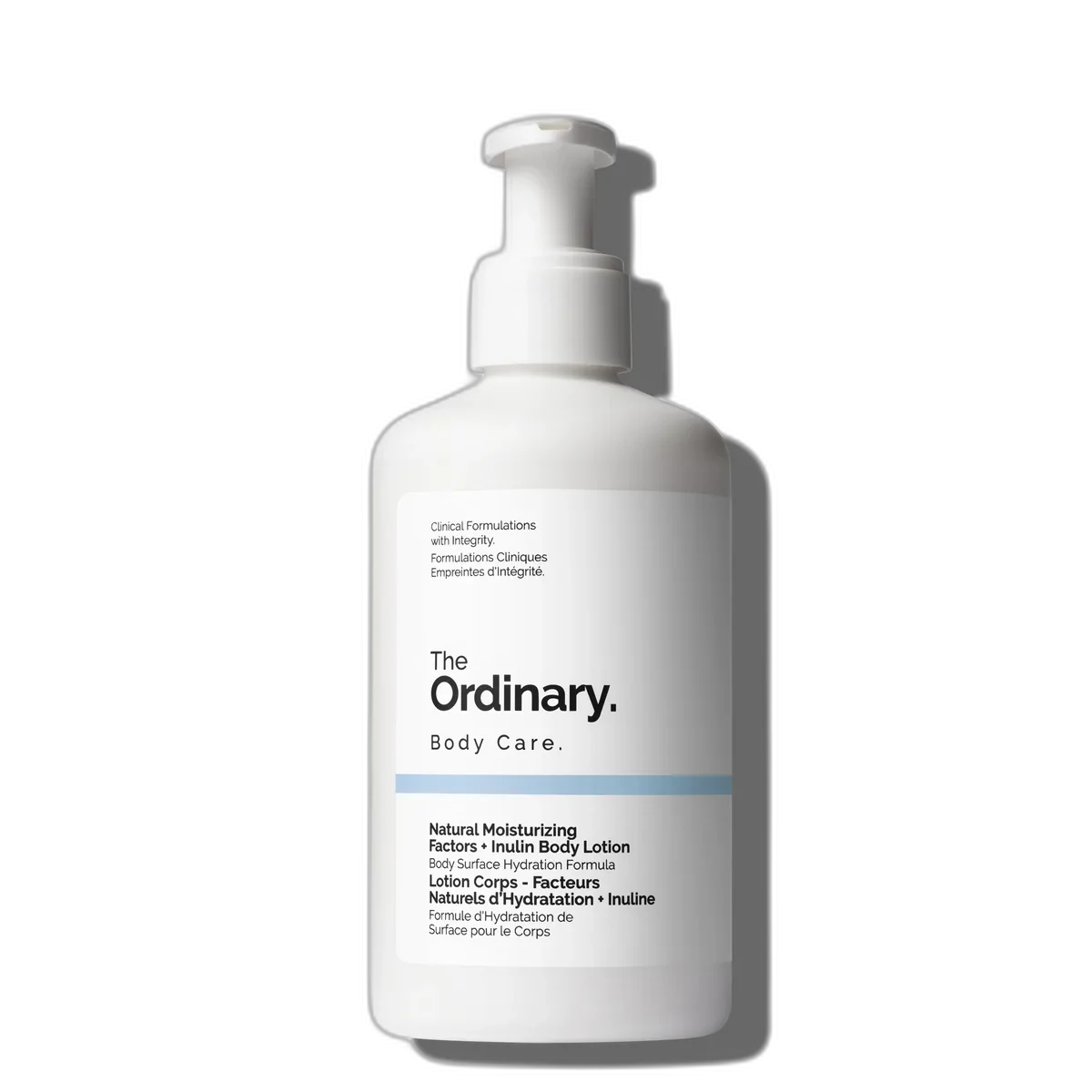
Natural Moisturizing Factors + Inulin Body Lotion
Barrier-Repair Body Staple
 Verified reviewer
Pros & cons.
- +Full NMF complex built on amino acids, PCA, urea, lactate, and sugars
- +National Eczema Association Seal of Acceptance (real third-party validation)
- +240 mL for $15 is exceptional value for a well-built eczema-friendly lotion
- +Fragrance-free, allergen-clean, sensitive-skin appropriate
- +Lightweight texture works daily without greasiness
- +Inulin prebiotic supports microbiome balance
- +Pregnancy-compatible and safe for all skin types
- +Layers cleanly under occlusive ointments for severe patches
- −Too lightweight alone for active severe eczema flares
- −No sensory body-care ritual (fragrance-free by design)
- −Pump can become uneven near the bottom of the bottle
- −Results are subtle rather than dramatic on mildly dry skin
- −Inulin's prebiotic effect is emerging rather than well-established
The full review.
Many people wrongly think treating dry skin requires piling on heavier creams. Dry skin is actually a water-retention problem. Skin loses the tiny intracellular molecules that hold water inside corneocytes, leaving a barrier that cannot keep hydration in regardless of how much oil you apply. In dermatology, these water-holding molecules are Natural Moisturizing Factors, or NMFs. Healthy skin produces them as a byproduct of protein breakdown during cell turnover. They include amino acids like glycine and proline, plus PCA, urea, lactate, and various sugars. Chronic dryness or eczema-prone skin depletes the internal NMF pool. Replacing these molecules topically works differently than applying heavy cream.
The original version of The Ordinary’s NMF story launched years ago as a face moisturizer. It became a top recommended entry point for barrier support on dermatologist Instagram. It was cheap, fragrance-free, and used a humectant system to replace lost molecules rather than just adding surface moisture. This body lotion uses that same philosophy at body scale. This 240 mL bottle provides NMF-forward hydration for larger surface areas and daily body care. It passed the National Eczema Association’s evaluation process for the Seal of Acceptance. That seal is not marketing fluff; it is a third-party review of fragrance, allergen, and irritation potential that brands do not get easily.
The ingredient deck shows deliberate formulation restraint. The NMF complex includes the long list of amino acids, PCA, lactate, urea, and sugars used in the face version. Glycerin handles the humectant bulk. Inulin sits at the top of the INCI as a prebiotic polysaccharide to support the commensal skin microbiome, which often disrupts in eczema-prone skin. This supports a different axis of barrier function than the humectants. Caprylic/capric triglyceride and isodecyl neopentanoate provide a light emollient structure for non-greasy slip without a heavy occlusive system. Rhus succedanea fruit wax adds slight body. Sodium hyaluronate supports the NMFs as a larger-molecule water-binding agent. The rest is standard Deciem housekeeping. There is no fragrance, dye, essential oil, or botanical filler, which the National Eczema Association’s evaluation process rewards.
In practice, this formulation delivers a lightweight lotion that performs like a treatment product rather than a standard body moisturizer. The first application feels unremarkable—no tingle or drama, just a clean, smooth finish that sinks in quickly without greasy residue. The hydration sticks. Areas that struggle with body lotion, like shins, elbows, and the backs of upper arms, look visibly less dry by day three of consistent use. This improvement holds between applications. Skin that normally feels tight after a shower does not feel tight. Flaky patches smooth out over the first week. This is not dramatic, but the cumulative effect beats standard drugstore lotion because it replaces NMFs instead of just adding glycerin.
This lotion is an obvious recommendation for people with mildly to moderately dry body skin who do not need prescription-grade intervention. This includes winter dryness, post-shower tightness, chronic flaking on extremities, or anyone using drugstore body lotion that fails to work. It is also appropriate for eczema-prone skin during daily maintenance. The NEA seal specifically covers that use case, and the formulation matches clinical recommendations for gentle, non-irritating daily hydration between flares. For acute eczema flares, this lotion is likely not enough alone; those situations usually need a heavier occlusive ointment layered on treated patches. As the daily body hydration layer underneath that strategy, it is a solid, sensible pick.
The product has limits. Its lightweight nature is its main strength and its main ceiling. If your skin has severe eczema or winter dryness causes cracked, painful skin, you will want something heavier on the worst patches. The fragrance-free, unscented profile makes it broadly tolerated but offers no sensory body-care ritual. If you want body products that smell like coconut or feel like dessert, this will feel clinical. The pump bottle is functional but gets harder to use near the bottom of the 240 mL container. While inulin is a supporting ingredient, the microbiome claim is still emerging science; do not buy this expecting a dramatic skin-bacteria transformation.
The value proposition is strong. Fifteen dollars for 240 mL of well-built, fragrance-free NMF body lotion with a third-party eczema endorsement is cheap. Comparable eczema-friendly body lotions from specialist brands like Vanicream or Eucerin cost similar or slightly higher prices for similar volumes, and some have less humectant complexity. Luxury body lotions with less-evidence-backed formulations often cost three to four times more. For daily body care, the math makes the decision: it is cheap enough to replace your current product, it works better than drugstore alternatives, and the safety profile allows almost anyone to try it without fear of reactions. This combination is characteristic of The Ordinary at its best, and this body lotion shows what the brand does when the formulation team is on their game.
Formula
Ingredient analysis.
Full INCI list
Aqua/Water/Eau, Caprylic/Capric Triglyceride, Glycerin, Inulin, Propanediol, Isodecyl Neopentanoate, Arachidyl Alcohol, Rhus Succedanea Fruit Wax, Sodium Hyaluronate, Arginine, Glycine, Alanine, Serine, Proline, Threonine, Glutamic Acid, Lysine HCl, Betaine, Sodium PCA, PCA, Xylitylglucoside, Anhydroxylitol, Xylitol, Glucose, Maltose, Fructose, Sucrose, Trehalose, Sodium Lactate, Urea, Allantoin, Behenyl Alcohol, Arachidyl Glucoside, Pentylene Glycol, Polyacrylate Crosspolymer-6, Xanthan Gum, Trisodium Ethylenediamine Disuccinate, Tocopherol, Citric Acid, Sodium Hydroxide, Sodium Chloride, Ethylhexylglycerin, Phenoxyethanol, Chlorphenesin
Skin match.
The science.
The Science
Natural Moisturizing Factors are low-molecular-weight, hygroscopic compounds. Healthy corneocytes produce them as byproducts of filaggrin degradation during cell turnover. Dermatology literature has mapped their composition—free amino acids, PCA, urea, sodium lactate, various sugars, and electrolytes—for decades. NMFs deplete in dry skin conditions like xerosis, atopic dermatitis, and ichthyosis. Peer-reviewed work shows topical replacement improves corneocyte hydration, reduces transepidermal water loss, and restores barrier function. The specific amino acids in this lotion's NMF complex—glycine, alanine, serine, proline, threonine, glutamic acid, lysine, and arginine—match the dominant free amino acids in healthy stratum corneum. At concentrations below the 10% keratolytic threshold, urea acts as a humectant and barrier-restoring agent with strong clinical support for atopic and xerotic skin. Sodium PCA and sodium lactate add skin-identical humectant activity. The sugar components—trehalose, betaine, glucose, xylitol derivatives—provide osmoprotectant activity; trehalose has a published evidence base for protecting cellular hydration under osmotic stress. Inulin as a topical prebiotic has emerging support; small studies show it can influence the commensal skin microbiome, though researchers are still characterizing its clinical relevance for broad skin health. The National Eczema Association Seal of Acceptance requires the product to be free of common irritants and allergens and to meet sensitivity testing thresholds. This third-party validation confirms the formulation meets gentleness standards for compromised skin.
Dermatologist Perspective
Dermatologists routinely recommend NMF-based moisturizers as first-line body care for xerosis, atopic dermatitis, and other dry-skin conditions. The clinical rationale is simple: dry and eczema-prone skin lacks intracellular NMFs, and topical replacement restores barrier hydration more effectively than simple occlusion alone. Board-certified dermatologists often flag products with the National Eczema Association Seal of Acceptance as safer starting points for sensitive or compromised skin, as the seal requires independent evaluation of fragrance, allergen content, and irritation potential. For patients in active eczema flares, clinicians typically recommend layering a heavier occlusive ointment—plain petrolatum or a prescribed barrier repair cream—over affected patches, using a lightweight NMF lotion like this for daily hydration on unaffected skin. This product fits standard derm-recommended routines for patients with mild to moderate chronic dryness or for maintenance between flares. The fragrance-free, allergen-clean formulation is particularly useful for pediatric and pregnant patients, who benefit from conservative ingredient choices.
Where it fits in your routine.
Apply to slightly damp skin within three minutes of showering or bathing to capture maximum hydration. This short window works because damp skin locks in water faster than dry skin. Use enough to cover skin completely without excess pooling. For very dry patches like shins, elbows, and knees, apply twice daily or layer a heavier occlusive balm (plain petrolatum works) on top of this lotion. This lotion is safe for the face and body, but it is lighter than a typical face cream and may not be enough for dry facial skin in winter. It is compatible with body exfoliants — apply acid body products first, let them absorb, then layer this lotion. Use daily to maintain chronically dry or eczema-prone body skin.
At $15 for 240 mL, this is a top value in the eczema-friendly body lotion category. Specialist brands like Vanicream, CeraVe, and Eucerin offer fragrance-free body lotions at similar or slightly higher prices, but most have thinner humectant systems and lack the full NMF complex in this product. Luxury body lotions with less-evidenced formulations cost $40–$60 for similar volumes. Twice-daily full-body application uses the 240 mL bottle in six to eight weeks, making the monthly cost about seven or eight dollars — low for a product that reliably performs its job. The National Eczema Association seal adds value not reflected in the price. For daily body hydration on dry or sensitive skin, this pricing makes the decision easy.
This fragrance-free daily body lotion works for anyone with chronically dry, sensitive, or eczema-prone body skin at a fair price. It suits people using drugstore body lotions that fail to work, pregnant patients, and anyone wanting third-party validation for gentleness. It is also a smart first-line recommendation for kids and teens with dry skin.
Skip if your dryness is severe enough to need prescription-grade treatment or thick occlusive ointments as your primary body care — this lotion is too lightweight alone for that use case, though it can layer underneath heavier treatments. Also skip if what you love about body care is a sensory experience of scent, ritual, and luxury packaging; this is deliberately clinical.
Product details.
Light, creamy-white lotion spreads smoothly and absorbs in about a minute. It leaves a soft, non-tacky finish.
Fragrance-free with a neutral, very faint lipid note.
240 mL plastic pump bottle in Deciem's usual white-and-grey labeling.
The first use feels like a standard high-quality body lotion — no tingle, no scent, and no adjustment period. The difference shows after two or three days on chronically dry patches: shins, elbows, and the backs of the upper arms look visibly less dry and flaky. Hydration lasts longer between applications than a typical drugstore lotion delivers.
Use twice daily for 6–8 weeks; once daily takes longer.
12 months
All Year
The backstory.
The Ordinary's original Natural Moisturizing Factors + HA face moisturizer, launched in the brand's early years, became a reference point for entry-level barrier support across thousands of dermatologist recommendations on social media. This body lotion is the same underlying philosophy — replace the skin-identical molecules that healthy skin makes and chronically dry skin loses — rebuilt at body scale and sent through the National Eczema Association's evaluation process for the seal.
About The Ordinary
Established Brand (5–20 years)The Ordinary launched in 2016. Its NMF face formulations have been top entry points for barrier repair for a decade. This body lotion uses that same formulation DNA for body care and has the National Eczema Association's Seal of Acceptance — third-party proof it is gentle for compromised skin.
Common myths.
You need a thick, heavy cream to treat very dry skin.
Dry skin is a water-retention problem, not an oil problem. Thick creams work for very compromised skin, but for most dryness, a well-built humectant system like the NMF complex here provides more sustained hydration than a heavy occlusive cream without the greasy residue.
Inulin is just filler.
Inulin is a prebiotic polysaccharide with evidence that it supports the commensal skin microbiome. On eczema-prone skin where microbiome disruption drives flare patterns, a prebiotic supporting ingredient is a logical addition—not a breakthrough, but not filler.
FAQ.
What makes NMFs different from regular humectants?
Natural Moisturizing Factors are specific molecules healthy skin produces inside its corneocytes — amino acids like glycine, proline, and alanine, plus PCA, urea, lactate, and sugars. Topical application replaces what the skin lost instead of adding a foreign humectant like glycerin alone. This works by restoring the barrier rather than just hydrating the surface, so NMF-based products work better on chronically dry skin than standard humectants.
Is this safe for eczema-prone skin?
Yes — the formula is fragrance-free, allergen-clean, and has the National Eczema Association's Seal of Acceptance. This means independent tests show it is gentle on compromised skin. Use it daily for eczema maintenance, but layer a heavier occlusive cream on top during active flares.
How is this different from the face version?
The core NMF complex is similar, but the body lotion has a larger volume and lighter texture for body-scale application and includes inulin as a prebiotic. The face version is thicker and more occlusive for a smaller surface area. You can use either on the other, but the formats match their intended use cases best when kept that way.
Does the prebiotic inulin actually do anything?
Inulin is a small but effective ingredient. It feeds commensal skin bacteria and shows emerging evidence for treating microbiome-related skin conditions. While not the primary reason this lotion works, it is a logical addition for eczema-prone skin where microbiome disruption occurs.
Can I use it on my face?
Yes — the formulation is safe for the face, but it is a body lotion and may be lighter than what facial dry skin needs in winter. For the same formulation philosophy in a face-appropriate format, The Ordinary's Natural Moisturizing Factors + HA face moisturizer is the direct equivalent.
How often should I apply it?
Apply once or twice daily. For best hydration, apply to slightly damp skin within three minutes of showering. For chronically dry areas like shins and elbows, a second application later in the day extends the hydration window.
Is it pregnancy safe?
Yes — no ingredients in the formula appear on standard pregnancy-avoidance lists. Doctors often recommend fragrance-free gentle body lotions during pregnancy when skin becomes more reactive. The National Eczema Association seal shows it meets standards for broad skin tolerance.
What the community says.
"Noticeably hydrating without being heavy"
"Fragrance-free and safe for eczema-prone skin"
"Large 240 mL bottle for $15"
"No sticky or greasy residue"
"Not occlusive enough for severe eczema flares alone"
"Pump can dispense unevenly"
"Needs frequent reapplication in very dry winters"