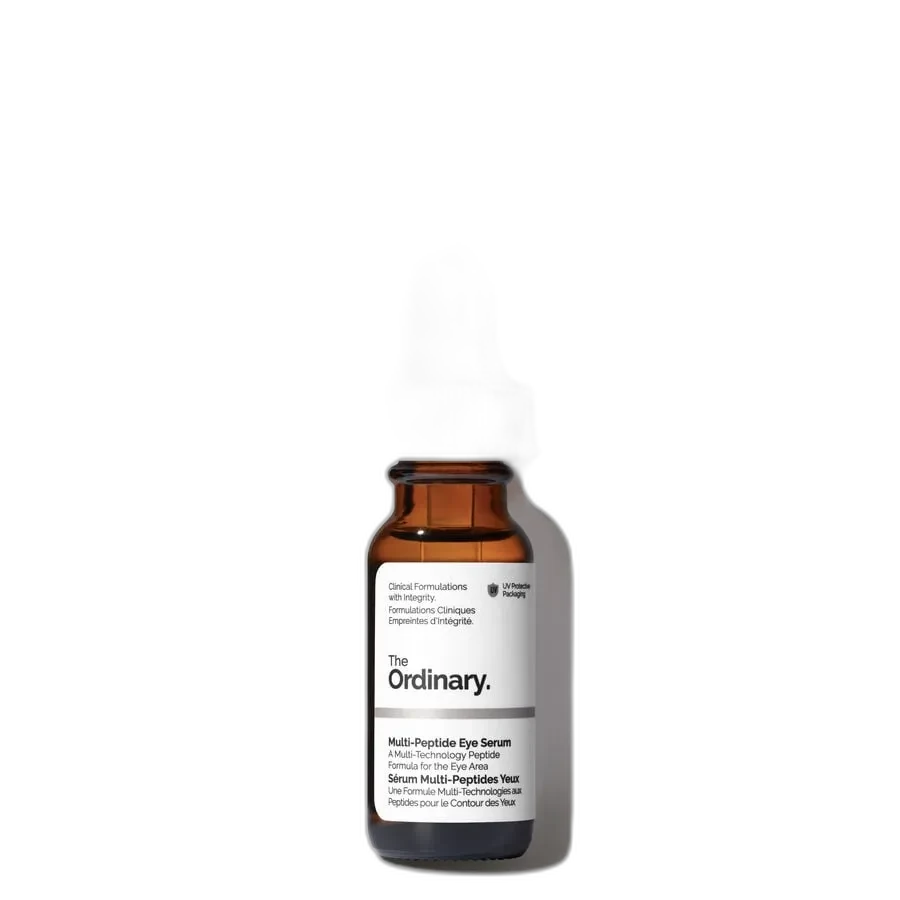
Multi-Peptide Eye Serum
The Eye-Area Specialist
 Verified reviewer
Pros & cons.
- +Genuinely eye-specific formulation with Eyeseryl peptide for periorbital puffiness
- +Caffeine provides immediate visible depuffing within 15-30 minutes of application
- +Syn-Ake peptide targets dynamic crow's feet at their muscular origin
- +Niacinamide at eye-appropriate concentration brightens without irritation risk
- +Lightweight watery texture absorbs instantly without migration into eyes
- +Significantly more affordable than comparable luxury peptide eye treatments
- −At $25 for 15ml, premium pricing by The Ordinary's standards
- −Dark circle improvement is modest — cannot address genetic or structural causes
- −Some users report stinging or irritation in the sensitive eye area
- −Peptide anti-aging benefits require 4-12 weeks of patient consistent use
- −Contains benzyl alcohol which may be sensitizing for very reactive eye areas
The full review.
The eye cream debate is a long-running skincare argument. Dermatologists and minimalists often argue that a good facial moisturizer works fine for the eye area. Conversely, formulators and eye-area obsessives insist the periorbital zone needs dedicated products. This skin is 40% thinner, lacks oil glands, sits over blood vessels, and undergoes 10,000+ blinks per day. The Ordinary enters this debate with a product that supports the specialist view.
The Multi-Peptide Eye Serum is not just a scaled-down, higher-priced face peptide serum. The ingredients show specific formulation intent for the eye area. Eyeseryl (Acetyl Tetrapeptide-5) is a peptide used for periorbital edema—the fluid accumulation that causes under-eye bags and puffiness. You won’t find this in a generic anti-aging face serum because facial skin does not pool fluid like the thin eye area. Its inclusion shows DECIEM formulated for eye area needs rather than marketing requirements.
The second eye-specific choice uses Syn-Ake (Dipeptide Diaminobutyroyl Benzylamide Diacetate) alongside Matrixyl synthe’6. Crow’s feet are dynamic wrinkles caused by the orbicularis oculi muscle contracting during smiles or squinting. Syn-Ake’s muscle-relaxation mechanism targets crow’s feet better than forehead wrinkles or nasolabial folds, where structural volume loss drives the issue. Pairing it with Matrixyl synthe’6—which stimulates six structural proteins to address static wrinkles—targets both muscle movement and collagen loss.
Caffeine provides immediate results that peptides cannot. Within fifteen to thirty minutes, it constricts dilated blood vessels in the thin periorbital skin, reducing puffiness and dark discoloration from blood pooling. This vasoconstrictive effect is temporary and wears off within hours, but it bridges the gap until peptide benefits appear weeks later. This choice keeps users engaged while slower-acting actives work.
Niacinamide at 1.4-2.1% increases brightness without the irritation risk of higher concentrations in the sensitive eye area. This moderate concentration is deliberate; the eye contour does not need the 10% niacinamide found in The Ordinary’s face serum, which could cause irritation. This concentration calibration shows genuine formulation thought for the specific application area.
The texture is a watery serum that absorbs into thin eye-area skin within seconds. It has no heaviness, no white cast, and does not migrate into the eyes. The dropper tip is narrower than The Ordinary’s standard pipettes for more precise application—a small detail for the few square centimeters of sensitive skin on your face.
Results follow a layered timeline. Caffeine depuffs immediately after the first morning application. Niacinamide-driven brightness improves within one to two weeks, reducing the dull quality of the under-eye area. Peptide benefits—smoothed crow’s feet, improved firmness, and reduced fine wrinkling—emerge at four to eight weeks and continue improving through twelve weeks of consistent use.
Dark circles require an honest conversation. This serum improves them but does not eliminate them. Caffeine and niacinamide provide meaningful improvement if dark circles come from visible blood vessels (bluish-purple) or periorbital hyperpigmentation (brownish). If bone structure or genetics cause shadowing, no topical product will fully resolve them. This is a limitation of topicals in an area where anatomy, genetics, and age converge.
At $25 for 15ml, this is premium pricing for The Ordinary—roughly four times the per-ml cost of their face serums. However, eye-specific peptide technologies like Eyeseryl and higher formulation complexity cost more to produce. In the broader market, comparable peptide eye serums cost $50-120 from mid-range brands and $150-300 from luxury lines. The Ordinary delivers equivalent technology at a fraction of those prices.
The Multi-Peptide Eye Serum won’t convert eye-cream skeptics who use face serum around the eyes. But for those seeking a dedicated product that justifies its existence, this formula makes a strong argument. It offers eye-specific peptides, immediate depuffing, moderate brightening, and a texture for the thinnest skin on your body—all for $25. The debate continues, but this product is persuasive.
Ingredient analysis.
Full INCI list · pH 6
Aqua (Water), Glycerin, Butylene Glycol, Propanediol, Dipropylene Glycol, Acetyl Glucosamine, Niacinamide, Palmitoyl Tripeptide-38, Acetyl Tetrapeptide-5, Myristoyl Nonapeptide-3, Dipeptide Diaminobutyroyl Benzylamide Diacetate, Caffeine, Epigallocatechin Gallatyl Glucoside, Gallyl Glucoside, Fraxinus Excelsior Bark Extract, Silanetriol, Arginine, Pentylene Glycol, Hydroxymethoxyphenyl Decanone, Propyl Gallate, Maltodextrin, Hydroxypropyl Cyclodextrin, Hydroxyethylcellulose, Xanthan Gum, Citric Acid, Glycolic Acid, Sodium Citrate, Polysorbate 20, Trisodium Ethylenediamine Disuccinate, Dehydroacetic Acid, Ethylhexylglycerin, Benzyl Alcohol, Phenoxyethanol, Chlorphenesin
Skin match.
The science.
The Science
The eye-area-specific peptide technologies in this formula use different mechanisms to address periorbital concerns.
Acetyl Tetrapeptide-5 (Eyeseryl) targets the periorbital zone. The peptide's developer shows it reduces under-eye edema by decreasing vascular permeability—the fluid leakage from blood vessels into tissue that causes morning puffiness and chronic under-eye bags. This mechanism differs from caffeine's vasoconstrictive action. The two work together: caffeine constricts vessels to reduce visible blood pooling, while Eyeseryl reduces the fluid leakage that causes tissue swelling.
Palmitoyl Tripeptide-38 (Matrixyl synthe'6) stimulates six structural components of the dermal-epidermal junction. This matters in the periorbital area, where the dermal-epidermal junction flattens with age and creates papery, crepey eye-area skin. By stimulating collagen I, III, and IV alongside laminin-5 and fibronectin, the peptide supports the structural integrity of this thin skin.
Caffeine's depuffing mechanism is well-established: as a methylxanthine, it inhibits phosphodiesterase, causing vasoconstriction and reduced edema in periorbital tissue. A study in the Journal of Cosmetic Dermatology by Kola et al. confirms topical caffeine reduces periorbital puffiness and dark circles via this vasoconstrictive mechanism.
Niacinamide at the 1.4-2.1% concentration range brightens by inhibiting melanosome transfer from melanocytes to keratinocytes—useful for dark circles caused by hyperpigmentation. This lower concentration than face formulations accounts for the eye area's sensitivity while still providing measurable brightening activity.
Dermatologist Perspective
Dermatologists disagree on whether dedicated eye products are necessary. However, those who support eye-specific formulation note that the periorbital area's unique traits—thinner skin, no sebaceous glands, proximity to mucous membranes, and constant muscle movement—require different ingredient concentrations and selection. Board-certified dermatologists recognize the Eyeseryl peptide as an eye-specific technology that addresses periorbital edema through a mechanism distinct from generic anti-aging peptides. Dermatologists frequently recommend the caffeine-niacinamide combination for dark circles and puffiness as a well-tolerated, evidence-based approach. Dermatologists generally advise using the ring finger to apply eye products to minimize pressure on the delicate periorbital skin.
Where it fits in your routine.
Apply one small drop per eye. Use your ring finger to pat the product gently along the orbital bone from the inner corner outward, covering the under-eye area and crow's feet zone. Use morning and evening after cleansing and face serums, but before eye cream or moisturizer. Avoid the eyelid and the lash line. Do not use direct acids, direct vitamin C, or EUK 134 in the eye area.
At $25 for 15ml, The Ordinary's second most expensive product follows the Copper Peptides serum. The $1.67 per-ml cost exceeds the brand's face serums, but eye-specific peptide technologies (Eyeseryl, Matrixyl synthe'6, Syn-Ake) justify the price through specialized formulation. Comparable peptide eye serums from mid-range brands cost $50-120, so this is 50-75% less expensive than the competition. One tube lasts three to four months using it twice daily on both eyes, making the per-application cost roughly 20 cents.
This eye treatment targets crow's feet, puffiness, and dark circles using eye-specific technologies instead of generic face-serum ingredients. It works for people in their late 20s-50s who want dedicated eye care at a fraction of luxury pricing.
Minimalists who apply face serum to the eye area and want adequate results. People with sensitive eye areas or known sensitivity to benzyl alcohol. Users who want depuffing and dark circle reduction without anti-aging peptides — The Ordinary's Caffeine Solution at $7.90 is a more targeted, affordable option for that concern.
Product details.
Lightweight, watery serum with a slight gel texture. It absorbs fast into thin eye-area skin without heaviness, greasiness, or white cast.
Essentially unscented with no detectable fragrance
A frosted glass bottle uses a narrow dropper tip for precise eye-area application. This design dispenses more controlled amounts than standard dropper bottles.
It applies smoothly and absorbs in seconds. Most users feel no stinging, but those with sensitive eye areas may feel mild tingling. Caffeine depuffs within 15-30 minutes of the first application. Niacinamide shows brightness within one to two weeks. Peptide-based structural improvements in crow's feet and firmness take 4-8 weeks of consistent use.
3-4 months with twice-daily use on both eyes
12 months
All Year
The backstory.
Eye products have always been a contentious category in skincare — many dermatologists argue that a good face serum applied to the eye area is sufficient, while others insist the thinner, more sensitive periorbital skin needs dedicated formulations. The Ordinary entered this debate with a product that makes a compelling case for specialization: peptides chosen specifically for eye-area concerns (Eyeseryl for puffiness, Syn-Ake for crow's feet) alongside actives that address the unique characteristics of periorbital skin rather than just recycling a face formula into a smaller bottle.
About The Ordinary
Established Brand (5–20 years)The Ordinary launched in 2016 under parent company DECIEM. It is now a top name in affordable, ingredient-focused skincare. The brand does not run proprietary clinical trials on its specific formulations, but it uses well-studied actives at transparent concentrations. This approach earns widespread dermatologist acknowledgment.
Common myths.
Eye serums are face serums in smaller bottles with higher prices.
Some are, but this one isn't. The formula uses Eyeseryl (Acetyl Tetrapeptide-5) — a peptide researched for periorbital edema — and has a pH of 5.5-6.5 for the sensitive eye area. A standard face peptide serum lacks these eye-specific technologies.
Caffeine can permanently fix dark circles.
Caffeine constricts blood vessels temporarily. This reduces dark circles caused by vasodilation and fluid pooling. It works as a temporary fix, but topical products won't resolve genetic dark circles from thin skin or hyperpigmentation. This serum's niacinamide adds mild brightening, but structural dark circles need different interventions.
FAQ.
Does The Ordinary Multi-Peptide Eye Serum work for dark circles?
It helps, but set realistic expectations. Caffeine provides temporary vasoconstriction to reduce dark circles from visible blood vessels, and niacinamide adds mild brightening. However, no topical product fully resolves dark circles caused by genetics, thin skin, or bone structure. Expect improvement, not elimination.
Can I use this eye serum with retinol?
Yes, with care. This serum lacks retinoids and works under a retinol eye cream. The Ordinary recommends avoiding direct acids and vitamin C with this product. If you use retinol around your eyes, apply this serum first, let it absorb, then apply the retinol product on top.
Is this better than The Ordinary Caffeine Solution for eyes?
These products serve different purposes. The Caffeine Solution ($7.90) uses caffeine and EGCG to depuff and target dark circles. The Multi-Peptide Eye Serum ($25) provides anti-aging benefits; it includes caffeine but adds peptide technologies for crow's feet, firmness, and structural support. The Caffeine Solution works for puffiness. The Multi-Peptide Eye Serum offers broader anti-aging results for the higher price.
How do I apply this eye serum correctly?
Put one small drop per eye on your ring finger to use the least pressure. Pat gently along the orbital bone — the bony ridge around your eye socket — from the inner corner outward. Do not tug or drag. Apply morning and evening after face serums but before eye cream or moisturizer. Do not apply to the eyelid or too close to the lash line.
Why is this product more expensive than most The Ordinary products?
Eyeseryl (Acetyl Tetrapeptide-5) and Matrixyl synthe'6 (Palmitoyl Tripeptide-38) are premium peptide technologies for the eyes. The formulation costs more than simpler products because the thin, sensitive eye area requires specific concentrations. At $25, it costs less than comparable eye peptide serums from other brands.
Community
What the community says.
"Visible reduction in puffiness and under-eye bags with consistent morning use"
"Lightweight texture absorbs quickly without migrating into eyes"
"Noticeable improvement in crow's feet after several weeks of use"
"Well-formulated with genuinely eye-specific peptides, not generic face-serum ingredients"
"Good value compared to luxury eye serums costing $50-100+"
"Results on dark circles are modest — caffeine and niacinamide help but can't fully address genetic or structural causes"
"At $25 for 15ml, feels expensive compared to other The Ordinary products"
"Some users report stinging or irritation in the eye area"
"Peptide benefits require patience that some users don't commit to before judging"
People also looked at.