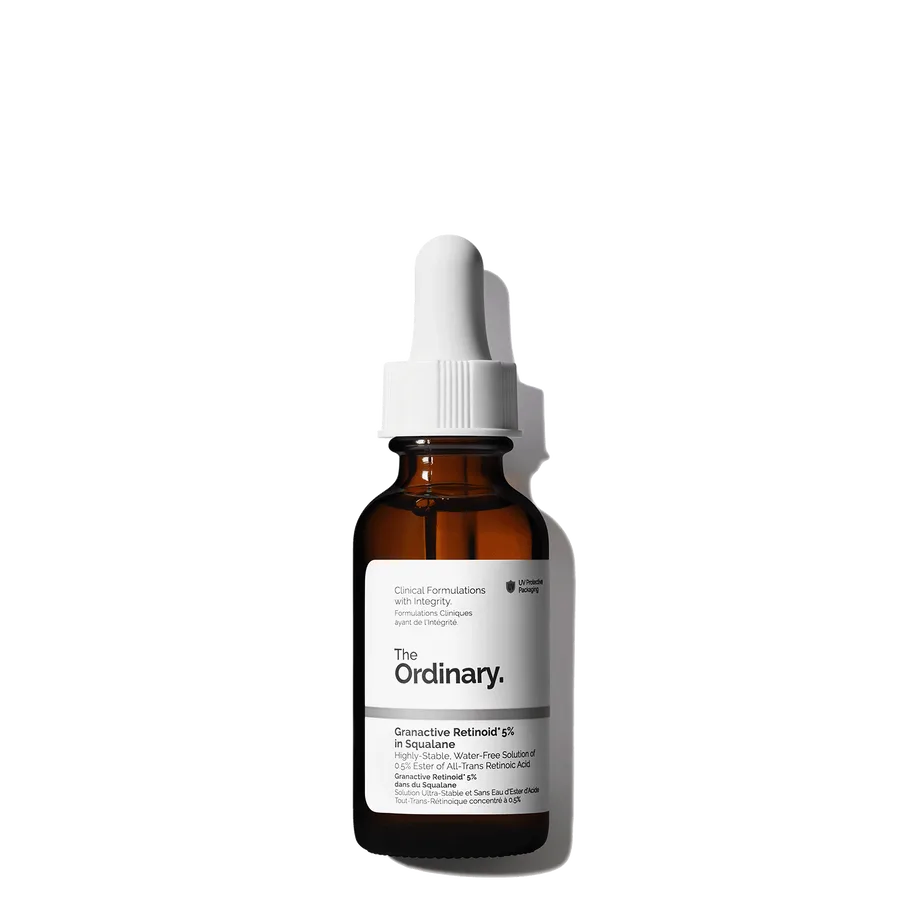
Granactive Retinoid 5% in Squalane
Dry Skin Retinoid Pick
 Verified reviewer
Pros & cons.
- +Highest HPR concentration in The Ordinary's lineup at 0.5% for more potent retinoid activity
- +Squalane base simultaneously treats and moisturizes, eliminating the need for additional oils
- +Ultra-minimal 10-ingredient anhydrous formula with no water, emulsifiers, or unnecessary fillers
- +Twelve-month PAO is significantly more practical than the 2% Emulsion's three-month window
- +Bisabolol and botanical antioxidants provide built-in soothing and protective support
- +Fungal acne safe — squalane and jojoba do not feed Malassezia yeast
- −Oil texture is too heavy for oily skin types and takes 2-3 minutes to absorb
- −Results develop slowly — not suitable for those seeking rapid, aggressive anti-aging
- −Lower review count and fewer user testimonials than the more popular 2% Emulsion
- −Not suitable during pregnancy or breastfeeding due to retinoid content
- −Dropper dispenses a thin oil that can drip and waste product
The full review.
Most retinoid products treat dry skin as an afterthought. They deliver the active, cause peeling, and leave you to fix moisture with whatever cream you layer on top. The Ordinary’s Granactive Retinoid 5% in Squalane uses a different approach: it builds the retinoid into a vehicle that also treats dryness.
Squalane — the hydrogenated, shelf-stable form of squalene — is a lipid your skin already produces. It is a major component of human sebum; applying it topically tops off a reservoir that starts depleting in your twenties. As a carrier for Hydroxypinacolone Retinoate, squalane does double duty: it provides occlusive moisture to counteract retinoid drying, and its structural similarity to skin lipids helps HPR penetrate the stratum corneum. The active rides in on a familiar vehicle.
The formula is minimal. Ten ingredients. No water, no emulsifiers, and no preservatives for an aqueous phase. Squalane leads, followed by C12-15 alkyl benzoate (an emollient ester), bisabolol for anti-inflammatory support, dimethyl isosorbide as a penetration enhancer, caprylic/capric triglyceride and jojoba seed oil for lipid support, HPR, and three botanical antioxidants — tomato fruit extract, rosemary leaf extract, and hydroxymethoxyphenyl decanone. That is the entire product. Ineffective filler ingredients are absent.
At 0.5% HPR — derived from the 5% Granactive Retinoid complex designation — this is the strongest HPR product in The Ordinary’s range, containing 2.5 times the active retinoid concentration of the 2% Emulsion. The distinction matters, but not how the numbers suggest. The 2% Emulsion uses encapsulated retinol to supplement its lower HPR, creating a dual-retinoid approach. The 5% Squalane relies entirely on a higher dose of HPR in a thick vehicle. Neither is better; they target different skin types and priorities.
On the skin, this product feels like a lightweight facial oil. The dropper delivers a thin, slightly golden liquid that spreads easily but takes two to three minutes to absorb fully. On dry and normal skin, it leaves a comfortable dewy finish that works as a final PM step or under a heavier night cream. On oily skin, it may feel heavy — the squalane layer sits on the surface longer than a water-based emulsion, and the dewiness can look like shine on oilier complexions.
The adjustment period is gentler than most retinoid products, but it exists. Some users report mild dryness around the eyes and lips during the first two weeks — areas where skin is thinner and more sensitive to retinoid activity. Starting with every-other-night application and building to nightly use over two to three weeks is standard dermatological advice, and it applies here. The bisabolol, positioned high in the formula, provides anti-inflammatory support to help the transition.
Results follow a retinoid’s timeline, not a moisturizer’s. By week four to six, skin texture feels smoother — from both the squalane’s emollient effect and the HPR-driven increase in cellular turnover. By month two to three, fine lines soften and skin tone looks more even and luminous. Deep wrinkles and significant photodamage will improve but not transform — for those concerns, prescription tretinoin remains the gold standard, and this product works better as a gentle maintenance step or a bridge for retinoid-intolerant patients.
The twelve-month PAO is a practical advantage over the 2% Emulsion’s three-month window. Anhydrous formulas are more stable than water-based ones — there is no aqueous phase to support microbial growth, and the squalane vehicle protects the HPR from oxidative degradation better than an emulsion base. If you use retinoids intermittently, this longer stability window means less waste.
At 6.70, the value is compelling. You get 0.5% HPR — a retinoic acid ester that binds directly to retinoid receptors — in a premium squalane base with botanical antioxidant support, for less than the cost of a mediocre lunch. Comparable HPR concentrations in luxury brands run 0-120. The Ordinary’s pricing makes trying HPR essentially risk-free.
This is not the retinoid for everyone. Oily skin types should use the lighter 2% Emulsion. People wanting aggressive, visible-within-weeks anti-aging should consider prescription tretinoin. But for dry and mature skin types who want their retinoid to feel like a treat rather than a treatment — who want retinoid signaling and lipid nourishment from a single product — this ten-ingredient oil delivers that.
Formula
Ingredient analysis.
Full INCI list
Squalane, C12-15 Alkyl Benzoate, Bisabolol, Dimethyl Isosorbide, Caprylic/Capric Triglyceride, Simmondsia Chinensis (Jojoba) Seed Oil, Hydroxypinacolone Retinoate, Solanum Lycopersicum (Tomato) Fruit Extract, Rosmarinus Officinalis (Rosemary) Leaf Extract, Hydroxymethoxyphenyl Decanone
Skin match.
The science.
The Science
HPR in a squalane vehicle works through two principles. First, HPR's mechanism: as a retinoic acid ester, it binds directly to retinoid acid receptors (RAR) and retinoid X receptors (RXR). It skips the enzymatic conversion steps retinol requires. This direct binding delivers retinoid signaling with less irritation because HPR does not produce the irritating intermediates created during retinol's two-step oxidation to retinoic acid.
Second, the squalane delivery system: the stratum corneum is a lipid-rich barrier. Oil-soluble actives in skin-compatible lipids penetrate more efficiently than those in aqueous vehicles. Squalane's structure resembles human squalene—a major component of the skin's lipid matrix—so the vehicle integrates with the existing lipid architecture instead of sitting on top. Dimethyl isosorbide, the penetration enhancer in 90% of the Granactive Retinoid raw material, helps HPR pass through the stratum corneum.
Evidence supports HPR efficacy at concentrations used in this product. Wang et al. (Journal of Cosmetic Dermatology, 2023) showed HPR-containing formulations improved wrinkle depth, smoothness, and elasticity after eight weeks with fewer adverse effects than retinol at comparable concentrations. Research in JAAD (2018) showed HPR increased procollagen production in skin models; the highest dose outperformed tretinoin in qualitative assessment. The anhydrous formulation also stays stable longer. HPR degrades in aqueous systems via hydrolysis, which explains why this product has a longer PAO than the water-based Emulsion version.
References
- The synergistic effect of retinyl propionate and hydroxypinacolone retinoate on skin aging — Journal of Cosmetic Dermatology (2023)
Dermatologist Perspective
Dermatologists view the squalane-based HPR format as a useful option for patients with dry or mature skin. These patients need retinoid therapy but struggle with the barrier disruption caused by water-based retinoid formulations. Board-certified dermatologists note the lipid-rich vehicle provides barrier support during the retinoid adjustment period, reducing the need for "retinoid sandwich" buffering strategies. For patients intolerant to retinol, dermatologists often suggest this product as an alternative that activates retinoid receptors through a gentler mechanism. However, dermatologists note that HPR lacks the depth of independent clinical evidence that supports retinol or prescription tretinoin. Patients with significant photodamage or deep wrinkles may need prescription-strength retinoids for optimal results.
Where it fits in your routine.
Apply 4-5 drops to clean, dry skin at night, after water-based serums. Use this oil after lighter products and before heavier creams, or as a final step for dry skin. Beginners should use it every other night, building to nightly use over 2-3 weeks. Avoid the immediate eye area at first. Use sunscreen (SPF 30+) every morning when using any retinoid. Store in a cool, dark place; refrigeration is recommended but less critical than for the water-based Emulsion version.
At 6.70 for 30 mL, this product uses 0.5% HPR in a squalane base for less than comparable formulations from other brands. The twelve-month shelf life reduces waste compared to the 2% Emulsion, and the combination of retinoid activity and lipid-rich moisturization replaces a separate facial oil in many routines. For dry and mature skin types, the cost per use is among the lowest in the retinoid category. The only size available is 30 mL — no trial size exists to test before committing.
Dry and mature skin types want retinoid benefits in a nourishing, moisturizing oil base. It works for anyone who experienced excessive dryness or peeling from retinol. It also suits retinoid users moving up from the 2% Emulsion before using prescription tretinoin.
This oil base feels heavy on oily skin and increases shine — the lighter 2% Emulsion works better. This is also the wrong choice for rapid, aggressive anti-aging results, pregnancy, or breastfeeding.
Product details.
This thin, lightweight oil has a slight golden tint. It applies with the silky slip of squalane-based products. It absorbs fully in 2-3 minutes, leaving dry to normal skin with a dewy, non-greasy finish.
It is nearly unscented, with a faint botanical note from the rosemary and tomato extracts.
Amber glass dropper bottle with The Ordinary's standard minimalist white label and black text. The dark glass protects the light-sensitive HPR from degradation.
The oil applies smoothly and feels nourishing, not medicinal, on first use. Most users have no immediate irritation. Some dryness around the eyes and lips occurs during the first 1-2 weeks as skin adjusts to the higher HPR concentration. Use it every other night first, then build to nightly use over 2-3 weeks.
2-3 months with nightly use of 4-5 drops
12 months
fall winter
The backstory.
This product represents the stronger sibling in The Ordinary's Granactive Retinoid duo. While the 2% Emulsion became the brand's bestselling retinoid thanks to its universal texture, the 5% in Squalane was designed for users who wanted more HPR without switching to traditional retinol. The squalane vehicle was chosen both for its stability benefits — HPR is more stable in anhydrous systems — and for its skin-compatibility with dry and mature skin types that struggle with water-based retinoid formulations.
About The Ordinary
Established Brand (5–20 years)The Ordinary launched under DECIEM in 2016. It disrupted skincare by offering clinical-grade actives at unprecedented price points. Now owned by Estée Lauder Companies, the brand has nearly a decade of consumer trust from ingredient transparency and accessible pricing.
Common myths.
5% is five times stronger than 1% retinol
The "5%" refers to the Granactive Retinoid complex (10% HPR in 90% dimethyl isosorbide solvent), meaning the actual HPR concentration is 0.5%. HPR and retinol use different mechanisms and do not compare on a percentage-to-percentage basis. HPR binds directly to retinoid receptors, but retinol needs two conversion steps. Direct potency comparisons are misleading.
Oil-based retinoids penetrate less effectively than water-based ones
The stratum corneum is a lipid-rich barrier. Oil-soluble actives penetrate it more efficiently than water-soluble ones. Squalane mimics human sebum, so the skin recognizes and absorbs this delivery vehicle readily. The dimethyl isosorbide in the Granactive Retinoid complex increases penetration.
FAQ.
What is the actual HPR concentration in Granactive Retinoid 5% in Squalane?
The 5% refers to the total Granactive Retinoid complex, which uses 10% HPR (Hydroxypinacolone Retinoate) and 90% dimethyl isosorbide (a penetration enhancer). Thus, 5% of the complex is 0.5% HPR — the active retinoid that binds to skin receptors. This concentration is 2.5 times the HPR in the 2% Emulsion version.
Should I choose the 5% in Squalane or the 2% Emulsion?
Pick the 5% in Squalane for dry or mature skin needing a higher HPR concentration in a moisturizing oil base. Pick the 2% Emulsion for oily, combination, or normal skin wanting a lighter texture. The 2% Emulsion uses retinol as a secondary active, but the 5% Squalane uses only HPR for retinoid activity.
Can I use Granactive Retinoid 5% in Squalane every night?
Yes, once your skin adjusts. Use it every other night for the first 2-3 weeks, then use it nightly. This product is gentler than most traditional retinol serums despite the higher HPR concentration. If you have persistent dryness or irritation, use it 3-4 nights per week.
Is The Ordinary Granactive Retinoid 5% in Squalane fungal acne safe?
Yes. The formula uses squalane (which does not feed Malassezia yeast), jojoba oil (a wax ester, not a true oil), and caprylic/capric triglyceride. None of the 10 ingredients trigger fungal acne, so this is a safe retinoid option for fungal acne-prone skin.
Does this product need to be refrigerated?
The Ordinary recommends refrigerating retinoid products after opening for stability. This anhydrous squalane formula is more stable than water-based retinoid products. The 12-month PAO exceeds the 2% Emulsion's 3-month window because the oil base is more stable.
Community
What the community says.
"Effectively reduces fine lines and improves skin texture with minimal irritation"
"Squalane base provides excellent hydration for dry and mature skin"
"Gentle enough for retinoid-sensitive users who want a stronger concentration"
"Clean, minimal 10-ingredient formula with no fragrance or irritants"
"Good value at 6.70 for a higher-strength HPR treatment"
"Oily texture takes time to absorb and can feel greasy on the skin"
"Too heavy for oily skin — the 2% Emulsion is a better option"
"Some users report limited visible results even after months of use"
"Thin oil consistency drips from the dropper and can be messy to apply"
"Initial dryness around eyes and lips during the adjustment period"
People also looked at.