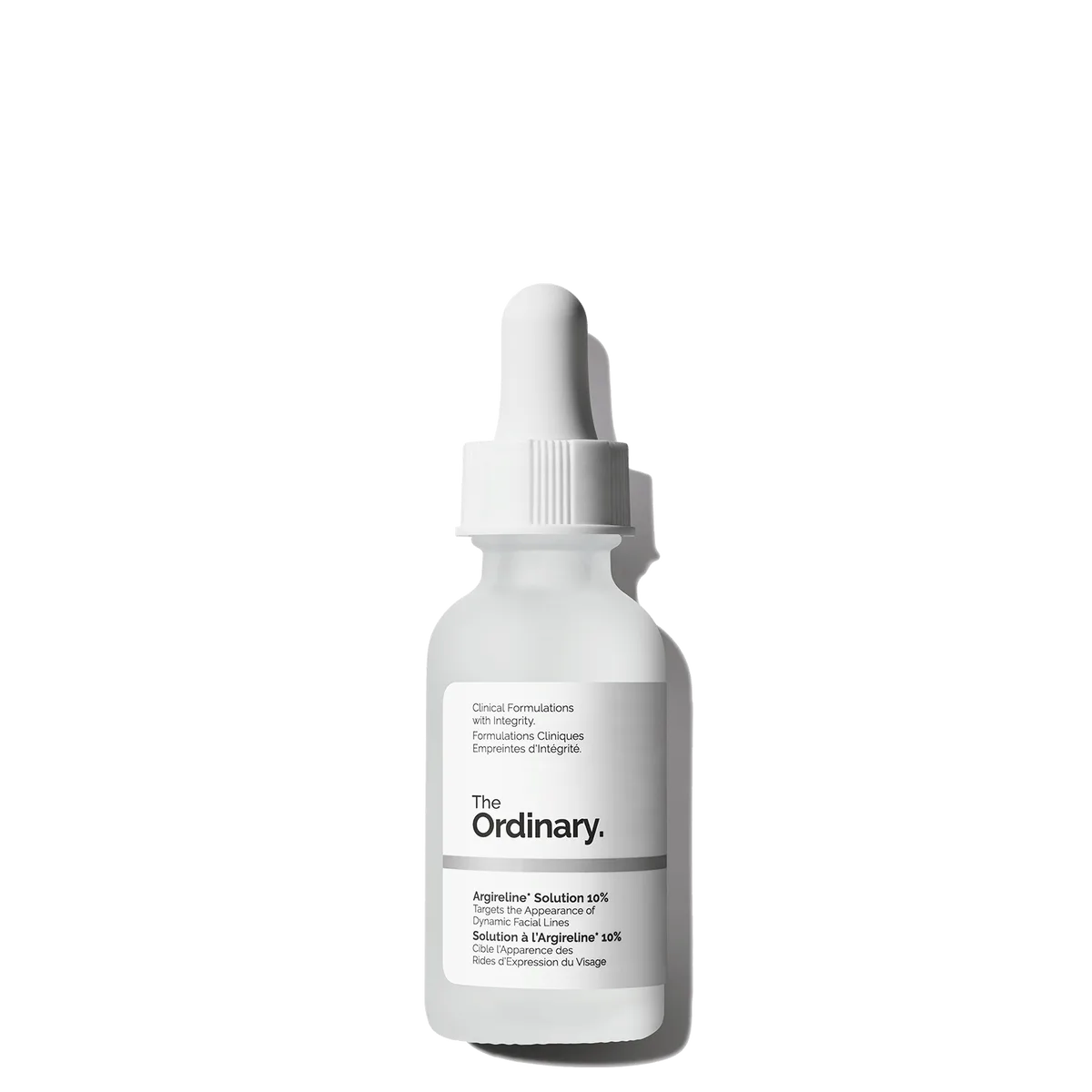
Argireline Solution 10%
Budget Anti-Aging Pick
 Verified reviewer
Pros & cons.
- +Argireline at 10% matches the concentration used in positive clinical studies
- +Dimethyl Isosorbide penetration enhancer addresses the peptide's known bioavailability limitation
- +Minimalist 11-ingredient formula with zero fragrance, alcohol, or silicones
- +Fungal acne safe — free from oils, fatty acids, and esters
- +Under $10 for a peptide serum that competitors price at $40+
- +Near-zero irritation risk suitable for even sensitive skin types
- +Lightweight invisible texture absorbs instantly without residue
- +Can be used alongside retinoids and niacinamide for complementary anti-aging
- −Clinical evidence is mixed — some studies show significant results, others do not
- −Requires 4-8 weeks minimum for any visible effect on expression lines
- −Not moisturizing — must be followed with hydrating products
- −Cannot be used with direct acids or L-ascorbic acid vitamin C in the same routine
- −Results are modest compared to injectable neurotoxins like Botox
- −Very watery consistency is easy to over-dispense
The full review.
Few skincare ingredients are as heavily marketed or misunderstood as Argireline. When the Spanish biotech firm Lipotec first introduced Acetyl Hexapeptide-3 (later reclassified as Acetyl Hexapeptide-8), media outlets focused on its mechanism: it modulates the same SNARE complex that botulinum toxin targets. They called it “Botox in a bottle.” That name stuck, helping and hurting this peptide simultaneously.
It helped by driving consumer interest in peptide skincare and forcing brands to use Argireline at meaningful concentrations. It hurt by setting impossible expectations. Botox paralyzes muscles via direct neurotoxin injection. Argireline mildly modulates neurotransmitter release through topical application of a six-amino-acid peptide. They are different; a $10 serum will not provide frozen-smooth results.
Let’s look at what this serum actually does. Clinical evidence for Argireline at 10% concentration is interesting, though not conclusive. A 2002 study in the International Journal of Cosmetic Science showed up to 30% wrinkle depth reduction after 30 days. A 2013 randomized controlled trial in the American Journal of Clinical Dermatology reported 48.9% total anti-wrinkle efficacy versus 0% for placebo after 4 weeks in 60 subjects, with all roughness parameters significantly decreased. These are real numbers from real studies.
The data is not always positive. A 2023 study using the Visia Complexion Analysis camera system found decreased wrinkle scores that were not statistically significant. A 2025 review in the International Journal of Molecular Sciences identified low skin penetration as Argireline’s persistent Achilles’ heel—the peptide works in vitro, but passing through the stratum corneum is difficult.
The Ordinary’s formulation addresses this. It includes Dimethyl Isosorbide—a penetration enhancer from sorbitol—to distinguish it from competitors that only dissolve Argireline in water. The formula is minimalist: 11 ingredients total, using Propanediol as the primary vehicle, Gellan Gum for viscosity, and standard preservatives. It has no fragrance, no unnecessary botanicals, and no marketing-driven filler.
On the skin, this serum is unremarkable. A few drops from the glass dropper spread easily across the forehead, around the eyes, and along smile lines. The texture is lighter than most serums—slightly more viscous than water but not a gel. It absorbs within seconds without residue, stickiness, or scent. You can apply it and forget it.
The results are also subtle. This product does not announce its effects. You will not see smoother forehead lines after one week. Argireline works by modulating the cumulative muscle contractions that deepen expression lines over time; it is preventive and gradual, not corrective and immediate. Most users report a slow-build effect over 4-8 weeks, with maximum benefits after 3-6 months of consistent twice-daily use.
Check the conflict list. The Ordinary advises against using this product in the same routine as direct acids (glycolic, lactic, salicylic), pure L-ascorbic acid vitamin C, and resveratrol or ferulic acid. Low-pH environments can degrade the peptide, and competing actives can compromise stability. Niacinamide, hyaluronic acid, retinol, and other peptides are compatible and can be layered freely.
For a $10 peptide serum, the irritation profile is nearly flawless. It contains no fragrance, alcohol, silicones, oils, or common sensitizers. It is fungal acne safe. Sensitive skin users can use it with confidence. However, it provides no hydration or moisturization, so you must follow with a moisturizer.
The assessment: Argireline is a promising but not definitive anti-wrinkle ingredient. This is a well-formulated, engineered delivery at clinical study concentrations. If you are in your late twenties or thirties and want to address early expression lines without the cost or downtime of injectables, this is a reasonable start. If you expect visible transformation, you must combine this with other actives (retinoids, vitamin C in a separate routine step) or accept the limits of topical application.
At $9.70, the risk-reward calculation favors the user. Even if results are modest—as they will be for most—the cost is less than a lunch. For the subset of users for whom Argireline works, this is a $10 preventive treatment they can sustain indefinitely. It is not Botox in a bottle, but it is a much more affordable, accessible neighbor.
Formula
Ingredient analysis.
Full INCI list
Aqua (Water), Propanediol, Acetyl Hexapeptide-8, Trisodium Ethylenediamine Disuccinate, Gellan Gum, Sodium Chloride, Isoceteth-20, Dimethyl Isosorbide, Potassium Sorbate, Phenoxyethanol, Chlorphenesin
Skin match.
The science.
The Science
Acetyl Hexapeptide-8 (Argireline) targets the SNARE complex—proteins that control neurotransmitter release at the neuromuscular junction. It mimics the N-terminal end of SNAP-25 to block the ternary SNARE complex formation needed for vesicle docking and acetylcholine release. This reduces the muscle contraction intensity that creates expression lines, though the effect is milder than botulinum toxin's enzymatic cleavage of SNARE proteins.
A 2002 study in the International Journal of Cosmetic Science showed that 10% Argireline in an emulsion reduced wrinkle depth by up to 30% after 30 days in healthy female volunteers; the peptide is non-toxic and biosafe. A 2013 randomized, placebo-controlled trial in the American Journal of Clinical Dermatology tested Argireline in 60 Chinese subjects. It reported 48.9% total anti-wrinkle efficacy versus 0% for placebo after 4 weeks, and all skin roughness parameters decreased significantly (p < 0.01).
Evidence varies. A 2023 study using the Visia Complexion Analysis camera system on 19 participants found wrinkle scores decreased after 4 weeks of Argireline serum use, but the differences lacked statistical significance. Penetration issues explain this. A 2025 review in the International Journal of Molecular Sciences concluded that while Acetyl Hexapeptide-8 shows anti-wrinkle promise in controlled settings, low skin permeability limits its topical bioavailability.
The Ordinary's formula includes Dimethyl Isosorbide to address this penetration issue. As a known skin penetration enhancer, it improves water-soluble peptide delivery through the stratum corneum, which may increase the Argireline reaching the neuromuscular junction in the dermis.
References
- A synthetic hexapeptide (Argireline) with antiwrinkle activity — International Journal of Cosmetic Science (2002)
- The anti-wrinkle efficacy of argireline, a synthetic hexapeptide, in Chinese subjects: a randomized, placebo-controlled study — American Journal of Clinical Dermatology (2013)
- Investigating the effects of Argireline in a skin serum containing hyaluronic acids on skin surface wrinkles — GMS Interdisciplinary Plastic and Reconstructive Surgery DGPW (2023)
- Acetyl Hexapeptide-8 in Cosmeceuticals — A Review of Skin Permeability and Efficacy — International Journal of Molecular Sciences (2025)
Dermatologist Perspective
Dermatologists see Argireline as a modest, legitimate topical anti-aging tool. Board-certified dermatologists note it won't replicate injectable botulinum toxin results, but it provides a non-invasive, zero-downtime option for patients who avoid injectables. Dermatologists often recommend it within a multi-active anti-aging routine with retinoids and antioxidants instead of as a standalone treatment. The 10% concentration in this product matches levels used in clinical studies that showed measurable wrinkle reduction, a meaningful formulation decision. Dermatologists emphasize that expectations must be realistic—this is a preventive, gradual treatment, not a corrective one.
Where it fits in your routine.
Apply a few drops to clean skin on expression line areas: forehead, between the brows, around the eyes, and smile lines. Use morning and evening before heavier serums and moisturizer. Do not use this in the same routine step as direct acids (glycolic, lactic, salicylic) or pure L-ascorbic acid vitamin C. Separate these into different routine steps (AM vs PM) or alternate days. Always follow with moisturizer, as this serum provides minimal hydration alone.
At $9.70 for 30 mL, this peptide serum is one of the most affordable from reputable brands. Comparable Argireline formulations from medical skincare brands cost $35-60 for similar volumes, often with lower concentrations and no dedicated penetration enhancer. Only one size is available, so there is no bulk discount, but the base price is low enough that the cost of trying is negligible even if results are modest. The value is strongest for users who use this as a long-term preventive addition to their routine instead of a quick-fix treatment.
People in their late twenties to forties can use this to prevent expression lines without injectables. It works well for those starting peptide skincare with low risk, users with sensitive skin who cannot tolerate stronger anti-aging actives, and anyone adding a complementary mechanism of action to a retinoid routine.
This is not a Botox-like wrinkle smoother; the effect is subtle. Users with a full anti-aging routine using retinoids and vitamin C may see marginal extra benefit. Save your money if you will not use this consistently for 8+ weeks before evaluating results.
Product details.
This liquid serum is lightweight and slightly viscous. It is thinner than most serums but thicker than water. It absorbs in seconds and leaves skin smooth without visible residue.
Completely fragrance-free with no detectable scent.
30 mL frosted glass dropper bottle with white dropper cap. Standard The Ordinary minimalist design with white label and black text.
The serum feels like a lightweight, slightly hydrating liquid that absorbs almost instantly. It has no dramatic sensation on first application. There is no tingling, warming, or visible changes. This is a slow-build product; use it consistently over weeks to months.
2-3 months with twice-daily application to expression line areas
12 months
All Year
The backstory.
Argireline was developed by the Spanish biotechnology company Lipotec (now part of Lubrizol) as a topical peptide alternative to botulinum toxin injections. Branded as 'Botox in a bottle' by beauty media — a comparison the science doesn't fully support — it works by a fundamentally different mechanism: modulating SNARE complex assembly rather than paralyzing muscles. The Ordinary made it accessible at clinical study concentrations for under $10, democratizing a peptide that once commanded premium prices.
About The Ordinary
Established Brand (5–20 years)The Ordinary launched in 2016 under DECIEM and quickly became a top global clinical skincare brand. Its ingredient-first, transparency-driven approach uses formulation science, but the brand does not run proprietary clinical trials on most products.
Common myths.
Argireline works like Botox and replaces injectable neurotoxins.
Argireline targets a different pathway (SNARE complex assembly vs. botulinum toxin's direct neuromuscular blockade), but its effects are smaller. Clinical studies show 30-49% wrinkle depth reduction over 4 weeks. This is meaningful, but it does not provide the near-complete muscle relaxation of injectable Botox. It supplements injectables rather than replacing them.
Peptide serums don't actually penetrate the skin to work.
Penetration is Argireline's main limitation — a 2025 review in the International Journal of Molecular Sciences noted this. But this formula uses Dimethyl Isosorbide as a penetration enhancer, and clinical studies using 10% concentrations (matching this product) show measurable wrinkle reduction.
FAQ.
Does The Ordinary Argireline actually work for wrinkles?
Clinical evidence is promising but mixed. A 2013 randomized controlled trial showed 48.9% anti-wrinkle efficacy versus 0% for placebo after 4 weeks at 10% concentration — matching this product. However, a 2023 study showed non-significant results. This formula uses Dimethyl Isosorbide to fix Argireline's known penetration limitation, which improves real-world efficacy. Expect subtle, gradual improvement over 8+ weeks.
Can I use The Ordinary Argireline with retinol?
Yes — Argireline and retinol use different mechanisms and work together in one routine. Apply Argireline first because it has a lighter texture, then apply retinol. You can use both in a PM routine. Do not combine Argireline with direct acids or pure L-ascorbic acid vitamin C in the same step.
How long does it take The Ordinary Argireline to show results?
Most users report subtle softening of expression lines at 4-8 weeks. Maximum benefits show after 3-6 months of consistent twice-daily use. This is a preventive, gradual treatment; do not expect immediate visible changes. Clinical studies evaluated results at the 4-week mark, so wait at least that long before assessing.
Is The Ordinary Argireline as good as Botox?
No. Argireline modulates neurotransmitter release topically, but Botox paralyzes muscles via direct injection of a potent neurotoxin. The mechanisms relate, but the effect magnitude differs. Clinical studies show 30-49% wrinkle reduction with Argireline versus near-complete muscle relaxation with Botox. Argireline works as a complementary topical approach, not a replacement for injectables.
What products should I NOT use with The Ordinary Argireline?
Do not use this in the same routine step as direct acids (glycolic, lactic, mandelic, salicylic acid), pure L-ascorbic acid vitamin C, or resveratrol or ferulic acid. These ingredients degrade the peptide or compromise its stability. Use these products in a separate routine step (e.g., vitamin C in AM, Argireline in PM) or on alternate days.
Is The Ordinary Argireline safe for sensitive skin?
Yes. The 11-ingredient formula has no fragrance, alcohol, silicones, or oils. It is also fungal acne safe. Clinical studies show the peptide is non-toxic and biosafe. The irritation risk is near zero, so it is one of the gentlest anti-aging treatments available.
Can I use The Ordinary Argireline around my eyes?
Yes — this product targets the eye area. Apply it carefully around crow's feet and between the brows. The lightweight, fragrance-free formula is gentle for the delicate eye area. Do not get the product in your eyes. ---
What the community says.
"Visibly softens forehead lines and crow's feet with consistent long-term use"
"Extremely affordable peptide treatment at under $10"
"Lightweight formula absorbs quickly with no stickiness or residue"
"Clean 11-ingredient formula appeals to sensitive skin users"
"Layers well under moisturizers and sunscreens"
"Skin feels smoother and firmer with regular application"
"Results are subtle — not the 'Botox in a bottle' marketing may suggest"
"Requires months of consistent use to see meaningful wrinkle reduction"
"Very watery consistency makes it easy to dispense too much"
"Some pilling when layered under certain products"
"Not moisturizing on its own — must be followed with moisturizer"
People also looked at.