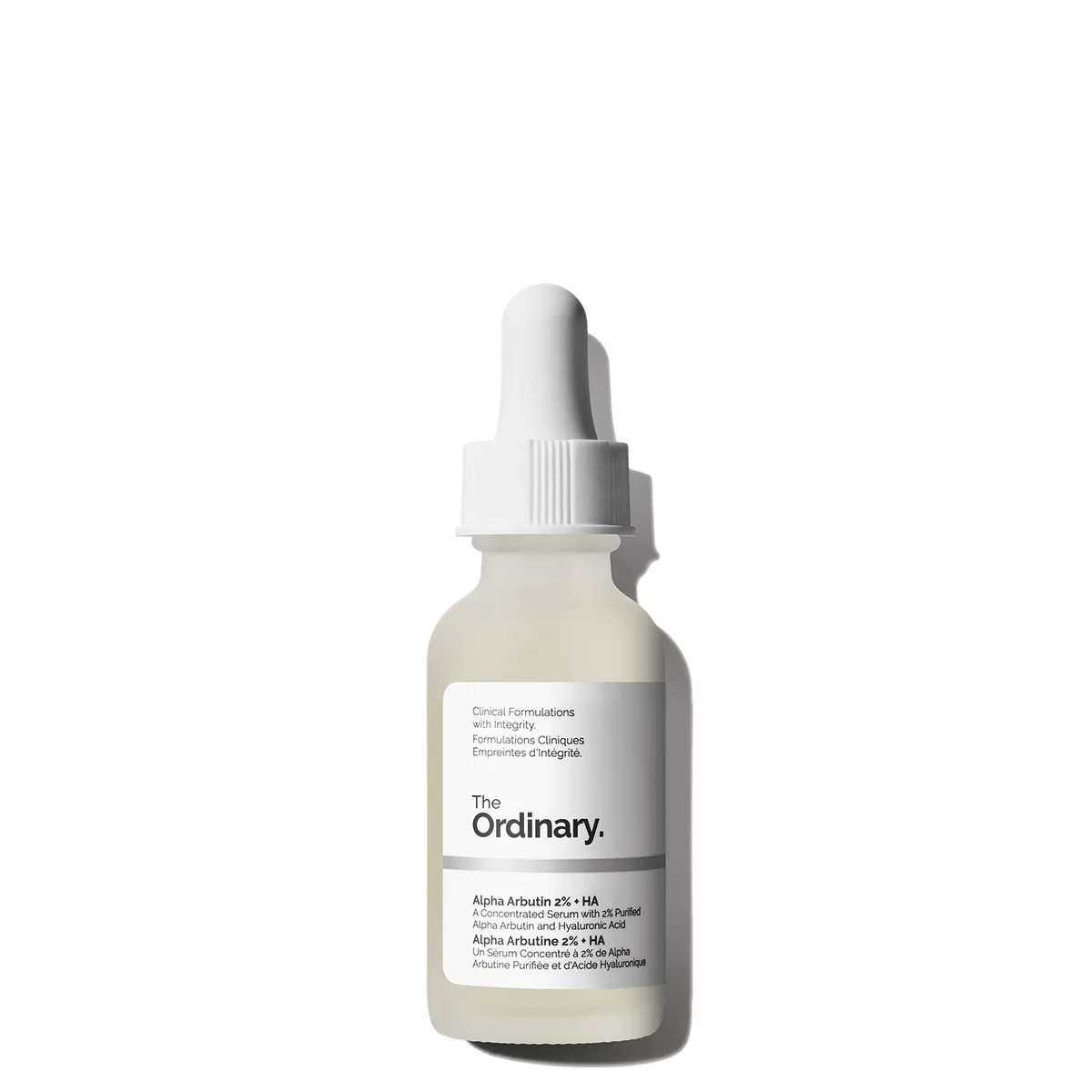
Alpha Arbutin 2% + HA
Budget Brightening Essential
 Verified reviewer
Pros & cons.
- +Alpha-arbutin at maximum SCCS-recommended 2% concentration for targeted brightening
- +pH optimized at 4.9 to prevent arbutin degradation in aqueous solution
- +Clean 12-ingredient formula with no unnecessary fillers or fragrances
- +Extremely affordable at $10 compared to $40-80 clinical brightening serums
- +Layers seamlessly under niacinamide, vitamin C, retinoids, and moisturizers
- +Gentle enough for sensitive skin with minimal risk of irritation
- +Strong clinical evidence supporting alpha-arbutin's efficacy for hyperpigmentation
- +Over 15,000 user reviews with consistently positive feedback on dark spot fading
- −Results require 8-12 weeks of patience — no immediate visible brightening
- −Slightly tacky texture on initial application can occasionally cause pilling
- −Not moisturizing on its own — requires layering with hydrating products
- −Pregnancy safety unclear due to hydroquinone glycoside classification
- −PEG-40 Hydrogenated Castor Oil may not be suitable for fungal-acne-prone skin
The full review.
Hydroquinone has been the gold standard for treating hyperpigmentation for decades, but its reputation has declined. Cytotoxicity concerns, bans or restrictions in multiple countries, and the risk of paradoxical darkening with prolonged use drive dermatologists and consumers toward alternatives. Alpha-arbutin — a glycosylated form of hydroquinone that inhibits tyrosinase without the same safety baggage — is the leading candidate. In 2017, The Ordinary bottled it at the maximum recommended concentration for ten dollars.
The formulation is minimal. Twelve ingredients mostly support the alpha-arbutin rather than adding marketing claims. The pH is approximately 4.9. This matters because alpha-arbutin is unstable in aqueous solutions; it degrades into hydroquinone if the pH is too low or loses efficacy if it is too high. At 4.9, the molecule remains intact and active. Many competing brightening serums do not disclose their pH or optimize for arbutin stability, meaning the active on the label may not reach your skin.
The supporting cast is lean. Hydrolyzed sodium hyaluronate — a low-molecular-weight form of HA — provides hydration and improves absorption without competing with the star ingredient. Lactic acid at a sub-exfoliating dose maintains that critical pH and offers mild keratolytic activity to enhance arbutin penetration. Propanediol ensures even distribution. Every ingredient earns its place.
On the skin, this serum feels like water with brief tackiness. A few drops from the glass pipette spread easily and absorb within seconds. There is no tingling, no warming, and no immediate visible effect. This serum is quiet and almost invisible, which works well for wearing under other products twice a day for months.
You will need months. Alpha-arbutin does not bleach existing pigment; it inhibits tyrosinase, the enzyme that produces new melanin. Dark spots must gradually shed through natural cell turnover while new cells produce less pigment. The clinical timeline for meaningful results is 8-12 weeks.
When results arrive, they are genuine. Users report that post-inflammatory hyperpigmentation from acne fades faster and more completely with consistent use. Sun spots and uneven tone gradually even out. The effect is progressive, subtle, and sustainable rather than dramatic like a chemical peel. A 2025 split-face randomized controlled trial in the Journal of Cosmetic Dermatology found that alpha-arbutin formulations achieved results comparable to hydroquinone 4% triple combination cream for treating melasma. This is notable for an ingredient without hydroquinone’s safety concerns.
The formula layers well. It works with niacinamide, vitamin C, retinoids, tranexamic acid, and azelaic acid — ingredients that use complementary pathways to address pigmentation. Using this serum as a tyrosinase-inhibiting anchor in a multi-pronged brightening routine is a strategy dermatologists approve of.
The limitations are manageable. This is a treatment serum, not a moisturizer, so you need hydration and occlusion on top. The brief tackiness can cause pilling if the next product is applied too quickly. The dropper cap develops a slight crusty residue over weeks that requires cleaning. Sunscreen is non-negotiable; using a brightening serum without UV protection is ineffective.
Pregnancy safety remains a question. While alpha-arbutin has lower systemic absorption than hydroquinone, its status as a hydroquinone glycoside means most dermatologists recommend caution during pregnancy. Niacinamide, azelaic acid, and vitamin C are generally safer alternatives for expectant mothers.
At $10 for 30 mL, the value is high. Clinical-grade brightening serums with comparable active concentrations from medical skincare brands cost $40-80. The Ordinary undercuts the competition and reframes the cost of brightening skincare. This serum has over 15,000 reviews with a 4.4 average rating across major retailers.
This is not a miracle product. It is a well-formulated, pH-optimized delivery of a clinically validated active at a fair price. In a market of overwrought claims, this modest honesty stands out.
Ingredient analysis.
Full INCI list · pH 4.9
Aqua (Water), Alpha-Arbutin, Polyacrylate Crosspolymer-6, Hydrolyzed Sodium Hyaluronate, Propanediol, PPG-26-Buteth-26, PEG-40 Hydrogenated Castor Oil, Lactic Acid, Trisodium Ethylenediamine Disuccinate, Ethoxydiglycol, Phenoxyethanol, Chlorphenesin
Skin match.
The science.
The Science
Literature well characterizes how alpha-arbutin depigmenting works. It acts as a competitive inhibitor of tyrosinase—the rate-limiting enzyme in melanin biosynthesis—by binding to the enzyme's active site and stopping L-DOPA oxidation into melanin precursors. A 1996 study in the Journal of Pharmacology and Experimental Therapeutics showed arbutin inhibited tyrosinase activity in cultured human melanocytes at non-cytotoxic concentrations, proving it is safer than hydroquinone.
A 2021 review in the International Journal of Molecular Sciences confirmed alpha-arbutin is about 10 times more potent than beta-arbutin on human tyrosinase, which is why this product uses this form. That same review noted antioxidant properties, suggesting alpha-arbutin protects melanocytes from oxidative stress that triggers excess melanin production.
Kinetic analysis in PLOS ONE (2017) showed that alpha-arbutin's inhibitory activity depends on concentration and environmental conditions. This product's 2% concentration matches the maximum the EU Scientific Committee on Consumer Safety recommends for leave-on facial products, and its pH of approximately 4.9 sits within the stability window found in formulation science literature.
A 2025 split-face randomized controlled trial in the Journal of Cosmetic Dermatology compared alpha-arbutin 5% plus kojic acid 2% against hydroquinone 4% triple combination cream for melasma treatment. The alpha-arbutin formulation achieved similar improvement in modified MASI scores, showing alpha-arbutin-based treatments can match hydroquinone's gold-standard efficacy without the risks.
References
- Arbutin as a Skin Depigmenting Agent with Antimelanogenic and Antioxidant Properties — International Journal of Molecular Sciences (2021)
- Arbutin: mechanism of its depigmenting action in human melanocyte culture — Journal of Pharmacology and Experimental Therapeutics (1996)
- Action of tyrosinase on alpha and beta-arbutin: A kinetic study — PLOS ONE (2017)
- The Efficacy of Topical Cosmetic Containing Alpha-Arbutin 5% and Kojic Acid 2% Compared With Triple Combination Cream for the Treatment of Melasma — Journal of Cosmetic Dermatology (2025)
Dermatologist Perspective
Dermatologists often recommend alpha-arbutin as a first-line brightening agent for patients who cannot tolerate hydroquinone or want to avoid its risks. Board-certified dermatologists note that alpha-arbutin's competitive tyrosinase inhibition provides depigmenting activity without the cytotoxicity that limits hydroquinone to short-term use. This product's 2% concentration and pH-optimized formulation follow dermatological best practices to maximize arbutin stability and efficacy. Dermatologists emphasize using alpha-arbutin with daily broad-spectrum sunscreen; without UV protection, melanin stimulation will outpace any brightening treatment. For melasma patients, dermatologists often suggest combining alpha-arbutin with agents like niacinamide, tranexamic acid, or azelaic acid for a multi-pathway approach.
Where it fits in your routine.
Apply a few drops to clean, dry skin every morning and evening. Pat it into hyperpigmentation areas or across the full face. Layer it under heavier serums, moisturizer, and sunscreen. In the AM, always use broad-spectrum SPF 30+ — brightening actives fail without UV protection. Use it with niacinamide, vitamin C, retinoids, and other treatments. Do not apply to broken or severely compromised skin. Store in a cool, dark place to prevent oxidation.
At $10 for 30 mL, this pH-optimized brightening serum provides high value with alpha-arbutin at the maximum recommended concentration. Clinical brightening serums from medical skincare brands with similar active concentrations cost $40-80 for comparable volumes. A 60 mL size also exists, which offers better per-milliliter value if this works for your skin. The Ordinary's pricing follows the brand's disruptive philosophy — the formulation science is legitimate, and the low price comes from removing marketing overhead instead of cutting ingredient quality.
People with post-inflammatory hyperpigmentation, sun spots, uneven skin tone, or mild melasma who want a clinically validated brightening active at an accessible price. It works well for those building a multi-step brightening routine who need a reliable tyrosinase inhibitor as the foundation.
This takes 8-12 weeks for immediate brightening results. Pregnant or breastfeeding individuals must consult a healthcare provider because alpha-arbutin is a hydroquinone glycoside. Avoid this product if you have a known allergy to arbutin or hydroquinone derivatives.
Product details.
This lightweight water-based serum has a consistency between water and gel. It feels slightly tacky at first but absorbs in 10-15 seconds, leaving a smooth, non-greasy finish.
No added fragrance. A faint, barely perceptible clean scent dissipates immediately on application.
30 mL frosted glass dropper bottle with white label and black text. Standard The Ordinary serum packaging. The dropper opening can accumulate residue with repeated use.
The hyaluronic acid provides immediate hydration. First use shows no tingling, burning, or visible changes. The slightly tacky texture disappears within seconds. Expect brightening effects in several weeks — alpha-arbutin inhibits future melanin production rather than lightening existing pigment immediately.
2-3 months with twice-daily application across full face
12 months
All Year
The backstory.
Alpha-arbutin has long been the dermatologist-preferred alternative to hydroquinone for hyperpigmentation — offering similar tyrosinase inhibition without the cytotoxicity concerns that led to hydroquinone's restriction in several countries. The Ordinary made this clinical-grade brightening active accessible at a fraction of typical prices when this serum launched in 2017, and it has since become one of the brand's most-reviewed products.
About The Ordinary
Established Brand (5–20 years). The Ordinary launched in 2016 under DECIEM and quickly became a top global clinical skincare brand. Its ingredient-first, transparent approach uses formulation science, but the brand does not run proprietary clinical trials on most products.
Common myths.
Alpha arbutin is just a weaker version of hydroquinone.
Alpha-arbutin inhibits tyrosinase differently than hydroquinone; it acts as a competitive inhibitor instead of a substrate analogue. A 2025 split-face RCT in the Journal of Cosmetic Dermatology shows alpha-arbutin formulations match hydroquinone 4% triple combination cream results for melasma, proving it is not just a weaker alternative.
You'll see results from alpha arbutin within a week or two.
Alpha-arbutin inhibits melanin production in new skin cells instead of bleaching existing pigment. Results take a full skin cell turnover cycle, usually 8-12 weeks. Faster-fading products often use stronger exfoliants that increase irritation risk.
FAQ.
How long does The Ordinary Alpha Arbutin take to work?
Alpha-arbutin inhibits new melanin production instead of bleaching existing pigment. Results require a full skin cell turnover cycle. Expect mild tone improvement at 2-4 weeks, visible fading of lighter spots at 4-6 weeks, and significant results on established hyperpigmentation at 8-12 weeks of consistent twice-daily use with sunscreen.
Can I use The Ordinary Alpha Arbutin with vitamin C?
Yes — this pairing works well. Alpha-arbutin and vitamin C use complementary mechanisms: arbutin inhibits tyrosinase and vitamin C interrupts melanin synthesis at a different enzymatic step. Using both in one routine provides multi-pathway brightening. Apply the one with the lower pH first (typically vitamin C), then layer this serum on top.
Is The Ordinary Alpha Arbutin safe during pregnancy?
Safety data is insufficient to confirm or deny. Alpha-arbutin is a glycosylated form of hydroquinone with lower systemic absorption, but most dermatologists recommend caution during pregnancy. Safer brightening alternatives include niacinamide, azelaic acid, and vitamin C.
Can I use The Ordinary Alpha Arbutin with niacinamide?
Yes — niacinamide and alpha-arbutin use complementary pathways and often work together. Niacinamide stops melanosome transfer from melanocytes to keratinocytes, while alpha-arbutin lowers melanin production at the source. Both ingredients stay stable and effective in this product's pH-neutral-to-mildly-acidic range.
Why is The Ordinary Alpha Arbutin so cheap?
The Ordinary's business model cuts traditional skincare marketing overhead — it uses no celebrity endorsements, minimal advertising, and direct-to-consumer distribution. The alpha-arbutin raw material is not expensive; competing products' premium pricing reflects brand positioning instead of ingredient cost. This formula uses the same 2% concentration found in clinical studies.
Does The Ordinary Alpha Arbutin work on melasma?
Clinical evidence shows alpha-arbutin works for mild to moderate melasma. A 2025 split-face RCT in the Journal of Cosmetic Dermatology found alpha-arbutin formulations achieve results comparable to hydroquinone 4% triple combination cream. For best melasma results, dermatologists recommend using this serum with tranexamic acid and daily sunscreen.
Should I use The Ordinary Alpha Arbutin morning or night?
Both. Use this serum twice daily. Apply broad-spectrum sunscreen in the morning; brightening actives work against you without UV protection. In the evening, layer it with retinol or other treatments to add anti-pigmentation benefits.
Community
What the community says.
"Extremely affordable for a targeted brightening serum at this concentration"
"Effectively prevents and fades post-inflammatory hyperpigmentation from breakouts"
"Lightweight formula absorbs quickly and layers well under other products"
"Minimal irritation even for users with sensitive skin"
"Clean, short ingredient list with no unnecessary fillers"
"Noticeable reduction in dark spots with 2-3 months of consistent use"
"Results are slow — visible fading requires 8-12 weeks of patience"
"Slightly sticky texture upon initial application before absorption"
"Not moisturizing on its own — requires pairing with a hydrating product"
"Dropper cap can accumulate crusty residue over time"
"Can oxidize and turn slightly brown if not stored properly"
Featured in.
People also looked at.