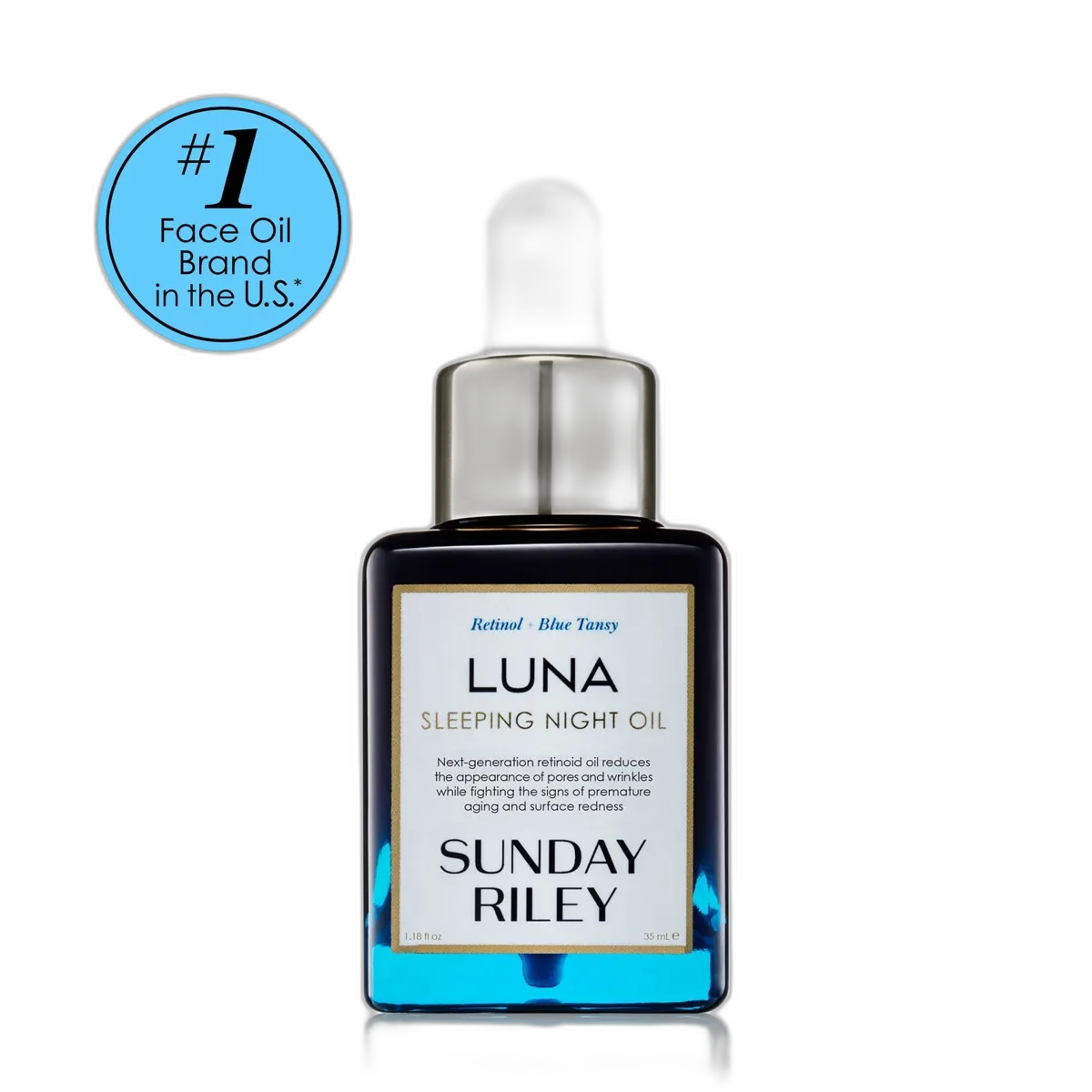
Luna Sleeping Night Oil
Retinoid Gateway Oil
 Verified reviewer
Pros & cons.
- +HPR retinoid delivers anti-aging benefits with significantly less irritation than traditional retinol
- +Triple-chamomile complex provides unusually thorough anti-inflammatory support for retinoid tolerance
- +Anhydrous oil format keeps HPR stable without the preservatives water-based formulas require
- +Cold-pressed seed oils deliver documented nutritional benefits beyond simple moisturization
- +Immediate visible glow by morning makes it easy to stay motivated with consistent use
- +Simple, short ingredient list with no silicones, emulsifiers, or unnecessary fillers
- +Leaping Bunny certified, PETA certified, vegan, and B Corp certified
- −HPR concentration is undisclosed, making it impossible to assess retinoid potency objectively
- −At $55 for 0.5 oz, the cost per application is significantly higher than most retinoid products
- −Essential oils including citrus and ylang ylang are potential sensitizers in a product marketed for gentleness
- −Blue color can stain light pillowcases and sheets, requiring extra care at bedtime
- −Strong herbal scent is deeply polarizing and may be overwhelming for fragrance-sensitive users
- −Contains two synthetic dyes that serve no skincare function and may irritate very sensitive skin
The full review.
When Sunday Riley launched Luna in 2015, the retinoid conversation in mainstream skincare was stuck in a binary: you either committed to the peeling, flaking, purging gauntlet of retinol, or you opted out entirely. Luna proposed a third option — a retinoid that worked while you slept, buffered by botanicals, delivered in an oil that felt more like a spa ritual than a clinical treatment. It was a radical pitch at the time, and it won Refinery29’s inaugural Beauty Innovator Award within months of launch.
The star of this formula is hydroxypinacolone retinoate, or HPR — a retinoid ester that skips the multi-step conversion process traditional retinol requires before it can interact with skin cells. Where retinol must convert to retinaldehyde and then to retinoic acid before it does anything useful, HPR binds directly to retinoid receptors. The result, at least in theory, is retinoid benefits with dramatically less irritation. Published research supports this premise: a 2018 study in the Journal of the American Academy of Dermatology found that HPR increased procollagen production comparably to tretinoin in skin models, and a 2024 study showed HPR-based products achieving results comparable to fractional CO2 laser for photodamage parameters.
The formula itself is refreshingly simple for a prestige product. There are no silicones, no water phase, no emulsifiers — just cold-pressed seed oils serving as both the delivery vehicle and active contributors. Avocado oil leads the INCI list, providing oleic acid and phytosterols that reinforce the skin barrier during the overnight repair window. Concord grape seed oil adds resveratrol and proanthocyanidins. Blackberry seed oil contributes vitamin C and omega-3 fatty acids. Chia seed oil rounds out the base with alpha-linolenic acid. These aren’t filler oils — each brings a documented nutritional profile to the skin.
Then there’s the blue tansy, which is responsible for Luna’s signature sapphire color and much of its personality. Tanacetum annuum yields chamazulene during steam distillation — a compound with anti-inflammatory properties that gives the oil its natural blue hue. Sunday Riley pairs this with not one but three types of chamomile: German, English, and Cape. It’s an unusually thorough approach to soothing, and it helps explain why so many retinoid-shy users tolerate Luna without incident.
The sensory experience is polarizing in the best possible way. The oil drops onto skin as a vivid, almost jewel-toned blue that fades as you massage it in. The scent is aggressively herbal — vetiver, ylang ylang, neroli, and blood orange layered over that chamomile-tansy base. It smells like a very expensive apothecary, and you will either find this deeply relaxing or deeply annoying. There is no neutral position on Luna’s fragrance.
Absorption is reasonable for a pure oil. Four to five drops spread easily across the face, leaving skin with a dewy, nourished finish rather than the greasy slick you might expect. By morning, the oil has absorbed fully, and there’s a legitimate glow — skin looks plumper, smoother, and more rested. This immediate cosmetic payoff is partly why Luna built such a devoted following. The long-term retinoid benefits (fine line reduction, improved texture, more even tone) develop over six to eight weeks.
But Luna is not without its complications. The most significant is transparency — or the lack thereof. Sunday Riley does not disclose the concentration of HPR in this formula. For a product positioned as a serious retinoid treatment at a premium price, this is a meaningful omission. It makes it impossible for consumers or dermatologists to assess potency, compare to other retinoid products, or make informed decisions about where Luna fits in a progressive retinoid regimen.
The essential oil load also deserves scrutiny. While the chamomile and blue tansy serve legitimate anti-inflammatory functions, the formula includes citrus oils (neroli, blood orange) and ylang ylang — known sensitizers that offer more aromatic appeal than dermatological benefit. For a product marketed partly on its gentleness, including potential irritants is a contradictory choice. The two synthetic dyes (CI 61565 and CI 60725) that enhance the blue color beyond what the tansy naturally provides fall into the same category: cosmetically appealing but functionally unnecessary.
The elephant in the room is Sunday Riley’s 2020 FTC settlement over fake reviews posted on Sephora between 2015 and 2017, directed by CEO Sunday Riley herself. While post-settlement reviews should be unaffected, it’s worth noting when evaluating this brand’s relationship with consumer trust. The product should stand on its formulation merit, not manufactured enthusiasm.
Value is where Luna struggles most. At $55 for half an ounce, the cost per application is significantly higher than most retinoid products on the market. The larger 35 mL bottle at $105 offers marginally better value, but this remains a premium-priced product without the disclosed active concentrations that would justify confident comparison to more affordable options.
All that said, Luna does something genuinely useful: it makes retinoids feel accessible and even enjoyable for people who would otherwise avoid them entirely. The ritual of applying a blue oil before bed, the morning-after glow, the absence of peeling and irritation — these things matter for adherence, and adherence is everything in skincare. If Luna gets someone started on retinoids who then graduates to stronger formulations, it has served its purpose beautifully. Just know what you’re paying for: an exceptionally pleasant retinoid experience, not necessarily the most potent one.
Formula
Ingredient analysis.
Full INCI list
Persea Gratissima (Extra Virgin Cold Pressed Avocado) Oil, Vitis Vinifera (Organic Cold Pressed Concord Grape) Seed Oil, Rubus Fruticosus (Cold Pressed Blackberry) Seed Oil, Salvia Hispanica (Cold Pressed Chia) Oil, Dimethyl Isosorbide, Hydroxypinacolone Retinoate, Chamomilla Recutita (Matricaria) Flower Oil, Tanacetum Annuum (Blue Tansy) Oil, Anthemis Nobilis (English Chamomile) Oil, Eriocephalus Punctulatus (Cape Chamomile) Oil, Citrus Aurantium Amara (Neroli) Oil, Citrus Aurantium Dulcis (Blood Orange) Oil, Cananga Odorata Flower (Ylang Ylang) Oil, Vetivera Zizanoides (Vetiver) Oil, Helianthus Annuus (Sunflower) Seed Oil, Rosmarinus Officinalis (Rosemary) Leaf Extract, CI 61565 (Green 6), CI 60725 (Violet 2)
Skin match.
The science.
The Science
Luna's core active, hydroxypinacolone retinoate (HPR), represents a meaningful evolution in retinoid chemistry. Unlike retinol, which must undergo two enzymatic conversion steps (retinol → retinaldehyde → retinoic acid) before it can activate retinoid receptors, HPR is a direct retinoic acid ester that binds to retinoid acid receptors (RARs) without conversion. This bypass mechanism is the pharmacological basis for HPR's reduced irritation profile.
A 2018 study presented at the American Academy of Dermatology demonstrated that HPR significantly increased procollagen I production in skin models at levels comparable to all-trans retinoic acid (tretinoin), with the highest concentration tested actually outperforming tretinoin in qualitative collagen assessment (Journal of the American Academy of Dermatology, 2018). A 2023 study in the Journal of Cosmetic Dermatology found that HPR combined with retinyl propionate synergistically enhanced collagen production, with participants showing an 8.3% decrease in wrinkles and 14.5-22.6% improvement in elasticity over eight weeks (Wang et al., 2023).
More recently, a 2024 study compared a topical HPR-peptide product against fractional CO2 laser treatment and found comparable improvements in photodamage parameters — a striking result for a topical formulation (PMC, 2024).
The delivery system matters here. HPR is lipophilic, and the anhydrous oil base of cold-pressed avocado, grape seed, blackberry, and chia oils creates an environment where HPR remains stable (no water means less hydrolytic degradation) and where the fatty acid profile may enhance skin penetration. The dimethyl isosorbide in the formula is a penetration enhancer that helps HPR reach the deeper epidermal layers where retinoid receptors are most active.
The blue tansy component contributes chamazulene, a sesquiterpene with documented anti-inflammatory activity. While clinical evidence for blue tansy in skincare specifically remains limited, chamazulene's mechanism of inhibiting leukotriene synthesis (a key inflammatory pathway) provides a pharmacological rationale for the soothing claims.
References
- Anti-aging effects of retinoid hydroxypinacolone retinoate on skin models — Journal of the American Academy of Dermatology (2018)
- The synergistic effect of retinyl propionate and hydroxypinacolone retinoate on skin aging — Journal of Cosmetic Dermatology (2023)
- Efficacy of Topical Hydroxypinacolone Retinoate-Peptide Product Versus Fractional CO2 Laser in Facial Aging — PMC (2024)
Dermatologist Perspective
Dermatologists generally view HPR as a viable entry point for patients who cannot tolerate traditional retinol or prescription retinoids. Board-certified dermatologists note that HPR's direct receptor-binding mechanism theoretically reduces the inflammatory byproducts that cause retinoid dermatitis, making it appropriate for retinoid-naive patients or those with reactive skin. However, dermatologists also caution that the undisclosed concentration in Luna makes it difficult to prescribe with precision. The essential oil content is a concern from a dermatological standpoint — while the chamomile oils have anti-inflammatory merit, the citrus and ylang ylang additions introduce unnecessary sensitization risk. Dermatologists frequently recommend Luna as a starter retinoid for patients who have abandoned retinol due to irritation, with the understanding that patients may eventually graduate to disclosed-concentration or prescription retinoid formulations.
Where it fits in your routine.
Apply 4-5 drops to clean, dry skin after your evening routine, or before a heavier night cream for more moisture. Massage into the face and neck with upward motions. Wait 1-2 minutes for absorption before touching your pillowcase. Mix a few drops with your nighttime moisturizer for a lighter application. Use every other night for the first two weeks if you are new to retinoids, then use nightly. Always wear SPF 30+ the next morning because retinoids increase photosensitivity.
Luna costs $55 for 0.5 fl oz and $105 for 1.18 fl oz, placing it in the prestige category. The larger bottle has better per-milliliter value and makes sense if Luna works for your skin. This pricing is standard for a brand founded in 2009 with prestige credibility, but the undisclosed HPR concentration makes it harder to justify than products that list exact amounts. You pay for the elegant delivery system, the botanical support complex, the sensory experience, and the brand's formulation expertise. Whether it is worth it depends on if you value the ritual as much as the retinoid.
Luna works for retinoid beginners wanting anti-aging benefits without a harsh adjustment period, dry-skinned individuals who find retinol products too drying, and anyone who values a nighttime skincare routine's sensory ritual as much as clinical results.
Skip Luna if your oily or acne-prone skin dislikes heavy oils, if you are sensitive to essential oils or strong fragrances, or if you want a retinoid with a disclosed concentration to calibrate your routine's potency precisely.
Product details.
fall winter Certifications Leaping Bunny CertifiedPETA Cruelty-FreeB Corp CertifiedVegan
The backstory.
Luna launched in 2015 as Sunday Riley's answer to the common retinoid dilemma: people wanted the anti-aging benefits but couldn't tolerate the irritation. Cosmetic chemist Sunday Riley chose HPR specifically because it bypasses the multi-step conversion process that makes traditional retinol so harsh, and paired it with blue tansy — an ingredient that was relatively obscure in Western skincare at the time. The product won Refinery29's first Beauty Innovator Award the year it launched.
About Sunday Riley
Established Brand (5–20 years)Cosmetic chemist Sunday Riley founded Sunday Riley in 2009 in Houston, Texas. The brand is B Corp certified and Leaping Bunny and PETA certified cruelty-free. NPD data shows Sunday Riley is the top independently owned female-led prestige skincare brand in America. Sunday Riley settled with the FTC in 2020 regarding fake reviews posted from 2015 to 2017.
Common myths.
Luna contains retinol and causes peeling and purging like prescription retinoids.
Luna uses hydroxypinacolone retinoate (HPR) instead of retinol. HPR binds directly to retinoid receptors. This avoids the multi-step conversion that causes traditional retinol irritation. Most users see no peeling or purging, but results work more gradually than prescription-strength retinoids.
The oil's blue color is an aesthetic choice and provides no skincare benefit.
The formula uses two synthetic dyes (CI 61565, CI 60725) to boost the blue color. The natural blue hue comes from chamazulene in the blue tansy oil, which has documented anti-inflammatory properties. These dyes make the color more intense than blue tansy alone.
FAQ.
Is Sunday Riley Luna a retinol or retinoid?
Luna contains hydroxypinacolone retinoate (HPR), a retinoid ester rather than traditional retinol. HPR binds directly to retinoid receptors. This skips the conversion steps that cause irritation, so Luna is gentler than retinol-based products but still promotes cellular turnover and collagen production.
Can I use Sunday Riley Luna every night?
Most users tolerate Luna nightly because HPR is gentler than retinol. If you are new to retinoids, use it every other night for the first two weeks to test your skin's tolerance. The chamomile and blue tansy oils in the formula buffer sensitivity.
Will Sunday Riley Luna stain my pillowcase?
The vivid blue color transfers to light-colored pillowcases and sheets if you apply it heavily or skip absorption time. Wait at least 5 minutes after application before lying down, or use a dark-colored pillowcase during the adjustment period.
Is Sunday Riley Luna safe during pregnancy?
Luna contains a retinoid (HPR), and all retinoids are generally advised against during pregnancy and breastfeeding as a precaution. Consult your OB-GYN or dermatologist for personalized guidance on pregnancy-safe skincare alternatives.
Why does Sunday Riley Luna smell so strong?
The herbal scent comes from the essential oil blend — blue tansy, three types of chamomile, vetiver, neroli, and ylang ylang. These are functional ingredients with anti-inflammatory properties, not added fragrance. The scent is polarizing but typically fades within 15-20 minutes of application.
Can I use vitamin C with Sunday Riley Luna?
Yes, but use them at different times. Apply your vitamin C serum in the morning for antioxidant protection, and use Luna at night. Using both together isn't harmful, but it reduces the efficacy of each and increases sensitivity in some users.
What percentage of retinoid is in Sunday Riley Luna?
Sunday Riley does not disclose the HPR concentration in Luna. Ingredient-conscious consumers often find this frustrating. Without a disclosed percentage, comparing potency to other retinoid products is difficult, but the gentle user experience suggests a moderate concentration.
What the community says.
"Visible morning glow and radiance after overnight use"
"Gentler than traditional retinol with minimal irritation"
"Smoother skin texture and reduced fine lines over time"
"Skin feels plump, nourished, and deeply hydrated"
"Luxurious ritual-like experience with the blue oil"
"Good entry point for retinoid beginners"
"High price for a small bottle — poor value per ounce"
"Strong herbal scent is polarizing and can linger on pillowcases"
"Blue color can stain light-colored sheets and pillowcases"
"Contains artificial dyes that serve no skincare function"
"Retinoid concentration is not disclosed by the brand"
"Can feel heavy or sit on top of oilier skin types"
People also looked at.