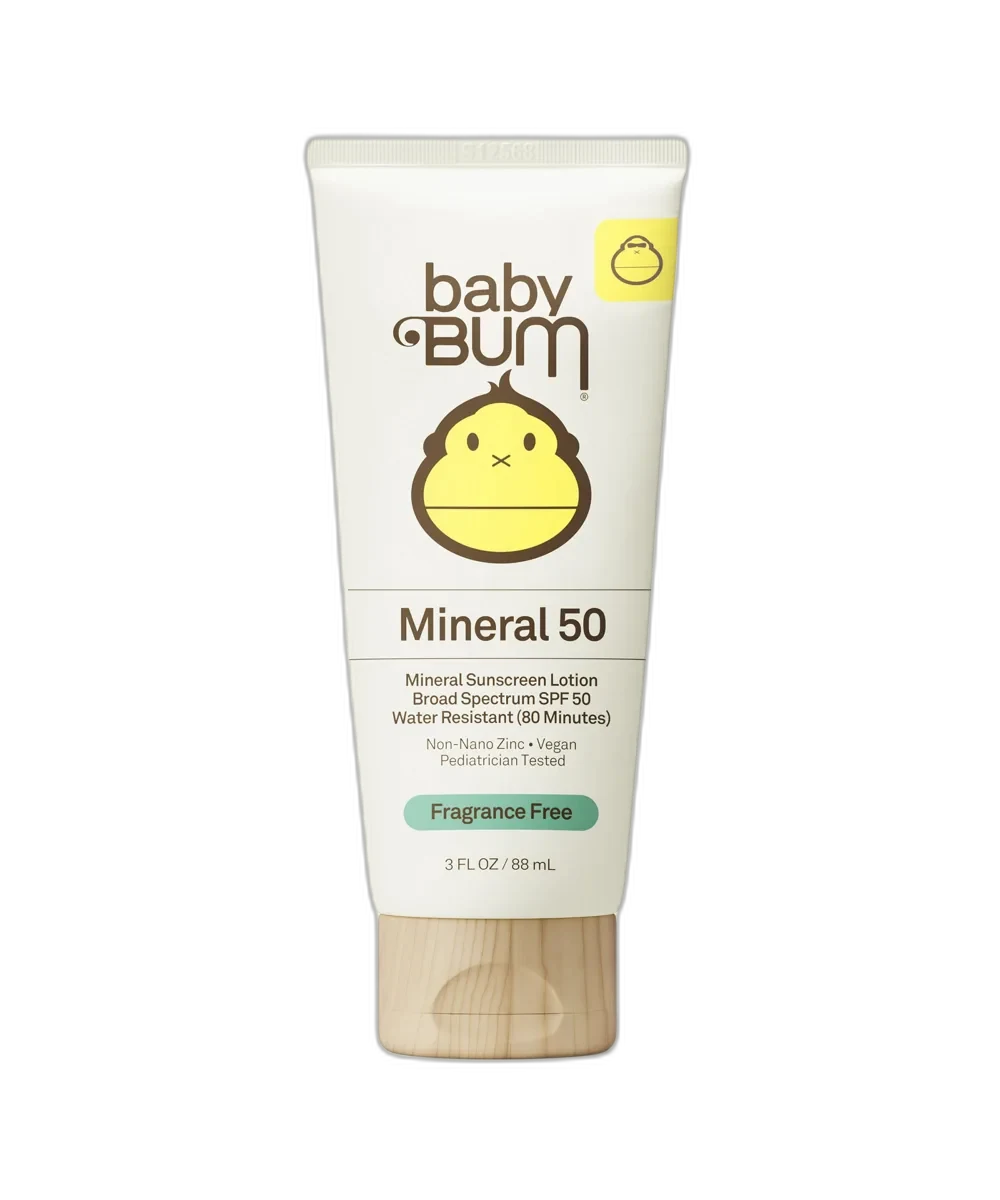
Baby Bum SPF 50 Mineral Sunscreen Lotion
Gentle Baby Sun Shield
 Verified reviewer
Pros & cons.
- +20% zinc oxide provides one of the most robust mineral UV protections in the baby sunscreen category
- +Fragrance-free, silicone-free, paraben-free formula designed for the most sensitive skin
- +Nourishing base of coconut oil, shea butter, and cocoa butter keeps baby skin moisturized
- +80-minute water resistance is essential for pool and beach use with children
- +Bisabolol and hyaluronic acid additions show genuine formulation care beyond basic sunscreen
- +Pediatrician and dermatologist tested with a minimal, purposeful ingredient list
- +Popular crossover product for adults with sensitive skin seeking robust mineral protection
- −Noticeable white cast is inherent to the 20% zinc oxide concentration
- −3 oz tube depletes rapidly during full-body baby application at the beach
- −Thick texture requires effort to blend and can feel heavy on the face
- −Coconut oil is comedogenic (rating 4) and may concern acne-prone adult users
- −Price per ounce ($5.50) is relatively high for a drugstore sunscreen brand
- −No larger size option available for more economical extended-use purchasing
The full review.
Baby Bum has a simple origin: the Sun Bum creators became parents and wanted a sunscreen they could trust for their own children. No marketing consultants or trend analyses drove this line extension. The team realized their existing adult products were not made for skin that is thinner, more permeable, and more reactive. The result is a mineral sunscreen that prioritizes protection and gentleness over cosmetic elegance.
The formula uses 20% zinc oxide, a high concentration for the mineral sunscreen spectrum. Many adult mineral sunscreens marketed as “elegant” or “lightweight” use only 9-15% zinc oxide. Twenty percent provides robust broad-spectrum UVA and UVB coverage with a safety margin, which is vital for a six-month-old who cannot communicate when sunscreen wears off. Zinc oxide is the sole active ingredient; the formula contains no titanium dioxide and no chemical filters. This simplicity is intentional. Fewer UV filters mean fewer potential sensitization vectors, and minimizing sensitization risk is the primary design constraint for infant skin.
The inactive ingredient list focuses on nourishment. Coconut oil follows water as the primary emollient base. Shea butter and cocoa butter add fatty acid moisture. These are not trendy ingredients, but nourishing lipids that keep thin, fragile skin comfortable under mineral sunscreen. Sodium hyaluronate adds humectant hydration to counteract the drying effect of high-concentration zinc oxide. Bisabolol, derived from chamomile, provides anti-inflammatory soothing, while tocopherol adds antioxidant support. Every ingredient has a functional purpose.
The formula is fragrance-free, silicone-free, paraben-free, and sulfate-free. These are formulation necessities for the most sensitive human skin. Baby skin has a thinner stratum corneum, a higher surface-area-to-body-mass ratio, and a maturing immune system, making it more susceptible to absorption and sensitization. A fragrance that does not react on adult skin can trigger a rash on a baby. The conservative ingredient approach reflects this.
On baby or adult skin, the texture is creamy and moisturizing but thick compared to chemical sunscreens or low-concentration mineral formulas. This is the trade-off for 20% zinc oxide: serious protection costs a lighter feel. The formula blends reasonably well after thirty to sixty seconds of massage, but a white cast remains. This is physics, not a flaw. Zinc oxide is a white mineral that physically scatters UV radiation on the skin surface. At 20%, the mineral is visible. Reducing the white cast by applying less would mean less protection—a trade-off parents should not make.
The moisturizing qualities are notable. Many mineral sunscreens leave skin tight and dry, especially after water exposure. The coconut oil and shea butter base in Baby Bum maintains skin comfort during the 80-minute water resistance window. Parents report their children’s skin feels soft and moisturized after sun and water, which many adult sunscreens fail to do.
Size is a practical limitation. At 3 ounces, one tube provides roughly three to five full-body applications for a baby at the beach, before the required reapplication every two hours. A full day of outdoor activity can use most or all of a tube. At $16.49 per tube (approximately $5.50 per ounce), the per-use cost adds up during beach or pool days. Budget for at least two to three tubes for a week-long vacation.
Adults with sensitive skin also use Baby Bum as a reliable mineral sunscreen. The 20% zinc oxide provides more robust protection than many adult mineral formulas. The fragrance-free, gentle base is better tolerated by reactive adult skin than sunscreens that include fragrance, chemical UV filters, or alcohol to achieve cosmetic elegance. The trade-off remains the same—white cast and a thicker feel—but it is a trustworthy option for adults who prioritize protection over appearance.
Baby Bum SPF 50 does not try to be beautiful or invisible. It does not compromise for a social media-friendly finish. It provides 20% zinc oxide in a nourishing, gentle base for the most vulnerable skin in the household, and it does so reliably. In a category where cosmetic elegance often reduces protection adequacy, this honesty is refreshing.
Ingredient analysis.
Full INCI list
Active Ingredient: Zinc Oxide 20%. Inactive Ingredients: Water, Cocos Nucifera (Coconut) Oil, Butyloctyl Salicylate, Diheptyl Succinate, Methyl Dihydroabietate, Butyrospermum Parkii (Shea Butter), Capryloyl Glycerin/Sebacic Acid Copolymer, Sodium Stearoyl Glutamate, Cetearyl Alcohol, Theobroma Cacao (Cocoa) Seed Butter, Coco-Glucoside, Tocopherol, Microcrystalline Cellulose, Cellulose Gum, Bisabolol, Cetyl Alcohol, Arachidyl Alcohol, Behenyl Alcohol, Arachidyl Glucoside, Polyhydroxystearic Acid, Sodium Hyaluronate, Sodium Gluconate, Phenoxyethanol, Ethylhexylglycerin, Citric Acid
Skin match.
The science.
The Science
Zinc oxide at 20% provides broad-spectrum UV protection by scattering and absorbing UV rays. Chemical UV filters absorb UV radiation and turn it into heat, but zinc oxide physically deflects UV rays from the skin surface. This works immediately upon application and needs no chemical activation period. Research in the Journal of the American Academy of Dermatology shows zinc oxide provides better UVA1 (340-400nm) protection than titanium dioxide, making it the best sole mineral filter for broad-spectrum coverage.
The 20% concentration creates a large safety margin for SPF 50 protection. Studies on mineral sunscreen application show consumers usually apply only 25-50% of the recommended amount, which lowers the actual in-use SPF compared to the label. The higher zinc oxide concentration compensates for under-application and provides protection even when applied imperfectly—a key factor for products used on squirming babies.
The formula's moisturizing components solve a known mineral sunscreen problem. A 2019 study in the British Journal of Dermatology found that mineral sunscreens increase transepidermal water loss in sensitive skin if the formula lacks emollients. The coconut oil, shea butter, and sodium hyaluronate in Baby Bum counteract this effect.
Dermatologist Perspective
Pediatric dermatologists recommend zinc oxide-based mineral sunscreens as the safest sun protection for infants 6 months and older because the mineral filter does not absorb systemically and is non-irritating. Board-certified dermatologists note the 20% zinc oxide concentration in Baby Bum provides excellent broad-spectrum coverage and a safety margin for the under-application common with young children. The fragrance-free, minimal-ingredient formula follows dermatological recommendations for pediatric skincare products. Dermatologists advise that infants under 6 months should use sun avoidance and protective clothing instead of sunscreen.
Where it fits in your routine.
Apply a thick layer to all exposed skin 15 minutes before sun exposure. Use about one teaspoon for a baby's face and exposed body areas. Rub in using gentle circular motions. Reapply every 2 hours during sun exposure, or immediately after swimming, sweating, or towel drying. This formula is water resistant for 80 minutes. Consult a pediatrician before use for babies under 6 months. Use sun-protective clothing, hats, and shade as well — no sunscreen provides 100% protection.
At $16.49 for 3 fl oz, Baby Bum costs about $5.50 per ounce. This price competes with mineral baby sunscreens but exceeds adult drugstore chemical sunscreens. The 20% zinc oxide concentration, fragrance-free formula, and 80-minute water resistance justify the cost for its intended use. No larger size exists, which increases the cost for families using Baby Bum frequently. As an established brand (now SC Johnson-owned) with nearly a decade of market history in baby sun care, the price reflects formulation quality instead of a marketing premium.
Parents of babies and toddlers (6 months to 5 years) need a reliable, gentle mineral sunscreen for outdoor activities. The formula also works for adults with sensitive, reactive, or post-procedure skin who want robust zinc oxide protection in a fragrance-free formula and accept the white cast trade-off.
Adults wanting an invisible, cosmetically elegant sunscreen. People needing an oil-free formula or those prone to comedonal acne from coconut oil. Users seeking a budget sunscreen for high-volume daily adult use — the 3 oz tube size makes this impractical as a sole daily adult SPF.
Product details.
This creamy mineral lotion is lighter than many 20% zinc oxide formulas but thicker than chemical sunscreens. The coconut oil, shea butter, and cocoa butter base feels thick and moisturizing for baby skin. Blend thoroughly to minimize white cast.
Fragrance-free and has no detectable scent. It lacks the typical sunscreen smell.
The squeeze tube uses the Baby Bum line's pastel yellow and white colors, which differs from the adult Sun Bum line. The 3 oz size fits in diaper bags but is small for long vacations.
The first application is a creamy white lotion that needs 30-60 seconds of blending to spread evenly. A visible white cast remains; this is inherent to 20% zinc oxide mineral sunscreens. The moisturizing base feels comfortable and not drying. Babies typically tolerate it well without fussing.
Apply 3-5 times full-body for a baby at the beach, or use 2-4 weeks daily on exposed areas
12 months
spring summer
The backstory.
The Baby Bum line was born when Sun Bum team members started having children and wanted sun protection that met the same quality standards as the adult line but was specifically formulated for infant skin. Launched around 2016, the mineral SPF 50 uses only zinc oxide — no chemical filters — at a substantial 20% concentration to provide robust protection for skin that is thinner, more permeable, and more sun-sensitive than adult skin. The acquisition by SC Johnson in 2019 expanded the line's distribution while maintaining the original formulation approach.
About Sun Bum
Established Brand (5–20 years)Sun Bum launched in 2010 in Cocoa Beach, Florida. SC Johnson acquired Sun Bum in 2019 for about $400 million. The Baby Bum line targets infants and children; the product is pediatrician and dermatologist tested. PETA lists the brand as cruelty-free.
Common myths.
All sunscreens are safe for babies from birth.
The FDA and most pediatricians recommend avoiding sunscreen for infants under 6 months old. Their skin is thinner and absorbs more, so shade and protective clothing work best. Baby Bum SPF 50 is for babies 6 months and older.
A white cast from mineral sunscreen shows you applied too much product.
Zinc oxide at 20% concentration causes some white cast. This physical mineral sits on the skin surface to provide protection. The white cast shows the product works as intended. Applying less to avoid the cast reduces protection.
FAQ.
What age can I start using Baby Bum SPF 50 on my baby?
Sun Bum recommends Baby Bum for babies 6 months and older. The FDA and most pediatricians advise against any sunscreen for infants under 6 months. For younger babies, use shade and protective clothing for sun protection. Always consult your pediatrician before starting any sunscreen.
Does Baby Bum SPF 50 leave a white cast?
Yes — the 20% zinc oxide formula has some white cast. This mineral sits on the skin surface to provide protection. Thorough blending minimizes the cast, but it does not disappear. The white cast is more noticeable on darker skin tones.
Is Baby Bum SPF 50 reef-safe?
The formula uses zinc oxide as its only UV filter. It lacks oxybenzone and octinoxate, which Hawaii's reef protection law bans. However, Sun Bum settled a 2025 lawsuit regarding misleading 'reef friendly' claims on their chemical sunscreen lines. The mineral Baby Bum product avoids the primary reef-toxic chemicals.
Can adults use Baby Bum SPF 50?
Many adults with sensitive skin use Baby Bum as a daily mineral sunscreen. Its fragrance-free, gentle formula has 20% zinc oxide, which is a higher concentration than many adult mineral sunscreens. The trade-off is a white cast and thick texture compared to cosmetically elegant adult formulas.
How often should I reapply Baby Bum SPF 50?
Reapply every 2 hours during sun exposure, or immediately after swimming, sweating, or towel drying. The water-resistant formula protects for 80 minutes during water activities, but you must reapply after that period.
Is Baby Bum SPF 50 safe for eczema-prone baby skin?
The fragrance-free, gentle mineral formula uses soothing bisabolol and moisturizing butters. Eczema-prone skin generally tolerates it well. However, coconut oil irritates some people. If your baby has active eczema, patch test on a small area before full application.
What the community says.
"Gentle on baby's sensitive skin with no irritation or rashes reported"
"Fragrance-free formula appreciated by parents of allergy-prone children"
"Effective sun protection — parents consistently report no sunburns with proper use"
"Water resistant for 80 minutes during pool and beach activities"
"Moisturizing formula with nourishing butters keeps baby skin soft"
"Easy to wash off compared to many other mineral sunscreens"
"Noticeable white cast that can be stubborn to blend on all skin tones"
"Small 3 oz tube runs out very quickly for whole-body baby application"
"Can feel thick and heavy when applied to the face"
"Requires effort to rub in fully and evenly"
"Price per ounce is relatively high at approximately $5.50/oz"
"Texture can feel slightly grainy or thick compared to chemical sunscreens"
Featured in.
People also looked at.