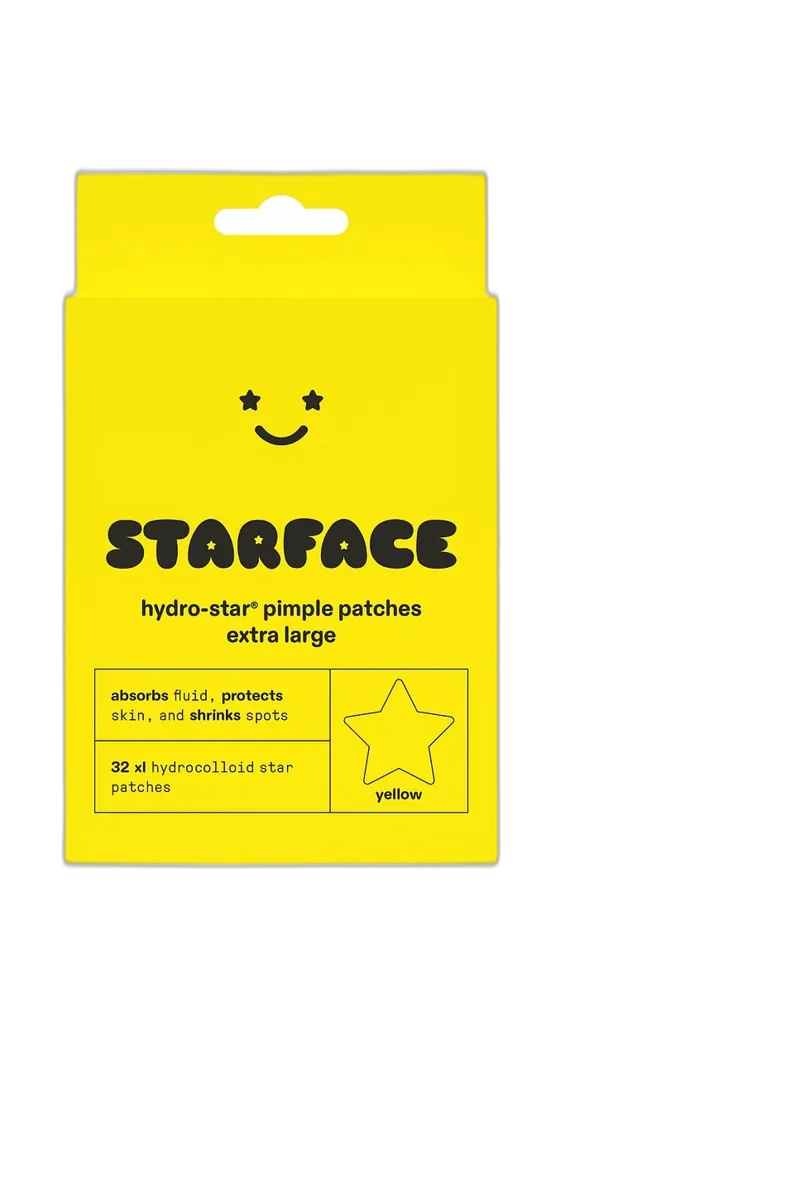
Big Star Pimple Patches
Gen Z Acne Favorite
 Verified reviewer
Pros & cons.
- +XL 20mm size effectively covers larger blemishes that standard patches miss
- +Hydrocolloid technology is clinically proven to absorb fluid and reduce blemish size
- +Completely fragrance-free and irritant-free — safe for all skin types
- +Prevents picking and touching, supporting both physical and psychological healing
- +Reusable star-shaped compact is portable, fun, and includes a mirror
- +Vegan and cruelty-free with a minimal, clean ingredient list
- −Significantly more expensive per patch than generic hydrocolloid alternatives
- −Star-shaped points can lift at the edges, compromising the occlusive seal
- −Ineffective on deep cystic acne that sits below the skin surface
- −Highly visible star shape isn't suitable for professional or discreet settings
- −Same core technology available in cheaper circular patches from other brands
The full review.
Beauty editor Julie Schott watched the acne industry sell shame for years. Products promised to ‘hide,’ ‘conceal,’ or ‘eliminate’ blemishes as if pimples were personal failings. When she co-founded Starface in 2019, the pitch was simple: turn the pimple patch—a clinical wound care technology effective for decades—into something people want to see.
The Big Star is the XL version. At 20mm across, these hydrocolloid patches cover larger blemishes that standard Hydro-Stars cannot. The bright yellow star shape is recognizable and looks nothing like medical supplies. That visibility is intentional. Starface didn’t invent hydrocolloid technology—it has been used in surgical wound dressings since the 1980s—but the brand knew the main barrier to using pimple patches wasn’t efficacy. It was embarrassment.
The technology is straightforward. Hydrocolloid is a moisture-absorbing material that creates an occlusive environment over a blemish. When applied to a pimple—ideally one with a head—the material draws out fluid (pus, sebum, wound exudate) while maintaining the moist conditions skin needs to heal. Within hours, the patch turns from translucent to opaque white, confirming it is absorbing. By morning, the blemish is usually flatter, less red, and less tender.
The Big Star patches are thin and flexible enough to fit most facial contours. However, the star shape has a structural quirk: the five points can lift at the tips, especially on moving areas like the chin or jawline. A circle maintains its seal more consistently because it has no protruding edges to catch on pillows or clothing. This is a minor issue for overnight wear but matters if you apply one during the day.
The ingredient list is minimal: hydrocolloid and its component materials. There is no fragrance, no active acids, and no potential irritants. This makes the Big Star patches suitable for almost every skin type, including sensitive and reactive skin that cannot tolerate chemical acne treatments. For people prone to picking, pimple patches provide a psychological benefit alongside the dermatological one. The physical barrier stops fingers from reaching the blemish, allowing it to heal without interference.
Regarding value: a 32-count pack costs roughly $15, or about 47 cents per patch. Generic hydrocolloid patches from brands like CosRX or drugstore options often cost 15-25 cents per patch using the exact same technology. The hydrocolloid does not care about the star shape. It absorbs fluid the same way whether it is a yellow star or a transparent circle. You pay a premium for the design, the reusable compact (which is cute and doubles as a mirror), and a brand identity that makes wearing a pimple patch a style choice rather than a medical intervention.
Whether that premium is worth it depends on your priorities. If you use pimple patches regularly and want the most cost-efficient option, generic circular patches are the rational choice. For someone—especially a younger consumer—who avoided pimple patches because they felt too clinical or embarrassing, the star shape may encourage them to treat blemishes instead of picking. There is real value in that behavioral shift, even if the hydrocolloid is commodity technology.
The Big Star works. It absorbs fluid, reduces blemish size and redness overnight, and prevents compulsive touching. It does this while looking like a decorative sticker, which is either the entire point or an unnecessary markup.
Ingredient analysis.
Full INCI list
Hydrocolloid (Cellulose Gum, Polyisobutene, Petroleum Resins, Styrene-Isoprene-Styrene Block Copolymer)
Skin match.
The science.
The Science
Wound care has used hydrocolloid dressings since the 1980s, supported by extensive evidence. A systematic review in the Journal of Wound Care confirmed hydrocolloid dressings maintain moist wound healing environments, absorb exudate, and promote autolytic debridement of necrotic tissue.
Hydrocolloid works through two primary mechanisms on acne lesions. First, the occlusive seal blocks external bacteria and contaminants while the moist environment accelerates epithelial cell migration and wound closure. Second, the absorbent matrix draws fluid from the lesion, reducing swelling and the concentration of inflammatory mediators at the site.
A 2020 study in the Journal of Cosmetic Dermatology shows hydrocolloid acne patches significantly reduce lesion size, erythema, and pigmentation compared to untreated controls over 24 hours. The patches work best on papules and pustules — surface-level inflammatory lesions — matching clinical advice to use them on blemishes that have come to a head instead of deep nodular or cystic acne.
The physical barrier function is important. Research on excoriated acne (acne worsened by picking) shows that preventing manual manipulation of blemishes significantly reduces scarring and post-inflammatory hyperpigmentation. Covering a pimple with a patch provides a meaningful intervention beyond the hydrocolloid's direct effects.
References
- Hydrocolloid acne dressing versus tea tree oil for the treatment of acne vulgaris: a pilot study — Journal of Cosmetic Dermatology (2020)
Dermatologist Perspective
Dermatologists view hydrocolloid patches as a helpful adjunct to acne treatment, not a standalone solution. Board-certified dermatologists note these patches work best on superficial inflammatory lesions — papules and pustules — where the hydrocolloid absorbs wound exudate. For deep cystic or nodular acne, dermatologists recommend prescription-strength treatments like retinoids, antibiotics, or hormonal therapies. Dermatologists also cite the anti-picking benefit as clinically significant, as excoriated acne leads to more severe scarring and hyperpigmentation than untouched lesions.
Guidance
Where it fits in your routine.
Cleanse the skin and pat dry; the patch needs a clean, oil-free surface to stick. Peel a Big Star from the sheet and place it over the blemish, pressing gently to seal the edges. Leave it on for at least 6 hours or overnight. The patch turns white once it absorbs fluid and needs replacement. Do not apply over serums, oils, or moisturizers because this prevents adhesion. For best results, apply as the last step in your routine on clean skin.
At approximately $15 for 32 patches ($0.47 per patch), Starface Big Stars cost more than generic hydrocolloid alternatives that use the same technology for $0.15-0.25 per patch. This price covers the star shape, the reusable compact, and the brand's destigmatizing identity. Value depends on if you want the aesthetic and motivational aspects or just the hydrocolloid function. For regular patch users treating frequent breakouts, the cost grows fast — a budget alternative may be more sustainable long-term.
Younger consumers and people who want acne treatment to feel empowering instead of clinical use this. It also works for chronic pickers who need a physical barrier to stop hands from touching active blemishes. The XL size covers larger blemishes that standard patches cannot.
Generic circular patches use identical hydrocolloid technology for less than half the cost. This suits budget-conscious consumers focused on efficacy. Skip these if you need discreet patches for work or school, as the bright yellow star shape is meant to be seen.
Product details.
Thin, flexible hydrocolloid material conforms to the skin's surface. The XL star shape is about 20mm wide, which is larger than standard Hydro-Stars to cover bigger blemishes.
No scent — completely fragrance-free.
The product comes in a reusable yellow star-shaped compact that works as a mirror case. This signature packaging is playful, pocket-sized, and Instagram-ready. Patches stay on sheets inside the compact.
Apply to a clean, dry blemish for immediate adhesion. The hydrocolloid turns white within a few hours as it absorbs fluid from the pimple. By morning, the blemish is usually flatter and less inflamed. The star shape is visible on the face; Starface designs them to be worn visibly.
32 patches per compact — duration depends on breakout frequency
24 months
All Year
The backstory.
Starface launched in September 2019 with a radical premise: what if treating acne could be fun instead of shameful? Co-founder Julie Schott, former beauty director at ELLE.com, designed the star-shaped patches to be worn visibly — a deliberate rejection of the 'hide your blemishes' messaging that dominated acne marketing. The Big Star variant launched as an XL option for larger breakouts that the original Hydro-Stars couldn't cover.
About Starface
Emerging Brand (2–5 years)Julie Schott (former beauty director of ELLE.com) and Brian Bordainick co-founded Starface in 2019 to destigmatize acne. The brand makes about $90 million in annual revenue. Starface products use standard hydrocolloid technology; the brand differentiates through design and marketing instead of formulation innovation.
Common myths.
Pimple patches can treat deep cystic acne.
Hydrocolloid patches absorb fluid from the skin's surface. They work best on pimples that have a head or have been lanced. Deep cystic acne sits too deep for hydrocolloid to reach. This requires different treatments like benzoyl peroxide, retinoids, or professional extraction.
Star-shaped patches work better than circular ones.
The star shape is purely aesthetic — hydrocolloid technology works the same regardless of patch shape. The star points lift more easily than a smooth circular edge, which can break the occlusive seal that makes hydrocolloid effective.
FAQ.
Do Starface Big Star patches actually work?
Yes, the hydrocolloid technology in these patches absorbs fluid and reduces blemish size. They work best on pimples that have come to a head. The XL size covers larger blemishes that standard patches cannot. They do not help with deep cystic acne.
Are Starface patches worth the price compared to generic alternatives?
The hydrocolloid technology is the same as cheaper drugstore patches. You pay more for the star shape, the reusable compact, and the brand experience. Generic patches give the same results for less if effectiveness is your only priority. The premium is worthwhile if the aesthetic and anti-picking motivation matter to you.
How long should I leave Starface Big Star patches on?
Leave the patch on for at least 6 hours or overnight for best results. The hydrocolloid needs time to absorb fluid and create a healing environment. The patch turns white when it absorbs fluid. Replace with a fresh patch if the blemish still has fluid to drain.
Can I wear Starface patches under makeup?
These patches work as visible, fun accessories, but you can apply thin makeup over them if needed. The XL star shape is noticeable and does not blend seamlessly under foundation. Starface also offers Clear Hydro-Stars for a more discreet option.
Are Starface Big Star patches safe for sensitive skin?
These patches contain only hydrocolloid. They have no fragrances, active acids, or potential irritants. They are among the gentlest acne treatments and work for all skin types, including sensitive and reactive skin.
Community
What the community says.
"XL size covers larger blemishes that standard patches can't reach"
"Fun star shape makes wearing a pimple patch feel less clinical"
"Effectively draws out fluid overnight and reduces blemish size"
"Prevents picking and touching, which helps blemishes heal faster"
"Gentle enough for sensitive skin with no irritation"
"Significantly more expensive per patch than generic hydrocolloid alternatives"
"Star shape doesn't provide full coverage and can leave gaps around edges"
"Adhesion can be inconsistent — patches sometimes lift at the points"
"Doesn't work on deep cystic acne or blemishes without a head"
Featured in.
People also looked at.