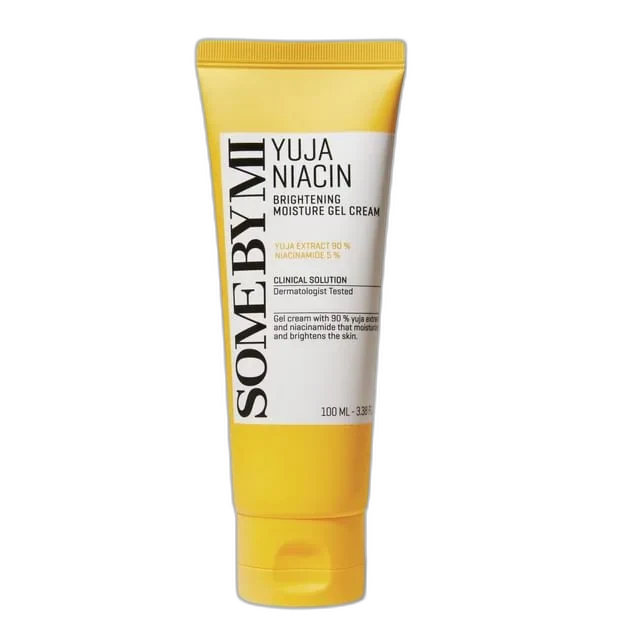
Yuja Niacin Brightening Moisture Gel Cream
K-Beauty Brightening Pick
 Verified reviewer
Pros & cons.
- +Yuja extract as first ingredient, not a trace addition
- +Four-mechanism brightening stack in a single moisturizer
- +Niacinamide, ascorbyl glucoside, and arbutin work additively
- +Lightweight bouncy gel cream texture
- +Ceramide NP provides genuine barrier support
- +Madecassoside buffers against active-related irritation
- +Accessible K-beauty price for the formulation
- −Added fragrance unsuitable for fragrance-sensitive users
- −Not fungal-acne safe
- −Under-hydrating for very dry skin in cold weather
- −Citrus extract can be irritating to reactive skin
The full review.
Yuja is a citrus fruit most Americans encounter first in a K-beauty aisle rather than a grocery store. In Korea, it’s an everyday ingredient — yujacha (yuja tea) is a winter staple, and the fruit’s vitamin C content is part of the cultural reason why. When Some By Mi built a brightening line around yuja, it wasn’t just cherry-picking a trendy botanical. It was leaning on an ingredient with real domestic familiarity, the kind of thing a Korean consumer already trusts for its antioxidant reputation. The Yuja Niacin Brightening Moisture Gel Cream is the moisturizer step of that line, and despite the slightly clunky English name, it’s a more thoughtful formulation than the ‘brightening gel’ category usually delivers.
Start with the INCI. The very first ingredient is Citrus junos (yuja) fruit extract — not water, which is the usual first ingredient in a K-beauty moisturizer. That’s a formulation choice that matters: it signals the brand is using the yuja extract as the base of the water phase rather than as a trace addition at the end of the list. Yuja itself contributes naturally occurring vitamin C, flavonoids, and limonene, which is where the characteristic citrus scent comes from and also where the fragrance-sensitive should pause. This isn’t a hypoallergenic formula.
The brightening stack is more layered than the ‘yuja’ branding implies. Niacinamide provides well-documented tone support by inhibiting melanosome transfer to keratinocytes. Ascorbyl glucoside, a stable vitamin C derivative that converts to L-ascorbic acid on the skin, adds a second vitamin C vector alongside the whole-fruit yuja extract. Arbutin — a glycosylated hydroquinone precursor — provides a third mechanism via tyrosinase inhibition. Four overlapping pathways in a single moisturizer is more than most brightening products attempt, and the fact that each one works through a slightly different mechanism means the combined effect is additive rather than redundant.
Backing it up is a quiet supporting cast. Ceramide NP adds lipid barrier structure so the moisturizing claim isn’t purely humectant bluff. Madecassoside takes care of the anti-inflammatory angle — necessary because stacking vitamin C precursors with arbutin could otherwise push reactive skin into irritation. Panthenol and polyglutamic acid add hydration layers, and the emulsion base uses cetearyl alcohol and glyceryl stearate rather than heavier occlusives, which is why the finish stays gel-cream light instead of tipping into cream-heavy territory.
On the skin, the texture is the immediate win. It’s genuinely bouncy — if you dip a finger into the jar, it springs back in that slightly theatrical K-beauty way — and it spreads into a fresh, cool gel that absorbs within a minute. The citrus scent is moderate-to-strong on application and fades within a few minutes, but fragrance-averse users will notice it. Finish is dewy, not tacky, and it sits cleanly under sunscreen for the brightening routines it’s designed to support.
Efficacy-wise, the gel cream delivers what its ingredient stack promises — but slowly. Vitamin C derivatives, niacinamide, and arbutin all require weeks to show tone improvement, and the modest per-ingredient doses here mean this is a supporting player rather than a headline brightening treatment. Pair it with a dedicated vitamin C serum and daily SPF, and you’ll see meaningful improvement in dullness and post-inflammatory hyperpigmentation within two to three months. Use it in isolation and expect subtle changes instead of dramatic ones.
Its limitations are the same as the category’s limitations. It’s too light on its own for genuinely dry skin in winter. The added fragrance and citrus extract make it a poor fit for sensitized or rosacea-prone users. It isn’t fungal-acne safe, which rules out one segment of the acne-prone audience. And Some By Mi remains a relatively young brand — the formulation is well-constructed, but the decades of clinical validation that back a CeraVe or La Roche-Posay just aren’t there yet. At around nineteen dollars for 60 grams, though, the cost-to-formulation ratio is attractive, particularly for combination and normal skin types looking for a daily moisturizer that contributes to a brightening routine.
Ingredient analysis.
Full INCI list · pH 5.5
Citrus Junos (Yuja) Fruit Extract, Water, Glycerin, Niacinamide, Butylene Glycol, 1,2-Hexanediol, Cetyl Ethylhexanoate, Dipropylene Glycol, Caprylic/Capric Triglyceride, Betaine, Cetearyl Alcohol, Glyceryl Stearate, PEG-100 Stearate, Sodium Hyaluronate, Tocopheryl Acetate, Ascorbyl Glucoside, Adenosine, Arbutin, Allantoin, Panthenol, Centella Asiatica Extract, Madecassoside, Ceramide NP, Beta-Glucan, Polyglutamic Acid, Carbomer, Arginine, Xanthan Gum, Ethylhexylglycerin, Disodium EDTA, Fragrance
Skin match.
The science.
The Science
Four well-characterized mechanisms drive this gel cream's brightening efficacy. Niacinamide has extensive dermatology literature; studies in the British Journal of Dermatology show it reduces hyperpigmentation by inhibiting melanosome transfer from melanocytes to keratinocytes. At 2-5% cosmetic concentrations, niacinamide improves skin tone and barrier function with minimal irritation risk.
Ascorbyl glucoside is a stable vitamin C derivative. Research in the International Journal of Cosmetic Science examined its conversion to L-ascorbic acid on the skin. While its clinical efficacy is lower than pure ascorbic acid at comparable concentrations, it is gentler and pairs well with other brightening actives. Arbutin — specifically alpha-arbutin, though beta-arbutin is also common — inhibits tyrosinase. Cosmetic research shows modest but real tone-evening effects over 8-12 weeks of use.
Phytochemical research has characterized the vitamin C, naringenin, hesperidin, and limonene content in Yuja (Citrus junos) extract, suggesting antioxidant and anti-inflammatory potential. While clinical dermatology studies on Yuja (Citrus junos) extract are fewer, it acts here as a vitamin C source and antioxidant base rather than a standalone clinical active.
The formulation works by stacking four brightening mechanisms through different pathways: melanosome transfer inhibition, tyrosinase inhibition, antioxidant support, and vitamin C delivery. These provide additive rather than redundant benefits. This explains why multi-active brightening moisturizers can outperform single-ingredient products over time, even with modest individual concentrations.
Dermatologist Perspective
Dermatologists often recommend multi-vector brightening moisturizers for post-inflammatory hyperpigmentation and general dullness, especially if the patient uses a dedicated vitamin C serum or prescription retinoid. Board-certified dermatologists note that niacinamide, arbutin, and stable vitamin C derivatives are well-tolerated brightening actives with a good safety profile. Stacking them in a moisturizer adds incremental tone support without increasing the routine's irritation burden. Clinicians caution that results require consistent use over 8-12 weeks and strict daily SPF, and that citrus-based fragrances can sensitize rosacea-prone patients.
Where it fits in your routine.
Warm a small amount between clean fingertips before applying. Pat it over your face and neck as the final hydrating step — after PM serums and before AM sunscreen. Use daily SPF when using brightening actives; UV exposure undoes tone-evening results. This works twice daily for combination and normal skin; dry skin can layer it over a hydrating essence.
At about nineteen dollars for 60 grams, this sits mid-range in the K-beauty brightening moisturizer category. It costs less than dermatology-brand equivalents and competes with other yuja-based products. The per-gram cost is reasonable for a multi-active formulation; the addition of ceramides and madecassoside makes it better than drugstore alternatives. Some By Mi is an emerging brand, so you pay for formulation quality instead of clinical heritage, but the ingredient substance justifies the price.
Combination, normal, and oily skin types with dullness or uneven tone want a lightweight moisturizer that brightens. This works for K-beauty fans who like multi-mechanism formulations and those who layer tone care instead of using one serum.
Sensitive and rosacea-prone users should skip this — the fragrance and citrus extract make it a poor fit for reactive skin. Those with fungal acne need a fragrance-free, fatty-ester-free alternative. Very dry skin types need a thicker cream, used with or instead of this gel cream.
Product details.
Bouncy, bright orange-tinted gel cream
Fresh yuja citrus aroma
Orange plastic jar with inner lid
The first application feels cool and refreshing, with a brief citrus scent. The first use leaves a dewy finish. Tone improvements show after 3-4 weeks of consistent use and daily SPF.
2-3 months with twice-daily face use
12 months
spring summer
The backstory.
Some By Mi developed the Yuja Niacin line to push beyond its original acne-focused identity into brightening care. Yuja (Korean citron) is a traditional Korean ingredient used in tea and cooking, and the brand leveraged its cultural familiarity to position this line for users interested in glow-focused routines.
About Some By Mi
Emerging Brand (2–5 years)Some By Mi launched in 2017, building its reputation through acne-focused and brightening K-beauty lines. The brand is in an emerging category with limited long-term clinical validation but clear ingredient transparency.
Common myths.
You need a dedicated vitamin C serum to brighten your skin.
A multi-vector brightening moisturizer like this one delivers results through repeated, moderate doses, especially with daily SPF. Users do not need a dedicated serum.
FAQ.
What exactly is yuja, and why is it in this moisturizer?
Yuja (Citrus junos) is a Korean citrus fruit containing vitamin C, flavonoids, and limonene. Some By Mi uses it as the first ingredient. This whole-fruit extract provides antioxidant and brightening effects instead of using pure ascorbic acid.
Does this replace my vitamin C serum?
Not exactly—yuja, ascorbyl glucoside, niacinamide, and arbutin provide brightening, but at lower concentrations than a dedicated vitamin C serum. Use it for layered brightening, not as a replacement for a high-dose active serum.
Is it hydrating enough for winter?
Yes, for most combination and oily skin types. Dry skin in cold weather needs a thicker cream or can layer this over a more occlusive product.
Can I use it with a retinol or tretinoin routine?
Yes — apply this gel cream as your moisturizer after your retinol absorbs. The niacinamide and madecassoside buffer retinoid-related irritation, but sensitive skin should monitor for fragrance reactions.
Is it safe during pregnancy?
Yes — none of the brightening actives here have pregnancy concerns. The arbutin, niacinamide, and vitamin C derivatives are safe, but consult your OB-GYN before using new products.
Community
What the community says.
"Fresh, bouncy gel texture"
"Noticeable brightening with consistent use"
"Great for combination skin"
"Absorbs without stickiness"
"Fragrance can be strong"
"Not hydrating enough for dry skin alone"
"Citrus note may bother some"