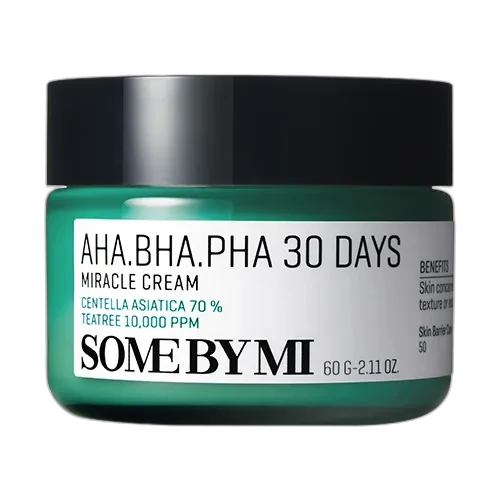
AHA BHA PHA 30 Days Miracle Cream
K-Beauty Triple-Acid Moisturizer
 Verified reviewer
Pros & cons.
- +Centella asiatica extract as the first ingredient delivers meaningful soothing and anti-inflammatory benefits
- +Capryloyl salicylic acid provides gentler BHA exfoliation than standard salicylic acid in a leave-on format
- +Ceramide NP and sodium hyaluronate support barrier repair alongside the exfoliating acids
- +Niacinamide adds brightening, sebum control, and barrier strengthening to the formula
- +Lightweight gel-cream texture absorbs quickly without greasiness
- +Silicone-free, paraben-free, and sulfate-free formulation
- −Peppermint oil is an unnecessary irritant, especially in a leave-on product for acne-prone skin
- −Jar packaging exposes active ingredients to air and contamination with each use
- −Not moisturizing enough for dry skin types, especially in cold weather
- −Extensive botanical extract list increases the risk of sensitization for allergy-prone users
- −Castor seed oil may be comedogenic for acne-prone skin despite the product's acne-targeting positioning
The full review.
Most moisturizers list ingredients the same way: water, then a humectant, then marketing highlights. Some By Mi’s Miracle Cream starts with centella asiatica extract. This detail shows its philosophy: it is a soothing cream first, an exfoliating treatment second, and a conventional moisturizer third.
That order matters. When a brand puts a signature botanical before water—the cheapest, most common skincare ingredient—it makes a costly formulation commitment. The brand does not disclose if the centella concentration is 30% or 50%, but its first-position placement means it is more concentrated than anything else in the jar, including glycerin and niacinamide. For a $26 K-beauty moisturizer, this is a real investment in the formula.
The cream has a lightweight, gel-cream texture that feels watery when you first dip into the jar. It spreads easily and absorbs within about thirty seconds, leaving a satin finish that works under sunscreen or makeup. Oily skin types will find it adds no perceptible grease. Combination skin will find it comfortable in the T-zone without being insufficient on drier cheeks. Dry skin will likely need something thicker on top—this cream is not a heavy-duty occlusive.
The triple-acid component is more nuanced here than in the cleansing foam. Instead of standard salicylic acid, Some By Mi uses capryloyl salicylic acid—a lipophilic derivative that provides gentler, more sustained BHA activity. This is a smart choice for a leave-on product. While standard salicylic acid might cause irritation during extended skin contact, the capryloyl form releases its exfoliating action more gradually. The PHA component is lactobionic acid, which works as both a humectant and antioxidant. The AHA is citric acid, present at a modest concentration based on its position near the end of the ingredient list.
Supporting ingredients elevate this cream above a simple acid moisturizer. Niacinamide appears at a meaningful position in the ingredient list to strengthen the barrier, regulate sebum, and brighten. Ceramide NP provides lipid barrier repair—a thoughtful inclusion for a product with daily acid exposure. Sodium hyaluronate pulls in hydration. Adenosine offers anti-aging benefits. The formulation is more sophisticated than the 30 Days Miracle branding suggests.
The Truecica complex includes all four centella triterpenes isolated individually (asiaticoside, madecassoside, asiatic acid, and madecassic acid), which suggests genuine anti-inflammatory potency rather than a token centella mention. Tea tree leaf water provides additional antimicrobial support. The botanical extract list is extensive—turmeric, calendula, green tea, willow bark, witch hazel—which is either impressively comprehensive or a potential sensitization minefield, depending on your skin’s tolerance for botanical diversity.
One persistent criticism follows the entire Miracle line: peppermint oil. It appears last on the ingredient list, meaning it is at a low concentration, but its inclusion in a cream for acne-prone skin (which often skews sensitive) is questionable. Peppermint oil contributes nothing therapeutic that centella, niacinamide, and tea tree are not already providing. It exists for the sensory experience—the cooling tingle consumers associate with a working product. Dermatologically, the product would be better without it.
The jar packaging is a minor drawback. Screw-top jars expose the product to air and bacteria with each use, which is not ideal for a formula containing active botanicals and acids. A pump or tube would better protect the formula’s integrity.
For oily and combination skin dealing with mild acne, congested pores, or textural roughness, this cream delivers a multi-benefit experience. You get daily exfoliation, barrier support, anti-inflammatory soothing, and lightweight hydration in one step. The formulation is more thoughtful than its playful Miracle branding implies.
The value is reasonable at $26 for 60 grams. You are not paying luxury prices, but you pay more than drugstore rates. The dense ingredient list—centella extract, niacinamide, ceramide NP, adenosine, multiple acids, sodium hyaluronate—justifies the price. Each ingredient costs money to source, and having them in one jar saves you from buying separate products.
This cream works best in a minimal routine as both your acid treatment and your moisturizer, reducing the need for separate exfoliating steps. If you already use a dedicated AHA or BHA leave-on product, adding this cream risks over-exfoliation. Choose one or the other, not both.
### Formula
Ingredient analysis.
Full INCI list
Centella Asiatica Extract, Dipropylene Glycol, Glycerin, Water, Niacinamide, Caprylic/Capric Triglyceride, Cetyl Ethylhexanoate, Melaleuca Alternifolia (Tea Tree) Leaf Water, Ricinus Communis (Castor) Seed Oil, Hydrogenated Castor Oil, Melia Azadirachta Leaf Extract, Melia Azadirachta Flower Extract, Coccinia Indica Fruit Extract, Solanum Melongena (Eggplant) Fruit Extract, Aloe Barbadensis Flower Extract, Ocimum Sanctum Leaf Extract, Curcuma Longa (Turmeric) Root Extract, Corallina Officinalis Extract, Calendula Officinalis Flower Extract, Camellia Sinensis Leaf Extract, Lavandula Angustifolia (Lavender) Extract, Rosmarinus Officinalis (Rosemary) Extract, Origanum Vulgare Flower/Leaf/Stem Extract, Thymus Vulgaris (Thyme) Extract, Fructan, Albatrellus Ovinus Extract, Salix Alba (Willow) Bark Extract, Enantia Chlorantha Bark Extract, Lens Esculenta (Lentil) Seed Extract, Hamamelis Virginiana (Witch Hazel) Extract, Houttuynia Cordata Extract, Coptis Japonica Extract, Saccharide Isomerate, Sodium Hyaluronate, Butylene Glycol, Propanediol, Betaine, Allantoin, Madecassoside, Madecassic Acid, Asiaticoside, Asiatic Acid, Adenosine, Ceramide NP, Oleanolic Acid, Capryloyl Salicylic Acid, Inulin Lauryl Carbamate, Polyglyceryl-3 Methylglucose Distearate, Cetearyl Glucoside, Sorbitan Olivate, Cetearyl Alcohol, Lactobionic Acid, Citric Acid, Ammonium Acryloyldimethyltaurate/VP Copolymer, 1,2-Hexanediol, Benzyl Glycol, Ethylhexylglycerin, Raspberry Ketone, Disodium EDTA, Mentha Piperita (Peppermint) Oil
Skin match.
The science.
The Science
The centella-first formulation approach in this cream draws on a robust evidence base. Centella asiatica's four primary triterpenes — asiaticoside, madecassoside, asiatic acid, and madecassic acid — have been extensively studied for their wound-healing and anti-inflammatory properties. Research published in the Indian Journal of Pharmaceutical Sciences demonstrated that centella asiatica stimulates collagen synthesis and reduces inflammation through inhibition of the NF-kB pathway, mechanisms that are particularly relevant when skin is undergoing chemical exfoliation.
Capryloyl salicylic acid, the BHA derivative used here instead of standard salicylic acid, is a patented lipophilic compound that provides more gradual, sustained release of salicylic acid into the skin. This controlled-release mechanism reduces the peak irritation associated with standard BHA application while maintaining pore-clearing efficacy over a longer period — a meaningful advantage in a daily leave-on moisturizer.
Lactobionic acid, the PHA component, has been shown in research published in Dermatologic Surgery to provide comparable exfoliation to glycolic acid with significantly less irritation and sting. Its polyhydroxy structure also gives it humectant and antioxidant properties that AHAs and BHAs lack, contributing additional moisturizing benefits.
The inclusion of ceramide NP is pharmacologically significant. Research has demonstrated that chemical exfoliation can deplete intercellular lipids in the stratum corneum, and ceramide supplementation helps maintain barrier integrity during regular acid use. The combination of exfoliating acids with barrier-repairing ceramides represents a thoughtful formulation strategy that addresses the primary risk of daily acid exposure.
References
- Pharmacological Review on Centella asiatica: A Potential Herbal Cure-all — Indian Journal of Pharmaceutical Sciences (2010)
Dermatologist Perspective
Dermatologists recognize centella asiatica as a well-studied botanical with genuine anti-inflammatory and wound-healing properties, making it a rational base for an exfoliating moisturizer. Board-certified dermatologists note that the use of capryloyl salicylic acid rather than standard salicylic acid shows formulation sophistication — the gentler derivative is more appropriate for a leave-on product. However, dermatologists consistently advise that patients with rosacea, eczema, or compromised barriers should avoid multi-acid products regardless of how gentle the individual acids may be. The peppermint oil is flagged by dermatologists as an unnecessary inclusion that adds irritation risk without therapeutic benefit.
Where it fits in your routine.
Apply a thin, even layer to the face and neck after cleansing and toning. Avoid the eye area. Use morning and evening. Always follow morning use with sunscreen because the exfoliating acids increase photosensitivity. Apply once daily (preferably evening) for the first week to check tolerance before increasing to twice daily. Do not apply over broken skin, active irritation, or fresh wounds. If you use other acid treatments, alternate them instead of layering to prevent over-exfoliation.
At $26 for 60 grams, this cream is a mid-range K-beauty moisturizer. The ingredient density—centella as the lead ingredient, plus niacinamide, ceramide NP, sodium hyaluronate, adenosine, and three exfoliating acids—offers solid value. The cost per gram is roughly $0.43, which is competitive for a multi-active moisturizer. However, the jar packaging means the active botanicals may degrade faster than in a pump or tube, which reduces the effective value over the product's lifespan.
This cream works for oily and combination skin types that need gentle daily exfoliation and acne management without an extra acid treatment step. K-beauty enthusiasts seeking a centella-rich moisturizer with multi-active benefits at a reasonable price get real value here.
Skip this if you have dry, sensitive, or eczema-prone skin — the triple-acid formula and peppermint oil cause irritation even at low concentrations. Avoid using this with prescription retinoids or strong leave-on AHA/BHA treatments. Patch test carefully if you have known sensitivities to botanical extracts because of the extensive plant extract list.
Product details.
Lightweight gel-cream has a slightly translucent, watery consistency. It absorbs quickly and leaves no heavy residue.
Mild herbal and minty scent from the peppermint oil and botanical extracts
Green-and-white jar with a screw-top lid, matching the 30 Days Miracle line branding
The cream applies smoothly and the peppermint oil provides a subtle cooling sensation. Most users find the texture lightweight enough for layering. Some users notice mild tingling from the acids during the first week — this subsides as skin acclimates. If irritation persists beyond a week, use it every-other-day.
2-3 months with twice-daily use
12 months
spring summer
The backstory.
The Miracle Cream was developed as the moisturizing anchor of Some By Mi's 30 Days Miracle line, designed so users could maintain consistent triple-acid exposure from cleanser through moisturizer. The choice to lead with centella asiatica extract rather than water was a deliberate formulation decision to position this as a soothing-first product that happens to exfoliate, rather than an exfoliant that happens to moisturize.
About Some By Mi
Established Brand (5–20 years)Some By Mi launched in South Korea in 2016 and exports to over 20 countries. The brand's 30 Days Miracle line uses its proprietary Truecica formula and has thousands of global reviews, though it relies on consumer validation rather than peer-reviewed clinical research.
Common myths.
A cream with AHA, BHA, and PHA is too harsh for daily use
This cream uses capryloyl salicylic acid—a gentler salicylic acid derivative—and lactobionic acid, the mildest PHA. It uses centella as the lead ingredient and ceramide NP for barrier support. The acid intensity works for daily leave-on use instead of intensive exfoliation.
Centella asiatica is the first ingredient, so the cream is mostly centella extract.
centella is the first ingredient, but the total percentage is undisclosed. First-ingredient placement means it is the highest-concentration component, though the cream also has large amounts of dipropylene glycol, glycerin, and water. The centella concentration is likely meaningful but not overwhelming.
FAQ.
Is the Some By Mi Miracle Cream good for acne?
Yes, this cream uses capryloyl salicylic acid (BHA) to clear pores, lactobionic acid (PHA) for gentle exfoliation, and centella asiatica to soothe inflammation. It targets acne-prone skin, but those with cystic or severe acne may need prescription treatments alongside this moisturizer.
Can I use the Some By Mi Miracle Cream with retinol?
Use caution when combining. This cream contains three types of exfoliating acids; adding retinol increases irritation and over-exfoliation risks. If you use both, alternate them on different nights instead of layering them in the same routine.
Is this moisturizer hydrating enough for dry skin?
This cream is likely too lightweight for dry skin. Glycerin, sodium hyaluronate, and the lactobionic acid's humectant properties provide mild hydration, but dry skin types typically need a thicker moisturizer or an additional occlusive layer on top.
Why does this cream contain peppermint oil?
Peppermint oil provides a cooling sensation during application. It lacks skincare benefits in this formula and appears as the last ingredient at a low concentration. Sensitive skin types may find it an irritant.
How is centella asiatica the first ingredient instead of water?
The centella asiatica extract in this cream is a water-based botanical extract. By listing it first, Some By Mi shows this extract is the highest-concentration ingredient. It replaces plain water with a therapeutically active alternative. This shows the formula has a meaningful amount of centella.
Does this cream cause purging?
Some users report a 1-2 week adjustment period where existing congestion surfaces as small breakouts. This matches how exfoliating acids accelerate cell turnover. If breakouts worsen or last beyond 4-6 weeks, the product may not suit your skin.
Community
What the community says.
"High centella content delivers genuine soothing benefits"
"Lightweight texture absorbs well under sunscreen"
"Helps reduce breakouts over consistent use"
"Affordable for a multi-active moisturizer"
"Peppermint oil irritates sensitive skin types"
"Can feel slightly sticky if too much is applied"
"Not moisturizing enough for dry skin in winter"
"Heavy botanical extract list may cause reactions in allergy-prone users"