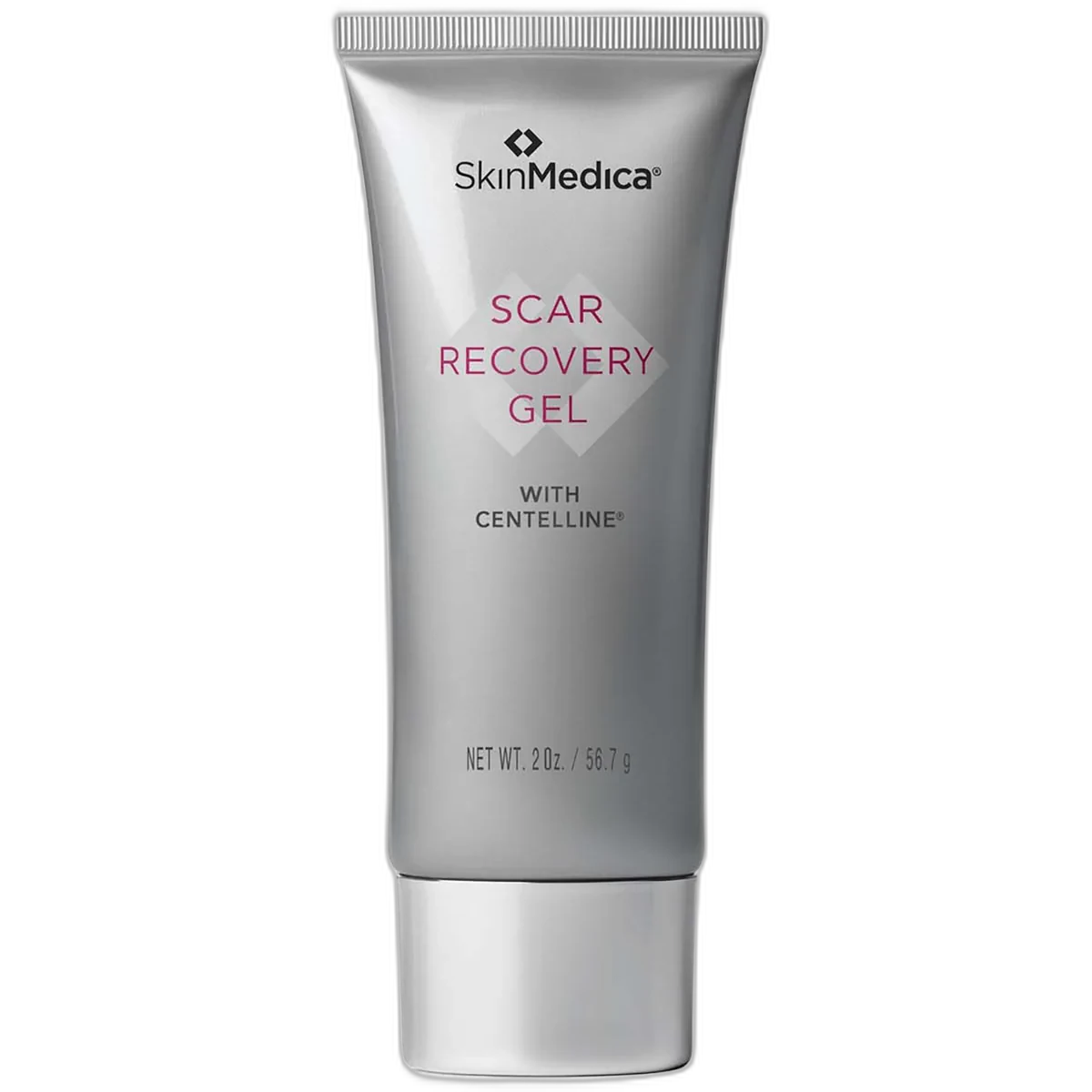
Scar Recovery Gel with Centelline
Derm Office Post-Procedure Staple
 Verified reviewer
Pros & cons.
- +Cosmetically elegant on faces where silicone sheets are impractical
- +Centella asiatica is a credible scar-remodeling active with real published data
- +Dimethicone adds meaningful silicone-style occlusion to a light gel base
- +Gentle enough for freshly epithelialized post-procedure skin
- +Fragrance-free, essential-oil-free, and generally very well tolerated
- +Absorbs cleanly and layers under sunscreen without pilling
- −$106 for 2 ounces is significantly more than silicone sheets or drugstore alternatives
- −Clinical evidence base is narrower than silicone sheets for scar management
- −Results are subtle and slow — not dramatic scar erasure
- −Has very little effect on scars older than one year
The full review.
At-home scar treatment is simple: silicone sheets have the most clinical evidence of any topical approach, and most dermatologists agree. However, silicone sheets are hard to wear. They do not stay on faces, joints, or moving parts. Since you must use a treatment daily for it to work, compliance is the issue. SkinMedica’s Scar Recovery Gel, launched in 2013 and unchanged since, addresses this. It takes the occlusive silicone used in sheets, suspends it in a gel base with a Centelline botanical complex, and gives dermatologists a product patients will actually use after a laser or biopsy appointment. Whether it justifies its $106 price tag depends on your comparison. The Centelline complex drives the formulation. It uses three ingredients: Centella asiatica extract, which has the strongest evidence; Bulbine frutescens gel, a South African succulent with limited data on wound-closure speed; and oleuropein from olive leaf, an antioxidant that targets the oxidative-stress pathway in scar remodeling. Centella is a proven ingredient—the triterpene saponins madecassoside and asiaticoside have decades of study as modulators of fibroblast activity and collagen organization, and the mechanism is plausible. Bulbine has much less published data. Oleuropein is a supporting ingredient. Dimethicone runs the formula; it is not flashy but is important because it shares the same mechanism of action (occlusion and hydration of scar tissue) as silicone sheets. Cosmetically, the gel works well for this use. It is clear, lightweight, essentially odorless, and spreads thin enough to forget within a minute. A slightly tacky film remains, which helps because it shows the dimethicone is working, and sunscreen layers over it without pilling. Tactile feel matters for scar products because treatment lasts months, not weeks; unpleasant textures lead to abandonment. Real-world performance is subtle. Users report reduced redness on new scars within four to six weeks of twice-daily use. Changes in height, pigment, and pliability take three to six months. Improvements are usually partial—scars soften rather than disappear—and effectiveness drops on scars older than a year, which is typical for topical scar products. On new scars, it works as expected by combining centella’s anti-inflammatory and fibroblast-modulating effects with a light silicone occlusive: a modest improvement over doing nothing. The argument against this product focuses on price and evidence. Over-the-counter silicone scar gels cost $20 to $40, have more published data than Centelline, and feel similar. Mederma and similar drugstore options cost half as much. The best defense for the $106 price is that dermatology offices often provide it after expensive procedures. If you spent $4,000 on a fractional CO2 laser, spending $106 to optimize healing feels rational. This is how most units sell, and it is where the price makes sense. The formula works for sensitive skin. It is fragrance-free, has no essential oils, no drying alcohols, and no actives that conflict with compromised post-procedure skin. Propylene glycol is high in the INCI list, which may mildly irritate a very small subset of readers, but here it acts as a penetration enhancer and humectant. Safety during pregnancy is generally fine—it contains no retinoids, hydroquinone, or salicylic acid—though pregnancy-specific testing is absent, so consult your OB. Packaging is basic: a small squeeze tube in a clinical carton, available in a 0.5 oz travel size or a 2 oz standard size. The 2 oz version has better per-ounce value, though “better” is relative when the price is fifty-three dollars an ounce.
Ingredient analysis.
Full INCI list
Water/Aqua/Eau, Poloxamer 407, Bulbine Frutescens Gel, PEG-40 Hydrogenated Castor Oil, Propylene Glycol, Dimethicone, Olea Europaea Leaf Extract, Centella Asiatica Extract, Xanthan Gum, Lactic Acid, Potassium Sorbate, Sodium Benzoate, Phenoxyethanol
Skin match.
The science.
The Science
Cosmetic dermatology has studied topical scar management extensively, and the evidence hierarchy is clear. Silicone gel sheets and silicone-based topical gels have the strongest data. Decades of randomized trials show they improve hypertrophic and keloid scar appearance by using occlusion, hydration, and fibroblast activity modulation. Centella asiatica has a smaller, growing evidence base. In cell culture and small clinical studies, the triterpene saponins madecassoside and asiaticoside influence fibroblast proliferation, collagen type I and III ratios, and TGF-beta signaling—all relevant to scar remodeling. A 2020 review in the Journal of Cosmetic Dermatology lists Centella asiatica as a supportive agent for scar management, specifically for post-inflammatory redness and texture. Bulbine frutescens has small-scale clinical support for wound closure and traditional use on burns and cuts, though large randomized trials on specific scar outcomes are limited. Oleuropein provides antioxidant activity, which matters because oxidative stress during the remodeling phase contributes to abnormal scar formation. The dimethicone content in this formula is important: it creates a mechanistic overlap with silicone gel sheets, even at a lower concentration than a pure silicone gel. This formulation works as a hybrid botanical-and-silicone approach rather than a replacement for gold-standard silicone treatment.
Dermatologist Perspective
Dermatologists often recommend topical scar treatment for patients recovering from fractional laser procedures, surgical excisions, biopsies, and mole removals once the wound has fully closed and the skin has re-epithelialized. Board-certified dermatologists note that adherence is the biggest determinant of outcome—any scar gel works better than an abandoned silicone sheet. Cosmetically elegant formulas like this one can improve compliance, especially on facial scars. Dermatology offices frequently offer this alongside in-office procedures, typically pairing it with aggressive sun protection, which is the non-negotiable part of any scar management plan.
Where it fits in your routine.
Apply only after the wound closes and the skin re-epithelializes, typically 10-14 days after a procedure or injury, and follow your dermatologist's timing. Apply a thin layer to the scar twice daily, morning and night, massaging gently for about 30 seconds. Layer a broad-spectrum SPF 50 sunscreen over the gel during the day — UV exposure causes scar hyperpigmentation quickly. Use for at least 3 months; 6 months often yields optimal results on new scars. Do not apply over open or weeping wounds.
At $106 for 2 ounces, this scar gel is among the most expensive on the market. The value depends on your situation. If you are recovering from an expensive in-office procedure, the marginal cost is small compared to the procedure and you get a cosmetically usable gel your provider trusts. If you are treating a scar at home without a procedure, drugstore silicone gels and over-the-counter scar sheets offer more evidence-backed performance for much less. The 2 oz size has a better per-ounce value than the 0.5 oz travel size, but it still costs roughly $53 per ounce. The brand's established dermatology-channel reputation makes this a defensible premium for some, but not a smart default purchase.
Patients use this for surgical, laser, or procedural scarring on the face or mobile areas where silicone sheets do not work. It is a logical choice for those using other SkinMedica post-procedure products for a cohesive regimen, or if a dermatologist recommends this product.
If you treat a scar at home without recent procedures and want the most evidence-backed approach, a plain silicone gel or silicone sheet gives more proven performance for less money. Skip this if the scar is older than a year and you expect dramatic change, or if you have a strict budget.
Product details.
This clear, lightweight gel spreads thin and absorbs within a minute, leaving a slightly tacky film.
Essentially odorless.
Small squeeze tube in a branded carton. Available in 0.5 oz and 2 oz sizes.
The first application feels cool and lightweight. It causes no tingling or visible changes on day one; this product works slowly. Most users see reduced redness on new scars around the 4-week mark. Older or hypertrophic scars respond more slowly.
The 2 oz size lasts about 3-5 months if you use it twice daily on a typical surgical size scar line.
12 months
All Year
The backstory.
SkinMedica launched the Scar Recovery Gel with Centelline in 2013 as part of its post-procedure lineup, timed with the brand's growing presence in dermatology offices offering laser, microneedling, and surgical procedures. The Centelline complex was positioned as SkinMedica's answer to the silicone-sheet gold standard, aimed at patients who find sheets impractical on facial scars.
About SkinMedica
Established Brand (5–20 years)SkinMedica launched in 1999 and belongs to Allergan Aesthetics (AbbVie). It sells mainly through US dermatology and medspa channels. Clinicians use its post-procedure products for post-laser, post-biopsy, and post-surgical recovery.
Common myths.
This gel can erase old scars.
Like all topical scar treatments, this product works best on new scars during the active remodeling phase. Scars older than a year show much smaller improvements regardless of the product used.
It can be applied to open wounds to speed healing.
Scar Recovery Gel should only be used on fully closed, re-epithelialized skin. Applying it to an open wound is not its intended use and can interfere with normal healing.
FAQ.
How long does it take to see results from SkinMedica Scar Recovery Gel?
Most users see less redness within 4-6 weeks of consistent twice-daily use on a new scar. Changes to scar texture, pigment, and height take 3-6 months. Scars older than a year show smaller, slower improvements regardless of the product used.
Can I use this on a fresh surgical scar?
Wait until the wound closes and the skin re-epithelializes, usually 10-14 days after surgery. Follow your surgeon's or dermatologist's timing instructions before you start any topical scar treatment.
How does this compare to silicone sheets?
Silicone sheets have the most evidence for at-home scar treatment. SkinMedica's gel uses a botanical-plus-silicone approach. This gel works better on faces and mobile areas where sheets do not stay, but the formal evidence base is narrower.
Is this product safe during pregnancy?
The formula lacks retinoids, hydroquinone, and salicylic acid, making it generally compatible with pregnancy. Check with your OB before using any new topical product during pregnancy.
Does it work on acne scars?
It helps with post-inflammatory redness and hyperpigmentation from recent acne lesions. It works less on atrophic (ice-pick, rolling, or boxcar) acne scars, which usually need in-office treatments like microneedling or laser to improve.
Can I layer it with sunscreen?
Yes — you must apply sunscreen over the scar during daylight hours. UV exposure on a healing scar causes hyperpigmentation quickly, and no topical product replaces SPF.
What the community says.
"Visibly reduces redness on new scars"
"Gentle enough to use on freshly healed skin"
"No fragrance or irritation"
"Clear gel that layers under sunscreen easily"
"Very expensive compared to over-the-counter scar gels"
"Results are subtle, not dramatic"
"Small tube for the price"
"Not effective on older, established scars"
People also looked at.