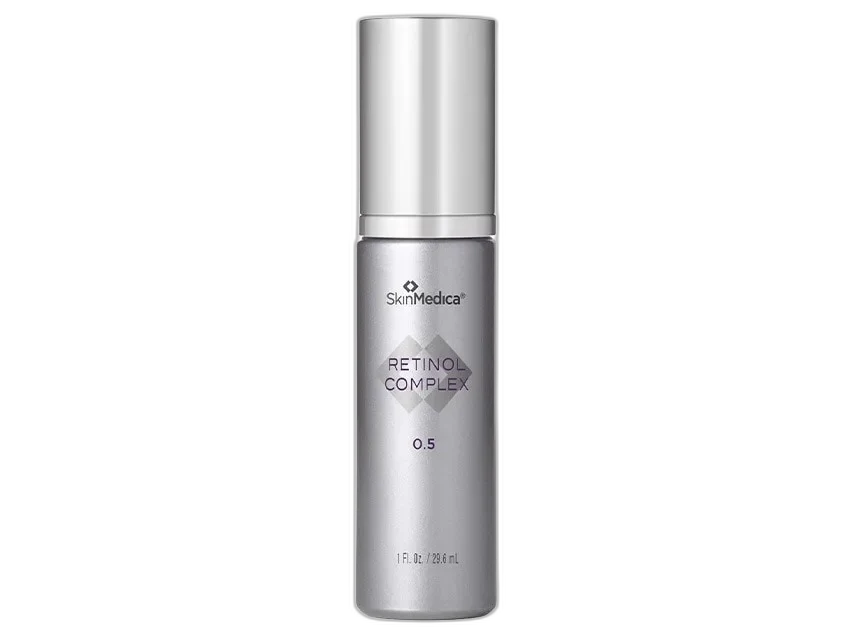
Age Defense Retinol Complex 0.5
Clinical-Grade Mid-Strength Retinol
 Verified reviewer
Pros & cons.
- +Same comprehensive six-active soothing system as the 0.25% now cushioning a clinically significant 0.5% retinol dose
- +Completely alcohol-free formula avoids compounding retinol's drying effects at this stronger concentration
- +Niacinamide at meaningful concentration provides barrier support, brightening, and anti-aging synergy with the retinol
- +Seamless step-up from the 0.25% — identical vehicle and soothing actives, only the retinol dose changes
- +Airless pump packaging preserves retinol potency throughout the product's life
- +At $80 (or $64 on auto-replenish), it's actually less expensive than SkinCeuticals' comparable 0.5% retinol
- −Soybean oil-based formula may feel too rich for oily skin types
- −Only available through authorized sellers — less convenient than mass-market retinols
- −Mild retinization still expected during weeks 1-2 even with the soothing system
- −Not vegan and not cruelty-free certified
- −Results still require 8-12 weeks of consistent use — the soothing system doesn't accelerate the retinol's timeline
The full review.
If the SkinMedica Retinol Complex 0.25 is the introductory handshake, the 0.5 is the working relationship. Same formulation philosophy, same multi-active soothing system, double the retinol. This is the concentration where SkinMedica expects most of its retinol users to settle permanently — and the data suggests that’s exactly what happens.
The formulation continuity between the 0.25 and 0.5 is a strategic advantage that shouldn’t be overlooked. When you step up from one SkinMedica concentration to the next, you’re changing exactly one variable: the retinol dose. The vehicle, the soothing actives, the texture, the packaging — everything else stays constant. This means the adjustment period is genuinely about your skin adapting to more retinol, not simultaneously adapting to a different formula, different base oils, different soothing agents, and different delivery system. It’s the kind of clinical thinking that comes from a brand developed by dermatologists rather than marketers.
At 0.5%, the retinol starts to assert itself more confidently. Where the 0.25% whispered improvements into your skin over weeks, the 0.5% speaks at a conversational volume. Fine lines soften with more conviction by week six. Dark spots and post-inflammatory hyperpigmentation fade faster as melanin-laden keratinocytes cycle out more aggressively. Pore texture refines as the normalized cell turnover reduces the buildup that makes pores look enlarged. The improvements are still gradual — this isn’t a peel — but they’re meaningfully more pronounced and faster to develop than at the lower concentration.
The soothing system earns its engineering at this strength. The palmitoyl tripeptide-8 — that neuro-calming peptide that keeps the skin’s inflammatory signaling in check — works harder here. At 0.5% retinol, the irritation potential is roughly double what it was at 0.25%, and the peptide’s targeted modulation of pro-inflammatory cytokines (IL-1α, IL-6, IL-8) becomes proportionally more important. The niacinamide continues its dual role of independent anti-aging activity and retinol-tolerance enhancement through increased ceramide synthesis. The magnolia bark and bisabolol provide their botanical anti-inflammatory cover. And the ceramide NP reinforces the barrier against the greater transepidermal water loss that higher-strength retinol generates.
The alcohol-free formulation matters more at 0.5% than at 0.25%. When the retinol is already pushing the skin’s tolerance threshold, the presence of a drying alcohol in the vehicle — a feature of several competing retinol products at this concentration — creates a compounding dehydration effect that can tip the balance from manageable adjustment into genuine irritation. SkinMedica’s decision to build on squalane and soybean oil instead of alcohol denat. removes this compounding factor entirely. The texture trade-off is a slightly richer feel that oily skin types may find suboptimal, but for the majority of retinol users, the emollient base is a feature, not a bug.
The airless pump continues to deserve recognition at this price point. Retinol at 0.5% represents a meaningful active ingredient investment per application, and every pump that delivers fully potent product (rather than partially degraded retinol from a poorly sealed tube) is money well spent. The opaque container blocks light, the airless mechanism prevents oxidation, and the pump dispenses precisely. It’s packaging that serves the chemistry rather than the Instagram photographer.
At $80 for an ounce, SkinMedica’s 0.5% sits comfortably in the premium clinical retinol tier. It’s actually $10 less than SkinCeuticals’ Retinol 0.5 ($90) while offering a more comprehensive soothing system and alcohol-free formulation. The 20% auto-replenish option drops the price to $64 — making it genuinely competitive with mid-range retinol products that offer far less formulation sophistication.
The restricted distribution remains both a barrier and a quality assurance mechanism. Finding SkinMedica at your local pharmacy isn’t possible, but the authorized channel (Dermstore, LovelySkin, dermatology offices) ensures product authenticity and proper storage conditions that matter for retinol stability.
This is the retinol for someone who has graduated from the beginner phase and wants to invest in a working-strength formula from a brand with genuine clinical heritage. The multi-active soothing system isn’t a marketing bullet point — it’s the reason users at 0.5% can maintain nightly compliance without their skin declaring war. And in the world of retinol, compliance is the only variable that ultimately matters.
Ingredient analysis.
Full INCI list
Aqua / Water / Eau, Cetyl Ethylhexanoate, Glycine Soja (Soybean) Oil, Niacinamide, Polyacrylate-13, Caprylic/Capric Triglyceride, Glycerin, Squalane, Retinol, Palmitoyl Tripeptide-8, Dunaliella Salina Extract, Magnolia Grandiflora Bark Extract, Tocopherol, Tocotrienols, Ceramide NP, Bisabolol, Tocopheryl Acetate, Oryza Sativa (Rice) Bran Oil, Polysorbate 20, Butylene Glycol, Cetyl Palmitate, Laureth-23, Trideceth-6 Phosphate, Sodium Hydroxide, Dicaprylyl Ether, Lauryl Alcohol, Polyisobutene, Dextran, Potassium Sorbate, Disodium EDTA, Phenoxyethanol, Ethylhexylglycerin
Skin match.
The science.
The Science
At 0.5%, retinol provides twice the substrate for the enzymatic conversion cascade (retinol → retinaldehyde → all-trans retinoic acid) than 0.25%, driving more aggressive RAR-mediated gene expression modulation. This increases procollagen I and III synthesis, speeds keratinocyte turnover, strengthens tyrosinase inhibition, and increases MMP suppression.
The 2015 Randhawa et al. study in the Journal of Drugs in Dermatology evaluated stabilized retinol at 0.5% concentration. It showed statistically significant improvements in periorbital wrinkles, mottled pigmentation, and overall photodamage severity after 12 weeks. This concentration is a well-characterized dose-response sweet spot—the inflection point where clinical significance occurs without the tolerance challenges of 1.0%.
The multi-active soothing system is proportionally more critical at 0.5%. Palmitoyl tripeptide-8 targets the substance P-mediated neurogenic inflammation pathway, which activates more intensely at higher retinol concentrations. In vitro data shows this peptide reduces IL-1α secretion from stimulated keratinocytes by up to 45%, providing targeted anti-inflammatory activity at the specific pathway retinol activates. Niacinamide's ability to increase ceramide synthesis in the stratum corneum (Tanno et al., British Journal of Dermatology, 2000) is more functionally important at 0.5%, where retinol-accelerated cell turnover increases demand for barrier lipid replenishment.
Magnolia bark's honokiol component inhibits NF-κB transcriptional activity, suppressing the inflammatory cascade downstream of retinol-induced cytokine release. The combination of neurogenic pathway modulation (peptide), NF-κB suppression (magnolia), COX-2 inhibition (bisabolol), and barrier reinforcement (ceramide + squalane) creates a multi-pathway anti-irritation architecture no single ingredient achieves alone.
References
- Improvement of Naturally Aged Skin With Vitamin A (Retinol) — Archives of Dermatology (2007)
Dermatologist Perspective
Board-certified dermatologists consider 0.5% the most commonly recommended maintenance retinol concentration—the strength where clinical significance is reliably achieved without the irritation of higher doses that threatens compliance. SkinMedica's version is valued in clinical settings for its alcohol-free base and multi-active soothing system. Practitioners report it produces fewer patient callbacks about irritation than alcohol-containing alternatives. Dermatologists often recommend this as the permanent step-up after successful acclimation at 0.25%, noting that the identical vehicle and soothing actives make the concentration transition more predictable than switching brands.
Where it fits in your routine.
Apply a pea-sized amount to clean, dry skin at night. If moving from the 0.25%, use every other night for 1-2 weeks, then use nightly as tolerated. If you use retinol from other brands, use every other night for the first week. Follow with moisturizer. Do not use AHAs, BHAs, or benzoyl peroxide on the same evening. Apply SPF 30+ every morning. If irritation lasts after 3-4 weeks, use it less often instead of stopping.
SkinMedica's Retinol 0.5 costs $80 for 1 oz ($64 on auto-replenish), placing it competitively in the clinical retinol category. It costs $10 less than SkinCeuticals' Retinol 0.5 ($90) and has a more comprehensive soothing system (six actives vs two), an alcohol-free formulation, and better airless packaging. The 20% auto-replenish discount rewards regular users. While the price premium over drugstore retinols is high, the formulation gap—specifically the multi-active soothing architecture—improves daily tolerance.
Retinol users with 0.25-0.3% tolerance want clinically significant anti-aging results in a well-cushioned formula. This suits those who value the alcohol-free, multi-active soothing approach and pay a premium for formulation sophistication. It works well for dry or normal skin types who find alcohol-containing retinols too drying at mid-strength concentrations.
Retinol beginners should start with 0.25% first. People with active eczema, severe rosacea, or deeply compromised barriers must stabilize before using 0.5% retinol. Budget-conscious users can find effective 0.5% retinol at lower prices, but with less soothing support. Pregnant or nursing individuals must avoid all retinol products.
Product details.
This uses the same lightweight cream base as the 0.25%, with squalane and soybean oil for a smooth, emollient feel. The sensory effect is slightly stronger; some users feel a mild warming sensation that fades quickly.
Fragrance-free — no detectable scent
The airless pump bottle is identical to the 0.25% version. It protects the higher-concentration retinol from light and air degradation. The pump dispenses consistently and prevents the product contamination that jars allow.
This 0.5% retinol is more noticeable than the 0.25% but stays gentle. Expect mild dryness and light flaking during the first 1-2 weeks, especially when moving up from a lower concentration. The multi-active soothing system manages retinization; most users report 'mild tightness' instead of 'my skin is revolting.'
2-3 months with nightly application of a pea-sized amount to the face
12 months
All Year
The backstory.
The 0.5% concentration represents the working-strength tier of SkinMedica's retinol system — where the brand expects most long-term users to settle. While the 0.25% builds tolerance and the 1.0% provides maximum intensity, the 0.5% is designed to be the permanent prescription: strong enough for clinically significant anti-aging results, gentle enough (thanks to the PhytoShield complex) for sustained nightly use. It's the concentration that dermatology offices dispense most frequently.
About SkinMedica
Legacy Brand (20+ years)SkinMedica was co-founded in 1999 by renowned dermatologist Dr. Richard Fitzpatrick, who pioneered growth factor technology with the patented TNS (Tissue Nutrient Solution). Acquired by Allergan (now AbbVie) in 2012 for $350 million, the brand has over 25 years of clinical skincare heritage and is widely distributed through dermatology offices nationwide.
Common myths.
Increasing from 0.25% to 0.5% doubles the irritation.
Retinol irritation does not scale linearly with concentration. Skin acclimated to 0.25% has already upregulated retinol-metabolizing enzyme activity and adapted its barrier recovery mechanisms. Moving to 0.5% usually causes a brief, mild adjustment period (1-2 weeks) instead of repeating the full initial retinization experience.
Use the highest retinol concentration your skin tolerates.
Many dermatologists call 0.5% the optimal long-term concentration. It is aggressive enough for anti-aging results and comfortable enough for daily use. The SkinMedica 0.5% uses a comprehensive soothing system to work as a permanent routine fixture rather than a stepping stone to higher concentrations.
FAQ.
How does SkinMedica Retinol 0.5 compare to 0.25?
The formulation base is identical—the same multi-active soothing system, alcohol-free vehicle, and airless packaging. The difference is retinol concentration: 0.5% has about double the active retinol, which produces faster, more pronounced results for fine lines, texture, and hyperpigmentation. Most users experience a brief adjustment period (1-2 weeks of mild dryness) when stepping up, but the soothing complex keeps it manageable.
Is SkinMedica Retinol 0.5 better than SkinCeuticals Retinol 0.5?
Both are excellent mid-strength retinols from legacy dermatologist-developed brands at the same concentration. SkinMedica's advantages: alcohol-free formula, more comprehensive soothing system (peptide + niacinamide + ceramide + magnolia bark + bisabolol), and airless pump packaging. SkinCeuticals' advantages: lower price ($90 vs $80 — actually SkinMedica is cheaper here), longer market history. Choose SkinMedica for the soothing system; choose SkinCeuticals for the established track record.
Can I use SkinMedica Retinol 0.5 every night?
Yes, once acclimated. If moving up from 0.25%, use it every other night for 1-2 weeks, then use nightly as tolerated. The multi-active soothing system supports nightly use at this concentration. If redness or flaking persists after 3-4 weeks, use it less often and consult your dermatologist.
Do I need to use the SkinMedica 0.25 before starting the 0.5?
It is recommended but not mandatory. If you use 0.3-0.5% retinol from another brand, you can use the SkinMedica 0.5 directly at a reduced frequency (every other night). If you are new to retinol, use the 0.25% for 3-6 months to build tolerance before stepping up.
Should I upgrade from 0.5 to SkinMedica Retinol 1.0?
Not always. Many dermatologists view 0.5% as the optimal long-term retinol concentration—the level where anti-aging results are clinically significant without excessive irritation management. The 1.0% is for stubborn photodamage, deep wrinkles, or persistent hyperpigmentation that fails to respond to 0.5%. Most users get excellent long-term results staying at 0.5% indefinitely.
Community
What the community says.
"More visible results than the 0.25% while remaining well-tolerated"
"Alcohol-free formula doesn't compound retinol's drying effects"
"Multi-active soothing system makes the 0.5% concentration notably more comfortable than competing products"
"Airless pump packaging maintains retinol potency throughout use"
"Smoother skin texture and reduced fine lines visible within 6-8 weeks"
"$80 is premium pricing for a mid-strength retinol"
"Soybean oil base may feel too rich for oily skin types"
"Only available through authorized sellers — limits purchasing convenience"
"Some users experience mild flaking during the first 1-2 weeks despite the soothing system"
"Not cruelty-free certified"
People also looked at.