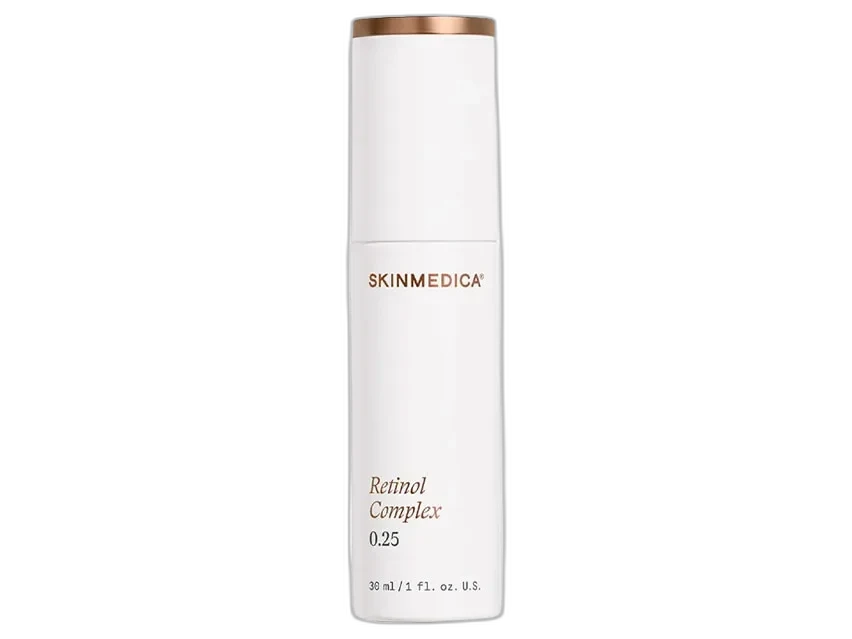
Age Defense Retinol Complex 0.25
Derm-Office Starter Retinol
 Verified reviewer
Pros & cons.
- +Multi-active soothing system with six different calming ingredients minimizes retinization to near-imperceptibility
- +Completely alcohol-free formula — no drying agents working against the retinol's moisturizing base
- +Niacinamide at meaningful concentration provides additional brightening and barrier support alongside the retinol
- +Palmitoyl tripeptide-8 addresses neurogenic inflammation through a unique calming mechanism
- +Ceramide NP provides barrier lipid reinforcement against retinol-induced water loss
- +Airless pump packaging preserves retinol potency better than tubes or jars
- +Backed by 25+ years of SkinMedica/AbbVie dermatological heritage
- −0.25% concentration produces subtle, gradual results that may underwhelm impatient users
- −Soybean oil-based formula may feel too rich for oily skin types
- −Only available through authorized sellers — less convenient than drugstore alternatives
- −At $64, it's pricier than many effective retinol options at comparable concentrations
- −Not vegan and not cruelty-free certified
The full review.
The fundamental problem with retinol has never been whether it works — that question was settled decades ago. The problem is that it works by challenging the skin, and most people interpret that challenge as a reason to stop. Flaking, redness, tightness: the classic retinization triad sends more beginners running back to their gentle moisturizers than any actual adverse reaction ever could. SkinMedica’s Age Defense Retinol Complex 0.25 was formulated with this dropout problem as the primary design constraint.
The ingredient list tells the story. Yes, there’s retinol, and at 0.25% it provides a clinically meaningful concentration for initiating cellular change. But look at what surrounds it: niacinamide at a prominent fourth position on the INCI (suggesting a meaningful percentage), palmitoyl tripeptide-8 (a neuro-calming peptide that suppresses the inflammatory cascade retinol triggers), ceramide NP (barrier lipid reinforcement), magnolia bark extract (anti-inflammatory honokiol and magnolol), bisabolol (chamomile-derived COX-2 inhibitor), and squalane (skin-identical moisture). This isn’t a retinol cream with soothing ingredients added. It’s a soothing system with retinol incorporated.
SkinMedica was co-founded in 1999 by Dr. Richard Fitzpatrick, a dermatologist whose growth factor research produced the TNS technology that became the brand’s signature innovation. Acquired by Allergan in 2012 and now under AbbVie’s umbrella, the brand operates with the clinical infrastructure and regulatory rigor of a pharmaceutical company rather than a cosmetics startup. The Retinol Complex line reflects this heritage — it reads like something designed in a clinical trial environment, not a marketing brainstorm.
Texture
The texture is a notable departure from SkinCeuticals’ approach. Where SkinCeuticals uses a dimethicone-heavy base with alcohol denat. for quick absorption, SkinMedica builds on soybean oil and squalane, creating a richer, more emollient feel that skips the alcohol entirely. For dry and normal skin types, this is a meaningful advantage — you’re getting retinol delivery without any drying agents working against the moisturizing base. For oily skin, the oil-based vehicle may feel slightly heavier than ideal, though the squalane absorbs reasonably well.
Scent
The absence of alcohol deserves emphasis. In a market where even premium retinol products routinely include alcohol denat. as a texturizing and penetration-enhancing agent, SkinMedica demonstrates that a well-formulated retinol doesn’t need it. The trade-off is a slightly richer texture, but for a product designed to minimize irritation in first-time users, removing a known barrier disruptor is the right call.
Works for
Performance at 0.25% is gradual and subtle. This is not the retinol that transforms your skin in four weeks and makes your colleagues ask what you’ve done. It’s the retinol that, after two months of consistent nightly use, makes you realize your skin looks noticeably smoother, slightly more radiant, and somehow more even in tone. Fine lines begin to soften rather than disappear, and texture improves incrementally rather than dramatically. For many first-time users, this gentle trajectory is exactly right — it builds confidence in retinol as an ingredient before stepping up to concentrations that demand more tolerance.
Best for
The palmitoyl tripeptide-8 is a clever inclusion that differentiates this from most starter retinols. This peptide works by modulating the neurogenic inflammation pathway — essentially telling the skin’s nerve endings not to overreact to the retinol’s presence. It’s a different mechanism than the general anti-inflammatory action of magnolia bark and bisabolol, creating a multi-pathway calming system that addresses retinol irritation from several angles simultaneously.
Packaging
The airless pump packaging is quietly excellent. Retinol degrades when exposed to light and air, and most tube formats allow both to reach the product with repeated use. The airless pump dispenses product without introducing air, and the opaque container blocks light. It’s the kind of functional design choice that doesn’t photograph well on Instagram but genuinely preserves the active ingredient your money is paying for.
Price
At $64 for an ounce, SkinMedica’s 0.25 sits between drugstore retinols and super-premium clinical options. The price reflects the multi-active formulation, the airless packaging, and the SkinMedica/AbbVie clinical heritage — though it’s worth noting that The Ordinary’s retinol costs a fraction of this, and CeraVe’s retinol resurfacing serum provides ceramides at a lower price. What you’re paying for is the comprehensive soothing architecture and the confidence of a brand that derives its formulations from dermatology practice, not trend forecasting.
Who Should Buy
The restricted distribution through authorized sellers (Dermstore, LovelySkin, dermatology offices) means you won’t find this at Target, which is both a limitation and a quality control advantage. Retinol is sensitive to storage conditions, and authorized channels are more likely to maintain proper handling. It also means you may get professional guidance on starting concentration — the kind of advice that a drugstore endcap can’t provide.
Best for
For anyone who has tried retinol before and given up because their skin hated it, or for anyone starting retinol for the first time who wants to minimize the risk of that experience, SkinMedica’s 0.25 offers a genuinely different proposition: retinol that works because you can actually tolerate using it consistently.
Ingredient analysis.
Full INCI list
Aqua / Water / Eau, Cetyl Ethylhexanoate, Glycine Soja (Soybean) Oil, Niacinamide, Polyacrylate-13, Squalane, Retinol, Palmitoyl Tripeptide-8, Dunaliella Salina Extract, Magnolia Grandiflora Bark Extract, Tocopherol, Tocotrienols, Ceramide NP, Bisabolol, Tocopheryl Acetate, Oryza Sativa (Rice) Bran Oil, Glycerin, Caprylic/Capric Triglyceride, Polysorbate 20, Butylene Glycol, Cetyl Palmitate, Laureth-23, Trideceth-6 Phosphate, Sodium Hydroxide, Dicaprylyl Ether, Lauryl Alcohol, Polyisobutene, Dextran, Potassium Sorbate, Disodium EDTA, Phenoxyethanol, Ethylhexylglycerin
Skin match.
The science.
The Science
The retinol conversion cascade — retinol → retinaldehyde → all-trans retinoic acid via endogenous oxidoreductases — works the same at 0.25% as at higher concentrations, but with less substrate available for conversion. Kafi et al. (2007, Archives of Dermatology) showed that 0.4% retinol produced statistically significant improvements in fine wrinkles and skin roughness; later studies show measurable effects at concentrations as low as 0.025%.
The soothing architecture in this formula stops retinol-induced irritation through multiple mechanisms. Palmitoyl tripeptide-8, a fragment of the naturally occurring neuropeptide substance P receptor antagonist, modulates neurogenic inflammation by inhibiting pro-inflammatory cytokine release (IL-1α, IL-6, IL-8) from keratinocytes exposed to irritant stimuli. This mechanism differs from the general anti-inflammatory action of bisabolol (COX-2 inhibition) and magnolia bark (honokiol-mediated NF-κB suppression), creating a multi-pathway calming system.
Niacinamide in the formula provides direct anti-aging activity and increases retinol tolerance. A 2005 study by Bissett et al. in the Journal of Cosmetic Dermatology showed that 5% niacinamide produced significant improvements in fine lines, hyperpigmentation, and skin elasticity. Niacinamide also increases ceramide and fatty acid synthesis in the stratum corneum, strengthening the barrier against retinol-induced transepidermal water loss.
Ceramide NP reinforces the lipid lamellae of the stratum corneum to fix the barrier disruption caused by retinol-accelerated keratinocyte turnover. Squalane, a hydrogenated form of squalene naturally present in human sebum, provides biomimetic emolliency without comedogenic risk. Dunaliella salina extract contributes beta-carotene and other carotenoids with antioxidant properties that protect the retinol from degradation and provide additional photoprotective support.
References
- Improvement of Naturally Aged Skin With Vitamin A (Retinol) — Archives of Dermatology (2007)
Dermatologist Perspective
Board-certified dermatologists value SkinMedica's retinol line because dermatologists developed it for dermatology practice. Practitioners use the 0.25% concentration and its comprehensive soothing system for cautious patients — those with sensitive skin, rosacea tendencies, or a history of retinol intolerance. Dermatologists note that the multi-active calming approach (peptide, niacinamide, ceramide, botanicals) addresses retinol irritation more thoroughly than single-soothing-agent formulas, which improves patient compliance. The alcohol-free base does not compound retinol's barrier-disrupting effects.
Where it fits in your routine.
Apply a pea-sized amount to clean, dry skin at night. New retinol users should start twice a week (e.g., Monday and Thursday evenings) for 2-3 weeks. Then, move to every other night, and finally to nightly use as tolerated. Follow with moisturizer. Do not layer with AHAs, BHAs, or benzoyl peroxide on the same evening until your skin acclimates. Apply SPF 30+ every morning.
SkinMedica's Retinol Complex 0.25 costs $64 for 1 oz, placing it in the mid-premium retinol tier. The price covers a sophisticated multi-active formula; the soothing system (peptide, niacinamide, ceramide, magnolia bark, bisabolol, squalane) alone works as a standalone product. SkinMedica's concentration is lower than SkinCeuticals' Retinol 0.3 at $80, but it has a more comprehensive soothing system and no alcohol denat. This trade-off favors sensitive or dry skin types. The 20% auto-replenish discount ($51.20) increases value for regular users.
First-time retinol users seeking a clinical-grade starter formula with maximum soothing support. It works for sensitive skin, those with previous retinol intolerance, and patients who trust dermatologist-developed brands. The alcohol-free, fragrance-free formula also suits anyone prioritizing proven anti-inflammatory actives.
Experienced retinol users seeking aggressive results will find 0.25% too gentle. Budget-conscious shoppers can buy effective retinol for less, but these formulas have less sophisticated soothing support. Pregnant or nursing individuals must avoid all retinol products. Those with soy allergies should note the soybean oil base.
Product details.
Fragrance-free — no detectable scent
An airless pump bottle protects light-sensitive retinol from oxidation and air. This pump dispenses precise amounts and keeps the product stable, which beats tubes or jars for retinol stability. Finish satinlightweightnon-greasy
This retinol product is gentle. Most users see no visible retinization at 0.25% — no flaking, redness, or tightness. The cream feels moisturizing and comfortable when applied. Minor sensitivity usually feels like slight warmth that fades quickly.
2-3 months with nightly application of a pea-sized amount to the face
12 months
All Year
The backstory.
SkinMedica's retinol line represents the brand's expansion beyond its flagship TNS growth factor technology. Developed under the clinical infrastructure of Allergan (now AbbVie), the Age Defense Retinol Complex 0.25 was designed specifically for the dermatology office market — a product that practitioners could confidently recommend to first-time retinol patients knowing the multi-active soothing system would minimize the compliance-destroying irritation that causes most beginners to abandon retinol.
About SkinMedica
Legacy Brand (20+ years)SkinMedica was co-founded in 1999 by renowned dermatologist Dr. Richard Fitzpatrick, who pioneered growth factor technology with the patented TNS (Tissue Nutrient Solution). Acquired by Allergan (now AbbVie) in 2012 for $350 million, the brand has over 25 years of clinical skincare heritage and is widely distributed through dermatology offices nationwide.
Common myths.
0. 25% retinol is too weak to produce meaningful results.
Research shows retinol concentrations as low as 0.025% improve photodamaged skin significantly. At 0.25%—ten times that minimum effective concentration—this formula uses niacinamide, a calming peptide, and ceramide support to provide anti-aging activity. The formula is tolerable enough that users maintain the consistency needed for results.
If a retinol doesn't make your skin peel, it isn't working.
Peeling and redness signal irritation, not efficacy. This formula's multi-active soothing system (peptide, niacinamide, ceramide, magnolia bark) suppresses the inflammatory response that causes visible retinization. This allows the retinol's gene-expression modulation — the actual mechanism of anti-aging action — to proceed unimpeded.
FAQ.
How does SkinMedica Retinol 0.25 compare to SkinCeuticals Retinol 0.3?
SkinMedica's formula has a lower retinol concentration (0.25% vs 0.3%) but uses a more sophisticated soothing system — niacinamide, calming peptide, ceramide, and magnolia bark versus SkinCeuticals' boswellia and bisabolol. SkinMedica is alcohol-free; SkinCeuticals contains alcohol denat. Both are excellent beginner retinols from legacy dermatologist-developed brands.
When should I upgrade from SkinMedica 0.25 to 0.5?
Use 0.25% nightly for 3-6 months without irritation before moving to 0.5%. You are ready if your skin shows no sensitivity after application and you want more aggressive anti-aging results. The 0.5% uses the same soothing complex to make the transition smooth.
Can I use SkinMedica Retinol 0.25 with vitamin C?
Yes — use them at different times of day. Apply vitamin C serum in the morning for antioxidant protection, and use the Retinol Complex in the evening. The niacinamide in the Retinol Complex adds brightening synergy, so this combination works well for hyperpigmentation.
Why is SkinMedica only available through authorized sellers?
SkinMedica is distributed primarily through dermatology offices, medical spas, and authorized online retailers like Dermstore and LovelySkin. This restricted distribution ensures product authenticity and proper storage (retinol is sensitive to heat and light). It also means you can get professional guidance on which concentration to start with.
What the community says.
"Extremely gentle — users report little to no irritation even on sensitive skin"
"Noticeable improvement in skin smoothness and radiance within weeks"
"Alcohol-free formula feels comfortable and moisturizing rather than drying"
"Effective stepping stone before graduating to 0.5% concentration"
"Fragrance-free with a pleasant, lightweight texture"
"Results are subtle at 0.25% — some users wish they'd started at 0.5%"
"Only available through authorized sellers — harder to find than drugstore retinols"
"Price is moderate but higher than many comparable-concentration alternatives"
"Some users find the soybean oil-based formula too rich for oily skin"
People also looked at.