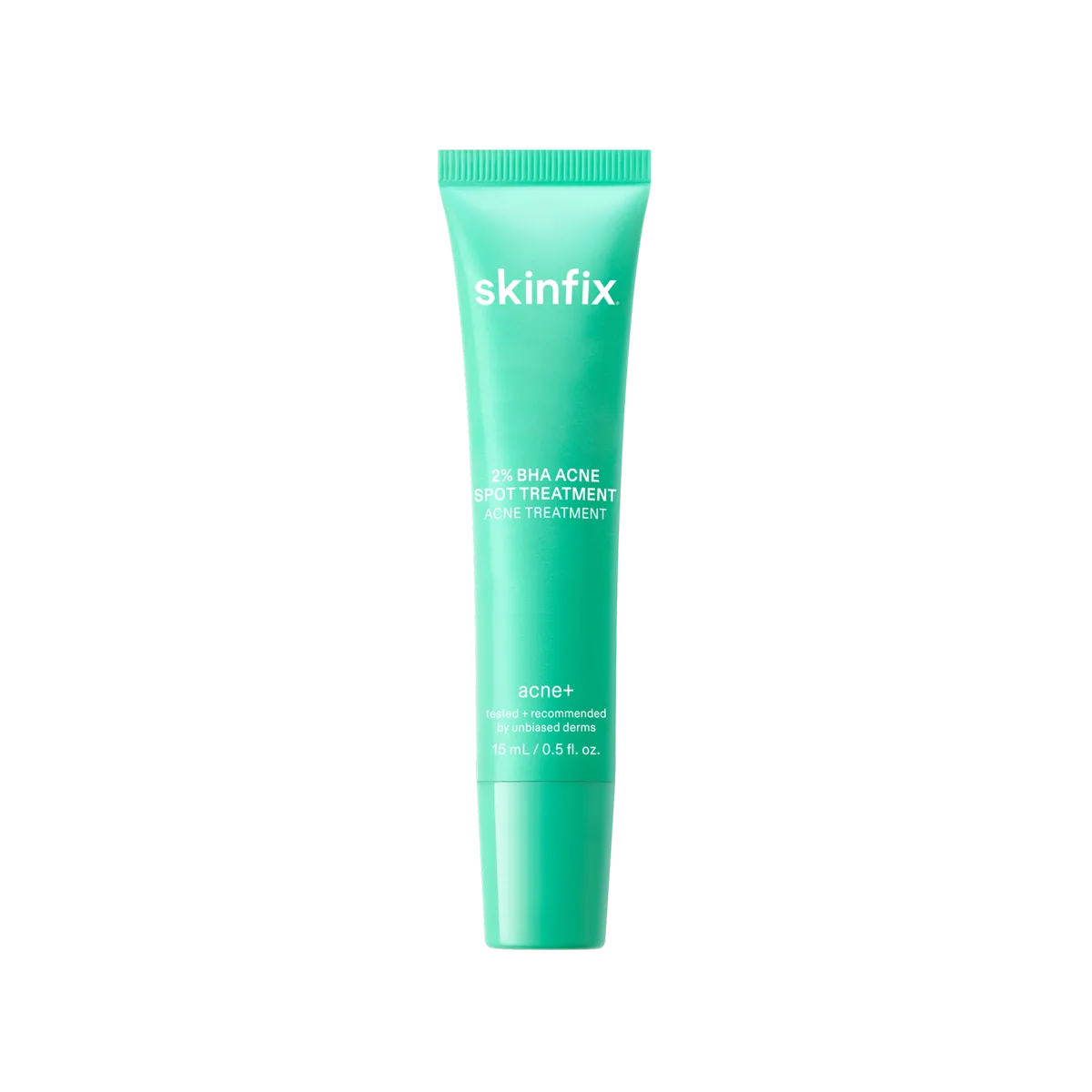
Acne+ 2% BHA and Azelaic Acid Acne Spot Treatment
Clean Acne Fighter
 Verified reviewer
Pros & cons.
- +Clinically effective BHA-azelaic acid duo targets both active blemishes and post-acne marks
- +Truly clean formulation without sacrificing active ingredient potency
- +Clay-based delivery system keeps actives precisely on the blemish
- +Fragrance-free, silicone-free, and free from common irritants
- +Niacinamide and zinc PCA provide sebum control and barrier support
- +PETA-certified cruelty-free and vegan with recyclable packaging
- +Allure Best of Beauty Award winner with proven track record
- −Small 15 ml tube is expensive at $30 for a spot treatment
- −Clay residue can be visible on darker skin tones when dried
- −Not effective enough on its own for deep cystic acne
- −Tingling sensation may concern first-time acid users
- −Spot-treatment-only format limits preventive use on wider acne-prone zones
The full review.
There has always been an awkward tension in the clean beauty world when it comes to acne. The movement that brought us thoughtful ingredient lists and transparent formulations has historically struggled with one inconvenient truth: fighting breakouts often requires ingredients that do not fit neatly on a “clean” label. Skinfix looked at that tension and decided it was a false choice. Their Acne+ 2% BHA and Azelaic Acid Spot Treatment is the result — a product that earned an Allure Best of Beauty Award in 2022 by combining genuine clinical actives with a formulation clean enough to satisfy the most ingredient-conscious shopper.
The hero combination here is salicylic acid at 2% and azelaic acid at an estimated 10%. This is not a tentative nod toward acne treatment with micro-doses of actives buried under botanical extracts. These are proper concentrations — the kind a dermatologist might recommend, deployed in a targeted spot treatment format. The salicylic acid handles the mechanical work of acne management: it is oil-soluble, meaning it can penetrate into the pore lining and dissolve the mixture of sebum and dead skin cells that creates the plug we call a blemish. The azelaic acid takes on the biological dimension — it is antibacterial against Cutibacterium acnes, anti-inflammatory, and, crucially, it inhibits tyrosinase to address the post-inflammatory hyperpigmentation that breakouts leave in their wake.
This dual-action approach is genuinely clever because it acknowledges something that many spot treatments ignore: a blemish is not just the bump on your skin today. It is also the dark mark that lingers for weeks or months afterward, especially on melanin-rich skin tones. By targeting both phases simultaneously, this treatment aims to shorten the entire acne cycle, not just the acute phase.
The supporting cast is well-chosen. Niacinamide at approximately 2% adds sebum regulation and barrier support, which is important context for a spot treatment — you want the active area treated without nuking the surrounding skin. Zinc PCA contributes additional oil control and anti-inflammatory support. And the dual licorice approach, with both whole root extract and stearyl glycyrrhetinate, reinforces the anti-redness and brightening benefits.
The delivery system deserves mention. This is not a liquid you pat on and hope it stays put. The kaolin and bentonite clay base creates an oil-absorbing matrix that sits on the blemish, drawing out excess sebum while keeping the actives in contact with the target area. It dries down to a matte finish — think of it as a treatment mask for individual spots. The downside of this approach is that the dried clay can be visible, particularly on darker skin tones, which makes this more of an evening or at-home treatment than something you would wear under makeup.
In terms of experience, the product applies as a thick, slightly gritty gel that you dab directly onto a blemish. There is a mild tingling sensation — the two acids announcing their presence — that subsides within a minute or two. The clay dries down fairly quickly, and you can feel it tightening slightly on the skin. Overnight, it does its work, and by morning, most users report a noticeable reduction in blemish size and redness. The 48-hour window that Skinfix cites for visible results is realistic for papules and early-stage blemishes. Deep cystic acne is a tougher opponent, and expectations should be calibrated accordingly.
The value conversation is the product’s most obvious friction point. Thirty dollars for half an ounce is not cheap, especially in a category where benzoyl peroxide spot treatments are available for a fraction of the price. Skinfix’s argument is that you are paying for the quality of the formulation and the clean ingredient profile — no fragrance, no parabens, no sulfates, no silicones, no essential oils. And that is a fair argument, to a point. The ingredients in this tube are genuinely good and genuinely clean. But the per-ounce cost means you need to be strategic with application — this is not a product you slather liberally.
Skinfix itself has an interesting lineage. The brand traces its origins to an 1870 Yorkshire healing balm, but its modern incarnation was relaunched in 2014 by Amy Gordinier with a mission to bridge clinical dermatology and clean beauty. The Barrier+ line has become its flagship, and the Acne+ extension shows the brand can apply the same philosophy to active treatment products. It has the credibility of a decade in the market and the awards to back up its claims.
The clean beauty positioning is genuine here, not performative. This is PETA-certified cruelty-free and vegan, the packaging is recyclable with FSC-certified materials, and the exclusion list is comprehensive without being paranoid. They have kept the ingredients they need to make the product work — including effective preservatives — while removing what is genuinely unnecessary.
Where this product falls short is in its scope. It is a spot treatment, and it should be evaluated as one. It will not prevent breakouts on its own, it will not replace a comprehensive acne routine, and it is not suitable for full-face use. For what it is — a targeted, clinically active, clean-formulated spot treatment — it delivers. The BHA clears, the azelaic acid calms and fades, the clays absorb, and the whole thing works without fragrance, silicones, or an ingredient list that requires a chemistry degree to decode.
If you are someone who breaks out occasionally and wants a targeted treatment that does not compromise your commitment to clean ingredients, this is one of the best options available. If you have persistent, severe acne, this should be one tool in your kit, not the entire toolbox.
Ingredient analysis.
Full INCI list
Active Ingredient: Salicylic Acid 2%. Inactive Ingredients: Water (Aqua), Azelaic Acid, Caprylic/Capric Triglyceride, Kaolin, Propanediol, Arachidyl Alcohol, Stearyl Alcohol, Behenyl Alcohol, Niacinamide, Bentonite, Arachidyl Glucoside, Potassium Cetyl Phosphate, Zinc PCA, Glycyrrhiza Glabra (Licorice) Root Extract, Camellia Sinensis Leaf Extract, Amylopectin, Glucose, Citric Acid, Potassium Sorbate, Sodium Hydroxide, Ethylhexylglycerin, Stearyl Glycyrrhetinate, Dextrin, Polydextrose, Phenoxyethanol, Xanthan Gum, Glycerin, Sodium Benzoate
Skin match.
The science.
The Science
This spot treatment combines salicylic acid and azelaic acid, using two well-researched acne ingredients with complementary mechanisms.
Salicylic acid (BHA) at 2% is an FDA-registered acne active. It works via keratolytic action, dissolving the intercellular cement that holds dead skin cells inside the pore to unclog the comedone. Salicylic acid is lipophilic, unlike glycolic acid, so it penetrates the oily sebaceous follicle. A 2018 study in the Journal of the European Academy of Dermatology and Venereology compared 2% supramolecular salicylic acid against 5% benzoyl peroxide/0.1% adapalene. The study found comparable efficacy for mild-to-moderate acne, showing well-formulated 2% BHA competes with prescription-adjacent treatments.
Azelaic acid at approximately 10% uses a different mechanism. A 2024 review in PMC documented azelaic acid's multifaceted activity: it is antibacterial against Cutibacterium acnes, normalizes keratinization to prevent pore plugs, and inhibits tyrosinase, the enzyme driving melanin production and post-inflammatory hyperpigmentation. A 2023 systematic review in the Journal of Cosmetic Dermatology confirmed azelaic acid manages acne, rosacea, and melasma, making it a versatile dermatological active.
Studies have looked at the BHA and azelaic acid combination directly. Elbadawy et al. (2019) published a randomized controlled trial in the Journal of Dermatological Treatment. They found the salicylic acid and azelaic acid combination effective for inflammatory acne lesions and noted strong patient satisfaction scores.
Niacinamide at 2% adds a third dimension. Draelos et al. (2006) published in the Journal of Cosmetic and Laser Therapy that 2% niacinamide significantly reduces sebum excretion rates, which matters for oily, acne-prone skin. Niacinamide also strengthens the barrier to mitigate drying from the two acids in this formula.
References
- Clinical and dermoscopic evaluation of combined salicylic acid 20% and azelaic acid 20% versus trichloroacetic acid 25% chemical peel in acne: an RCT — Journal of Dermatological Treatment (2019)
- Topical azelaic acid, salicylic acid, nicotinamide, sulphur, zinc and fruit acid for acne (Cochrane Review) — Cochrane Database of Systematic Reviews (2020)
- A systematic review to evaluate the efficacy of azelaic acid in the management of acne, rosacea, melasma and skin aging — Journal of Cosmetic Dermatology (2023)
- The effect of 2% niacinamide on facial sebum production — Journal of Cosmetic and Laser Therapy (2006)
Dermatologist Perspective
Board-certified dermatologists often recommend combining salicylic acid and azelaic acid for patients with both active acne and post-inflammatory hyperpigmentation, a common dual concern for patients with darker skin tones. Dermatologists note that 10% azelaic acid sits between OTC cosmetic concentrations and prescription-strength (15-20%) formulations, providing efficacy without the irritation of higher-strength products. The clean formulation suits patients with sensitive or reactive skin who need acne treatment without fragrance, essential oils, or other sensitizers. Dermatologists caution that spot treatments alone do not treat moderate-to-severe acne and must be part of a broader regimen including preventive treatments and consistent cleansing.
Where it fits in your routine.
Cleanse and tone your skin first. Apply a thin, even layer of the gel to individual blemishes; do not apply to the full face. Let it dry for 1-2 minutes, then apply moisturizer. Use it morning and evening, but start once daily (preferably PM) to test skin tolerance. Use sunscreen SPF 30+ during the day because salicylic acid and azelaic acid increase photosensitivity. Do not layer with other strong acids, benzoyl peroxide, or retinoids on the same spots to avoid irritation.
At $30 for 15 ml, this spot treatment costs more than many others. This price reflects Skinfix's clean beauty positioning and Sephora-exclusive distribution, not exotic ingredients. The salicylic acid and azelaic acid in this tube are well-studied, well-dosed actives, but they are not rare or proprietary. The premium price pays for the clean formulation, the cruelty-free certification, and the sustainable packaging. One tube lasts 2-3 months for occasional breakouts, which keeps the per-use cost reasonable. For persistent acne requiring daily application across multiple spots, the cost adds up quickly. Skinfix has built a solid reputation during its decade-long relaunch, and the Allure award validates the formulation quality — but budget-conscious consumers can find effective BHA and azelaic acid products at lower price points.
This spot treatment works for occasional breakouts and targets blemishes directly. It suits users with post-acne dark marks and active acne who want fragrance-free, vegan, and cruelty-free formulas that remain clinically potent.
Use this for severe or widespread cystic acne requiring comprehensive treatment instead of spot treatment. The clay base and dual acids dry out very dry or eczema-prone skin. Effective BHA spot treatments cost less if budget is a primary concern.
Product details.
Thick, concentrated clay-based gel for targeted spot application. Do not use on the full face. The kaolin and bentonite clays create a slightly gritty, paste-like consistency that dries to a matte finish on the blemish.
Fragrance-free and has no added essential oils. Base ingredients create a minimal clinical smell.
Small 0.5 fl oz / 15 ml squeeze tube uses recyclable PP/foil packaging. The FSC-certified paper box uses plant-based inks. A precision tip applies the formula to individual blemishes.
You will feel a mild tingling upon application. This is normal as salicylic and azelaic acids touch compromised skin. The clay base dries in a few minutes and forms a matte patch over the blemish. Some dryness around the treated area is common during the first week; keep the surrounding skin moisturized.
Use spot treatment on occasional breakouts for 2-3 months. Heavy acne users use it faster.
12 months
All Year
The backstory.
Skinfix developed its Acne+ line to fill a gap in the clean beauty space where most acne treatments either relied on harsh conventional ingredients or were too gentle to actually clear breakouts. The brand's approach was to combine FDA-registered salicylic acid with dermatologist-favorite azelaic acid in a clean formulation — earning an Allure Best of Beauty Award in its first full year on market.
About SkinFix
Established Brand (5–20 years)Skinfix was relaunched in 2014 by Amy Gordinier, building on a heritage brand originally created in 1870 in Yorkshire, England. The brand positions itself as the first clean and clinically active skincare line tested by unbiased dermatologists. Its Barrier+ line has won multiple awards, and the Acne+ line received an Allure Best of Beauty Award in 2022.
Common myths.
Clean beauty products can't treat acne effectively.
This formula contains 2% salicylic acid (an FDA-registered acne active) and about 10% azelaic acid—both are clinically proven acne fighters. Clean formulation and clinical efficacy coexist; efficacy depends on what you include, not just what you exclude.
Apply spot treatments to your whole face to prevent breakouts.
This clay-based formula works for targeted spot application. Applying it to the whole face causes excessive dryness and damages the skin barrier. For preventive treatment of acne-prone areas, use a leave-on BHA serum or azelaic acid serum on wider zones.
FAQ.
Can I use SkinFix Acne+ Spot Treatment on my whole face?
No — use this product for targeted spot application only. The clay-based formula has 2% salicylic acid and 10% azelaic acid. This concentration is too high for full-face use and causes excessive dryness. For broader acne-prone areas, use a BHA serum or azelaic acid treatment designed for wider application.
Does SkinFix Acne+ Spot Treatment work on cystic acne?
It reduces surface redness and inflammation on cystic acne, but deep cystic lesions usually need stronger interventions. This spot treatment works best on papules, pustules, and early-stage blemishes. For persistent cystic acne, ask a dermatologist about prescription options.
Can I use SkinFix Acne+ Spot Treatment with retinol?
Do not apply retinol and this spot treatment to the same area at once. The combination of salicylic acid, azelaic acid, and retinol can cause over-exfoliation and skin irritation. Use retinol on non-treated areas or alternate nights between the two products.
Is SkinFix Acne+ Spot Treatment safe during pregnancy?
No — this product contains 2% salicylic acid. Leave-on formulations with this ingredient are generally advised against during pregnancy. Consult your healthcare provider for pregnancy-safe acne treatment alternatives.
How quickly does SkinFix Acne+ Spot Treatment work?
Most users see smaller blemishes and less redness within 24-48 hours. The azelaic acid fades post-acne marks more slowly — usually after 2-4 weeks of consistent use. Results vary based on blemish type and severity.
Is SkinFix Acne+ Spot Treatment fungal acne safe?
Yes — this formula lacks common fungal acne triggers. It has no fatty acids, oils, or esters that feed Malassezia yeast. The clay-based, oil-free formula works with fungal acne management routines.
What the community says.
"Visibly reduces blemish size and redness within 48 hours"
"Helps fade post-acne marks over time"
"Fragrance-free and gentle compared to other spot treatments"
"Clean ingredient profile free from parabens, sulfates, and silicones"
"Works on both face and body acne"
"Small tube size for the $30 price point"
"Can be drying on surrounding skin if not applied precisely"
"Clay texture can leave a visible residue on darker skin tones"
"Inconsistent results — sometimes less effective on deeper cystic acne"
"Slight tingling sensation upon application"