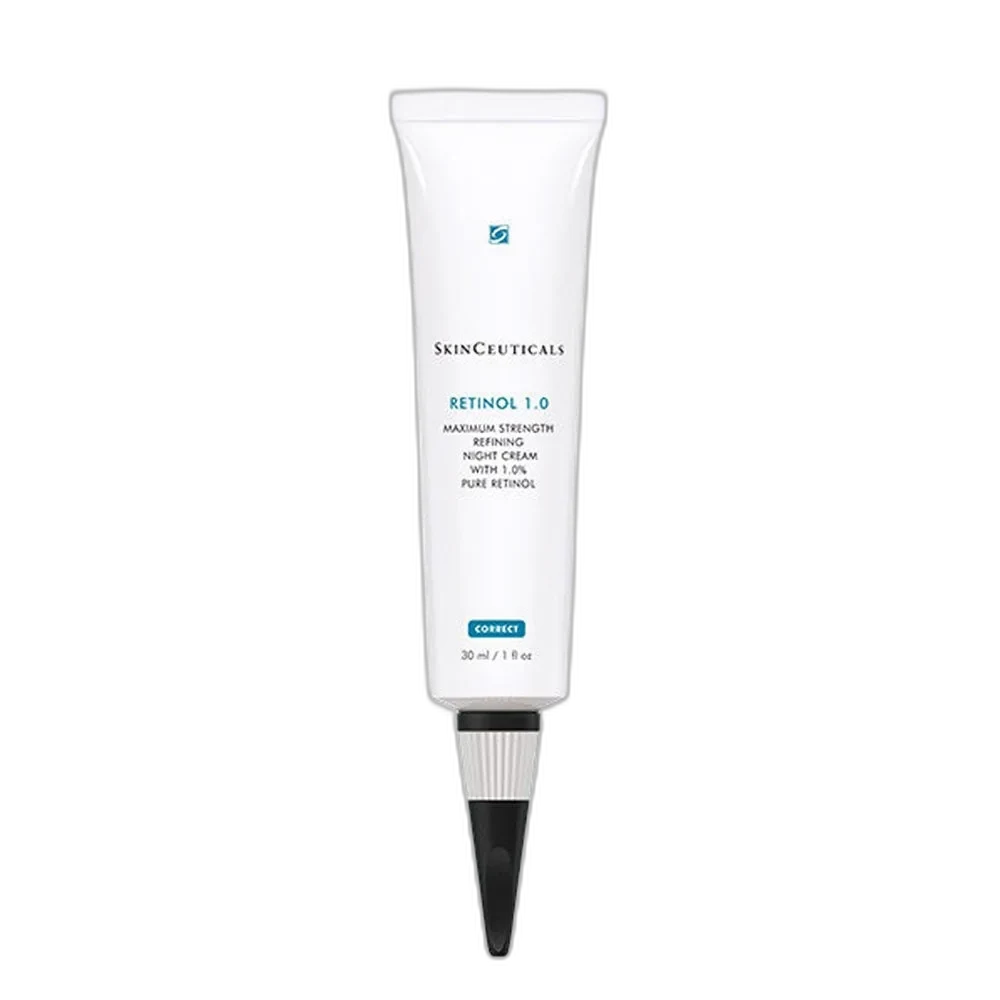
Retinol 1.0
Maximum Strength Retinol
 Verified reviewer
Pros & cons.
- +Maximum OTC retinol concentration delivers the most aggressive non-prescription anti-aging results available
- +Same proven stabilization and encapsulation technology ensures consistent potency throughout the tube
- +Boswellia-bisabolol soothing complex provides meaningful irritation management even at this intensity
- +Two decades of market history and extensive dermatologist validation provide unmatched confidence
- +Fragrance-free and clinically formulated for compatibility with professional skincare routines
- +Most effective option in the lineup for stubborn hyperpigmentation and deep wrinkles
- −Pronounced retinization phase with significant flaking and dryness lasting 2-4 weeks
- −Not suitable for retinol beginners or anyone who hasn't built tolerance at lower concentrations
- −Alcohol denat. compounds with retinol's barrier-disrupting effects at this concentration
- −Isopropyl myristate may trigger breakouts despite retinol's anti-acne properties
- −Incremental benefit over 0.5% is narrower than the 0.3% to 0.5% jump, while irritation increases significantly
The full review.
Every retinol user eventually wonders what happens at a higher concentration. For SkinCeuticals Retinol 1.0, the answer since 2004 is the same: more of everything. More cellular turnover, more collagen stimulation, more visible results, and more retinization. This is the ceiling of the three-tier system and demands respect.
The 1.0% concentration jumps in biological activity. Moving from 0.5% to 1.0% doubles the retinol concentration, providing more substrate for the enzymatic conversion cascade that produces retinoic acid in the skin. The INCI list confirms this: retinol sits at position ten, higher than in the 0.3% and 0.5% variants, proving the concentration is not just marketing.
SkinCeuticals uses the same formulation architecture across all three tiers: the same propanediol-dimethicone base, the same boswellia-bisabolol soothing complex, and the same hydrogenated lecithin encapsulation. This consistency is both a strength and a limitation. The soothing ingredients that manage irritation at 0.3% work at their limit at 1.0%. Boswellia and bisabolol provide anti-inflammatory support, but at maximum retinol concentration, they act as a safety net, not a trapeze act. Expect the retinization phase to be noticeable.
The first four weeks with SkinCeuticals Retinol 1.0 require patience. Even users who tolerated the 0.5% without incident will likely see visible flaking, intermittent tightness, and redness—especially around the nose, mouth, and forehead where skin is thinner and more reactive. This is not damage. It is the skin’s adaptation response; accelerated turnover pushes immature cells to the surface faster than the skin is used to handling. The flaking subsides and the redness calms, but it takes time and a generous application of moisturizer.
Once acclimated, the results at 1.0% are the most pronounced in the lineup. Fine lines soften more effectively. Dark spots and post-inflammatory hyperpigmentation fade faster as melanin-laden keratinocytes cycle out. Pore appearance improves as sebaceous activity normalizes aggressively. The skin develops a refined, polished quality known as the “retinol glow”—the luminosity from accelerated cell turnover revealing fresh, well-organized skin at the surface.
The uncomfortable truth the three-tier marketing ignores is that most people do not need 1.0%. The incremental benefit over 0.5% is real but diminishing, while the incremental irritation does not diminish. Many board-certified dermatologists suggest 0.5% is the optimal maintenance concentration—strong enough for anti-aging results and tolerable for nightly use. The 1.0% works best as a targeted treatment phase: a few months of intensive therapy for stubborn photodamage or deep wrinkles, then cycling back to 0.5% for maintenance.
The alcohol denat. at position five matters more at this concentration. When retinol challenges the skin’s barrier integrity through accelerated turnover, adding a drying solvent creates a compounding dehydration effect. SkinCeuticals likely optimized the alcohol level for texture and penetration, but at 1.0% retinol, the margin for error is thinner. Applying a heavier moisturizer afterward is essential.
Isopropyl myristate remains a debated formulation choice. As a known comedogenic ingredient in a product often used for acne-prone skin, its inclusion is a contradiction. If the 0.3% and 0.5% did not cause breakouts, the 1.0% likely won’t either, but it remains a formulation asterisk.
At $102 for one ounce, the 1.0% costs $12 more than the 0.5% and $22 more than the 0.3%. On price alone, it seems like the obvious choice. But retinol efficacy is not linear. The difference between 0.3% and 0.5% in visible results is substantial. The difference between 0.5% and 1.0% is meaningful but narrower, while the difference in irritation management is wide. You pay $12 more for incrementally stronger results and significantly higher management requirements.
The packaging and texture match its siblings: the same opaque tube, the same smooth cream, and the same fragrance-free application. SkinCeuticals made the concentration the only variable so consumers and practitioners can compare tiers without confounding factors.
Two decades of market presence matter. SkinCeuticals Retinol 1.0 does not chase trends or rebrand every few years. It exists because experienced retinol veterans with resilient skin and persistent aging concerns need the strongest non-prescription retinol available, formulated with the soothing and stabilization technology to make that strength manageable. For that population, SkinCeuticals Retinol 1.0 remains the gold standard.
Formula
Ingredient analysis.
Full INCI list
Aqua / Water / Eau, Propanediol, Dimethicone, Cetearyl Ethylhexanoate, Alcohol Denat., Allyl Methacrylates Crosspolymer, Dipropylene Glycol, Ammonium Polyacryloyldimethyl Taurate, Acrylamide/Sodium Acryloyldimethyltaurate Copolymer, Retinol, Hydrogenated Lecithin, Polysorbate 20, Isohexadecane, Phenoxyethanol, Caprylyl Glycol, Isopropyl Myristate, Sodium Citrate, Boswellia Serrata Gum, Polysorbate 80, BHT, Dimethiconol, Trisodium Ethylenediamine Disuccinate, Bisabolol, Sorbitan Oleate, Citric Acid, Propyl Gallate
Skin match.
The science.
The Science
At 1.0%, retinol works the same way as lower concentrations — enzymatic conversion to retinaldehyde, then all-trans retinoic acid — but higher substrate availability drives more aggressive downstream effects. More retinoic acid production means stronger RAR-mediated gene expression modulation: increased procollagen I and III synthesis, faster keratinocyte turnover (estimated 2-3 fold acceleration at sustained 1.0% use), and more pronounced inhibition of tyrosinase and matrix metalloproteinases.
A 2015 randomized, double-blind study by Kong et al. in the Journal of Cosmetic Dermatology evaluated 1.0% retinol cream over 12 weeks. It showed statistically significant improvements in photoaging parameters like fine lines, mottled pigmentation, tactile roughness, and overall photodamage compared to vehicle control. Histological analysis showed increased epidermal thickness and better collagen fiber organization in the papillary dermis.
The link between retinol concentration and irritation is not linear; it follows a steeper curve at higher concentrations. At 1.0%, retinoid-induced barrier disruption — caused by altered lipid biosynthesis and accelerated corneocyte desquamation — creates a self-limiting feedback loop: a compromised barrier allows more retinol to penetrate in subsequent applications, amplifying both effects and irritation. The hydrogenated lecithin encapsulation system tries to moderate this by metering retinol release, but at maximum concentration, moderation has practical limits.
Boswellic acids from the Boswellia serrata gum target the 5-lipoxygenase pathway, which matters at this concentration. Retinol-induced skin irritation involves significant leukotriene production through the 5-LOX pathway, and AKBA (acetyl-11-keto-beta-boswellic acid) is a direct, non-competitive inhibitor of this enzyme. This targeted anti-inflammatory mechanism addresses the specific inflammatory pathway that retinol activates instead of providing generalized soothing.
References
- Improvement of Naturally Aged Skin With Vitamin A (Retinol) — Archives of Dermatology (2007)
Dermatologist Perspective
Board-certified dermatologists usually reserve the 1.0% concentration for patients who tolerate 0.5% well and have stubborn photodamage, deep wrinkles, or persistent hyperpigmentation requiring aggressive topical intervention. Dermatologists note this concentration nears the practical ceiling for retinol efficacy — beyond 1.0%, irritation typically outweighs additional benefit. Many practitioners recommend using the 1.0% as a treatment phase (3-6 months of intensive use) before returning to the 0.5% for maintenance. The fragrance-free, stabilized formula makes it a straightforward clinical recommendation, though practitioners emphasize that thick moisturizer and daily sunscreen are non-negotiable companions at this strength.
Where it fits in your routine.
Apply a pea-sized amount to clean, dry skin at night. Use it 2-3 nights per week to start, even if you use 0.5% regularly. Increase use over 3-4 weeks as tolerated. Always follow with a thick, occlusive moisturizer; barrier support is essential at this concentration. Do not layer with other actives on the same evening. Apply SPF 30+ every morning. If irritation persists after 4 weeks, reduce frequency instead of stopping.
At $102 for 1 oz, Retinol 1.0 costs only $12 more than the 0.5% and has the highest retinol concentration in the SkinCeuticals system. The per-unit cost of active ingredient is lowest in this lineup. However, value depends on tolerability — if the 1.0% causes irritation that forces reduced frequency (every other night versus nightly), you use the product longer but get similar results to consistent nightly 0.5% use. For patients with specific concerns like deep photodamage or persistent hyperpigmentation, the maximum strength adds value. For general anti-aging maintenance, the 0.5% offers better value through easier compliance.
Experienced retinol users acclimated to 0.5% who want maximum non-prescription strength for stubborn photoaging, deep wrinkles, persistent hyperpigmentation, or significant sun damage. This works as an intensive treatment phase for those seeking the strongest clinical retinol available without a prescription, provided they have the resilient skin and moisturizing discipline to manage the retinization period.
New retinol users should start at 0.3% and increase slowly. People with sensitive, dry, or eczema-prone skin should use 0.5% or lower. Pregnant or nursing individuals must avoid all retinol. If 0.5% works for your results and you have no stubborn photoaging, you do not need to increase. Many dermatologists consider 0.5% the optimal long-term strength.
Product details.
Completely fragrance-free — no detectable scent ***
An opaque tube, same as the 0.3% and 0.5%, protects the maximum-concentration retinol from light and air degradation. Identical packaging across the line means the concentration number is the only visual differentiator.
This concentration shows the most pronounced retinization of the three. Even users acclimated to the 0.5% will likely see 1-2 weeks of flaking, tightness, and possible redness when stepping up. Start at 2-3 nights per week. Flaking can affect makeup application during the adjustment phase. ***
2-3 months with application 3-5 nights per week ***
12 months ***
fall winter ***
The backstory.
Launched alongside the 0.5% in 2004, the Retinol 1.0 was the original flagship of SkinCeuticals' retinol line — the 0.3% was added later to create the gentler entry point. It was conceived as the strongest non-prescription retinol a consumer could use, designed for dermatology patients who wanted professional-grade retinoid results without a tretinoin prescription. Two decades later, it remains the benchmark against which other maximum-strength OTC retinols are measured.
About SkinCeuticals
Legacy Brand (20+ years)SkinCeuticals was founded in 1997 by Dr. Sheldon Pinnell, Chief of Dermatology at Duke University, whose pioneering antioxidant research established the Duke Antioxidant patent. Acquired by L'Oréal in 2005, the brand remains a cornerstone of evidence-based clinical skincare with extensive peer-reviewed research behind its formulations.
Common myths.
1. 0% retinol equals prescription-strength tretinoin.
Retinol requires enzymatic conversion to retinoic acid (tretinoin) in the skin. This process is inefficient; only a fraction of applied retinol becomes active. Even at 1.0%, the effective retinoic acid concentration stays below the lowest prescription tretinoin (0.025%). The 1.0% retinol is the strongest OTC option, but it does not substitute for a prescription.
Use 1.0% retinol for maximum anti-aging benefits.
Many dermatologists call 0.5% the optimal long-term maintenance concentration. Use 1.0% for stubborn photodamage, deep wrinkles, or persistent hyperpigmentation, but this is not a universal recommendation. The higher irritation burden at 1.0% can be counterproductive; inflammation can damage the collagen the retinol tries to build.
FAQ.
Is SkinCeuticals Retinol 1.0 the strongest retinol you can buy without a prescription?
This is one of the strongest options available. It is a maximum-strength OTC retinol with 1.0% pure retinol, using SkinCeuticals' stabilization technology to keep the concentration effective. Some brands offer retinol up to 1.5%. Higher concentration is not always better; effectiveness depends on formulation stability and delivery, not just the number.
Can I start with SkinCeuticals Retinol 1.0 if I've never used retinol before?
Avoid this. The 1.0% concentration is for experienced retinol users with tolerance to lower concentrations. Starting here causes severe irritation—prolonged flaking, redness, and barrier compromise—that harms skin health instead of improving it. Start with 0.3%, build tolerance over several months, then move to 0.5% before considering 1.0%.
How often should I use SkinCeuticals Retinol 1.0?
Use this 2-3 nights per week, even if you use the 0.5% nightly. Increase frequency as your skin tolerates it. Many experienced users use it every other night or 4-5 nights per week instead of nightly. Listen to your skin — if you see persistent redness, flaking, or sensitivity, reduce frequency instead of pushing through.
Is SkinCeuticals Retinol 1.0 better than prescription tretinoin?
They work differently. Prescription tretinoin (retinoic acid) is the biologically active form that works immediately. Retinol at 1.0% must first convert to retinoic acid in the skin, which is inefficient. Tretinoin at 0.025% delivers more active retinoic acid than 1.0% retinol. Retinol's slower conversion causes gentler effects, so it suits users who find tretinoin too aggressive.
Should I use SkinCeuticals Retinol 1.0 every night?
You can use this nightly, but you do not have to. Many dermatologists recommend 1.0% concentrations 3-5 nights per week to balance results and tolerability. Off nights let the skin recover and rebuild its barrier. If you tolerate nightly use without persistent irritation after a full acclimation period, more frequent use accelerates results.
What the community says.
"Most effective retinol in the SkinCeuticals lineup for visible anti-aging results"
"Noticeable improvement in deep wrinkles and stubborn dark spots"
"Fragrance-free and well-formulated despite the high concentration"
"Professional-grade results without a prescription"
"Packaging protects retinol potency well over the product's life"
"Significant retinization phase with pronounced flaking and dryness"
"Too intense for anyone who hasn't built retinol tolerance first"
"Contains alcohol denat. which exacerbates drying effects at this concentration"
"Price of $102 for ongoing maximum-strength use adds up quickly"
"Isopropyl myristate can trigger breakouts in acne-prone users despite retinol's anti-acne properties"
People also looked at.