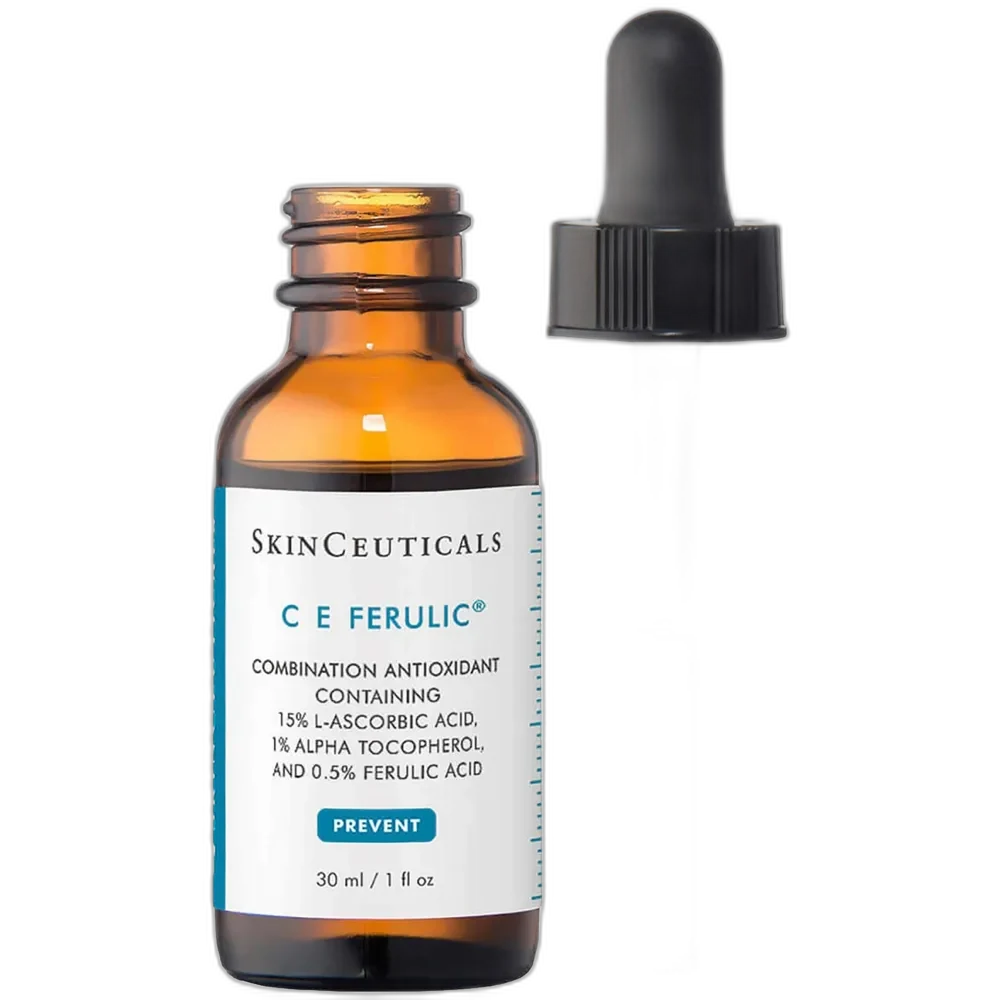
C E Ferulic
The Gold Standard Vitamin C
 Verified reviewer
Pros & cons.
- +Patent-backed formulation with published clinical research supporting efficacy
- +Provides up to 8x the antioxidant protection of untreated skin in testing
- +15% L-ascorbic acid at pH 2.5 — the optimal concentration and pH for activity
- +Vitamin E and ferulic acid stabilize and amplify the vitamin C's effect
- +Long-term use is associated with measurable improvements in tone and radiance
- +Reference standard used in dermatology practice for nearly two decades
- +Amber glass dropper bottle minimizes light and oxygen exposure
- +Works synergistically with sunscreen for reinforced photoprotection
- −$182 for 1 oz is the most expensive mainstream vitamin C serum on the market
- −Only 3-month shelf life once opened due to L-ascorbic acid oxidation
- −Distinctive sulfuric/meaty scent is off-putting for some users
- −Too aggressive for very sensitive or rosacea-prone skin
- −Effective dupes exist at a fraction of the price with very similar formulations
The full review.
There’s a paper from 2005 in the Journal of Investigative Dermatology, authored by Dr. Sheldon Pinnell and his team at Duke University, that most skincare enthusiasts have never read but nearly all of them are benefitting from. The paper demonstrated that adding ferulic acid to a formulation of 15% L-ascorbic acid and 1% alpha-tocopherol doubled the photoprotective effect of the combination, and that the resulting serum could provide roughly eight times the antioxidant protection of untreated skin against UV damage. That paper, more than any marketing campaign, is the reason C E Ferulic became the clinical reference standard for topical vitamin C — the benchmark against which every subsequent vitamin C serum has been measured. When a dermatology resident is being taught about topical antioxidants, C E Ferulic is not ‘a product,’ it’s ‘the product,’ and that’s a status almost no other skincare item has earned in the modern era.
Let’s talk about what this actually is, because the name makes it sound simple and the science underneath is anything but. L-ascorbic acid is the biologically active form of vitamin C, the one that actually donates electrons to neutralize free radicals and participates in collagen synthesis. The problem with L-ascorbic acid is that it’s notoriously unstable — it oxidizes rapidly in the presence of water, oxygen, light, and heat, which is why most vitamin C serums you’ll find on drugstore shelves are either dead on arrival or use less-active derivatives. The Duke research established the conditions required for L-ascorbic acid to remain stable and bioavailable: pH below 3.5 (for protonation of the molecule), concentrations up to 20% (the absorption limit), and specific co-ingredients for stabilization. The baseline C + E formula did well, but adding ferulic acid — a plant-derived polyphenol antioxidant — stabilized the complex further, extended its activity, and boosted photoprotection dramatically. That’s the formulation chemistry behind C E Ferulic in a paragraph.
What does this mean in practice? Two things. First, this is one of the few vitamin C serums you can actually trust to be active when you apply it, assuming the bottle is fresh and has been stored properly. The characteristic pale yellow to light amber color indicates functional L-ascorbic acid; as it oxidizes, it darkens to orange and then brown, which tells you it’s lost potency. You get roughly 3 months of active life from an opened bottle with careful storage. Second, the antioxidant protection is real and meaningful — photoaging is driven substantially by UV-generated free radicals, and topical antioxidants applied in the morning reinforce the protective effect of sunscreen by neutralizing reactive oxygen species that make it past the SPF barrier. Over years of consistent use, this accumulates into visibly healthier, brighter, more resilient skin.
The sensory experience is distinctive. On application, the serum is thin and oily-watery at the same time, absorbing within a minute or two with a subtle initial tingle that users adapt to quickly. The smell is the famous issue — a sulfuric, sometimes ‘hot dog’ scent that is a normal signature of L-ascorbic acid at 15% in aqueous solution and absolutely not a sign that the product has gone bad. New users are often surprised by it; long-term users stop noticing. It fades within a minute of application and doesn’t persist on the skin. A fresh bottle should smell distinctive but not offensive; an oxidized bottle smells notably worse and looks notably darker.
On results, user reports and clinical evidence both converge on the same picture: subtle immediate brightening (within the first few days), visible improvement in skin tone and radiance (within 2-4 weeks), gradual fading of dark spots and post-inflammatory pigmentation (within 8-12 weeks), and long-term benefits for photoprotection, fine lines, and overall skin health that accumulate over months and years of consistent morning use. The effects are not dramatic the way a strong retinoid’s are — vitamin C is a maintenance tool and a preventive antioxidant, not a resurfacing agent. Think of it as the slow daily work of keeping your skin in better shape than it would otherwise be, rather than the dramatic overhaul of a prescription retinoid or chemical peel.
The honest problems start and end with the price. One hundred and eighty-two dollars for 1 ounce is a lot of money for a serum you’ll go through in 3 months, and it works out to roughly $60 per month as an ongoing expense. The defenders of the price point out that clinical pedigree and patent-backed formulation chemistry are worth paying for, and that the specific ferulic acid stabilization isn’t trivially replicated. The critics — and they’re not wrong — point out that Timeless 20% Vitamin C + E + Ferulic Acid Serum and Maelove Glow Maker use very similar formulations at roughly a quarter of the price, and that for most users the dupes deliver 80-90% of the benefit. Where you land on this depends on how much you value the specific original formulation versus the general approach. For dermatology-office patients whose providers recommend specific products, C E Ferulic is often the reference. For budget-conscious enthusiasts, the dupes are remarkable and get you most of the way there.
The other consideration is skin compatibility. At pH 2.5 with 15% L-ascorbic acid, this serum is on the aggressive end of the vitamin C spectrum. Most normal to oily skin types tolerate it well after a brief adjustment period, but very sensitive skin, rosacea-prone skin, and patients with compromised barriers may find it irritating. SkinCeuticals makes Phloretin CF for oily skin types and Silymarin CF for oily and acne-prone skin, and other brands make gentler derivatives like magnesium ascorbyl phosphate or ascorbyl glucoside that sensitive users can turn to instead. One size does not fit all in vitamin C, and that’s worth emphasizing because most skincare advice treats C E Ferulic as universally appropriate when it isn’t.
Who should buy it
people who want the clinically validated gold standard vitamin C serum, existing SkinCeuticals loyalists, patients whose dermatologist specifically recommends it, and anyone whose skin tolerates L-ascorbic acid well and wants maximum antioxidant protection as part of long-term skin maintenance.
Who should skip
very sensitive or rosacea-prone users, people whose skin hasn’t tolerated L-ascorbic acid in other formulations, budget-conscious shoppers who’d do well with Timeless or Maelove dupes, and anyone who isn’t already using retinoids and sunscreen consistently — there are bigger wins to be had from foundational actives before adding a premium antioxidant.
Ingredient analysis.
Full INCI list · pH 2.5
Aqua/Water, Ethoxydiglycol, L-Ascorbic Acid, Propylene Glycol, Glycerin, Laureth-23, Phenoxyethanol, Tocopherol, Triethanolamine, Ferulic Acid, Panthenol, Sodium Hyaluronate, Chlorphenesin
Skin match.
The science.
The Science
This formulation uses research from Dr. Sheldon Pinnell and colleagues at Duke University. Their work on topical vitamin C defines how L-ascorbic acid stays stable and bioavailable on the skin. A 2005 study in the Journal of Investigative Dermatology shows that 15% L-ascorbic acid, 1% alpha-tocopherol, and 0.5% ferulic acid create a synergistic antioxidant effect. This combination provides about 8-fold photoprotection compared to untreated skin, and the ferulic acid stabilizes the vitamin C-vitamin E complex better than either alone. This same group previously found that L-ascorbic acid needs a pH below 3.5 to be protonated and pass through the stratum corneum. They also found that concentrations above 20% add no benefit because absorption saturates. The 15% concentration in C E Ferulic fits the optimal range from these studies. Other research shows topical vitamin C reduces erythema from UV exposure, supports collagen synthesis by hydroxylating proline and lysine residues in procollagen, and fades post-inflammatory hyperpigmentation via tyrosinase modulation. Vitamin E is lipid-soluble and moves antioxidant protection into skin cell lipid membranes where vitamin C alone cannot reach. Ferulic acid has independent antioxidant activity through its phenolic structure and enhances the photoprotective effects of combined vitamin C and E in multiple studies. This specific formulation has one of the strongest evidence bases of any topical skincare product.
References
- Ferulic acid stabilizes a solution of vitamins C and E and doubles its photoprotection of skin — Journal of Investigative Dermatology (2005)
- Topical L-ascorbic acid: percutaneous absorption studies — Dermatologic Surgery (2001)
Dermatologist Perspective
Dermatologists use C E Ferulic as the clinical reference standard for topical vitamin C. It has appeared in dermatology office displays and patient protocols since its 2005 launch. Board-certified dermatologists view topical antioxidants as a cornerstone of photoaging prevention; the published research for this formulation provides more confidence than most skincare products. Most dermatologist-directed routines use it as a morning antioxidant step with broad-spectrum SPF 30+ for extra photoprotection, alternating it with evening retinoid use. Dermatologists set realistic expectations: vitamin C maintains and prevents rather than provides dramatic treatment, and benefits build over months and years of consistent use. For patients who find the original formulation too aggressive, dermatologists often suggest SkinCeuticals vitamin C options like Phloretin CF and Silymarin CF, or gentler derivatives from other brands for very sensitive skin.
Where it fits in your routine.
Apply 4-5 drops to clean, dry skin every morning after cleansing. Pat the liquid into your face and neck, but avoid the immediate eye area. Wait 1-2 minutes for full absorption before you apply moisturizer and broad-spectrum SPF 30+. Use once daily in the morning to maximize photoprotective benefit during the day. Store in a cool, dark place with the cap tightly closed to slow oxidation. Replace every 3 months, or sooner if the formula turns dark brown or orange. Always pair with sunscreen for maximum photoprotection. Do not layer with niacinamide or benzoyl peroxide in the same application.
At $182 for 1 oz, C E Ferulic is the most expensive mainstream vitamin C serum available. The value case must address a clear fact: effective dupes exist. Timeless 20% Vitamin C + E + Ferulic Acid Serum costs around $25 for a similar volume and uses a formulation that closely approximates the original. Maelove Glow Maker ($30) is another popular alternative. For most users, these dupes deliver 80-90% of the benefit at a fraction of the cost, and long-term skin outcomes differ only modestly. The original has a niche defense: patent-backed formulation chemistry, specific ferulic acid stabilization, dermatology-office clinical validation, and the peace of mind of using the reference standard. C E Ferulic is defensible for patients who want the exact clinically validated formulation. For shoppers who want the concept without the premium, the dupes are remarkable and represent a smarter financial choice. The 1.7 oz size offers modest per-ounce savings over the 1 oz.
This formula suits people seeking the clinically validated gold standard in topical vitamin C, existing SkinCeuticals loyalists, and patients whose dermatologist specifically recommends the original formulation. It also works for skincare enthusiasts committed to long-term photoprotection and prevention. Normal to oily skin types that tolerate L-ascorbic acid well get the most from this formula.
Users with very sensitive or rosacea-prone skin should use gentler vitamin C alternatives. For better value, try Timeless 20% Vitamin C + E + Ferulic Acid Serum or Maelove Glow Maker first; these dupes provide most benefits for less money. Skip this if you do not already use retinoids and sunscreen consistently — those foundational actives come first.
Product details.
Thin, oily-slightly-watery serum with an amber tint
L-ascorbic acid at this concentration has a distinctive sulfuric/meaty note.
Dark amber glass bottle with dropper to minimize light and oxygen exposure
It applies thin and absorbs in 1-2 minutes. You may feel mild tingling at first, which usually stops within 2-3 uses. The distinctive scent — often described as sulfuric or 'hot dog' — is normal. It comes from the high concentration of L-ascorbic acid, not a formulation flaw.
Approximately 3 months with once-daily morning application
3 months
All Year
The backstory.
C E Ferulic launched in 2005 based on Dr. Sheldon Pinnell's antioxidant research at Duke University, which established that L-ascorbic acid required specific conditions (pH below 3.5, concentration up to 20%, and specific co-ingredients) to remain stable and bioavailable on the skin. The ferulic acid addition, published in a 2005 Journal of Investigative Dermatology paper, showed that the combination provided substantially greater antioxidant protection than vitamin C alone. The serum quickly became the clinical reference standard and has remained so for nearly two decades.
About SkinCeuticals
Legacy Brand (20+ years)Dr. Sheldon Pinnell founded SkinCeuticals in 1997 using his patented antioxidant research at Duke University. C E Ferulic built the brand's clinical reputation. It is one of the most studied vitamin C formulations in dermatology, and the original Duke University patents form its scientific backbone.
Common myths.
All vitamin C serums are essentially the same.
No. L-ascorbic acid needs specific conditions—low pH, stabilizing co-ingredients, and protection from light and oxygen—to stay active. Derivatives like magnesium ascorbyl phosphate, sodium ascorbyl phosphate, and ascorbyl glucoside are gentler but less active. C E Ferulic is the benchmark because it optimizes these variables in one formulation.
If it smells like hot dogs it's gone bad.
The sulfuric/meaty scent is normal for 15% L-ascorbic acid in aqueous solution. The formula is bad if it turns dark brown or orange in the bottle, which shows oxidation. A fresh bottle is pale yellow to light amber.
FAQ.
Is C E Ferulic really worth $182?
Patients wanting the clinically validated gold standard without gambling on alternatives will find this formulation works; it has decades of use and published research. Budget-conscious shoppers can use Timeless 20% C + E + Ferulic Acid Serum or Maelove Glow Maker as dupes for roughly a quarter of the price. The original C E Ferulic has specific patent-protected chemistry, but the dupes approximate the core antioxidant complex well.
When should I apply C E Ferulic?
Morning is optimal because the antioxidant protection works throughout the day beneath sunscreen, neutralizing UV-generated free radicals. Apply to clean, dry skin after cleansing, wait 1-2 minutes for absorption, then layer moisturizer and broad-spectrum SPF on top.
Why does C E Ferulic smell like hot dogs?
A sulfuric scent is normal for 15% L-ascorbic acid in aqueous solution. This scent comes from the active ingredient. A fresh bottle smells distinctive but not offensive. The formula is bad when it turns dark brown or orange in the bottle, which shows oxidation.
Can I use C E Ferulic with retinol?
Yes, by separating them. Most dermatologists recommend C E Ferulic in the morning and retinoid in the evening. Using both at once causes irritation for most users. This morning/evening split maximizes both products' benefits without conflict.
How long does C E Ferulic last once opened?
Consistent daily use lasts about 3 months. The serum oxidizes after opening, changing from pale yellow to amber to dark brown as it degrades. Potency drops once it reaches a medium-to-dark orange color. Store it in a cool, dark place and keep the cap tightly closed.
Can sensitive skin use C E Ferulic?
Use caution. The 2.5 pH and 15% L-ascorbic acid concentration can irritate very sensitive or compromised skin. Sensitive users may prefer Phloretin CF (a different SkinCeuticals vitamin C for oily skin) or gentler vitamin C derivatives from La Roche-Posay or Paula's Choice.
Community
What the community says.
"Noticeable brightening and radiance"
"Fades dark spots over consistent use"
"Well-tolerated for a 15% L-ascorbic acid formula"
"Supports visible skin health long-term"
"Very expensive — the most expensive mainstream vitamin C serum"
"Strong initial scent (hot dog/sulfuric)"
"Oxidizes over time once opened"
"Dupes exist at a fraction of the price"
Featured in.
People also looked at.