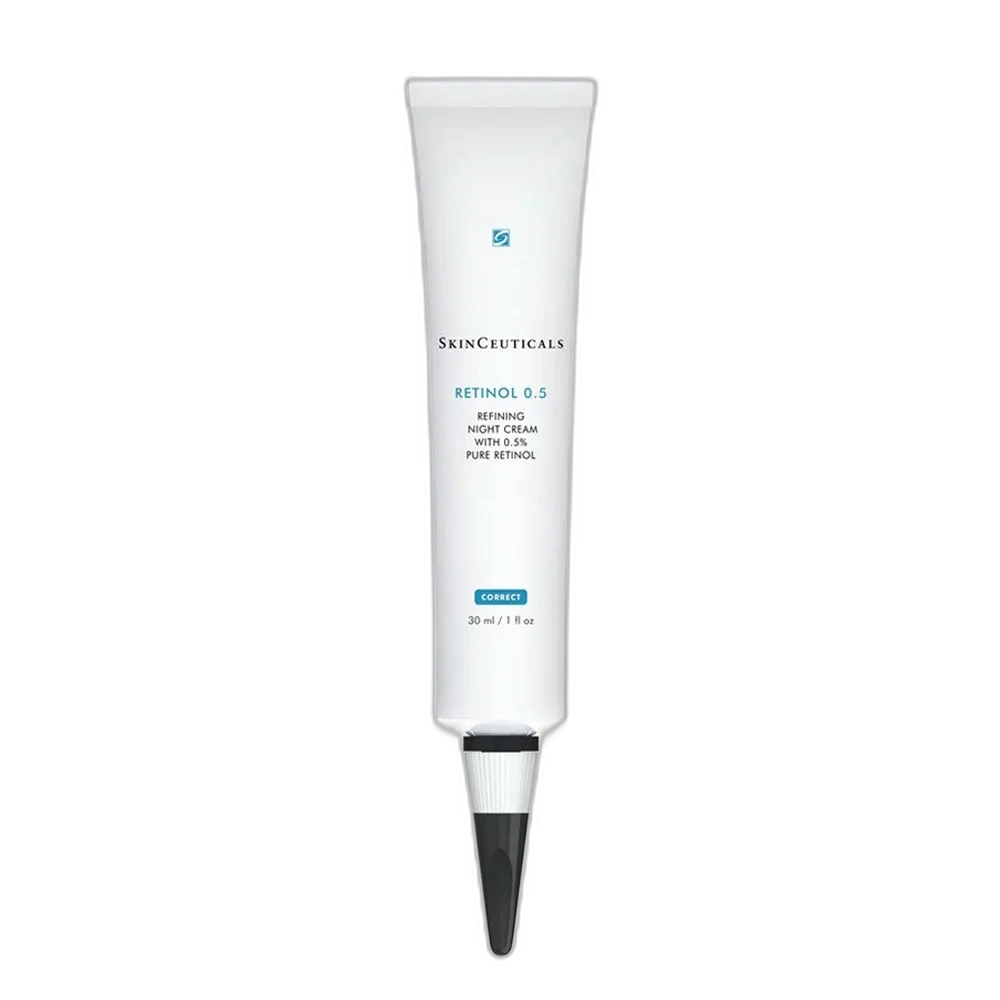
Retinol 0.5
The Goldilocks Retinol
 Verified reviewer
Pros & cons.
- +Optimal balance of retinol efficacy and tolerability for long-term maintenance use
- +Clinically meaningful 0.5% concentration drives visible improvement in lines, spots, and texture
- +Same proven soothing complex (boswellia + bisabolol) as the entire retinol line manages retinization reactions
- +Smooth transition for users graduating from the 0.3% concentration
- +Fragrance-free, non-comedogenic formula with stabilization technology to maintain potency
- +Two decades of market history and dermatologist validation at this specific concentration
- −Alcohol denat. at position five compounds with retinol's drying effects on sensitive skin
- −Isopropyl myristate remains a comedogenic concern for breakout-prone users
- −More pronounced retinization phase than the 0.3% — requires patience through weeks 1-3
- −Only $10 less than the 1.0%, which may make some users question why not go higher
- −Requires strict morning sunscreen compliance due to increased photosensitivity
The full review.
Middle options in concentration-tiered lineups often get overshadowed. The entry-level version attracts first-timers, the maximum strength gets the credit, and the middle option remains the best choice for most people. SkinCeuticals Retinol 0.5 has occupied this space since 2004, and two decades later, dermatologists still frequently recommend it as a permanent choice.
The reason is simple math and biology. At 0.3%, retinol provides a gentle start—enough to trigger cellular change, but soft enough that most skin reacts minimally. At 1.0%, you reach maximum over-the-counter strength, and the skin feels it. The 0.5% sits where the retinol curve bends: enough concentration to drive visible, clinically significant improvements in wrinkles, texture, and pigmentation, without the irritation burden of a nightly negotiation with your skin.
The formulation is virtually identical to its siblings. It uses the same propanediol and dimethicone base, the same boswellia-bisabolol soothing duo, and the same hydrogenated lecithin encapsulation system. SkinCeuticals didn’t reinvent the vehicle—they calibrated the engine. Stabilization technology matters more here than at 0.3% because the higher concentration requires more retinol protection from degradation and more controlled release to avoid an irritation-inducing burst.
The texture is identical to the 0.3%—a lightweight, silicone-smooth cream that absorbs within seconds. You won’t feel the concentration increase; you’ll see it in your skin’s response over the first few weeks. Expect a more pronounced retinization phase than the 0.3%: more definitive flaking, possible tightness, and perhaps mild redness around the nose and mouth where skin is thinner. This is skin recalibrating, not rebelling, and it resolves within two to three weeks for most users.
For those moving from the 0.3%, the transition is smoother than starting fresh. Your skin has already adapted its enzyme pathways to convert retinol to retinoic acid, rebuilt its barrier response for accelerated turnover, and adjusted its inflammatory threshold. The step from 0.3% to 0.5%—a 67% concentration increase—typically feels like a mild reprise of the initial retinization rather than a full adjustment period.
Clinical benefits at 0.5% are more assertive. While the 0.3% gently encourages collagen synthesis and cellular turnover, the 0.5% has more authority. Fine lines soften more perceptibly by week eight. Dark spots and post-inflammatory hyperpigmentation fade faster as pigmented keratinocytes are replaced more aggressively. Pore appearance improves as the retinol normalizes sebaceous activity and refines the pore lining texture. The difference isn’t dramatic in a single week, but over months, the 0.5% user typically sees results that the 0.3% user takes significantly longer to match.
The same formulation caveats apply. Alcohol denat. at position five remains controversial in a product that sensitizes the skin, and isopropyl myristate is a potential comedogenic trigger for acne-prone users. SkinCeuticals chose these compromises—likely for texture, stability, and penetration—and they are consistent across the entire retinol line. If you tolerated these ingredients at 0.3%, they are unlikely to cause problems at 0.5%.
At $90, the Retinol 0.5 costs $10 more than the 0.3%—a modest premium for higher efficacy. On a cost-per-result basis, this may be the best value in the three-tier system. The 0.3% at $80 is gentler but slower, and the 1.0% at $102 is stronger but requires more management. The 0.5% delivers the most efficient balance of investment to outcome, which is why dermatologists often keep patients here rather than pushing them to the top tier.
The long game matters with this product. Retinol is not a sprint ingredient. Benefits compound over months and years of consistent use: cumulative collagen deposition, progressive reduction in hyperpigmentation, and ongoing cellular turnover that keeps the skin surface fresh. The 0.5% is the concentration most likely to sustain that long game because it sits where results are clearly visible but nightly application isn’t a chore.
The SkinCeuticals retinol trilogy works because it respects how skin adapts to retinoids—gradually, with individual variation, and with a clear link between concentration, benefit, and burden. The 0.5% is where the story gets interesting, and for most people, it is where the story stays.
Formula
Ingredient analysis.
Full INCI list
Aqua / Water / Eau, Propanediol, Dimethicone, Cetearyl Ethylhexanoate, Alcohol Denat., Dipropylene Glycol, Ammonium Polyacryloyldimethyl Taurate, Allyl Methacrylates Crosspolymer, Acrylamide/Sodium Acryloyldimethyltaurate Copolymer, Hydrogenated Lecithin, Isohexadecane, Retinol, Phenoxyethanol, Caprylyl Glycol, Polysorbate 20, Isopropyl Myristate, Sodium Citrate, Boswellia Serrata Gum, Polysorbate 80, Dimethiconol, Trisodium Ethylenediamine Disuccinate, Bisabolol, BHT, Sorbitan Oleate, Citric Acid, Propyl Gallate
Skin match.
The science.
The Science
Retinol at 0.5% concentration is well-studied in cosmetic dermatology literature. The conversion cascade is the same at all concentrations: retinol enzymatically oxidizes to retinaldehyde, then to all-trans retinoic acid (tretinoin), which binds nuclear retinoic acid receptors (RARs). However, the 0.5% substrate concentration drives more aggressive gene expression modulation than 0.3%. This increases procollagen I and III synthesis, speeds keratinocyte turnover, and inhibits matrix metalloproteinases more strongly.
The 2007 Kafi et al. study in the Archives of Dermatology used 0.4% retinol (near this product's concentration) and showed statistically significant improvements in fine wrinkles, roughness, and overall photodamage severity over 24 weeks. Histology confirmed increased glycosaminoglycan deposition and procollagen I expression in the papillary dermis. A 2015 study by Randhawa et al. in the Journal of Drugs in Dermatology evaluated stabilized retinol at 0.5% and confirmed significant improvements in periorbital wrinkles, mottled pigmentation, and overall photodamage severity after 12 weeks.
The boswellia serrata gum in this formulation contains acetyl-11-keto-beta-boswellic acid (AKBA) and other pentacyclic triterpenes. These inhibit 5-lipoxygenase, suppressing leukotriene synthesis and downstream inflammatory cascades. Because 0.5% retinol causes a higher inflammatory burden than 0.3%, this anti-inflammatory support is more functionally important. The hydrogenated lecithin encapsulation system provides controlled release, distributing retinol delivery over hours instead of a single bolus. This maintains efficacy and reduces peak irritation.
References
- Improvement of Naturally Aged Skin With Vitamin A (Retinol) — Archives of Dermatology (2007)
- Daily Use of a Facial Broad Spectrum Sunscreen Over One-Half of a Face Demonstrates a Significant Improvement in Fine Lines, Wrinkles, Texture, and Overall Appearance of the Complete Face in Individuals Randomized to Concomitant use of a Stabilized Retinol Treatment on Only One-Half of the Face — Journal of Drugs in Dermatology (2015)
Dermatologist Perspective
Board-certified dermatologists often recommend 0.5% concentration for long-term anti-aging maintenance. Many patients tolerate 0.5% nightly after a brief adjustment period, and this concentration provides clinically meaningful results without the compliance issues of higher-strength formulations. For patients who finished the retinization phase at 0.3%, practitioners typically recommend 0.5% as a permanent step-up instead of automatically moving to 1.0%. The boswellia-bisabolol soothing system and stabilized delivery technology make this formulation easy to recommend alongside existing routines like vitamin C and sunscreen.
Where it fits in your routine.
Apply a pea-sized amount to clean, dry skin every evening. If moving up from 0.3%, use it every other night for 1-2 weeks. If new to retinol, start every third night and increase gradually. Apply before moisturizer, but avoid the eye area, lip corners, and nasal folds. Do not layer with AHAs, BHAs, or benzoyl peroxide the same night. Mandatory: use SPF 30+ every morning.
At $90 for 1 oz, Retinol 0.5 offers the best value in SkinCeuticals' three-tier system. It costs $10 more than the 0.3% but shows faster, stronger results, and sits $12 below the 1.0% which requires more skin management for small extra gains. For most users, the 0.5% concentration peaks in cost-per-result efficiency. Retinol 0.5 is premium compared to the broader retinol market—effective 0.5% retinols cost $20-40—but SkinCeuticals' stabilization technology, soothing complex, and two decades of clinical heritage justify the price for users who prioritize formulation confidence.
Retinol users with 0.3% tolerance ready for stronger results, or experienced users from other brands seeking SkinCeuticals' formulation quality, use this. It works best for visible fine lines, established dark spots, uneven texture, and enlarged pores for nightly use without excessive irritation.
Retinol beginners should start with 0.3% first. Pregnant or nursing individuals must avoid all retinol products. People with active eczema, severe rosacea, or compromised barriers should stabilize their skin before using this concentration. If you use prescription tretinoin, this over-the-counter retinol is a step down, not up.
Product details.
All Year
The backstory.
Launched in 2004 alongside the 1.0%, the 0.5% has quietly become the most recommended strength in the SkinCeuticals retinol lineup. While the 0.3% gets attention as the beginner's choice and the 1.0% gets headlines as the maximum strength, the 0.5% is where most dermatologists and long-term retinol users settle. It's the concentration that balances meaningful results with sustainable tolerability — the middle child that actually runs the family.
About SkinCeuticals
Legacy Brand (20+ years)SkinCeuticals was founded in 1997 by Dr. Sheldon Pinnell, Chief of Dermatology at Duke University, whose pioneering antioxidant research established the Duke Antioxidant patent. Acquired by L'Oréal in 2005, the brand remains a cornerstone of evidence-based clinical skincare with extensive peer-reviewed research behind its formulations.
Common myths.
Use the highest retinol concentration you can tolerate.
Retinol doesn't work better just because there is more. The 0.5% concentration stimulates cellular turnover and collagen synthesis without the constant irritation risk of 1.0%. Many dermatologists use 0.5% as the optimal maintenance concentration for long-term use, while they reserve 1.0% for specific treatment phases instead of permanent nightly application.
If the 0.3% does not cause irritation, switch directly to nightly use of 0.5%.
Even retinol-acclimated skin needs a short adjustment period when increasing concentration. Use the 0.5% every other night for 1-2 weeks, then switch to nightly use. Moving from 0.3% to 0.5% is a 67% increase in retinol concentration — your skin feels the change.
FAQ.
What's the difference between SkinCeuticals Retinol 0.3 and 0.5?
The main difference is retinol concentration — it rises 67% from 0.3% to 0.5%. The base formula, soothing ingredients (boswellia + bisabolol), and stabilization technology remain identical. The 0.5% version works faster on fine lines, dark spots, and texture, but has a more noticeable retinization phase. It targets users who tolerate the 0.3% or have prior retinol experience.
Is SkinCeuticals Retinol 0.5 too strong for a first-time retinol user?
Most first-time users should start with 0.3%. If you have resilient, non-sensitive skin and want faster results, some dermatologists start patients at 0.5% every other night. The soothing complex manages retinization, but the adjustment period is more noticeable than at 0.3%.
How long should I use SkinCeuticals Retinol 0.5 before moving to 1.0?
Use 0.5% consistently for 3-6 months before trying 1.0%. Many dermatologists recommend staying at 0.5% indefinitely; it provides anti-aging benefits and has a favorable tolerability profile. Move to 1.0% if you plateau at 0.5% and want maximum retinol intensity, but most users do not need this progression.
Can I use SkinCeuticals Retinol 0.5 every night?
Yes, once your skin acclimates. Use it every other night for the first 2-3 weeks, then apply nightly if tolerated. Always apply to clean, dry skin and follow with moisturizer. If redness or flaking persists after 3-4 weeks, return to every other night and try increasing again after one month.
Does SkinCeuticals Retinol 0.5 help with dark spots?
Yes — 0.5% retinol fades post-inflammatory hyperpigmentation and sun-induced dark spots. It works by inhibiting melanocyte tyrosinase activity and accelerating pigmented cell turnover. Hyperpigmentation shows visible improvement after 8-12 weeks of consistent nightly use. Use vitamin C in the morning and diligent sunscreen for optimal results.
Community
What the community says.
"Noticeable improvement in fine lines and skin texture within 6-8 weeks"
"Good balance between efficacy and tolerability"
"Smooth, comfortable cream texture for a mid-strength retinol"
"Effective at fading dark spots and evening skin tone"
"Fragrance-free formula with no irritating scent"
"Contains alcohol denat. which can exacerbate retinol-related dryness"
"Isopropyl myristate may trigger breakouts in acne-prone users"
"More noticeable retinization period than the 0.3%"
"Price increase from 0.3% ($80) to 0.5% ($90) offers only incremental concentration gain"
People also looked at.