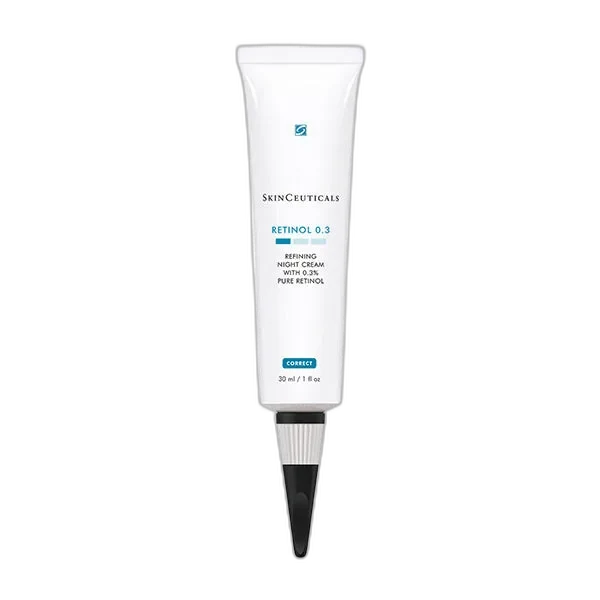
Retinol 0.3
Beginner-Friendly Retinol
 Verified reviewer
Pros & cons.
- +Ideal starter concentration designed to build retinol tolerance before stepping up to 0.5% and 1.0%
- +Dual botanical soothing complex with boswellia and bisabolol minimizes retinization discomfort
- +Advanced stabilization and encapsulation technology ensures consistent retinol delivery throughout product life
- +Completely fragrance-free and non-comedogenic formula suitable for most skin types
- +Lightweight cream texture absorbs quickly and layers well under night moisturizers
- +Opaque tube packaging protects light-sensitive retinol from degradation
- −Alcohol denat. at position five is a questionable inclusion in a formula for retinol-sensitized skin
- −Isopropyl myristate is a known comedogenic ingredient that may cause breakouts in acne-prone users
- −Some users find the 0.3% concentration too gentle for visible anti-aging improvement
- −At $80 per ounce, it's priced higher than many effective retinol alternatives at the same concentration
- −Results require 8-12 weeks of consistent nightly use — not a quick-fix product
The full review.
Dermatologists across the country often have the same conversation: a patient asks about retinol, the dermatologist nods, and then the critical question follows—which one? For many practitioners, SkinCeuticals Retinol 0.3 has been the answer for over a decade. It isn’t the strongest, cheapest, or most glamorous; it simply gets people started and keeps them coming back.
The logic is simple. Retinol works. The evidence for its ability to stimulate collagen production, accelerate cellular turnover, reduce hyperpigmentation, and improve skin texture is among the most robust in dermatology. But retinol also irritates—and irritation is the number one reason people quit retinol before seeing results. The SkinCeuticals three-tier system (0.3 → 0.5 → 1.0) mirrors how dermatologists titrate prescription retinoids in clinical practice: start low, build tolerance, and step up when ready.
The 0.3% concentration sits in a well-studied sweet spot. Research shows retinol concentrations as low as 0.025% produce measurable improvements in photodamaged skin with consistent use. At 0.3%, you get enough active to drive real change—improved cell turnover, enhanced collagen synthesis, and gradual fading of dark spots—without the aggressive retinization that makes higher concentrations feel like punishment.
This formulation is more thoughtful than most because of the soothing architecture built around the retinol. Boswellia serrata resin extract, derived from frankincense, has well-documented anti-inflammatory properties that counteract the redness and irritation pathways retinol activates. Bisabolol, the star compound from chamomile, adds a second layer of calming activity. Together, they create a buffer that makes the adjustment period more comfortable than bare retinol in a basic cream base.
SkinCeuticals also uses stabilization technology—the retinol is encapsulated and formulated for steady, even release rather than a burst of activity that overwhelms the skin. This matters more than most consumers realize. Pure retinol is notoriously unstable; it degrades rapidly when exposed to light, heat, and air. The opaque tube packaging and the stabilization chemistry ensure the retinol you apply on month three is as potent as the retinol from your first application.
The texture is a pleasant cream—lightweight, silicone-smooth, and fragrance-free. It absorbs quickly and leaves a matte, comfortable finish that works under any night cream or sleeping mask. It lacks the sticky, shiny residue found in some retinol serums, and the cream base provides enough emolliency to partially offset the drying effects of retinol without feeling heavy.
The ingredient list has compromises. Alcohol denat. is at position five, acting as a solvent and penetration enhancer. In a product for retinol-sensitized skin, including a drying alcohol is a familiar SkinCeuticals trade-off—it improves texture and absorption but adds a theoretical irritation vector. For most users, the soothing botanicals compensate, but it is worth noting. Isopropyl myristate, an emollient, is a known comedogenic ingredient that can trigger breakouts in acne-prone skin—ironic since retinol is often recommended for acne management.
Performance follows a predictable trajectory. The first two to four weeks bring the retinization phase: mild dryness, possible flaking, and occasional sensitivity. This is normal—it is the skin adjusting to accelerated turnover, not damage. By week four to six, skin looks more radiant and feels smoother. By week eight to twelve, deeper benefits emerge: softened fine lines, more even tone, and refined pore appearance.
At $80 for an ounce, SkinCeuticals Retinol 0.3 sits in the mid-premium range for retinol treatments. The price reflects the brand’s clinical heritage, the stabilization technology, and the soothing complex—though effective retinol formulations exist at lower price points. You are paying for the confidence of SkinCeuticals’ formulation expertise and nearly three decades in clinical skincare. For a first retinol, that confidence has value.
The graduation model is both a strength and a gentle upsell. Once skin tolerates the 0.3%, the next step is the 0.5%, then eventually the 1.0%. This approach mirrors best dermatological practice, meaning your initial investment in the 0.3% is preparation. However, some users stay at 0.3% indefinitely, which is a valid choice. Not everyone needs maximum-strength retinol.
This is the retinol for the person who wants to do it right rather than fast. It respects the skin’s adaptation timeline, surrounds the active with ingredients that make the process gentler, and comes from a brand with the clinical credibility to back its claims. It won’t provide dramatic before-and-after photos in a week. It provides a consistent, comfortable introduction to the most evidence-backed anti-aging ingredient in skincare.
Ingredient analysis.
Full INCI list
Aqua / Water / Eau, Propanediol, Dimethicone, Cetearyl Ethylhexanoate, Alcohol Denat., Dipropylene Glycol, Ammonium Polyacryloyldimethyl Taurate, Hydrogenated Lecithin, Allyl Methacrylates Crosspolymer, Phenoxyethanol, Caprylyl Glycol, Isopropyl Myristate, Retinol, Polysorbate 20, Sodium Citrate, Boswellia Serrata Resin Extract, Dimethiconol, Trisodium Ethylenediamine Disuccinate, Bisabolol, Citric Acid, BHT, Propyl Gallate
Skin match.
The science.
The Science
Retinol has one of the best-characterized mechanisms of action in cosmetic dermatology. Once applied topically, endogenous enzymes convert retinol to retinaldehyde, then to all-trans retinoic acid (tretinoin). This active form binds nuclear retinoic acid receptors (RARs) to modulate gene expression. This cascade increases collagen I and III production, speeds keratinocyte turnover, inhibits matrix metalloproteinase activity, and lowers melanocyte tyrosinase expression—treating fine lines, texture, photodamage, and hyperpigmentation.
A 2007 Kafi et al. study in the Archives of Dermatology showed that topical retinol at 0.4% applied to photodamaged skin three times weekly for 24 weeks improved fine wrinkles and skin roughness more than a vehicle control. Biopsies confirmed increased glycosaminoglycan and procollagen I expression. Subsequent studies show lower concentrations (0.025-0.3%) produce similar improvements with less irritation.
The boswellia serrata resin extract contains boswellic acids, specifically acetyl-11-keto-beta-boswellic acid (AKBA), which inhibit 5-lipoxygenase and NF-κB inflammatory pathways. This anti-inflammatory activity targets retinol-induced irritation, which involves upregulated inflammatory cytokines and disrupted barrier function. Bisabolol, the main active compound in chamomile, adds soothing effects through COX-2 inhibition and direct anti-inflammatory action on keratinocytes.
SkinCeuticals' encapsulation technology solves retinol's instability. Pure retinol degrades fast under UV exposure and oxidative conditions, losing efficacy. The hydrogenated lecithin in this formula acts as a liposomal encapsulant. This delivery system protects the retinol during storage and releases it gradually upon skin contact, providing sustained activity instead of a single burst that exceeds the skin's tolerance threshold.
References
- Improvement of Naturally Aged Skin With Vitamin A (Retinol) — Archives of Dermatology (2007)
Dermatologist Perspective
Board-certified dermatologists often view the 0.3% concentration as the best starting point for retinol-naive patients. Dermatologists note that irritation is the main barrier to retinol compliance; patients with significant flaking, redness, or stinging in the first weeks often stop treatment before the 8-12 week threshold when results appear. SkinCeuticals' use of boswellia and bisabolol addresses this, and the three-tier graduation system follows clinical retinoid titration protocols. Practitioners usually suggest starting with every-other-night application, moving to nightly use over 2-4 weeks, and using a moisturizer buffer if needed. The fragrance-free, non-comedogenic formula works for most skin types.
Where it fits in your routine.
Apply a pea-sized amount to clean, dry skin every evening. Use every other night for the first 2-4 weeks to let the skin adjust, then increase to nightly use. Apply before moisturizer. Avoid the eye area, corners of the nose, and lips. Do not use AHAs, BHAs, or benzoyl peroxide on the same evening. Apply sunscreen SPF 30+ every morning because retinol increases photosensitivity.
At $80 for 1 oz, SkinCeuticals Retinol 0.3 sits in the mid-premium tier for retinol treatments. Effective retinol products exist at lower price points — The Ordinary's retinol options start under $10, and CeraVe's retinol serum is under $20. What SkinCeuticals offers at this price is formulation confidence: proprietary stabilization technology, a purpose-built soothing complex, and the backing of a brand that has been developing clinically validated skincare since 1997. For a first retinol purchase, the reduced risk of irritation-driven abandonment has real economic value — a $10 retinol that you quit after two weeks costs more than an $80 one you actually use for a year.
This is for first-time retinol users, especially those in their late 20s to 40s targeting early aging, uneven texture, or dullness. It works for cautious users because the clinically backed formula minimizes the retinization adjustment period and includes a clear graduation path to higher concentrations.
Pregnant or nursing individuals must avoid all retinol products. Resolve active eczema, severe rosacea, or deeply compromised skin barriers before using retinol. If you use retinol and prefer higher concentrations, the 0.3% may not deliver your desired results — use the 0.5 or 1.0 instead.
Product details.
This lightweight cream has a smooth, silicone-enriched feel. It glides on easily and absorbs without heaviness or greasiness.
Completely fragrance-free — no detectable scent
An opaque tube protects the retinol from light and air degradation. This packaging is intentional; retinol is unstable, and the airless tube format maintains potency throughout the product's life.
Expect a mild adjustment period during the first 2-4 weeks. Some users see slight dryness, flaking, or temporary sensitivity; this is normal retinization, not damage. Start with every other night and gradually increase to nightly use. The cream feels comfortable and non-irritating on application.
2-3 months with nightly application of a pea-sized amount to the face
12 months
All Year
The backstory.
SkinCeuticals launched their retinol line with the 0.5 and 1.0 concentrations in 2004, then added the 0.3 to create a gentler on-ramp for retinol beginners. The three-tier system was designed to mirror how dermatologists typically introduce retinoids in clinical practice — starting low and gradually increasing concentration as the skin builds tolerance. It's a clinical approach translated into consumer skincare.
About SkinCeuticals
Legacy Brand (20+ years)SkinCeuticals was founded in 1997 by Dr. Sheldon Pinnell, Chief of Dermatology at Duke University, whose pioneering antioxidant research established the Duke Antioxidant patent. Acquired by L'Oréal in 2005, the brand remains a cornerstone of evidence-based clinical skincare with extensive peer-reviewed research behind its formulations.
Common myths.
0. 3% retinol lacks the strength to produce real anti-aging results.
Research shows low retinol concentrations (0.025-0.3%) improve fine lines, texture, and photodamage with consistent use. The 0.3% concentration in this formula increases cellular turnover but causes less irritation than higher concentrations. This helps users stick with the product long enough to see results.
Retinol works by causing peeling and redness.
Retinization side effects do not indicate efficacy; they show irritation. SkinCeuticals uses boswellia and bisabolol to minimize these reactions. The retinol works at the cellular level even if your skin flakes.
FAQ.
Is SkinCeuticals Retinol 0.3 good for beginners?
Yes — this is the entry point for SkinCeuticals' three-tier retinol system. The 0.3% concentration increases cellular turnover and collagen production. The boswellia and bisabolol soothing complex reduces the irritation that often makes beginners stop using retinol before they see results. Use it every other night, then move to nightly use.
When should I upgrade from SkinCeuticals Retinol 0.3 to 0.5?
Use 0.3% nightly for 3-6 months without significant irritation before moving to 0.5%. You are ready if your skin stops flaking or feeling sensitive after application and you want more visible anti-aging results. There is no rush; many users see excellent results staying at 0.3% indefinitely.
Can I use SkinCeuticals Retinol 0.3 with vitamin C?
Yes, but use them at different times. Apply vitamin C serum in the morning for antioxidant protection and UV defense, then use Retinol 0.3 in the evening. Using both on the same skin at the same time increases irritation and reduces the efficacy of both ingredients due to pH incompatibility.
Does SkinCeuticals Retinol 0.3 cause purging?
Some users experience brief purging during the first 2-4 weeks. Existing microcomedones surface faster than usual, causing temporary breakouts. This is a normal response to retinol-accelerated cell turnover and resolves within 4-6 weeks. If irritation persists beyond that, reduce frequency or consult a dermatologist.
How long does it take to see results from SkinCeuticals Retinol 0.3?
Radiance improves and texture smooths within 4-6 weeks. Fine lines, dark spots, and pore size reduce after 8-12 weeks of consistent nightly application. Full anti-aging benefits build over 6-12 months of continuous use.
Community ---
What the community says.
"Gentle enough for first-time retinol users without sacrificing results"
"Noticeable improvement in skin texture and radiance within weeks"
"Fragrance-free and non-irritating for most skin types"
"Good stepping stone before graduating to higher concentrations"
"Smooth, comfortable cream texture that doesn't feel drying"
"Contains alcohol denat. which some users find contradictory in a retinol product"
"Isopropyl myristate may cause breakouts in acne-prone skin"
"Price is high for the retinol concentration compared to some competitors"
"Some users see minimal anti-aging results and wish they'd started at 0.5%"
People also looked at.