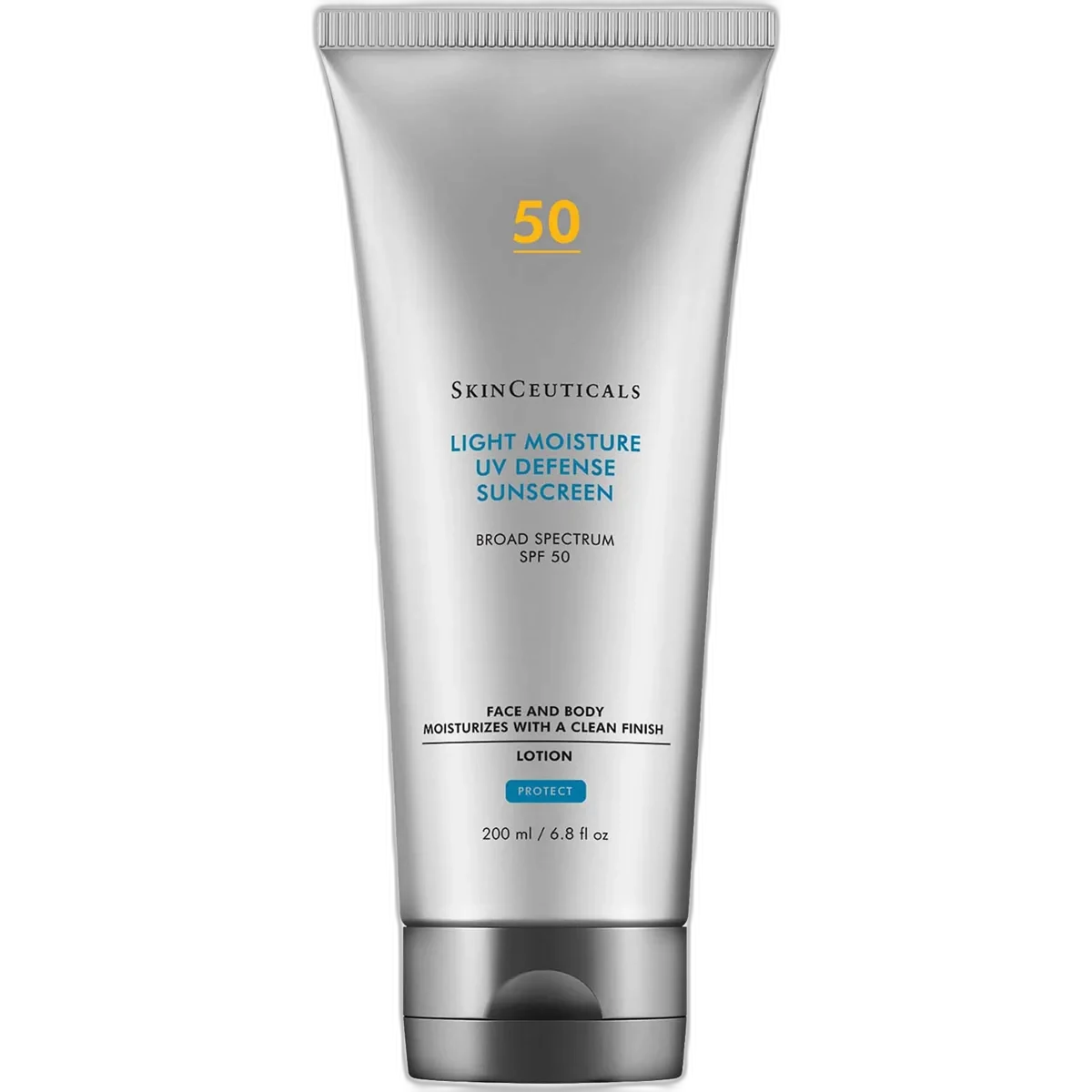
Light Moisture UV Defense SPF 50
Invisible Daily SPF
 Verified reviewer
Pros & cons.
- +Weightless fluid finish disappears under makeup
- +Broad-spectrum SPF 50 with stabilized avobenzone
- +Fragrance-free and suitable for most skin types
- +Doubles as a light morning moisturizer on combination skin
- +Slots cleanly into the full SkinCeuticals routine
- +No white cast or tint on any skin tone
- −Expensive at $43 for a 1 oz bottle
- −Not water-resistant — unsuitable for sport or beach use
- −Uses older-generation US chemical filters rather than modern alternatives
- −Small bottle runs out in 6-8 weeks of daily use
- −Homosalate content may concern hormone-sensitive users
The full review.
There is a particular kind of sunscreen frustration that anyone who wears makeup daily knows well. You find a product with solid UV filters, apply it generously because that is how sunscreens actually work, and then within thirty seconds your foundation is pilling, your concealer is sliding, and the sunscreen has somehow turned into a subtle sheen across your forehead that no amount of powder will fix. The options until recently have been depressing: use a mineral tint that leaves a white cast, use a heavier chemical SPF and accept the compromises, or skip sunscreen on makeup days and pretend that is fine.
SkinCeuticals Light Moisture UV Defense was built specifically to solve this problem, and it mostly does. The formulation is a conventional US chemical filter stack — 3% avobenzone for UVA, 8% homosalate and 5% octisalate for UVB, and 6% octocrylene to keep the avobenzone from photodegrading during wear — carried in a polymer-and-silicone base that turns an otherwise greasy filter cocktail into a fluid that absorbs in under twenty seconds. There is no tint. There is no white cast. There is no sheen. There is just a thin, weightless layer of protection that sits on skin like a hydrating primer.
The cosmetic experience is genuinely impressive. Light Moisture UV Defense pours out as a thin, white, slightly milky lotion that spreads across the face with essentially zero resistance. Within thirty seconds it has absorbed into a natural finish — not matte, not dewy, just skin-colored and smooth. Foundation goes on over it without any of the classic chemical-sunscreen problems. Powder sets cleanly. It lasts through a normal eight-hour workday without slipping or pilling. For makeup wearers, this is not a trivial achievement — it is the entire point.
The formulation sits in an interesting place in the broader SPF market. It is noticeably lighter than most SPF 50 chemical sunscreens, which tend to feel heavier because of the filter concentrations needed to hit that SPF number. It is more elegant than older SkinCeuticals daily chemical options. And it slots naturally into the brand’s full morning routine — CE Ferulic or Phloretin CF as the antioxidant, Hydrating B5 Gel as the hydration step, a light moisturizer if needed, and Light Moisture UV Defense as the final step before makeup. The whole sequence takes two minutes and the skin feels and looks genuinely finished at the end of it.
The honest caveats are worth discussing. First, this is not a water-resistant sunscreen, which means it is strictly a daily-wear product for office, commute, and indoor life. For beach days, outdoor workouts, or any situation involving real sweat or water exposure, you need SkinCeuticals Sport UV Defense or a water-resistant sunscreen from another brand. Second, the one-ounce bottle is small — if you are applying the recommended quarter-teaspoon dose to face and neck daily (and you should be), one bottle gets you about six to eight weeks of use. At forty-three dollars, that works out to a meaningful monthly sunscreen budget, and the bottle will feel like it runs out faster than you expect.
Third, and this is the core value conversation, the filter system is not advanced by international standards. Europe, Asia, Australia, and South Korea all have access to newer-generation UV filters — Tinosorb S, Tinosorb M, Uvinul A Plus, Mexoryl SX — that offer better photostability, broader absorption, and in many cases lighter textures than the classic US filter set this sunscreen uses. If you compare Light Moisture UV Defense to a modern European sunscreen like Bioderma Photoderm Max or La Roche-Posay Anthelios UVMune 400, the European products have a technical advantage in their filter systems that no amount of US formulation wizardry can fully close. What SkinCeuticals has done well is execute the old-generation US filters as elegantly as possible. What they have not done is fundamentally update the chemistry, because US regulations do not yet allow it.
The honest positioning is this: Light Moisture UV Defense is the best version of a specific category — the daily, invisible, makeup-friendly chemical SPF 50 that fits into a clinical-brand routine. Within the constraints of US-legal filters, it is genuinely well-built. The price reflects the SkinCeuticals premium and the cosmetic elegance, not a chemistry breakthrough. For anyone committed to the brand’s morning routine who wants their sunscreen to disappear into the rest of the regimen, this is a justifiable buy. For anyone willing to import European sunscreens or shop from Asian brands with better filter access, there are lighter-feeling and more photostable options at similar or lower prices.
Ingredient analysis.
Full INCI list
Avobenzone 3.0%, Homosalate 8.0%, Octisalate 5.0%, Octocrylene 6.0%, Water, Butyloctyl Salicylate, Styrene/Acrylates Copolymer, Glycerin, Dimethicone, Isododecane, Butylene Glycol, Nylon-12, Caprylic/Capric Triglyceride, Silica, Cetyl PEG/PPG-10/1 Dimethicone, Sorbitan Oleate, Alumina, Sodium Chloride, Disodium EDTA, Tocopherol, Phenoxyethanol, Caprylyl Glycol, Ethylhexylglycerin
Skin match.
The science.
The Science
Light Moisture UV Defense uses the standard US-legal chemical sunscreen stack for SPF 50: 3% avobenzone for UVA-I absorption, 8% homosalate and 5% octisalate for UVB absorption, and 6% octocrylene to photostabilize avobenzone. These filters have decades of regulatory and clinical history. Their combination provides stable broad-spectrum SPF 50 protection in the US market. Avobenzone is the primary UVA filter in almost every US chemical sunscreen because the US FDA has not approved newer-generation UVA filters like Tinosorb S, Tinosorb M, or Uvinul A Plus, which are available in Europe, Asia, and much of the rest of the world. The octocrylene is critical; without a photostabilizer, avobenzone degrades rapidly under UV exposure and loses its protective capacity within an hour or two. Recent research shows trace benzophenone formation from octocrylene during long-term storage, which caused consumer concern, but dermatology organizations agree these levels are not a meaningful safety concern at typical use. The 8% homosalate content stays within US legal limits and provides most of the UVB absorption. The formulation executes this filter set well—the polymer and silicone base turns a greasy stack into a fluid that behaves well on skin. It does not improve the underlying chemistry, which US regulations constrain rather than the brand's choices.
Dermatologist Perspective
Board-certified dermatologists often recommend Light Moisture UV Defense to patients wanting a daily chemical SPF that fits under makeup and works with the SkinCeuticals antioxidant-plus-sunscreen protocol. It suits normal to combination skin types who find heavier mineral sunscreens uncomfortable or want to avoid a white cast. Dermatologists note it is not a water-resistant sport sunscreen and is not for extended outdoor activity. Patients with very sensitive skin, rosacea, or a preference for mineral filters usually use Physical Fusion UV Defense or another mineral option instead.
Where it fits in your routine.
Apply at least a quarter-teaspoon to face and neck as your last morning step, ideally 15 minutes before sun exposure. Pat the product instead of rubbing if you wear serums underneath to keep prior layers intact. Apply makeup as usual without waiting. Reapply every two hours during outdoor exposure, or use a powder or stick SPF over makeup for daytime touch-ups. Shake well if the product sits unused. This is not a sport sunscreen — use a water-resistant option for beach days, workouts, or extended outdoor activity.
At $43 for 1 oz, Light Moisture UV Defense costs more than drugstore chemical sunscreens but matches mid-range clinical brands. The cosmetic experience justifies the premium over Neutrogena Ultra Sheer or CeraVe Hydrating Sunscreen, though the core filter chemistry is identical. Compared to European chemical sunscreens using modern filter systems, the value drops — Bioderma, La Roche-Posay, and Avène offer lighter, more photostable options at similar prices if available. The right buyer uses the SkinCeuticals ecosystem and wants a cohesive routine. Others find better value elsewhere.
Daily makeup or layered serum users want a chemical SPF 50 that leaves no pilling, sheen, or white cast. It works well for SkinCeuticals loyalists who use CE Ferulic or Phloretin CF.
Users with very sensitive skin, rosacea, or a mineral-sunscreen preference should choose Physical Fusion UV Defense instead. Sport, beach, and high-sweat situations require a water-resistant formulation — this one is not designed for that use case.
Product details.
Light fluid lotion that spreads easily and absorbs fast
Essentially unscented with a mild chemical filter note
Grey tube with flip-top cap
Absorbs in seconds to a natural finish without a white cast. Most users find it invisible under makeup from day one. It requires no breaking-in period.
6-8 weeks with daily full-face application at the recommended 1/4 teaspoon dose
12 months
All Year
The backstory.
Light Moisture UV Defense launched in 2022 as part of SkinCeuticals' expansion of its UV Defense line, designed specifically for users who wanted a chemical SPF that could double as the morning moisturizer step under makeup. It replaced older daily chemical options in the range and has become one of the brand's more popular everyday sunscreens.
About SkinCeuticals
Legacy Brand (20+ years)Dr. Sheldon Pinnell's topical antioxidant research at Duke University led to the founding of SkinCeuticals in 1997. Dermatology offices widely distribute its sunscreen range, which aligns with the brand's broader photoprotection protocol.
Common myths.
Avoid chemical sunscreens with octocrylene because they are unsafe.
Regulatory agencies worldwide approve Octocrylene for safe use in sunscreens for decades. Some studies question long-term photodegradation byproducts, but clinical consensus says Octocrylene is safe and works as a photostabilizer for avobenzone.
FAQ.
Is SkinCeuticals Light Moisture UV Defense SPF 50 good under makeup?
Yes — this is a main strength. The lightweight fluid finish sits cleanly under foundation, primer, or powder. It does not pill or change the makeup finish, so many dermatologists recommend it for makeup wearers.
Is this sunscreen water-resistant?
No — Light Moisture UV Defense is not formulated as a water-resistant sport sunscreen. For swimming, sweating, or beach use, choose SkinCeuticals Sport UV Defense or another water-resistant option.
Can I use Light Moisture UV Defense on oily skin?
Yes — the oil-free, silicone-based formulation works for oily and combination skin. The finish is natural, not matte, but it leaves no greasy sheen and does not cause breakouts in most users.
Does this sunscreen contain oxybenzone or octinoxate?
No — the filter system uses avobenzone, homosalate, octisalate, and octocrylene. It lacks oxybenzone or octinoxate, the filters restricted in reef-sensitive areas like Hawaii.
Can I skip moisturizer and use this alone?
On normal to combination skin, yes — the glycerin content and silicone base provide enough surface moisture for this sunscreen to act as your morning moisturizer. Dry skin still needs a dedicated moisturizer underneath.
How does Light Moisture UV Defense compare to Physical Fusion UV Defense?
Physical Fusion is a mineral (titanium + zinc) sunscreen with a tinted finish. It works best for sensitive or rosacea-prone skin. Light Moisture is a chemical sunscreen with a lighter, invisible finish. It works best for makeup layering and users who want no tint.
What the community says.
"Lightweight feel on skin"
"No white cast"
"Layers beautifully under makeup"
"Doubles as light moisturizer"
"Fragrance-free"
"Expensive for a standard chemical sunscreen"
"Small 1 oz bottle"
"Not water-resistant"
"Contains homosalate and octocrylene"
People also looked at.