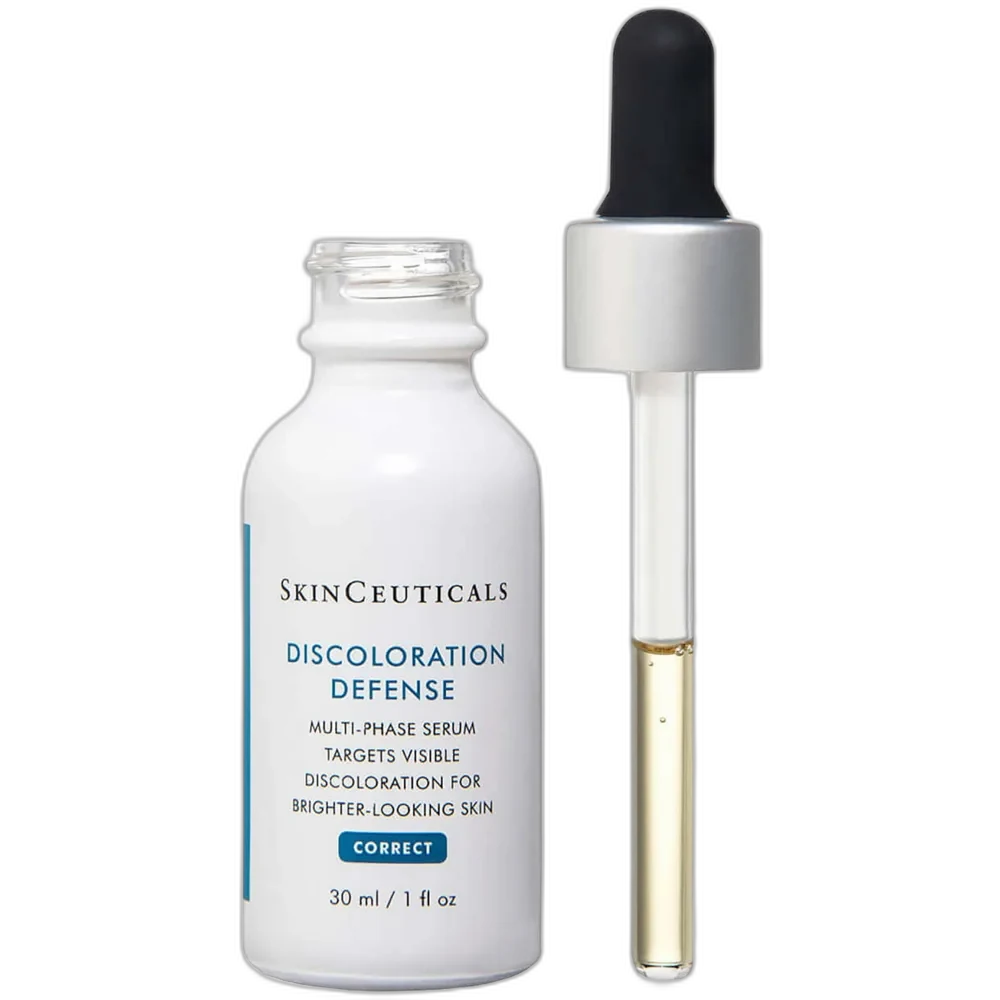
Discoloration Defense
Pigmentation Workhorse
 Verified reviewer
Pros & cons.
- +3% tranexamic acid at a meaningful clinical concentration
- +5% niacinamide — the evidence-backed dose for pigmentation improvement
- +Four complementary mechanisms targeting different points in the melanogenesis pathway
- +Well-tolerated including on most sensitive and rosacea-prone skin
- +Fragrance-free and alcohol-free base
- +Lightweight gel texture layers cleanly under moisturizer and SPF
- +Compatible with vitamin C, retinoids, and most other actives
- +Backed by published clinical research on the specific formulation
- −$112 for 1 oz places it in the premium clinical tier
- −Results require 12-16 weeks of consistent use, not instant
- −Effectiveness depends absolutely on rigorous daily sunscreen use
- −Severe melasma or deep pigmentation may need in-office treatment alongside
- −No larger economy size offered to reduce per-ounce cost
The full review.
Many dermatology appointments end the same way: a patient with melasma explains that hydroquinone fades dark patches temporarily, but they always return. Doctors agree melasma is one of the hardest conditions to treat in cosmetic dermatology. The issue isn’t just pigment; inflammation tells melanocytes to turn on. Hydroquinone shuts down melanin synthesis and fades existing pigment, but it doesn’t stop the underlying signaling. When patients stop hydroquinone—which they must, as long-term use risks paradoxical darkening—the melasma returns. This frustrating cycle brought tranexamic acid from Asian dermatology into global skincare around 2015-2018. Instead of fighting melanin production, tranexamic acid interrupts the plasmin-driven inflammatory cascade that activates melanocytes. It uses a different mechanism and a different angle for better long-term prospects.
SkinCeuticals Discoloration Defense launched in 2018 as one of the first major clinical brand products to use tranexamic acid as its headline active. The concentration matters: 3% is meaningful, not trace. Paired with 5% niacinamide (the concentration with the strongest published evidence for pigmentation improvement), kojic acid, and 4-butylresorcinol, the formula targets four distinct points in the melanogenesis pathway. Tranexamic acid interrupts plasmin-inflammatory signaling. Niacinamide blocks melanosome transfer from melanocytes to keratinocytes. Kojic acid inhibits tyrosinase (the enzyme that converts tyrosine to melanin). 4-butylresorcinol is another potent tyrosinase inhibitor with a different molecular structure, providing overlapping but not identical enzyme blocking. This multi-mechanism approach is why this serum works on pigmentation where single-mechanism products fail.
Texture
The texture is pleasant. It is a lightweight water-gel that absorbs within a minute, leaves no sticky residue, and layers cleanly under moisturizer and sunscreen.
Scent
Fragrance-free.
Pairs Well With
Use it alongside vitamin C in the morning (they have complementary mechanisms) and alongside retinoids at night. Stack it with consistent sunscreen to build one of the most effective multi-pronged approaches to stubborn pigmentation available from over-the-counter products.
Best for
The results timeline is slower than most users want. Subtle brightening shows up in 2-3 weeks. Noticeable fading of post-inflammatory hyperpigmentation—the dark marks left by acne, bug bites, or minor injuries—typically appears at 6-8 weeks. Melasma and deeper pigmentation usually require 12-16 weeks of twice-daily use with absolute sunscreen diligence. Pigmentation treatment without daily broad-spectrum SPF 30+ is essentially futile. UV exposure continuously reactivates melanocytes and undoes topical progress. People who use this serum faithfully but skip sunscreen on overcast days see much worse results than people who are less rigorous about the serum but religious about sun protection. The sunscreen is the treatment; the serum is the accelerator.
Works for
Regarding ingredient coherence: SkinCeuticals earns its clinical positioning here. Every active in the formula has an evidence-supported role, the concentrations are meaningful, and the mechanisms are complementary rather than redundant. The tranexamic acid dose is at a level where clinical studies show measurable benefit. The 5% niacinamide is at the sweet spot for pigmentation efficacy. The tolerability profile—fragrance-free, no alcohol, and gentle enough for most sensitive skin—is what you want for a product used twice daily for months to deliver results.
Common Complaints
The weaknesses are few. The price is $112 for 1 oz, which is expensive but reasonable for the ingredient density and clinical positioning. A 2-3 month supply costs roughly $1-1.25 per day. The bigger issue is patience: users expecting dramatic before-and-after results in four weeks will be disappointed. This is a slow-burn formula that compounds over months. If you aren’t committed to consistent twice-daily use and rigorous sun protection, you won’t get the full benefit. The formulation is not a miracle—for severe melasma or deeply-set hyperpigmentation, in-office treatments like chemical peels, IPL, or prescription compounded creams deliver faster results. Discoloration Defense works best as a maintenance and supporting therapy alongside those.
Who Should Buy
Anyone dealing with persistent hyperpigmentation, melasma, post-inflammatory marks, sun damage, or uneven skin tone who will commit to twice-daily use and consistent sunscreen for 12-16 weeks. It also fits patients whose dermatologist recommended a topical tranexamic acid product and who want a well-formulated clinical option.
Not ideal for
Anyone unwilling to pair it with daily broad-spectrum SPF (you will just waste the serum), people looking for instant results, and patients whose pigmentation is severe enough to warrant in-office treatment. Those users will still benefit from this serum, but should use it as a supplement to procedures rather than the primary tool.
Ingredient analysis.
Full INCI list
Aqua/Water, Glycerin, Propanediol, Butylene Glycol, Niacinamide, Tranexamic Acid, 4-Butylresorcinol, Kojic Acid, Dimethyl Isosorbide, Hydroxyethylcellulose, Tocopherol, Citric Acid, Sodium Hyaluronate, Tetrasodium EDTA, Caprylyl Glycol, Xanthan Gum, Phenoxyethanol, Chlorphenesin
Skin match.
The science.
The Science
This formulation uses several well-researched mechanisms to address hyperpigmentation. Tranexamic acid is a synthetic lysine derivative, originally an antifibrinolytic drug. Researchers found its role in pigmentation when patients taking oral tranexamic acid for other uses showed melasma improvement. It works by inhibiting plasmin activity, which stops the inflammatory cascade that activates melanocytes. Peer-reviewed studies in the Journal of the American Academy of Dermatology, JAMA Dermatology, and the Indian Journal of Dermatology show that both oral and topical tranexamic acid work for melasma; topical concentrations of 2-5% show measurable improvement in several clinical trials. Niacinamide has extensive evidence for pigmentation improvement. Landmark studies by Hakozaki and colleagues show that 5% topical niacinamide reduces hyperpigmentation by inhibiting melanosome transfer from melanocytes to keratinocytes—a mechanism different from tyrosinase inhibition. Kojic acid is a fungal-derived tyrosinase inhibitor used for decades in Asian dermatology. It has moderate clinical evidence for pigmentation reduction, though its potency is below hydroquinone. 4-Butylresorcinol is a resorcinol derivative. Published studies show its tyrosinase inhibition matches or exceeds hydroquinone in some in vitro models without the same side-effect profile. The combination works by targeting four distinct points in melanogenesis: plasmin signaling (TXA), melanosome transfer (niacinamide), and tyrosinase enzyme activity (kojic acid and 4-butylresorcinol via different molecular routes). A published 12-week clinical trial on this specific formulation showed statistically significant improvement in overall discoloration, skin tone evenness, and clarity in patients with multiple pigmentation concerns. This serum has one of the strongest evidence bases of any OTC pigmentation product.
References
- The inhibitory effect of topical tranexamic acid on melasma: A clinical trial — Journal of the American Academy of Dermatology (2019)
- The effect of niacinamide on reducing cutaneous pigmentation and suppression of melanosome transfer — British Journal of Dermatology (2002)
Dermatologist Perspective
Dermatologists recommend Discoloration Defense for patients with melasma, post-inflammatory hyperpigmentation, and stubborn dark spots that fail single-mechanism treatments. Board-certified dermatologists note that tranexamic acid has joined the topical pigmentation toolkit over the last decade, offering an alternative to hydroquinone for patients who cannot tolerate it or need long-term maintenance therapy. This serum often fits into multi-step pigmentation routines with morning vitamin C, evening retinoid, and strict sunscreen compliance. Dermatologists set realistic expectations: topical pigmentation treatment is slow and requires months of consistent use and sunscreen discipline. Some pigmentation patterns—especially dermal melasma and deeply set melasma—respond only partially to topical approaches and may need in-office procedures too. The formulation's tolerability makes it suitable for many patients, including those with sensitive skin.
Where it fits in your routine.
Apply 4-5 drops (about the size of a pea) to clean, dry skin morning and evening. Pat it into the full face, targeting hyperpigmentation. In the morning, apply after vitamin C serum and before moisturizer and sunscreen. In the evening, apply after retinoid (wait 1-2 minutes for retinoid absorption) and before moisturizer. Always use broad-spectrum SPF 30+ during the day; pigmentation treatment fails without sunscreen. Expect subtle improvement at 2-3 weeks and significant results at 12-16 weeks with consistent use. Use as maintenance after reaching goals to prevent recurrence, especially for melasma.
At $112 for 1 oz, Discoloration Defense is a premium clinical product, but the ingredient density and formulation coherence justify the price. The 3% tranexamic acid dose is a meaningful clinical concentration. Drugstore alternatives rarely combine it with 5% niacinamide, kojic acid, and 4-butylresorcinol. For patients with stubborn pigmentation who failed single-mechanism products, this upgrade is worth the cost. A 2-3 month supply costs roughly $1-1.25 per day, making it a manageable ongoing treatment expense. The lack of a larger economy size is a minor drawback. Compared to in-office pigmentation procedures costing $300-800 per session, this serum provides value as a maintenance and supporting therapy.
This is for people with persistent hyperpigmentation, melasma, post-inflammatory marks, sun damage, or uneven skin tone who commit to twice-daily use and rigorous sunscreen for 12-16 weeks. It also suits patients whose dermatologist recommended a topical tranexamic acid product, SkinCeuticals loyalists building a pigmentation routine, and users seeking a well-tolerated hydroquinone alternative.
People who skip daily broad-spectrum SPF (the treatment fails without it), those expecting instant dramatic results, and patients with severe melasma or deep dermal pigmentation needing in-office procedures as primary treatment. Budget-conscious shoppers get adequate results from cheaper niacinamide-plus-azelaic-acid routines.
Product details.
Lightweight, water-gel serum with a smooth feel that absorbs quickly
Unscented
Airless pump tube that protects the actives from light and oxidation
This thin, non-sticky gel absorbs within a minute. Most users feel no tingling or irritation. Results show gradually over weeks; this is a slow-burn formula, not an instant brightener. Daily sunscreen use is essential for results.
Approximately 2-3 months with twice-daily full-face application
12 months
All Year
The backstory.
Discoloration Defense launched in 2018 as SkinCeuticals entered the emerging tranexamic acid category. Tranexamic acid had been used orally and injection-based for melasma in Asian dermatology for years, and topical formulations were starting to show promising results. This serum was one of the first major clinical brand products to build around tranexamic acid as a headline active, and it quickly became a dermatologist favorite for patients with persistent pigmentation issues.
About SkinCeuticals
Legacy Brand (20+ years)SkinCeuticals has led clinical skincare since 1997, based on Dr. Sheldon Pinnell's Duke University antioxidant research. Dermatologists helped develop Discoloration Defense to treat patients with persistent hyperpigmentation. It is now one of the brand's most frequently recommended pigmentation-specific serums.
FAQ.
Can I use Discoloration Defense with vitamin C and retinol?
Yes, and combining these works better than any single product alone. Use vitamin C in the morning, Discoloration Defense both morning and evening (or split the uses), and retinoid at night. The mechanisms are complementary and non-overlapping, so layering accelerates results for most users.
How long until I see results?
Subtle brightening shows within 2-3 weeks. Post-inflammatory marks fade noticeably at 6-8 weeks. Melasma and deeper pigmentation require 12-16 weeks of twice-daily use and strict sunscreen adherence. Consistency beats quantity — skipping days or sunscreen reduces results.
Is Discoloration Defense safe during pregnancy?
The active ingredients (tranexamic acid, niacinamide, kojic acid, 4-butylresorcinol) are safer pregnancy options than hydroquinone, though topical tranexamic acid data for pregnancy is limited. Most dermatologists accept it during pregnancy for melasma (which often worsens with hormonal changes). Confirm with your OB or dermatologist.
How does this compare to hydroquinone?
Hydroquinone is the most effective single ingredient for hyperpigmentation. However, it causes tolerability issues, risks paradoxical darkening like ochronosis with long-term use, and is restricted or prescription-only in many markets. Discoloration Defense uses four complementary mechanisms. These work individually with less potency than hydroquinone but provide meaningful results and better long-term tolerability together.
Is this serum too strong for sensitive skin?
No—most sensitive skin types tolerate the formula well. It is fragrance-free and alcohol-free, using actives chosen for efficacy without high irritation potential. Patients with sensitive skin or rosacea-prone conditions typically start every other day and increase to twice daily as tolerated.
What the community says.
"Noticeable fading of stubborn dark spots within weeks"
"Well-tolerated even for sensitive skin"
"Pairs well with retinoids and vitamin C"
"Fragrance-free and lightweight"
"Expensive for the 1 oz size"
"Requires months of consistent use for best results"
"Results depend heavily on diligent sunscreen use"
People also looked at.