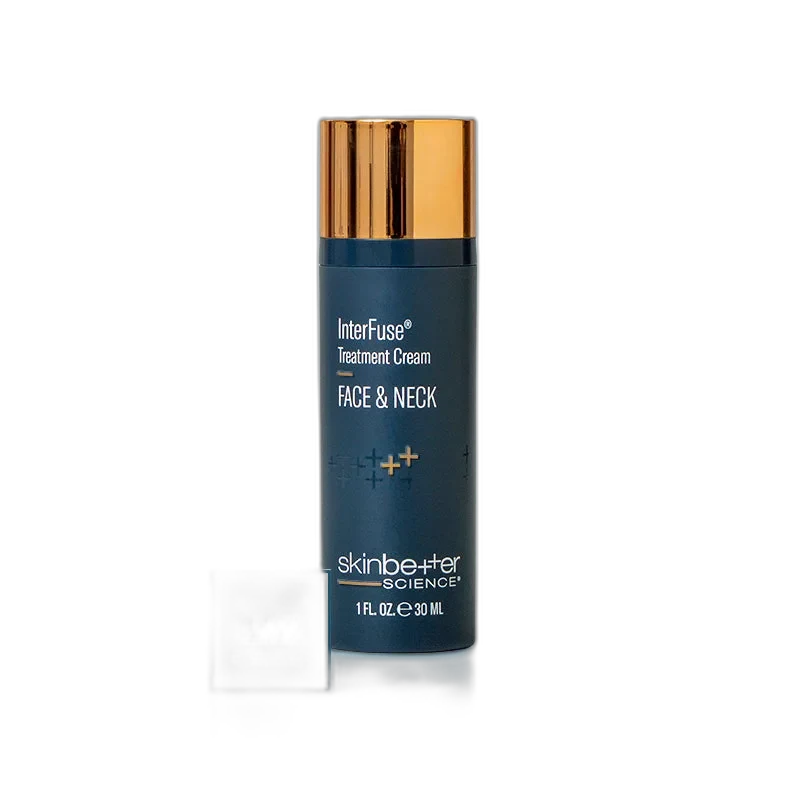
InterFuse Intensive Treatment
Derm Office Eye Staple
 Verified reviewer
Pros & cons.
- +Targets vascular, pigmentary, and aging concerns separately with dedicated ingredients
- +Three-peptide matrikine stack for fibroblast signaling
- +Caffeine provides immediate puffiness reduction and visible brightening
- +Haloxyl complex specifically addresses hemoglobin-derived pigmentation
- +Silky fast-absorbing texture layers cleanly under concealer
- +Exceptional tolerability around the sensitive eye area
- +Subtle light-reflecting mica adds immediate brightness
- +Pregnancy-safe with no retinoids or acids
- −$150 for 14.2g is expensive in the eye cream category
- −Jar packaging exposes the formula to air with each use
- −Cannot address structural tear-trough hollowing
- −Contains soy — allergen concern for soy-sensitive users
- −Results are subtle and take 8-12 weeks to become visible
The full review.
Dermatologists often hear patients say, “I need an eye cream for my dark circles.” Explaining that dark circles aren’t one single problem is difficult. Under-eye darkness usually involves at least three biological components: vascular shadowing where thin periorbital skin shows underlying blood vessels; pigmentary deposits from melanin buildup caused by genetics or UV exposure; and often, residual hemoglobin breakdown products (bilirubin and biliverdin) that leak from fragile capillaries and stain tissue brown-purple. A fourth component, structural tear-trough hollowing, is anatomical and requires filler or surgery. Because of this, a single-ingredient eye cream only targets one of these four causes. If that ingredient doesn’t match the dominant cause, nothing happens. Patients conclude eye creams fail, while the eye cream simply wasn’t designed for that specific cause.
SkinBetter Science’s InterFuse Intensive Treatment addresses this multi-component reality. It uses caffeine for the vascular component to constrict periorbital micro-vessels and reduce blue-purple shadowing. It contains Haloxyl, a proprietary complex of chrysin, N-hydroxysuccinimide, and palmitoyl tetrapeptide-7, which clears the bilirubin and biliverdin deposits causing brown-purple hemoglobin-derived pigmentation. It also includes niacinamide to address melanin via melanosome transfer inhibition—the same mechanism used in facial hyperpigmentation brightening serums—applied to the periorbital area. It uses three distinct mechanisms for three distinct causes of darkness. It cannot fix structural tear-trough hollowing, as no topical can.
The formula also includes a three-peptide matrikine stack—palmitoyl tripeptide-38, palmitoyl tetrapeptide-7, and acetyl tetrapeptide-5—to signal periorbital skin fibroblasts to upregulate collagen and hyaluronic acid production. Matrikines are fragment-based peptides that mimic signals from broken-down collagen to trigger a repair response in nearby cells. Whether OTC peptide creams reverse wrinkles dramatically is debatable; the effect is real but gradual and subtle, focusing on prevention and slow improvement rather than transformation. However, this three-peptide stack is well-chosen and uses peptides with published clinical support, exceeding most eye creams.
The texture is why this cream is popular in dermatology offices. It is a silky, fast-absorbing cream with a subtle light-reflecting finish from mica that adds immediate brightness to the under-eye area. It does not migrate, pill, or irritate sensitive eye contours. Pat it gently around the entire eye contour, including the upper lid, and it absorbs in thirty seconds to layer cleanly under concealer. Caffeine provides a subtle cooling-and-tightening sensation upon application. This makes the product feel immediate—partly because caffeine’s vasoconstrictive effect is fast, and partly as a sensory design choice to encourage consistent use. Consistent use matters: an eye cream you forget to use is worth $0 regardless of the formula.
Expectations: caffeine and immediate hydration drive subtle brightness and reduced puffiness within one to two weeks. Consistent twice-daily use shows visible improvement in fine lines and under-eye darkness around six to eight weeks. Cumulative results become meaningful at twelve weeks and beyond. This does not produce dramatic before-and-after results. If under-eye darkness is predominantly structural (a visible tear trough hollow), topical treatment will not fix it; you need filler or surgery. This cream effectively attacks non-structural components at the source, addressing 40-60% of the visible problem for most patients.
The packaging is a small wide-mouth jar with a screw-top lid. The jar format is the main drawback; dipping fingers into the product exposes the peptides and caffeine to air, and dispensing is less precise than a pump or tube. Use a spatula or clean tool to maintain stability. The 14.2g size is small, typical for physician-dispensed eye creams, and at $150, the price is about $10.50 per gram—placing it in the premium tier. Twice-daily use around both eyes lasts three to four months, costing roughly $40-50 per month. No larger size exists.
For those choosing between this and the InterFuse Intensive Treatment Lines variant: the Lines version uses a targeted applicator tube for crow’s feet and the outer eye corner, with a formula emphasizing peptides over the dark-circle pathway. Choose based on your primary concern: use this for dark circles or the Lines variant for crow’s feet. Some users apply both, using the Lines version on the outer corner and this version on the broader eye contour.
Final take: this is one of the more biologically thoughtful eye creams in the dermatology-office category, though the jar and 14.2g size are limitations. If you have a non-structural dark-circle concern and commit to twice-daily application for 12 weeks, this cream works. If your dark circles are structural, or you expect topicals to do what they cannot, you will be disappointed—not because the formula is bad, but because the problem requires a different tool.
Ingredient analysis.
Full INCI list · pH 5.5
Water, Propanediol, Glycerin, Dimethicone, Butylene Glycol, Caffeine, Niacinamide, Palmitoyl Tripeptide-38, Palmitoyl Tetrapeptide-7, Acetyl Tetrapeptide-5, Sodium Hyaluronate, Haloxyl (N-Hydroxysuccinimide + Chrysin + Palmitoyl Tetrapeptide-7), Ceramide NP, Squalane, Panthenol, Allantoin, Tocopherol, Tocopheryl Acetate, Glycyrrhiza Glabra Root Extract, Hydrolyzed Soy Protein, Light-Reflecting Mica, Xanthan Gum, Carbomer, Tromethamine, Phenoxyethanol, Ethylhexylglycerin, Disodium EDTA
Skin match.
The science.
The Science
This eye cream uses the multi-component model of dark circles, a concept supported by dermatology studies that separate vascular, pigmentary, and structural causes. A 2016 review in the Journal of Cutaneous and Aesthetic Surgery (Vrcek et al.) split periorbital hyperpigmentation into constitutional (pigmentary), post-inflammatory, vascular, shadowing, and secondary to skin laxity; it notes that treatment works only if you identify the dominant cause. Multiple small studies show Caffeine's vasoconstrictive and anti-inflammatory effects on periorbital skin; the ingredient reduces visible puffiness rapidly and reliably, though the effect lasts hours rather than being permanent. The three Matrikine peptides in this formula work via the principle Maquart et al. established in the 1990s: collagen breakdown fragments signal fibroblasts to produce new collagen and extracellular matrix components. Palmitoyl tripeptide-38 (Matrixyl Synthe'6) specifically affects six extracellular matrix elements, including collagen I, III, and hyaluronic acid synthesis. Haloxyl, the hemoglobin-clearing complex, uses chrysin — a flavonoid that supports heme oxygenase activity — with a peptide and N-hydroxysuccinimide to target bilirubin and biliverdin breakdown. Note that clinical data on Haloxyl comes from industry-sponsored studies; independent replication is thinner than for better-established actives. This formulation addresses multiple causes at once, matching the dermatological understanding that most patients have mixed-cause dark circles.
References
- Infraorbital Dark Circles: A Review of the Pathogenesis, Evaluation and Treatment — Journal of Cutaneous and Aesthetic Surgery (2016)
Dermatologist Perspective
Dermatologists often suggest multi-mechanism eye creams like this one for patients with mixed-cause dark circles, as single-ingredient approaches rarely address all biological contributors. Board-certified dermatologists say patient expectations must be calibrated: topical formulations improve vascular and pigmentary darkness but cannot fix structural tear-trough hollowing, which requires filler or surgery. This cream serves as a starting point for patients testing topical treatments before in-office options. Dermatologists also note that consistent daily use for 8-12 weeks is essential to see the full effect of any eye cream at this price point.
Guidance
Where it fits in your routine.
Use a clean fingertip or spatula to apply a small amount (about the size of a grain of rice per eye) around the entire eye contour, including the upper lid and the brow bone. Pat gently until absorbed. Do not rub or drag; the periorbital skin is thin and vulnerable to mechanical stress. Use morning and evening after serums and before moisturizer. Wait 1-2 minutes before applying concealer or sunscreen. Store in a cool location with the lid tightly closed to maintain product stability. Do not get in eyes; if contact occurs, rinse with water.
At $150 for 14.2g, the InterFuse Intensive Treatment costs roughly $10.50 per gram, placing it in the premium dermatology-office eye cream category. Applying it twice daily around both eyes lasts three to four months, making the monthly cost about $40-50. No larger size exists. It costs more than a $20-30 drugstore eye cream, but stays more reasonable than La Mer or Clé de Peau eye creams at $200-500. The multi-mechanism formulation justifies the price for patients with mixed-cause dark circles, and the dermatologist-dispensed distribution model includes professional oversight in the cost. A simpler eye cream provides 70-80% of the benefit for casual users with mild concerns at a lower price. For patients with serious dark-circle concerns using a 12-week trial, the value is there.
Patients with mixed-cause dark circles (vascular plus pigmentary), fine lines around the eyes, and a need for a comprehensive daily eye treatment. Best for people already using a dermatologist for a long-term periorbital plan.
People with structural dark circles (tear-trough hollowing — topicals won't fix this), people on a budget, and people with a soy allergy.
Product details.
Silky, fast-absorbing cream with subtle light-reflecting finish
None detectable
Small wide-mouth jar with screw-top lid
The first application feels cool and tingles slightly from the caffeine, which reduces puffiness within minutes. A subtle light-reflecting finish gives immediate brightness. It causes no irritation or stinging and works for the sensitive eye area.
3-4 months with twice-daily use around both eyes
12 months
All Year
The backstory.
InterFuse Intensive Treatment was part of SkinBetter Science's original launch lineup in 2016 and has remained one of the brand's core eye products for nearly a decade. It was designed to give dermatologists an eye cream they could recommend for patients with mixed dark-circle etiology — where a single-mechanism eye cream couldn't address both the vascular and pigmentary components.
About SkinBetter Science
Emerging Brand (2–5 years)SkinBetter Science launched in 2016, with the InterFuse Intensive Treatment eye cream among its first products. L'Oréal acquired the brand in 2024. Licensed dermatologist and medical aesthetic practices sell the brand exclusively.
Common myths.
Dark circles vary, but one treatment fixes them all.
Dark circles have many causes: vascular shadowing, bilirubin/biliverdin from capillary leak, melanin deposits, thin skin showing underlying structure, and true shadow from tear-trough hollowing. Each cause requires different treatment; no topical fixes structural hollowing.
Eye creams are redundant if you use a good face moisturizer.
Most face moisturizers contain ingredients too heavy or irritating for the periorbital area. A dedicated eye cream adds targeted actives — caffeine, Haloxyl, specific peptides — that do not belong in a face moisturizer.
FAQ.
What's the difference between this and InterFuse Intensive Treatment Lines?
This is a general eye treatment for all eye-area concerns. The Lines version targets crow's feet and fine lines around the outer eye and uses a smaller applicator tube. Most users choose one or the other; some anti-aging routines use both.
Will this eliminate my dark circles?
Consistent use for 8-12 weeks improves the vascular and pigmentary components of dark circles. It does not fix structural dark circles from tear-trough hollowing; those require in-office filler or other interventions.
Can I use it on the upper eyelid?
Yes — apply to the entire eye contour, including the upper lid. Pat gently. Keep the product near the lash line but avoid getting it in the eye.
Is it safe during pregnancy?
Yes. The formula lacks retinoids, hydroquinone, or salicylic acid.
Can I use it under makeup?
Yes. It absorbs fast and layers under concealer without pilling. Wait 1-2 minutes after applying the eye cream before applying makeup for best results.
Will it help with puffy eyes?
The caffeine in the formula constricts blood vessels and temporarily reduces puffiness. Daily use helps chronic morning puffiness; dietary and sleep factors matter more for severe or allergy-driven puffiness.
What the community says.
"visibly reduces dark circles over time"
"no tugging or pilling under concealer"
"improves fine lines with consistent use"
"comfortable for sensitive eye area"
"expensive for the small size"
"results are subtle and slow"
"no dramatic overnight change"
"jar dispenses more than needed"
People also looked at.