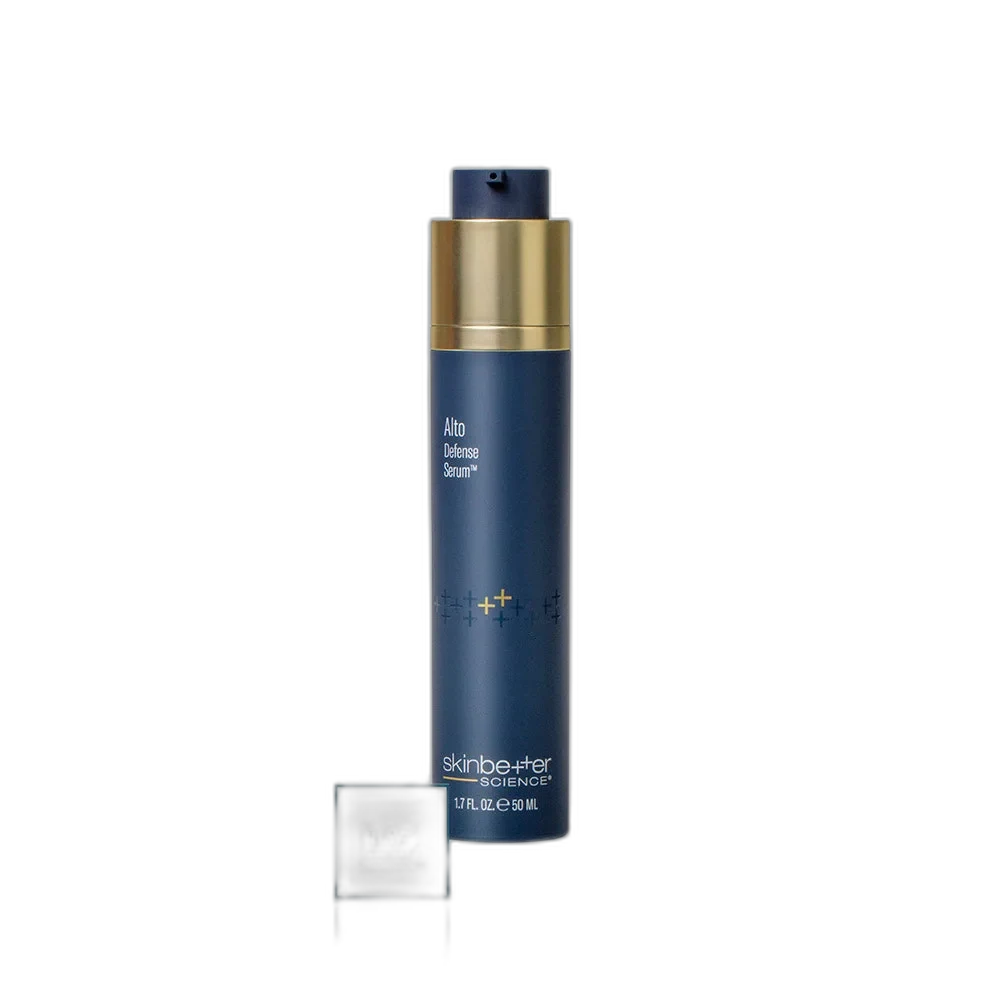
Alto Defense Serum
Derm Office Antioxidant Bestseller
 Verified reviewer
Pros & cons.
- +Stable vitamin C derivative avoids the low-pH irritation of L-ascorbic acid
- +Includes ergothioneine and silybin, two ingredients most competitors skip
- +Exceptional tolerability even for rosacea-prone and post-procedure skin
- +Allure Best of Beauty winner with strong dermatologist credibility
- +Silky texture layers cleanly under moisturizer and sunscreen
- +Opaque airless pump preserves the oxidation-sensitive formula
- +Pregnancy-safe with no retinoids or acids
- +Seven-plus antioxidants create formulation redundancy
- −At $165 for 30ml, significantly pricier than effective alternatives
- −30ml size lasts only three to four months with daily use
- −Physician-dispensed only — no online purchase options
- −No larger size available for loyal long-term users
- −Effects are subtle and build over months rather than weeks
The full review.
About SkinBetter Science
When Alto Defense Serum won the Allure Best of Beauty award in 2019, SkinBetter Science was barely three years old, and the brand had essentially zero name recognition outside of a couple thousand dermatology offices. Allure’s award didn’t make the brand — the quality of the formulation did — but it was the moment the skincare press started paying attention to a label that wasn’t SkinCeuticals, wasn’t iS Clinical, wasn’t Obagi, and wasn’t owned by any of the usual big-ticket aesthetic conglomerates. Seven years later, Alto Defense Serum remains the brand’s best-selling morning step, and it’s still one of the most quietly sophisticated antioxidant serums you can get without a compounding pharmacist.
Formula
The short version of the formula: it’s a stable vitamin C derivative (ascorbyl tetraisopalmitate) paired with vitamin E, then backed up by six more antioxidants from different structural and functional families. What makes it interesting isn’t the length of the ingredient list — lots of brands pile on antioxidants — it’s the specific choices. Most of those brands stop at vitamin C, vitamin E, ferulic acid, maybe some green tea polyphenols. Alto Defense adds two ingredients that most of its competitors skip entirely: ergothioneine and silybin. Ergothioneine is a sulfur-containing amino acid antioxidant that the body actually has a dedicated cellular transporter for (OCTN1), meaning it’s one of the few topical antioxidants that preferentially accumulates inside skin cells rather than sitting on top of them. Silybin, the active component of milk thistle extract, has been studied specifically for its ability to reduce UV-induced inflammation, not just oxidative damage. Put together, these two additions give the formula a broader defensive profile — oxidative protection plus anti-inflammatory support — than any of the standard C+E+ferulic acid templates offer.
Texture
What does that actually feel like on the skin? The texture is where this serum earns a lot of its loyalty. It’s a thin, subtly silky serum with a lipid-phase feel from the vitamin C derivative vehicle — not oily exactly, but softer than a water-based formula. It absorbs in about thirty seconds, leaves no visible residue, and layers cleanly under every moisturizer and sunscreen it’s likely to share a bathroom shelf with. There’s no tingling, no flush, no adjustment period. For sensitive and rosacea-prone skin that has historically struggled with the low pH of L-ascorbic acid serums, this is the alternative that actually works. Post-procedure patients coming out of laser treatments, microneedling, or chemical peels often get put on this specifically because it’s gentle enough to use within a couple of days of the procedure without drama.
Best for
The clinically interesting thing about this serum is that it doesn’t depend on a single hero active. Most vitamin C serums live or die by the stability and concentration of their vitamin C. Alto Defense is deliberately built so that if any single antioxidant loses activity over the life of the bottle, the others are still working. That’s part of why it holds up well over its 12-month period-after-opening — the airless pump protects the formula, and the redundancy of the stack means there’s no single point of failure. Whether this broader coverage translates to measurably better long-term outcomes than a high-quality CE Ferulic-style serum is an open question; head-to-head clinical trials between premium antioxidant serums basically don’t exist. But the theoretical case is real, and for anyone whose skin has rejected traditional vitamin C formulas, this is the version that tends to stick.
Common Complaints
Where things get complicated is the price. At $165 for 30ml, Alto Defense Serum sits solidly in the upper tier of the antioxidant category. It’s cheaper than its own bigger sibling (the Advanced Defense and Repair version, which runs $185) but more expensive than CE Ferulic and considerably more expensive than a good-quality pharmacy-brand vitamin C serum. The 30ml size lasts roughly three to four months with daily use, putting the monthly cost around $40-50 — not insane, but not trivial either. And because SkinBetter Science is physician-dispensed only, you can’t price-shop it online. The only way to get it is through a licensed dermatologist or medical aesthetic office, which is part of the value proposition (professional oversight) and part of the friction (you have to actually go to a derm’s office to buy serum).
The size complaint is worth taking seriously. A 30ml serum in this price range should really come in a 50ml option for long-term users, and it doesn’t. If you get into the SkinBetter ecosystem, you’ll be making quarterly purchases, and there’s no volume discount available. That pushes the effective annual cost of a ‘full routine’ into territory where the value math requires a genuine commitment to seeing this as a medical product rather than a discretionary purchase.
Who Should Buy
Who this is genuinely for: dermatology and aesthetic practice patients already working on a long-term photoaging plan, sensitive skin that can’t tolerate traditional L-ascorbic acid formulas, post-procedure recovery routines where tolerability matters more than shelf price, and anyone who wants a physician-grade morning step and has a dermatologist recommending this specific line. Who it’s not for: anyone starting out, anyone on a budget, or anyone who isn’t already working with a provider that stocks the brand. As a formulation, it’s genuinely excellent. As a purchase, it requires committing to a specific distribution channel that makes casual experimentation impossible. That’s a feature for the dermatologist community that sells it; for everyone else, it’s a barrier worth considering before you walk into the appointment.
Ingredient analysis.
Full INCI list · pH 5.5
Water, Propanediol, Dimethyl Isosorbide, Ethoxydiglycol, Ascorbyl Tetraisopalmitate, Tocopheryl Acetate, Glycerin, Niacinamide, Glutathione, Silybum Marianum (Milk Thistle) Fruit Extract, Glycyrrhiza Glabra (Licorice) Root Extract, Camellia Sinensis Leaf Extract, Vitis Vinifera (Grape) Seed Extract, Panax Ginseng Root Extract, Resveratrol, Ergothioneine, Sodium Hyaluronate, Panthenol, Bisabolol, Allantoin, Tromethamine, Carbomer, Phenoxyethanol, Ethylhexylglycerin, Disodium EDTA
Skin match.
The science.
The Science
This serum uses the synergy principle from the 2005 Journal of Investigative Dermatology paper by Lin et al. regarding the C+E+ferulic acid combination. That study showed combining antioxidants produces multiplicative, not just additive, photoprotective benefit. Alto Defense Serum extends this by adding two other antioxidants. Ergothioneine is unique because mammalian cells have a dedicated transporter (OCTN1) that actively concentrates it inside cells. A 2018 paper in Free Radical Biology and Medicine (Cheah et al.) reviewed ergothioneine as an intracellular antioxidant and noted its tissue distribution targets sites of oxidative stress. Silybin, the active part of milk thistle extract, affects UV-induced skin damage in multiple models. A 2006 paper in Photochemistry and Photobiology (Katiyar) showed topical silybin reduced erythema and DNA damage in UV-exposed skin by inhibiting NF-κB inflammatory signaling instead of just quenching radicals. The ascorbyl tetraisopalmitate used as the vitamin C anchor delivers vitamin C across the stratum corneum. Research on esterified vitamin C derivatives suggests lipid solubility helps them bypass some L-ascorbic acid penetration limits, though conversion efficiency to active vitamin C in the skin varies. This combination uses redundancy; the formula ensures that if one antioxidant loses activity during the bottle's life, the others still provide coverage. This is a formulation choice, not just an ingredient list choice.
References
- Ferulic acid stabilizes a solution of vitamins C and E and doubles its photoprotection of skin — Journal of Investigative Dermatology (2005)
- Ergothioneine, recent developments — Redox Biology (2021)
Dermatologist Perspective
Dermatologists often recommend Alto Defense Serum as a morning antioxidant step for patients with sensitive skin, rosacea-prone skin, or those recovering from in-office procedures. Board-certified dermatologists say its tolerability makes it a primary alternative to traditional L-ascorbic acid serums for patients who flush or sting with CE Ferulic. Dermatology office protocols often pair it with SkinBetter's AlphaRet Overnight Cream—using morning defense and evening retinoid as complementary steps. Dermatologists also note that any topical antioxidant must accompany broad-spectrum SPF, as the antioxidant mops up residual oxidative damage from UV exposure rather than blocking UV.
Where it fits in your routine.
Apply 1-2 pumps to clean, dry skin every morning, patting evenly across face and neck as the first serum step. Allow 30-60 seconds to absorb before layering additional serums, moisturizer, and broad-spectrum SPF 30 or higher — sunscreen is non-negotiable for any antioxidant routine. Can be used year-round and is safe within 48 hours of most in-office procedures once your dermatologist clears active skincare. Store upright away from direct sunlight; the airless pump protects against oxidation so refrigeration is unnecessary.
At $165 for 30ml, Alto Defense Serum sits at the high end of the antioxidant serum category. One 30ml bottle lasts about three to four months with daily face and neck use, making the monthly cost $40-50. No larger size exists, which limits savings for long-term users. Compared to SkinCeuticals CE Ferulic at roughly $182 for 30ml, Alto Defense Serum costs slightly less; its broader antioxidant matrix and better tolerability profile justify the price for the right patient. It costs much more than a $30-50 pharmacy-brand vitamin C serum. The value works for those following a full SkinBetter regimen under dermatological guidance. Casual users get most benefits from simpler, cheaper options.
Patients with sensitive, rosacea-prone, or post-procedure skin who cannot tolerate traditional L-ascorbic acid serums use this. It also works for anyone following a dermatologist-led long-term photoaging plan who wants a physician-grade morning antioxidant step.
This works for anyone on a budget, anyone new to actives who hasn't tried a standard vitamin C serum, and anyone without easy access to a dermatologist office that stocks SkinBetter Science.
Product details.
Apply once daily to face and neck for 3-4 months Period After Opening 12 months
All Year Background
The backstory.
Alto Defense Serum was SkinBetter Science's first big hit after the brand launched in 2016. It won the Allure Best of Beauty award in 2019 and became the brand's flagship morning step, paired in most dermatologist protocols with the AlphaRet Overnight Cream. The Advanced Defense and Repair version added several ingredients on top of this original formula in 2023.
About SkinBetter Science
Emerging Brand (2–5 years)SkinBetter Science launched in 2016. It is a physician-dispensed brand sold only through licensed dermatologist and aesthetic practices. The Alto Defense Serum won Allure's Best of Beauty award in 2019. L'Oréal acquired the brand in 2024, providing access to more research resources.
Common myths.
Vitamin C serums require 15-20% L-ascorbic acid to work.
That applies only to L-ascorbic acid. Stable derivatives like ascorbyl tetraisopalmitate use different pharmacokinetics and require lower effective concentrations. Clinical outcome matters more than label percentage.
Antioxidant serums replace sunscreen.
Never. Antioxidants work with sunscreen to mop up UV oxidative residue. A good antioxidant serum plus SPF 50 outperforms SPF 50 alone; the antioxidant serum alone offers almost zero UV protection.
FAQ.
How does this compare to SkinCeuticals CE Ferulic?
These two serums use different antioxidant strategies. CE Ferulic uses high-concentration L-ascorbic acid at a low pH. Alto Defense uses a stable vitamin C derivative in a broader matrix. Alto Defense works well for sensitive skin that cannot tolerate CE Ferulic.
What's the difference between Alto Defense and Alto Advanced Defense and Repair?
Alto Defense is the original formula. The Advanced Defense and Repair version adds ubiquinone, astaxanthin, and superoxide dismutase for more antioxidant coverage. For most users, the original Alto Defense provides 80-90% of the benefit at a lower price.
Can I use this with retinol?
Yes. Use Alto Defense in the morning and your retinoid at night. These products complement each other: morning antioxidants protect against daytime damage, while nighttime retinoid drives collagen remodeling.
Is it safe for sensitive skin?
Yes — it works well even on skin that reacts to traditional L-ascorbic acid serums. It has no fragrance, no alcohol, and no low-pH actives.
Can I use this during pregnancy?
Yes. The formula has no retinoids, hydroquinone, or salicylic acid. All antioxidants in it are pregnancy-compatible.
Where can I buy this?
SkinBetter Science is physician-dispensed only. Licensed dermatologist and medical aesthetic practices sell it exclusively. You cannot buy SkinBetter Science on Amazon, Sephora, or Ulta.
Community
What the community says.
"elegant layerable texture"
"visibly brighter skin within weeks"
"exceptionally well-tolerated"
"doesn't interact with other actives"
"expensive"
"only available from dermatologist offices"
"subtle rather than dramatic effects"
"small 30ml bottle"
People also looked at.