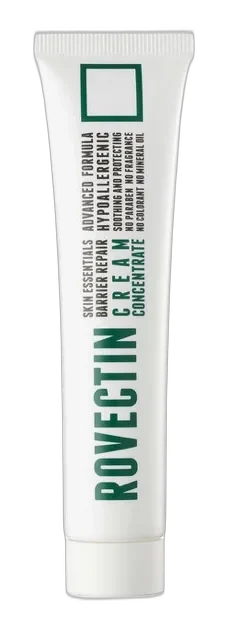
Skin Essentials Barrier Repair Cream Concentrate
Sensitive-Friendly Rovectin Reformulation
 Verified reviewer
Pros & cons.
- +Fragrance-free and essential oil-free — major upgrade over original
- +Shea butter provides rich, sustained emollient support
- +Lactobacillus ferment adds postbiotic microbiome support
- +Ceramide NP plus phospholipids form a genuine lipid-mimicry system
- +Retains astaxanthin and tocopherol antioxidant network
- +Vegan and cruelty-free, suitable for sensitive skin
- +Safe during pregnancy and breastfeeding
- −Shea butter can clog pores in a subset of acne-prone users
- −Jar packaging compromises astaxanthin stability over time
- −Slightly more expensive than the original formulation
- −Not safe for fungal-acne-prone users
- −Too rich for oily skin types in warm climates
The full review.
Skincare brands rarely admit an older formulation had a problem. When they reformulate, they usually swap an INCI list into the same jar and hope no one notices. Rovectin’s Skin Essentials line does this subtly, but the change is meaningful. The original Rovectin Barrier Repair Cream Concentrate had one problem: it contained rose oil, geranium oil, eucalyptus oil, clary sage oil, and orange peel oil. These essential oils smell pleasant but contradict the “barrier repair” claim for reactive skin. You cannot repair a compromised barrier with a cream that adds known fragrance allergens, a fact that makes dermatologists skeptical. The Skin Essentials reformulation, launched around 2020 during a Rovectin line refresh, fixes this. The essential oils are gone. A clinical ingredient lineup takes their place. The core brand story—barrier repair, antioxidant support, and plant-forward ingredients—remains, but the delivery now matches the claims.
The new INCI list is a real upgrade. Shea butter moves to the second position as the primary emollient, replacing the cocoa butter from the original. This matters because shea butter repairs the barrier; it contains stearic and oleic fatty acids in skin-compatible ratios, plus native tocopherols and triterpenes for mild antioxidant and anti-inflammatory activity. Dermatologists often recommend this plant butter for reactive skin. Squalane stays at position four, keeping the original’s silky absorption. Glycerin is the primary humectant at position six. At position nine, the formula adds lactobacillus ferment. This postbiotic is a liquid metabolite from bacterial fermentation containing organic acids, peptides, and other byproducts that support skin microbiome balance. At position nine, the concentration is meaningful, not just a marketing drop, showing the reformulation targets the skin microbiome for barrier health.
The ceramide NP, phospholipids, niacinamide, panthenol, and astaxanthin remain, though different positions suggest adjusted percentages. Astaxanthin appears lower on the new INCI list than in the original, meaning either a smaller amount of the active or more new ingredients above it. Beta-carotene joins the antioxidant layer with tocopherol, turmeric root extract, and carrot root extract, strengthening the cream’s lipophilic antioxidant network. Aloe leaf juice and flower extract add a water-based soothing layer that was less prominent in the original.
The texture is slightly thicker than the original due to the shea butter, but it is well-calibrated. It starts as a firm, butter-like cream, melts on contact, and absorbs to a satin finish within 2-3 minutes without a greasy residue. There is no pink astaxanthin tint; the beta-carotene and lower astaxanthin load make the cream a pale ivory color instead of the original salmon shade. Users who liked the pink color may be disappointed, but those wanting a good moisturizer likely will not notice.
This reformulation works well for sensitive skin. The original was hard to recommend to anyone with rosacea, eczema, or fragrance sensitivity. This version removes those concerns. It is fragrance-free, essential oil-free, and uses ingredients dermatologists recommend for compromised barriers. The only caveats are that it contains shea butter (low-to-moderate comedogenic rating for some), avocado oil, and sunflower oil. None are Malassezia-safe, so it is not for active fungal acne. For non-fungal-acne sensitive skin, this is a top k-beauty barrier cream at this price point.
Value is more complex. At around $38, this costs slightly more than the original due to reformulation and new positioning. It competes with other mid-range sensitive-skin barrier creams; the comparison is favorable but not overwhelming. It is well-formulated, but users seeking value can find effective, simpler, fragrance-free ceramide formulas for less. This cream offers a specific mix of shea butter, lactobacillus ferment, and a lipophilic antioxidant network. If you want those, the price is fair. If you only want ceramide barrier support, cheaper options exist.
The honest take is that this is the Rovectin Barrier Repair Cream Concentrate that should have launched first. The formulation matches the marketing. You can recommend it to a friend with sensitive skin without caveats. Rovectin’s decision to reformulate and release a better version instead of just changing the marketing is a notable brand move. More brands should do this.
Ingredient analysis.
Full INCI list · pH 5.5
Water, Butyrospermum Parkii (Shea) Butter, Ethylhexyl Palmitate, Squalane, Diheptyl Succinate, Glycerin, Helianthus Annuus (Sunflower) Seed Oil, Glyceryl Stearate SE, Lactobacillus Ferment, Steareth-21, Polyglyceryl-4 Laurate/Succinate, Microcrystalline Wax, Ammonium Acryloyldimethyltaurate/VP Copolymer, Hexyldecanol, Persea Gratissima (Avocado) Oil, Sorbitan Stearate, Haematococcus Pluvialis Extract, Ceramide NP, Tocopherol, Aloe Barbadensis Flower Extract, Aloe Barbadensis Leaf Juice, Beta-Carotene, Caprylic/Capric Triglyceride, Amino Esters-1, Melia Azadirachta Flower Extract, Melia Azadirachta Leaf Extract, Niacinamide, Phospholipids, Polyglyceryl-10 Oleate, Polyglyceryl-10 Stearate, Curcuma Longa (Turmeric) Root Extract, 1,2-Hexanediol, Xanthan Gum, Daucus Carota Sativa (Carrot) Root Extract, Glycine Soja (Soybean) Oil, Glycine Soja (Soybean) Sterols, Capryloyl Glycerin/Sebacic Acid Copolymer, Caprylyl Glycol, Ocimum Basilicum (Basil) Flower/Leaf Extract, Ocimum Sanctum Leaf Extract, Ricinus Communis (Castor) Seed Oil, Sodium Phytate, Solanum Melongena (Eggplant) Fruit Extract, Coccinia Indica Fruit Extract, Corallina Officinalis Extract, Hydroxyethylcellulose, Linoleic Acid, Lysolecithin
Skin match.
The science.
The Science
Shea butter, ceramide NP, and lactobacillus ferment form the core of this reformulation. Studies show shea butter replenishes skin lipids, reduces transepidermal water loss, and provides mild anti-inflammatory activity. Its stearic and oleic acids make its fatty acid composition more skin-compatible than many plant butters. Ceramide NP is a well-studied skin-identical ceramide that supports stratum corneum barrier function. Research shows topical ceramide replacement accelerates barrier recovery in compromised skin, especially when paired with other stratum corneum lipids. Lactobacillus ferment uses topical postbiotics to support the skin microbiome. While clinical literature is emerging, early studies show fermented ingredients help microbiome balance and provide mild antimicrobial and acidifying effects. In vitro and clinical research shows astaxanthin works as a lipid-soluble antioxidant to protect against UV-induced oxidative stress.
Dermatologist Perspective
Dermatologists favor this reformulation style, which replaces essential oils with ceramide and postbiotic actives for barrier repair. Board-certified dermatologists note that fragrance-free, ingredient-focused moisturizers serve patients with sensitive or barrier-compromised skin better than botanical-forward formulations containing aromatic essential oils. Dermatologists commonly recommend shea butter as a well-tolerated emollient for dry and reactive skin, though acne-prone patients should patch test first. Because research on postbiotic ingredients like lactobacillus ferment is promising, dermatologists increasingly discuss skin microbiome support for barrier health, especially for patients with rosacea or atopic dermatitis.
Where it fits in your routine.
Apply after cleansing, toning, and any treatment serums. Use the included spatula to dispense a half-pea-sized amount. Warm the product between fingertips and press it into your face and neck. Wait 2 minutes for full absorption before applying sunscreen in the morning. Use twice daily. The thick texture works as the only moisturizer in a minimal routine. Use the spatula instead of fingers to keep the jar hygienic.
At about $38 for 60ml, this cream costs slightly more than the original Rovectin concentrate it replaces. The higher price reflects the reformulation; adding shea butter, lactobacillus ferment, and phospholipid improves the formula, while removing essential oils makes it more broadly recommendable. Value is fair, not exceptional. Other fragrance-free ceramide creams work just as well for less, but few combine shea butter, postbiotics, and astaxanthin in one formulation. It offers good value for users wanting this specific combination.
Users with dry, normal, or sensitive skin want a thick, fragrance-free barrier-repair cream. This suits those who liked the original Rovectin concentrate but cannot tolerate the essential oil content. It also fits anyone interested in postbiotic ingredients or astaxanthin in skincare.
Users with very oily skin who prefer gel-based moisturizers, those actively managing fungal acne, and the minority of acne-prone users sensitive to shea butter. Minimalist-formulation enthusiasts may prefer simpler two-to-three-ingredient ceramide creams.
Product details.
Rich, buttery cream that melts into skin and leaves a silky satin finish
It is fragrance-free. Botanical ingredients provide a mild natural scent, but there is no added fragrance.
White jar with spatula — hygienic for a jar format but fails to protect light-sensitive astaxanthin
The cream changes from a firm butter texture to a silky fluid when it touches warm skin. It softens skin immediately, leaves a visible sheen that fades to satin, and does not tingle. Most users require no adjustment period.
3-4 months with twice-daily face and neck application
12 months
fall winter
The backstory.
Rovectin restructured its core range under the Skin Essentials line around 2020, responding to feedback about the essential oil content in earlier formulations. The Skin Essentials Barrier Repair Cream Concentrate is the refined successor — same barrier-repair positioning, but reformulated around a cleaner botanical profile with shea butter, lactobacillus ferment, and a reduced botanical essential oil load.
About Rovectin
Established Brand (5–20 years)Rovectin uses Kolmar Korea, a major South Korean contract manufacturer with R&D depth across dermocosmetic categories. The Skin Essentials line is the brand's reformulated core range with updated sensitivity-friendly positioning.
Common myths.
This is identical to the original Rovectin Barrier Repair Cream Concentrate
The Skin Essentials version is a major reformulation. The INCI list changes significantly: shea butter replaces cocoa butter as the primary emollient, and the formula adds lactobacillus ferment and phospholipids. It also removes the essential oil blend (rose, geranium, eucalyptus, clary sage). This version is better for sensitive skin.
FAQ.
How is this different from the original Rovectin Barrier Repair Cream Concentrate?
The Skin Essentials version reformulates with a different INCI. Shea butter replaces cocoa butter as the main emollient. It adds lactobacillus ferment and phospholipids, but removes the original essential oils (rose, geranium, eucalyptus, etc.). This version is better for sensitive skin or fragrance-averse users.
Is this cream safe for sensitive skin?
The reformulated Skin Essentials version is much better for sensitive skin than the original. It is fragrance-free, essential oil-free, and uses well-tolerated ingredients like shea butter, ceramide NP, and lactobacillus ferment. Most sensitive skin users tolerate it well, but a patch test is wise.
What does lactobacillus ferment do?
Lactobacillus ferment is a postbiotic active. This liquid comes from bacterial fermentation and contains organic acids, peptides, and beneficial metabolites. In this cream, it balances the skin microbiome and provides mild acidifying activity to complement the skin's natural acid mantle.
Can I use this during pregnancy?
Yes. The reformulated Skin Essentials version lacks retinoids, salicylic acid, or pregnancy-cautioned essential oils. This makes it safe for pregnancy and breastfeeding. The shea butter and ceramide NP base is gentle and well-established.
Will shea butter clog my pores?
Shea butter has a low-to-moderate comedogenic rating for most users. Most people tolerate it, but some acne-prone users may breakout. If you are acne-prone, patch test a small area first or choose a non-butter-based alternative.
Is this cream fungal acne safe?
No. The shea butter, sunflower oil, avocado oil, and soybean oil can feed Malassezia in susceptible users. For fungal acne, choose a fully vetted Malassezia-safe alternative.
What the community says.
"Fragrance-free unlike the original version"
"Rich but absorbs well"
"Visible barrier improvement in 1-2 weeks"
"Good for sensitive winter skin"
"Shea butter may clog pores in some users"
"Jar packaging compromises active stability"
"More expensive than original formula"
"Too rich for oily skin types"