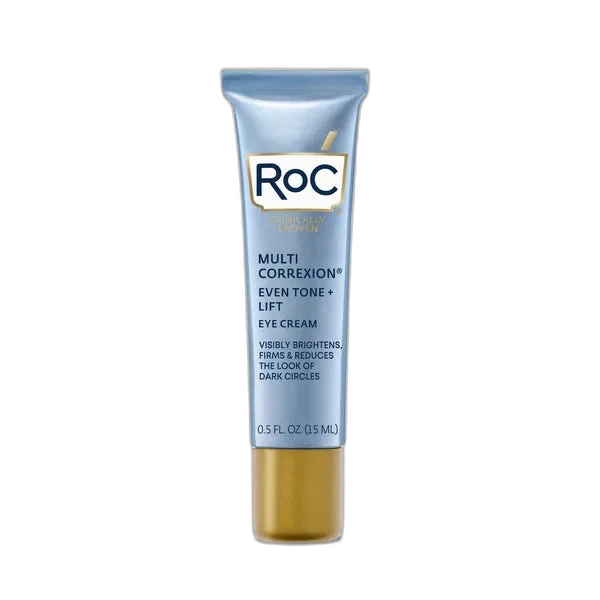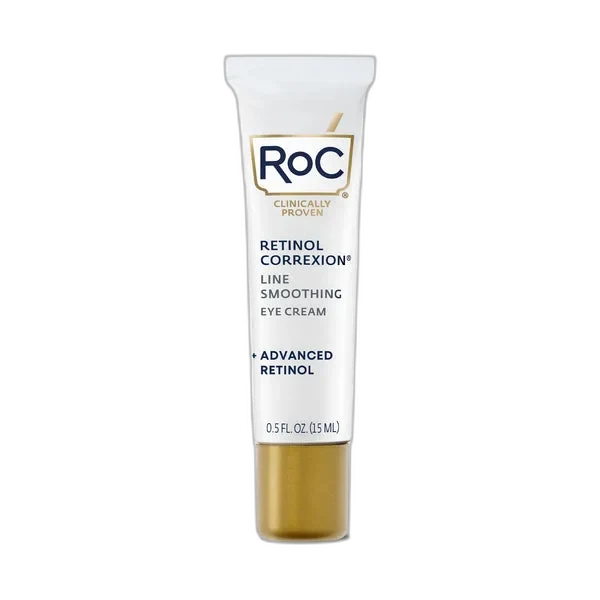
Retinol Correxion Line Smoothing Eye Cream
Drugstore Retinol Eye Classic
 Verified reviewer
Pros & cons.
- +Clinically proven: 50% reduction in crow's feet, 90% saw reduced dark circles
- +RoC's proprietary retinol stabilization ensures potency from first to last use
- +Excellent value at $21.99 for a 15 mL tube — roughly $7-11 per month
- +Lightweight, fast-absorbing texture that works flawlessly under makeup
- +Allure Best in Beauty 2025 winner with nearly 3,000 ratings across retailers
- +Fragrance-free and suitable for twice-daily use
- −Contains methylparaben and propylparaben — safe but increasingly avoided by consumers
- −No ceramides, peptides, or hyaluronic acid in the formula — less comprehensive than modern competitors
- −Isopropyl myristate may contribute to milia formation around the eye area in some users
- −Can cause mild dryness and irritation during the retinol adjustment period
- −Formula feels dated compared to clean-beauty-era eye creams
The full review.
Retinol was useless in consumer products until RoC solved its stability issues. Pure retinol degrades when exposed to light, air, or other ingredients. For decades, dermatologists could not formulate this potent anti-aging molecule into a stable cream that worked by the time a user opened it. RoC scientists stabilized retinol in the 1990s. This breakthrough created the Retinol Correxion line and allows other brands to use ‘retinol’ on their labels today.
The Line Smoothing Eye Cream is the periorbital specialist in the Retinol Correxion lineup. The formula uses stabilized retinol with a mineral complex of copper gluconate, zinc gluconate, and magnesium aspartate. Panthenol provides anti-inflammatory cushioning and glycerin supplies the hydration base. It contains no peptides, no ceramides, no hyaluronic acid, and no trendy botanical extracts. The ingredient list focuses on a few effective components rather than ingredient trends.
This minimalism yields clinical results. RoC studies show this formula reduces crow’s feet by 50%, with 90% of participants seeing reduced dark circles and 84% seeing reduced puffiness. These measurable claims rely on the clinical rigor of a brand with nearly 70 years of dermatological heritage. When RoC claims the retinol works, the claim carries more weight than a brand launched last year.
The texture is a lightweight cream that absorbs within seconds. It leaves no film or greasiness and sits invisibly under concealer or foundation. This matters for an eye cream used twice daily; if it balled up under makeup or felt heavy, users would stop using it. RoC optimized the texture to ensure daily use.
Panthenol acts as a supporting ingredient. Pro-vitamin B5 soothes periorbital skin against retinol-induced inflammation and draws moisture to a skin zone with fewer oil glands and chronic dehydration. The mineral soothing complex—copper, zinc, and magnesium—uses a different logic than peptides: copper supports collagen cross-linking and cellular repair, zinc provides anti-inflammatory action, and magnesium contributes to enzymatic skin processes.
The formula shows its age. Methylparaben and propylparaben remain in the preservative system; these are safe by current scientific consensus but unpopular with consumers seeking paraben-free products. Isopropyl myristate is moderately comedogenic and may cause milia around the eyes. BHT, an antioxidant preservative, is an ingredient newer formulations often omit. These ingredients are not harmful at these concentrations, but they give the formula a legacy feel compared to clean-beauty-era eye creams.
The lack of ceramides and peptides is the main formulation gap. Modern eye cream science emphasizes barrier repair (ceramides) and signal peptide communication for depuffing and firming. RoC’s formula relies on retinol for anti-aging, supported by hydration and minerals, but lacks the multi-pathway approaches of newer competitors. Retinol alone works for many users. However, users with significant volume loss, deep hollowing, or severe barrier compromise may need a more comprehensive formula.
At $21.99 for 15 mL at Target, the value is excellent. This costs roughly half of most department store retinol eye creams and a fraction of clinical brands, yet it has clinical data many pricier products lack. The 15 mL size is generous and should last two to three months with twice-daily use. The cost-per-month is about $7-11, which is affordable for a clinically proven retinol treatment.
The brand story adds weight. A French pharmacist founded RoC in 1957 with ties to the Parisian dermatology community. After being acquired by Christian Dior and then LVMH, it is now independently operated. RoC has survived ownership transitions because its products perform. The Allure Best in Beauty 2025 award for this product is the latest in decades of recognition.
This is not an exciting eye cream. It lacks 30 peptides, NAD+ complexes, or five different ceramides. It has retinol—stabilized by the brand that invented retinol stabilization—in an effective base with proven clinical outcomes and an accessible price. The most dependable option is often the one that has worked for decades while newer products try to prove themselves.
Formula
Ingredient analysis.
Full INCI list
Water, Glycerin, Lactose, C12-15 Alkyl Benzoate, Cetearyl Ethylhexanoate, Glyceryl Stearate, PEG-100 Stearate, PEG-8, Isopropyl Myristate, Retinol, Panthenol, Copper Gluconate, Zinc Gluconate, Magnesium Aspartate, Stearyl Alcohol, Tromethamine, Carbomer, Polysorbate 20, Citric Acid, Chlorhexidine Digluconate, Disodium EDTA, BHT, Propylparaben, Methylparaben, Phenoxyethanol
Skin match.
The science.
The Science
Retinol's efficacy in addressing periorbital aging is among the most extensively validated claims in dermatology. Upon application, retinol is enzymatically converted to retinoic acid within the skin, where it binds to nuclear retinoic acid receptors (RARs and RXRs) to modulate gene expression involved in collagen synthesis, cell differentiation, and melanin regulation. Multiple randomized controlled trials have demonstrated that topical retinol significantly reduces fine wrinkles, improves skin roughness, and increases epidermal thickness in photoaged skin.
RoC's contribution to this field is the stabilization technology that makes retinol viable in consumer products. Retinol is inherently unstable — it degrades via oxidation and photolysis when exposed to light, air, and heat. RoC's encapsulation system protects the retinol molecule until it makes contact with the skin, ensuring delivery of the active form rather than degraded metabolites. This is a meaningful differentiator: studies have shown that unstabilized retinol formulations can lose a significant percentage of their retinol content within weeks of opening.
The mineral complex of copper gluconate, zinc gluconate, and magnesium aspartate provides an interesting complementary mechanism. Copper peptides and copper salts have been studied for their role in stimulating lysyl oxidase, an enzyme essential for collagen and elastin cross-linking. Research published in the Journal of Cosmetic Dermatology has shown that copper complexes can enhance wound healing and promote the synthesis of glycosaminoglycans in the dermis. When combined with retinol's collagen-stimulating action, the mineral complex theoretically supports both the production and structural integrity of new collagen fibers.
Dermatologist Perspective
Dermatologists have recommended RoC's retinol products for decades, and the Line Smoothing Eye Cream is one of the most commonly cited drugstore options for patients asking about over-the-counter retinol for the eye area. Board-certified dermatologists appreciate the stabilized retinol formulation for ensuring reliable potency, and the clinical data supporting this specific product provides a level of evidence that most consumer eye creams lack. Dermatologists typically advise patients to start with nightly use and build to twice daily, noting that mild dryness during the first two weeks is normal and should not prompt discontinuation unless redness or significant irritation occurs.
Where it fits in your routine.
Apply a small amount (pea-sized for both eyes) to the eye area, including the under-eye, crow's feet area, and brow bone. Pat gently with your ring finger; do not rub or tug. Use it morning and evening. If used in the morning, always apply SPF 30+ to the face afterward. If new to retinol around the eyes, use it every other night for the first week, then move to nightly, then twice daily as tolerated. Do not apply directly to the eyelid or lash line.
At $21.99 for 15 mL, this is a top value retinol eye cream. Each application costs roughly 12-18 cents—less than a quarter for a clinically proven anti-aging treatment from a legacy brand. Department store retinol eye creams often lack clinical validation and cost $50-100 for similar or smaller sizes. The ingredient list is simple: if you want peptides, ceramides, and hyaluronic acid in your eye cream, you may buy extra products and offset the price advantage.
This is for anyone seeking a proven, no-nonsense retinol eye cream at a drugstore price. It suits retinol beginners wanting clinical-grade results without the clinical-grade price tag, and users who prioritize results data over trendy ingredient lists. This eye cream is for people who want to know it works, not just hope it does.
Pregnant or breastfeeding individuals (retinol), paraben-avoiders, people prone to milia around the eyes (isopropyl myristate may contribute), and those with very sensitive or eczema-prone eye areas. Users wanting a comprehensive multi-peptide, ceramide-rich eye treatment should look at newer formulations with broader anti-aging mechanisms.
Product details.
This lightweight, smooth cream absorbs quickly without a greasy or filmy residue. It is non-sticky and comfortable under the eyes. It layers well under concealer and foundation.
Fragrance-free with no noticeable scent.
A 15 mL tube has a small applicator tip. A 0.25 oz mini size also exists for travel or trial.
The cream feels hydrating and absorbs fast on first use. The retinol causes mild tingling for some users, which usually stops within a few days. During the first 1-2 weeks, the skin around the eye area may show very mild dryness or flaking as it adjusts to the retinol. This is normal and stops with continued use.
2-3 months with twice-daily use
12 months
All Year
The backstory.
When RoC's scientists figured out how to stabilize retinol in the 1990s, they solved a problem that had frustrated the entire skincare industry: retinol degraded rapidly when exposed to light and air, making it nearly impossible to formulate effectively. That stabilization technology is the foundation of the entire Retinol Correxion line, which has become RoC's best-selling collection and one of the most clinically validated retinol ranges available at the drugstore. This eye cream is the line's dedicated periorbital treatment, and its Allure Best in Beauty win in 2025 reflects decades of accumulated trust.
About RoC
Legacy Brand (20+ years)French pharmacist Dr. Jean-Charles Lissarrague founded RoC in 1957 at the Rogé Cavaillès pharmacy in Paris. The brand created the industry's first retinol stabilization technology and the first broad-spectrum sunscreen for aging prevention. Christian Dior acquired RoC in 1978 before LVMH took ownership. RoC has nearly 70 years of clinical skincare heritage.
Common myths.
Drugstore retinol products aren't strong enough to work.
RoC's clinical data shows this specific eye cream reduces crow's feet by 50%. 90% of users see visibly reduced dark circles and 84% see reduced puffiness. The brand's stabilization technology keeps the retinol potent throughout the product's life — a challenge some less rigorous formulations miss.
You shouldn't use retinol during the day.
Retinol increases photosensitivity, but you can use it during the day with enough SPF protection. RoC designs this eye cream for both AM and PM use. You must apply SPF 30+ over the treated area when using retinol in the morning.
FAQ.
How long does it take for RoC Retinol eye cream to work?
Most users see smoother, more hydrated under-eye skin in 1-2 weeks. Fine lines and crow's feet show visible improvement at 4-8 weeks. RoC's clinical data shows up to 50% reduction in crow's feet after 12 weeks of consistent twice-daily use.
Can I use RoC Retinol eye cream twice a day?
Yes. RoC formulated this eye cream for morning and evening use. Apply SPF 30+ after morning use to protect against retinol-induced photosensitivity. If dryness or irritation occurs, use it once daily (evening) until your skin adjusts.
Does RoC Retinol eye cream help with dark circles?
Yes. RoC's clinical studies show 90% of participants saw visibly reduced dark circles. The retinol accelerates cell turnover to treat pigmentation-based dark circles, and the hydrating formula addresses shadows from dehydration and thin skin.
Is RoC Retinol eye cream safe during pregnancy?
No. This product contains retinol. Avoid retinol during pregnancy and breastfeeding. Consult your healthcare provider and use a retinol-free eye cream alternative during pregnancy.
Why does RoC still use parabens in this formula?
RoC uses methylparaben and propylparaben as preservatives to keep the formula stable. Parabens face consumer controversy, but the FDA, EU Scientific Committee, and CIR (Cosmetic Ingredient Review) agree that parabens at cosmetic concentrations are safe. This formula is not for those who prefer paraben-free products.
What the community says.
"Visible reduction in fine lines and crow's feet within weeks"
"Affordable retinol eye cream that actually works"
"Lightweight texture that layers well under makeup"
"Helps with dark circles and puffiness"
"Gentle enough for twice-daily use for most people"
"Contains parabens which some consumers want to avoid"
"Can cause mild irritation or dryness during adjustment period"
"Lacks modern ingredients like peptides and ceramides"
"Small percentage of users report no visible improvement"
Featured in.
People also looked at.